

ICD-10 code S61.201A: Open wound of left index finger without nail damage
ICD-10 code S61.201A covers a left index finger wound of unstated type ICD-10 co...

Last Updated: Oct 16, 2026
Billable Code Specific Code
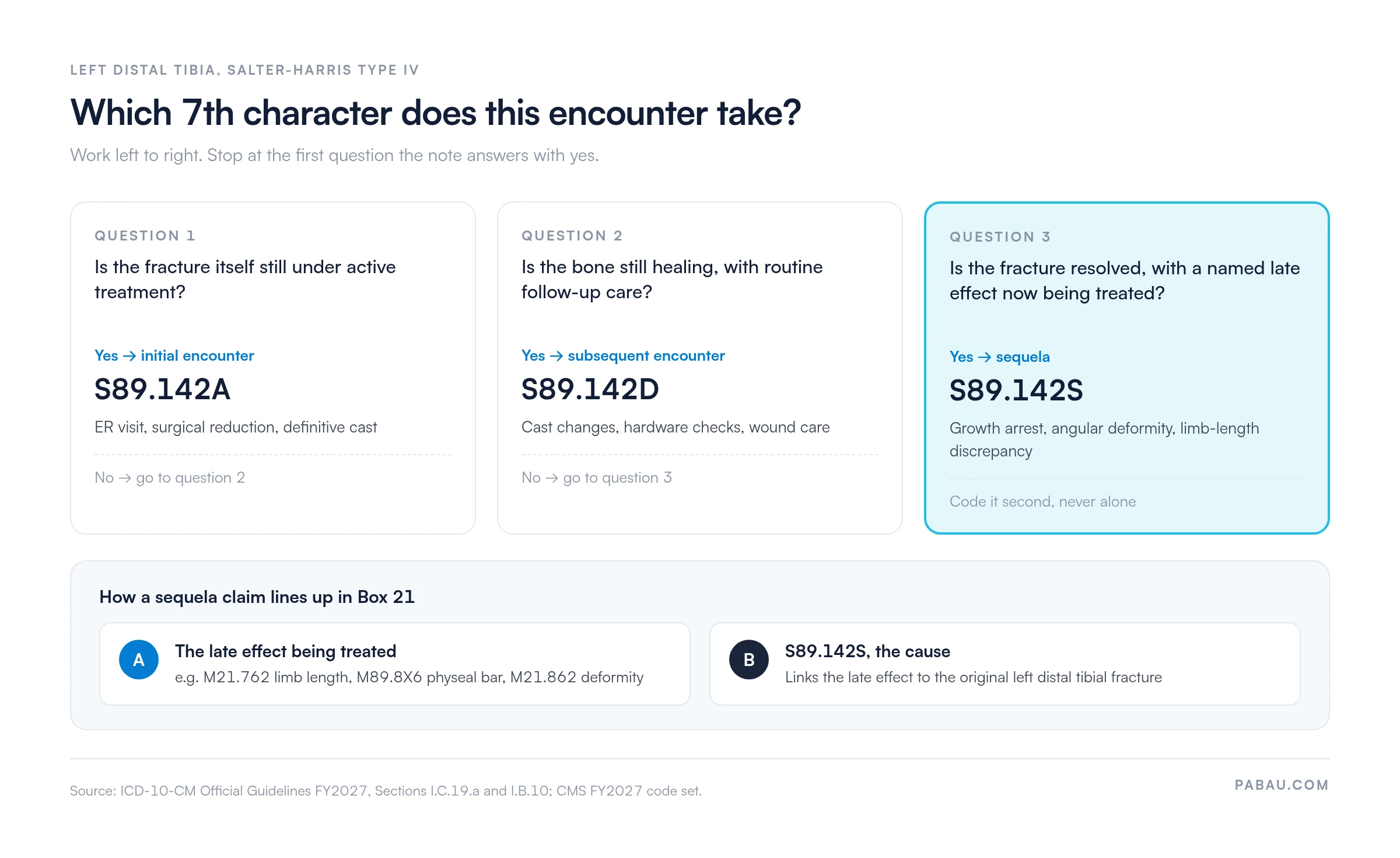
S89.142S is the billable ICD-10-CM code for Salter-Harris Type IV physeal fracture of lower end of left tibia, sequela. It applies when the current visit treats a late effect of that growth plate fracture, such as growth arrest, angular deformity or limb-length discrepancy.
The 7th character S separates this encounter from initial (A) and subsequent (D) care of the fracture itself. The code is sequenced second, after the code for the late effect being treated.
Let Pabau's smart automation suggest the right codes, reduce claim denials, and keep your practice compliant—effortlessly.
Automate repetitive tasks and focus on what matters most—your patients.
Reduce coding errors and ensure compliance with the latest regulations.
Clean claims, fewer denials, and faster reimbursements.
Powerful insights and reporting to help your practice thrive.
HIPAA compliant SOC 2 certified GDPR-compliant Trusted by 4,000+ clinics worldwide

ICD-10 Code S89.142S is a billable code for sequela encounters after a Salter-Harris Type IV fracture of the left distal tibial growth plate.
The 7th character S applies only when the visit treats an active late effect, such as growth arrest, angular deformity or limb-length discrepancy. Routine follow-up of a healing fracture takes D instead.
S89.142S is sequenced second, after the code for the late effect being treated, per ICD-10-CM Official Guidelines Section I.B.10.
Pabau’s claims management software and Claim.MD clearinghouse integration support accurate sequela claim submission and real-time denial tracking for orthopedic practices.
ICD-10 Code S89.142S is a valid, billable code for a sequela encounter after a Salter-Harris Type IV fracture of the left distal tibia.
It appears unchanged in the CMS code set for fiscal year 2027, which took effect on October 1, 2026. The code sits in category S89 (other and unspecified injuries of lower leg), within the injury chapter (S00-T88).
Every character in S89.142S carries a distinct clinical meaning. Misreading even one segment, particularly the laterality digit or the 7th character, produces the wrong code and a denied claim.
Clinical notes and code references write the code with its decimal point, as S89.142S. Electronic 837 claims drop the decimal and transmit S89142S, so let your claims software handle that conversion rather than keying it by hand.
A Salter-Harris Type IV fracture is a growth plate (physeal) fracture whose line crosses the epiphysis, the physis and the metaphysis in a single injury. The distal tibia is a common site for physeal fractures in children.
Type IV is more serious than Types I-III because the fracture disrupts the germinal cell layer of the physis. That disruption carries a meaningful risk of growth arrest, angular deformity or leg-length discrepancy. Those are the sequelae that bring patients back for care under S89.142S.
Patients are typically skeletally immature at the time of the original injury. The sequela visit may come months or years later. By then a late effect, such as physeal bar formation or a measurable limb-length discrepancy, needs active treatment.
The 7th character S designates a sequela encounter under ICD-10-CM Official Guidelines Section I.C.19.a. The current visit treats a direct late effect of the original Salter-Harris Type IV fracture of the left distal tibia, rather than the fracture itself.
Confusing S with D is a common coding error on this code family. Here is the practical distinction:
Under Section I.B.10 of the ICD-10-CM Official Guidelines, the code for the nature of the sequela is sequenced first. That is the late effect condition being treated, and S89.142S follows it as the underlying cause. Payers commonly deny a claim that lists S89.142S as the primary diagnosis without a companion sequela condition code. The decision path below shows which 7th character an encounter takes and how a sequela claim lines up.
Common sequela condition codes paired with S89.142S include:
Document the specific sequela condition explicitly in the operative or clinic note at the encounter. Vague language such as ‘post-fracture follow-up’ does not support a sequela code. The record should name the complication (e.g. ‘physeal bar with resulting limb length discrepancy’). It should also confirm the patient is receiving active treatment for that complication, not monitoring of a healing fracture.
S89.142A and S89.142S describe the same fracture anatomy but very different clinical situations. Selecting the wrong encounter type is a common denial trigger for this code family.
Payers audit sequela codes closely because the S character asserts a causal link to a prior injury on a specific side. The medical record must show all four elements below before S89.142S goes out on a claim. Together they make it a clean claim, and each missing element is a potential denial trigger.
Practices managing medical billing compliance for orthopedic sequela cases benefit from structured documentation templates. These prompt coders and clinicians to capture each element at the point of care, and missing even one weakens the claim’s audit trail.
Sequela visits for S89.142S typically involve corrective or evaluative procedures rather than routine fracture management. Medical billing workflows for these encounters pair the diagnosis with a procedure code that matches the specific intervention. Verify payer-specific pairing rules before billing, since not every payer accepts every pairing for every patient population.
27477 describes the proximal tibia and fibula only. It fits when the surgeon slows growth in the longer, uninjured leg, not an arrest at the injured distal physis. For a procedure on the left distal tibia itself, confirm the exact CPT code against the operative note and the payer’s pairing rules.
S89.142S is most common in pediatric populations, so Medicaid is frequently the primary payer. Commercial payers covering dependent children typically require pre-authorization for corrective surgical procedures such as epiphysiodesis or tibial osteotomy. Medicare coverage applies mainly when an adult presents with late effects of a childhood fracture, a less common but valid scenario.
Key payer considerations for orthopedic claims management:
Sequela codes draw extra payer scrutiny because they rely on a causal chain that must be explicit in the record. Denial management in healthcare for physeal fracture sequelae centers on six root causes:
Practices that track denial reason codes for sequela claims can spot systematic errors faster. If CO-11 (diagnosis inconsistent with procedure) recurs on these claims, the sequencing or companion code pairing is the likely cause.
Run a monthly audit of every claim submitted with 7th character S across your S89 code family. If first-pass denials cluster there, check whether companion sequela condition codes are populating correctly in your billing workflow. A template update to the charge capture process fixes the pattern at its source, rather than one claim at a time.
Many practices only learn that a sequela claim lacked its companion code when the denial comes back. A coder then pulls the note, adds the late effect code, reorders Box 21 and resubmits, often weeks after the visit.
Pabau, the practice management and billing platform we build, checks the diagnosis pair before the claim leaves. Its Claim.MD clearinghouse integration validates code pairs and sequencing at submission and runs real-time eligibility verification. Electronic remittance advice (ERA) processing returns denial reason codes quickly when a sequela pair is rejected.
The result is fewer sequela claims returned for a missing companion code, and a clear reason code to act on when one does come back.

Pabau’s claims management tools and Claim.MD integration help orthopedic and pediatric practices submit accurate sequela claims and track denial reasons. Claims go out with complete documentation the first time.

S89.142S is simple to define and easy to misbill. The fix sits upstream of the claim, in a note that names the late effect, confirms the left side and references the original fracture.
If your team bills sequela codes often, build the companion code into charge capture instead of catching it at denial. The trade-off is a little more structure at the point of care in exchange for fewer resubmissions. Book a demo to see how Pabau validates sequela code pairs before the claim goes out.

Need to understand how claims flow from code to clearinghouse? How medical claims clearinghouses work explains the end-to-end submission path and where sequela claims are most often flagged.
Tracking denial patterns across your orthopedic caseload? The Claim.MD clearinghouse guide covers how ERA processing surfaces denial reason codes before they age into write-offs.
Want a reference for fracture billing paperwork? The superbill guide outlines what must appear on the superbill to support a diagnosis.
Coding a right-side physeal fracture sequela? S89.121S covers the sequela of a Salter-Harris Type II fracture of the lower end of the right tibia.
Still treating a left distal tibia fracture that is slow to heal? S89.132G covers the delayed-healing follow-up for a Salter-Harris Type III fracture on that side.
ICD-10 Code S89.142S is the billable diagnosis code for a Salter-Harris Type IV physeal fracture of the lower end of the left tibia, sequela encounter. The 7th character S means the visit treats a late effect of the original growth plate fracture rather than the fracture itself. Typical late effects are growth arrest, angular deformity and limb-length discrepancy.
S89.142A designates an initial encounter during active treatment of the fracture. S89.142S designates a sequela encounter, where the fracture has resolved and a direct late effect is now being treated. A physeal bar or limb-length discrepancy are typical examples. Using S89.142A when the fracture is healed, or S89.142S when the patient is still in the healing phase, produces a payer-facing coding error.
Use the 7th character S when the current encounter treats an active, direct late effect of a prior injury, not the injury itself. For fracture codes, the fracture must be fully resolved. The current treatment must address a named complication of the original fracture. Examples include growth plate arrest, angular deformity, or leg-length inequality after the Salter-Harris fracture.
Yes, S89.142S is a fully billable 7-character ICD-10-CM code listed unchanged in the fiscal year 2027 code set. However, it cannot be submitted as the sole diagnosis code on a claim. Under ICD-10-CM Official Guidelines Section I.B.10, the code for the nature of the sequela is listed first. S89.142S follows it as the cause.
The most common denial is S89.142S submitted without a companion sequela condition code. Others include using the S suffix on a subsequent (D) follow-up, and a coded side that does not match the procedure documentation. Missing original fracture records, which are needed to establish the causal chain, also trigger denials frequently.
S89.142S specifies the left side. S89.141S specifies the right side. S89.149S is the unspecified-side code and should only be used when laterality is genuinely not documented. When the medical record confirms the left distal tibia, S89.142S is the correct code. Using the unspecified version when laterality is documented is a specificity error that some payers reject outright.



