ICD-10 code S61.201A: Open wound of left index finger without nail damage
ICD-10 code S61.201A covers a left index finger wound of unstated type ICD-10 co...

Last Updated: Oct 16, 2026
Billable Code Specific Code
S89.132G is the billable ICD-10-CM code for salter-Harris Type III physeal fracture of lower end of left tibia, subsequent encounter for fracture with delayed healing.
Most coders meet this code eight to twelve weeks after the injury, when the X-ray still shows incomplete callus. Pick the wrong 7th character and the claim contradicts the note, which is the mismatch payers audit.
Let Pabau's smart automation suggest the right codes, reduce claim denials, and keep your practice compliant—effortlessly.
Automate repetitive tasks and focus on what matters most—your patients.
Reduce coding errors and ensure compliance with the latest regulations.
Clean claims, fewer denials, and faster reimbursements.
Powerful insights and reporting to help your practice thrive.
HIPAA compliant SOC 2 certified GDPR-compliant Trusted by 4,000+ clinics worldwide

ICD-10 code S89.132G is billable for FY 2025 and FY 2026, and it applies to the left tibia only.
The 7th character G marks a follow-up visit where healing has slowed, which is separate from routine healing, nonunion and malunion.
A Salter-Harris Type III fracture crosses the physis and the epiphysis, so the fracture line reaches the joint surface.
The record has to state the fracture type, the side, the site, the encounter type and the delayed healing.
Laterality and the 7th character are the two positions coders get wrong most often on this code.
ICD-10 code S89.132G describes a Salter-Harris Type III physeal fracture of the lower end of the left tibia. It applies at a subsequent encounter with documented delayed healing.
The CMS ICD-10-CM code files list it as valid and billable for fiscal years 2025 and 2026. No additional character is needed.
Laterality is already built into the base code S89.132, so the 7th character carries only the encounter type and the healing status. That is why the code reads as unambiguous to a payer: fracture type, site, side and stage of care all sit in one string.
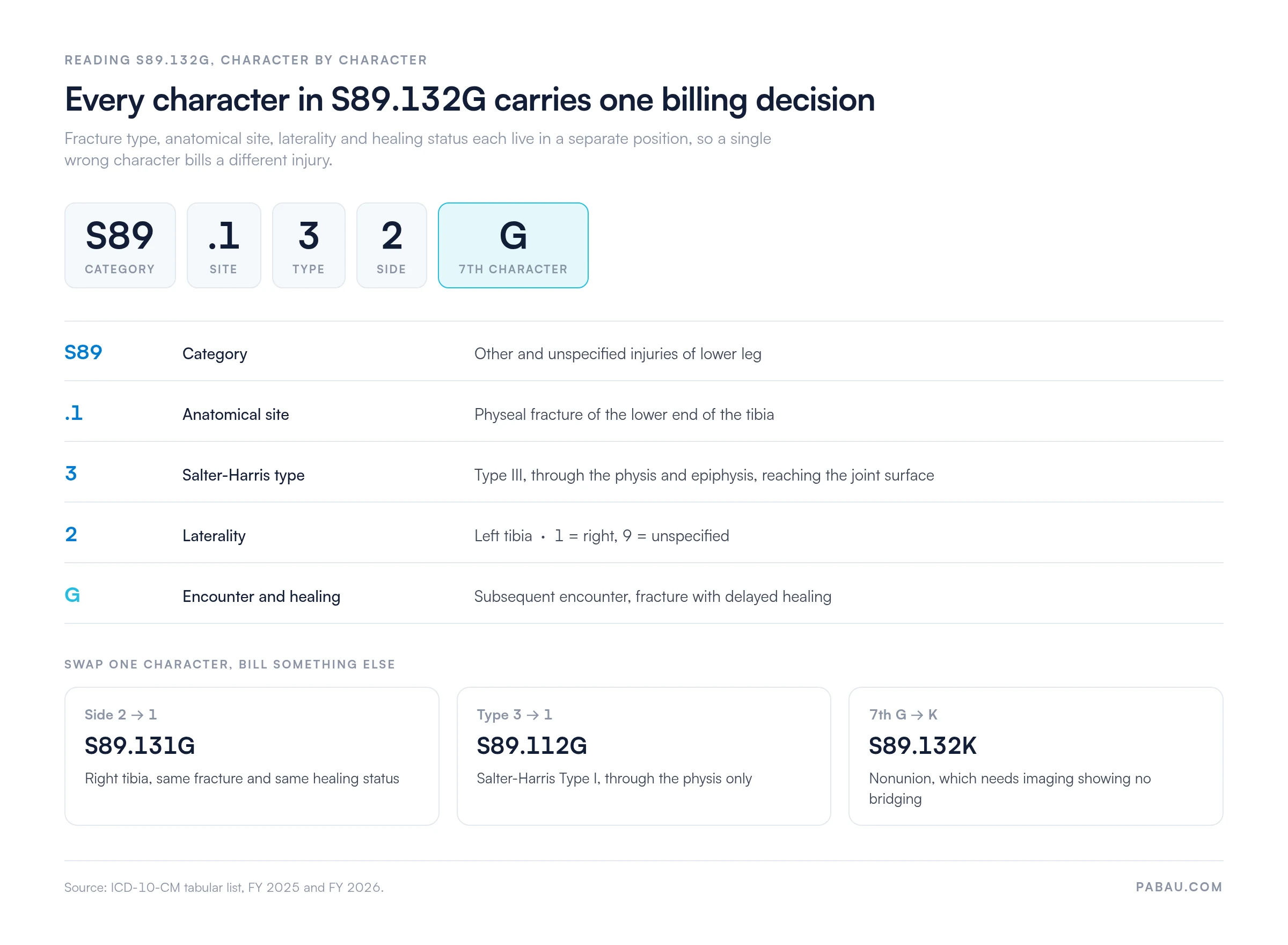
Each position in S89.132G answers a separate question, and the tabular list stacks them from broadest to narrowest.
Read the code left to right and the descriptor builds itself. It also shows where a single keystroke changes the injury you just billed.
The parent chain behind the code runs as follows:
The Excludes2 note at the S89 category level is worth a second look. S89 excludes other and unspecified injuries of the ankle and foot, which live in S99.
Confirm the documentation places the injury at the lower end of the tibia, not in the ankle joint itself. If the note points at the ankle, an S82 or S93 code fits better.
The Salter-Harris system sorts growth-plate fractures by how the fracture line crosses the physis, the epiphysis and the metaphysis.
Each type carries a different risk of growth disruption, and that is why ICD-10-CM gives them separate subcategories.
Type III matters because the line crosses the physis and then runs vertically through the epiphysis into the joint. That intra-articular extension calls for anatomical reduction to restore joint congruity. At the distal tibia, an incomplete reduction can leave a growing child with an incongruent ankle.
The classification assumes an open physis, so it only applies while the growth plate is still active. ICD-10-CM sets no age limit on the code itself, and the age check happens in the clinical record rather than in the tabular list.
The 7th character G says the patient came back after active treatment and the fracture is healing more slowly than this injury normally would.
Under the ICD-10-CM Official Guidelines for Coding and Reporting, a subsequent encounter is any visit after active treatment has been given. So the character fixes both the stage of care and the healing status on the claim.
S89.132 is not billable on its own. One of these six extensions has to be attached before the code will pass.
Use G only while the fracture is still healing, just slower than expected. Move to K once imaging or clinical findings confirm the bone has failed to unite. Use P when healing finished in a faulty position. Submitting G with no documented delayed healing is a standing audit trigger in orthopedic billing.
All three characters share the subsequent-encounter context and then split on what the bone did. G is slow healing, K is failed healing, and P is healing that finished in the wrong position.
Mixing them up is an expensive error on injury claims. It drives claim denials and hands an auditor a clean contradiction.
A worked example makes the split concrete. A 12-year-old is treated in March for a left distal tibial Type III fracture, coded S89.132A. At the ten-week visit in May the X-ray shows callus, but not enough bridging, so that visit codes S89.132G.
By August, serial films still show no union across the fracture line and the orthopedist documents nonunion. The August visit moves to S89.132K, and G should not appear on a claim for this patient again. Same fracture, same side, three different characters across five months.
The sibling codes sit one character away from S89.132G, which is exactly why they get picked by accident. The laterality digit and the Salter-Harris digit are neighbors in the string, so a transposition still produces a valid code that no scrubber will stop.
Two of these deserve a flag. S89.139G carries unspecified laterality, which payers read as a documentation problem rather than a clinical finding. Save it for a record that never states a side at all. S89.132S is for sequela, meaning the late effect is being treated and fracture care itself has finished.
Where the documentation points at a different bone or a different chapter altogether, our diagnostic codes guide indexes the ICD-10 families we cover.
Type III fractures at the lower end of the tibia turn up in skeletally immature patients. Most are children aged 10 to 15, with the tibial physis still open. The usual mechanism is a supination-external rotation or pronation-abduction injury to the ankle.
Point tenderness sits over the distal tibial physis rather than over the lateral ligaments. That finding is what separates this injury from a sprain. Confirmation takes plain films, and often CT or MRI, to show the intra-articular extension and any displacement.
For the coder, two elements carry the code: an imaging report naming Salter-Harris Type III, and a note confirming the left side. Without a stated type in the record, the only honest option is an unspecified physeal fracture code.
Every component of the code has to appear somewhere in the record before it can be assigned. Miss one and the claim either drops to a less specific code or comes back for more information. Run the note against this list before it goes out.
The 7th character moves with the chart rather than staying fixed to the injury. One patient can be coded A in March, G in May and K in August. Each claim has to match the note sitting in front of it.
If the fracture moves from delayed healing to nonunion between visits, change the 7th character at the next encounter. Do not keep billing G once imaging confirms nonunion, and do not assign K before the imaging supports it. Payer audits on physeal fracture codes check whether the documented healing status matches the character claimed across the billing history.
On a CMS-1500 the diagnosis goes in box 21, and box 24E points the service line at it. On an 837P the same code travels in the HI segment of the claim loop. Either way S89.132G rarely travels alone.
It usually accompanies a subsequent-visit E/M code or a therapy CPT code, and the payer reads the pair together before adjudicating. Once the payer responds, the remittance arrives as an ERA and has to be posted back against the original claim line.
Three errors trip this code up in practice, and none of them get caught by a claim scrubber:
All three share one root cause. The claim gets built somewhere other than the note. Keeping the diagnosis attached to the encounter it came from removes most of the risk.
The diagnosis usually gets re-keyed at the point of billing. A clinician writes the follow-up note, then someone in admin opens a separate claim screen and types S89.132G from a printed superbill or from memory. That is the step where a laterality digit or a stale 7th character slips through.
Practice management software like Pabau closes that distance. Pabau’s medical claims management builds the claim from the record itself. The CPT code attached to the service lands on the charge line, and the ICD-10 slots are seeded from the recorded problem list.
ICD-10-CM and CPT lookup libraries sit behind a search icon on the same screen, refreshed with each official release. The coder confirms S89.132G without leaving the claim screen.
On the US pipeline, Pabau connects to the Claim.MD clearinghouse. Required claim fields such as membership and authorization numbers are checked for completeness before the send button unlocks, and eligibility runs in real time. After submission you get claim-status tracking and ERA posting against the original line.
For a practice carrying a pediatric fracture across four or five follow-up visits, that means the healing-status change shows up in one place. The coder edits the character on the encounter, and the claim goes out reflecting the visit it was written for.
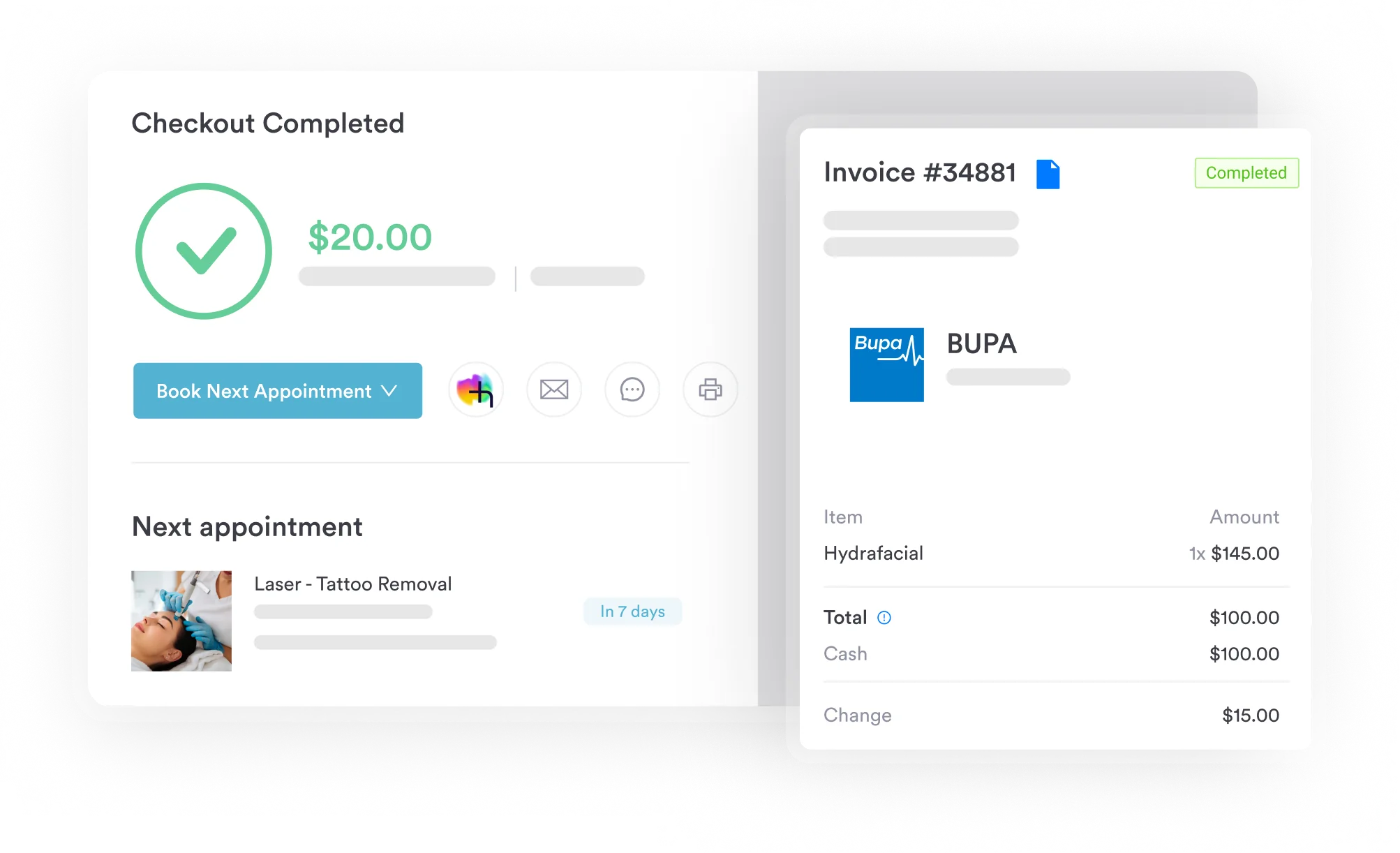

Pabau pre-fills the claim form from the encounter, keeps ICD-10-CM and CPT lookup libraries a click away, and tracks claim status and ERAs after submission. Orthopedic and physical therapy teams stop re-keying codes between the note and the payer.

Finding S89.132G is the easy half of the job. The harder half is keeping the note and the claim in agreement on the same day, visit after visit, while the healing status keeps moving.
So make the 7th character a fresh decision at every encounter. Copying last month’s character is how G survives past the point where the imaging says nonunion, and that is the version an auditor pulls first.
Book a demo to see how Pabau builds fracture follow-up claims from the record that justifies them.

Need a compliance framework behind your injury coding? Medical billing compliance sets out the documentation standards that hold up when a payer audits a fracture claim.
Want to know what a payer counts as a clean claim? What is a clean claim? breaks down the fields that decide first-pass acceptance, and the 98% target behind them.
Chasing a denial on a fracture follow-up? Denial codes in medical billing maps the common reason codes and how to resolve each one before resubmission.
Switching between code sets in one shift? Medical coding cheat sheet puts CPT, ICD-10-CM, HCPCS and E/M thresholds on a single printable page.
Still filling in the paper claim? CMS-1500 form covers all 33 numbered boxes and comes with an annotated template you can download.
Yes, where the record documents how the injury happened. Report the external cause code again at the follow-up visit. Chapter 20 codes only use the characters A, D and S, so a subsequent encounter takes the D character. Place, activity and status codes from Y92, Y93 and Y99 are reported once, at the initial encounter.
ICD-10-CM puts no time limit on the G character. The code stays correct for as long as the record shows healing underway and behind schedule. Once imaging confirms the fracture has united, the encounter moves to D. Once it confirms no union at all, it moves to K.
Yes. Where the delayed-healing fracture is the reason for the visit, it can sit first on the claim, ahead of any functional-deficit codes. The plan of care then has to show how the slow healing changes weight-bearing, loading or the review interval.
Yes, when both tibiae are injured. The S89.13 subcategory has no bilateral code, so each side takes its own code and its own 7th character. The two can carry different characters if one side is healing normally while the other lags.