Pabau Engage inbox

Pabau Engage is here: every patient conversation in one inbox.

Learn more
ICD-10-CM Code

ICD code S88.119A – Complete traumatic lower leg amputation

Billable Code Specific Code


Code Definition

S88.119A is the billable ICD-10-CM code for complete traumatic amputation at level between knee and ankle, unspecified lower leg, initial encounter. It applies when the record confirms a full amputation below the knee joint and above the ankle joint but names neither leg.

Its closest neighbors are S88.111A and S88.112A, which name the side. S88.919A is the other near miss: a complete amputation of an unspecified lower leg, with the level also unspecified. Assignment turns on three documented facts: the amputation is complete, it sits between the knee and the ankle, and active treatment is still underway.

Chapter
S00-T88 Injury, poisoning and certain other consequences of external causes
Category
S88 Traumatic amputation of lower leg
Group
S88.119 Complete traumatic amputation at level between knee and ankle, unspecified lower leg
Billable
Yes
Code also known as
below-knee traumatic amputation, transtibial traumatic amputation, BKA traumatic amputation
Save time. Improve accuracy. Get paid faster.
Automate coding with Pabau

Let Pabau's smart automation suggest the right codes, reduce claim denials, and keep your practice compliant—effortlessly.

  • AI-powered code suggestions
  • Real-time compliance checks
  • Faster claims, fewer denials
Why practices choose Pabau
Save hours every week

Automate repetitive tasks and focus on what matters most—your patients.

Improve accuracy

Reduce coding errors and ensure compliance with the latest regulations.

Get paid faster

Clean claims, fewer denials, and faster reimbursements.

Grow with confidence

Powerful insights and reporting to help your practice thrive.

HIPAA compliant SOC 2 certified GDPR-compliant Trusted by 4,000+ clinics worldwide

Key takeaways

Key takeaways

S88.119A applies to a complete traumatic amputation between the knee and ankle when the record names neither leg.

The seventh character A marks active treatment, however many providers have already seen the patient.

Using unspecified laterality when the operative report clearly names right or left is a frequent denial trigger.

Pabau, our practice management platform, checks each claim for missing or invalid details before submission, and its Claim.MD connection adds real-time eligibility checks.

ICD-10 code S88.119A: Definition and code structure

ICD-10 Code S88.119A is the billable ICD-10-CM code for a complete traumatic amputation between the knee and ankle when the record names neither leg. The CMS ICD-10 coding resources list it under Chapter 19, injury, poisoning and certain other consequences of external causes. Its category is S88, traumatic amputation of lower leg.

FieldValue
CodeS88.119A
Short descriptionComplete traum amp of unsp lower leg, init
Long descriptionComplete traumatic amputation at level between knee and ankle, unspecified lower leg, initial encounter
Code typeBillable (valid for submission)
Chapter19 – Injury, Poisoning and Certain Other Consequences of External Causes
CategoryS88 – Traumatic amputation of lower leg

Character-by-character breakdown of S88.119A

Each position in S88.119A carries a discrete clinical meaning. Misreading any single character shifts the code to a sibling with different documentation requirements.

PositionCharacter(s)Meaning
1-3S88Traumatic amputation of lower leg
41Level between knee and ankle
51Complete amputation (full separation, no tissue bridge remaining)
69Unspecified lower leg (side not documented or not determinable)
7AInitial encounter: patient is in the active treatment phase

What S88.119A covers and what it excludes

S88.119A covers complete traumatic transection at any point between the knee joint and the ankle joint. It applies when the operative or emergency department record doesn’t specify the right or left limb.

The following are excluded from this code and require a different code assignment:

  • Partial traumatic amputations: use S88.129A (unspecified lower leg, partial, initial).
  • Specified laterality: use S88.111A (right lower leg, complete, initial) or S88.112A (left lower leg, complete, initial) whenever the record identifies the side.
  • Amputations at or through the knee joint: use S88.0xx codes (traumatic amputation at knee level).
  • Foot and ankle amputations: use S98 category codes (traumatic amputation of ankle and foot).
  • Surgical or elective amputations: S88 codes are trauma codes only. Elective procedures follow surgical coding conventions. After healing, Z89 codes (acquired absence of limb) record the status, with Z89.5- for a leg below the knee.

Pro Tip

Check the operative or ED note before selecting unspecified laterality. Surgeons usually document the right or left limb, even in emergency notes. When the record names the right leg, the code is S88.111A, and S88.119A invites an avoidable payer edit.

Sibling codes: When to use S88.111A, S88.112A, and S88.129A instead

The S88.1 subcategory contains six initial-encounter codes, including S88.119A. Choosing the wrong one is a frequent denial pattern for traumatic lower-leg amputations.

CodeDescriptionUse when…
S88.111AComplete, right lower leg, initialRecord specifies right limb, complete transection
S88.112AComplete, left lower leg, initialRecord specifies left limb, complete transection
S88.119AComplete, unspecified lower leg, initialComplete transection, side not documented or determinable
S88.121APartial, right lower leg, initialIncomplete transection, right limb, active treatment
S88.122APartial, left lower leg, initialIncomplete transection, left limb, active treatment
S88.129APartial, unspecified lower leg, initialIncomplete transection, laterality not documented
S88.919AComplete, unspecified lower leg, level unspecified, initialComplete amputation, but neither the level nor the side is documented (last resort only)

The ICD-10-CM Official Guidelines (Section I.B.2) require the most specific code the documentation supports. Reserve S88.119A for a record that still names no side after a full read and a provider query.

Seventh character rules: Initial, subsequent, and sequela

The seventh character is a frequent source of S88 coding errors. “Initial encounter” refers to the care phase, so it applies throughout active treatment, however many clinicians have already seen the injury.

7th characterCodeWhen to useCommon scenario
AS88.119AActive treatment is ongoingED visit, inpatient surgical admission, wound management during active healing
DS88.119DRoutine care after active treatment phase is completeStump care, prosthetic fitting follow-up, rehabilitation appointments
SS88.119SLate effects or complications of the original amputationStump neuroma, phantom limb pain, heterotopic ossification at the amputation site

A patient transferred to another hospital for definitive replantation surgery is still in the active treatment phase, so A stays as the seventh character. The switch to D happens when the wound is closed, the stump is stable, and the patient moves into routine follow-up. Applying A to a routine rehab appointment is a compliance risk and a common trigger for post-payment audits.

Sequela codes follow the same side logic as the initial codes. A stump neuroma on a documented left leg takes S88.112S, while S88.119S stays reserved for a record that never names the side.

External cause codes to report alongside S88.119A

ICD-10-CM guidelines encourage external cause reporting for traumatic injuries, and many payers expect it. Submitting S88.119A without accompanying external cause codes raises the likelihood of a medical-necessity edit. Meeting billing compliance requirements means pairing the diagnosis with the mechanism and place of occurrence.

  • Machinery injuries: W28-W31 codes (contact with a powered lawn mower, other powered hand tools, or agricultural and other machinery).
  • Transport accidents: V-code category appropriate to the vehicle type (motorcycle, car, pedal cycle, rail vehicle).
  • Cutting and piercing instruments: W25-W27 (contact with sharp glass, a knife, or a nonpowered hand tool).
  • Place and activity: Y92 place-of-occurrence codes and Y93 activity codes record where the injury happened and what the patient was doing.
  • External cause status: Y99 codes to distinguish civilian activity from work-related injuries.

External cause codes are sequenced after the traumatic injury code. They do not drive payment directly but support medical-necessity determinations and are checked by payer claims-editing systems. Report as many as are documented.

Documentation requirements to support S88.119A

The clinical record must contain specific elements for S88.119A to survive a medical billing documentation review. Generic phrases like “traumatic leg amputation” are not sufficient.

  • Completeness stated explicitly: the ED or operative note must say “complete” transection or describe full separation without tissue bridge. “Partial” or “incomplete” requires a different code.
  • Anatomical level confirmed: the record must place the amputation between the knee joint and the ankle joint. Ambiguous language like “lower extremity amputation” without level specification invites a query.
  • Mechanism of injury documented: supports the selection of external cause codes and confirms the injury is traumatic rather than elective.
  • Laterality addressed: if the provider cannot or does not specify right or left, the note should state that laterality is indeterminate or undocumented. Using unspecified without any explanation creates audit exposure.
  • Date of injury: required for sequencing and for payer medical-necessity review, especially for workers’ compensation claims.
  • Care phase documented: the note should make clear whether active treatment is ongoing or whether the visit is a follow-up after the treatment phase ended. This drives seventh-character selection.

Payer requirements and claims submission for S88.119A

S88 codes describe acute injuries. Emergency treatment itself typically does not require prior authorization, but several downstream services do.

  • Emergency and acute care: generally does not require pre-authorization under most Medicare and commercial plans, but verify with the specific plan for non-emergent surgical management.
  • Inpatient admission: the case groups to MS-DRG 913-914 (traumatic injury) or a surgical DRG depending on procedures performed, and may trigger concurrent review. Hospitals should have a concurrent review process active from day one of admission.
  • Prosthetics and orthotics: most payers require prior authorization and a Letter of Medical Necessity before prosthetic fitting. The authorization request must carry the amputation diagnosis code, which usually takes seventh character D by this stage.
  • Inpatient rehabilitation: requires prior authorization and typically a functional assessment confirming the patient can tolerate three hours of therapy daily.
  • Local Coverage Determinations (LCDs): Medicare Administrative Contractors issue LCDs for prosthetic devices. The relevant LCD for lower-limb prosthetics requires the ICD-10-CM amputation code and clinical documentation of functional level (K-level classification).

Common claim denial reasons for S88.119A and how to avoid them

S88.119A has a predictable set of denial patterns. Most start in the documentation rather than the code itself, and a pre-submission check catches them before the payer does. Effective denial management starts with knowing these triggers and the denial codes payers return for them.

Denial reasonRoot causeRemediation
Incorrect seventh characterUsing ‘A’ for follow-up or rehab visits after active treatment has endedSwitch to S88.119D once wound is stable and active treatment is complete
Unspecified laterality used when record specifies a sideCoder defaulted to S88.119A without reading the operative noteQuery the record; recode to S88.111A (right) or S88.112A (left)
Missing external cause codesMechanism and place of occurrence not reportedAdd appropriate W/V/X/Y codes from the ED or trauma note
Diagnosis-procedure mismatchCPT procedure code does not align with traumatic amputation (e.g. wound care code billed for a replantation)Verify the CPT code matches the actual service performed during the visit coded as initial encounter
Partial vs complete documentation conflictNote describes tissue bridges or incomplete transection but S88.119A (complete) was assignedQuery the provider; if partial, recode to S88.129A
Wrong code levelAmputation was at the foot level but S88 was used instead of S98Confirm anatomical level from the note; reassign to the appropriate S98 code

Coding workflow: From ED presentation to final bill

A structured step sequence reduces the chance of selecting the wrong S88 subcode. The path below shows how four documented facts narrow the category to a single code.
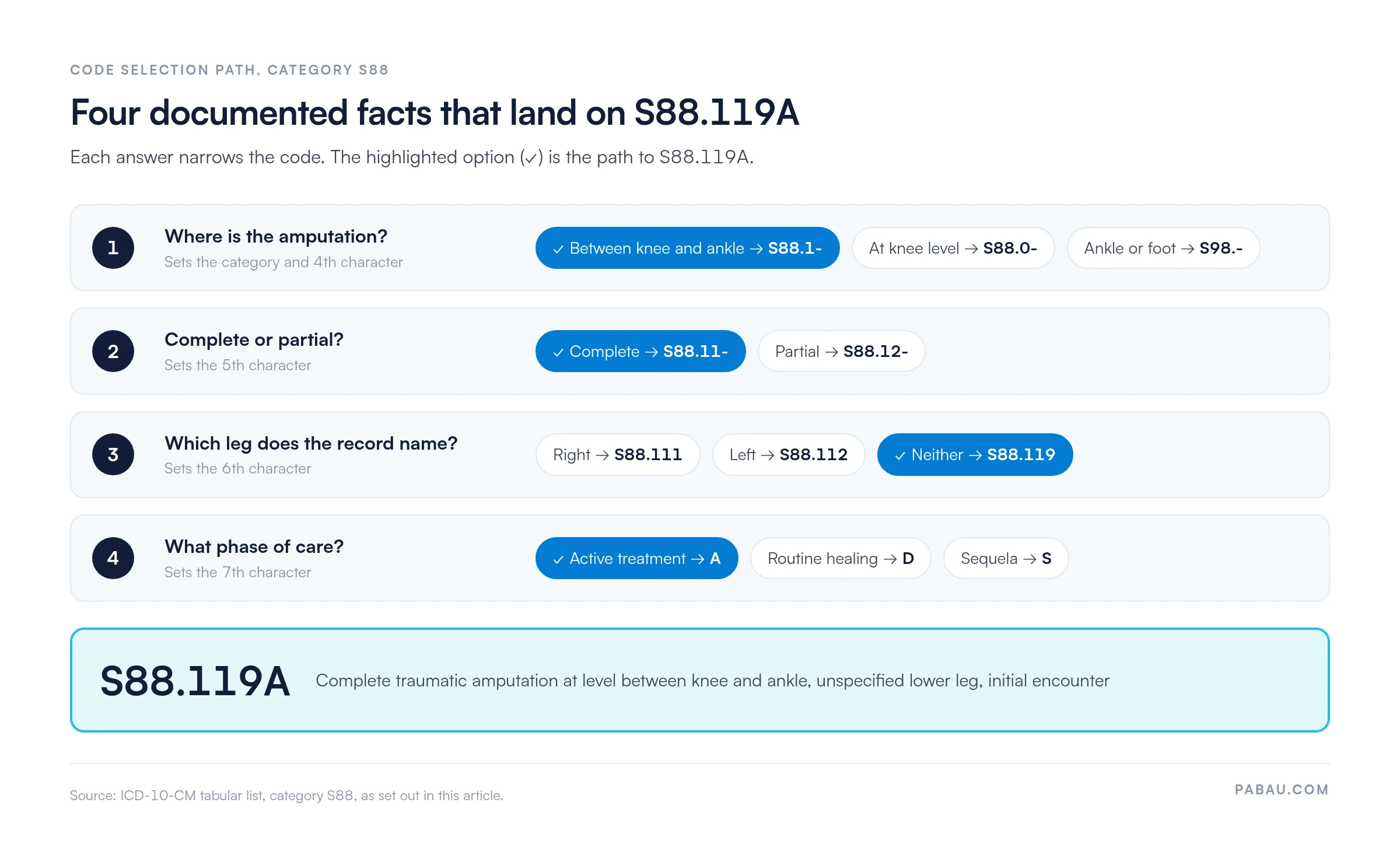
Four-step code selection path for ICD-10-CM category S88: amputation between knee and ankle gives S88.1, complete gives S88.11, no leg named gives S88.119, active treatment adds A, giving S88.119A. Alternatives: knee level S88.0, ankle or foot S98, partial S88.12, right S88.111, left S88.112, routine healing D, sequela S.
Only one answer at each step changes between S88.119A and its siblings, so the side of the body is usually the one to recheck. Code structure from the ICD-10-CM tabular list.
  1. Confirm completeness from the operative or ED note. Look for explicit language: “complete transection,” “amputation complete,” or equivalent. Any mention of tissue bridging or incomplete separation requires a partial amputation code.
  2. Confirm the anatomical level. The amputation must sit between the knee joint and the ankle joint for S88 to apply. Amputations at the knee use S88.0xx. Amputations at the foot or ankle use S98 codes.
  3. Determine laterality. Read the full operative or ED note for right/left designations. If laterality is undocumented and a query doesn’t settle it, use S88.119A. If it is documented, use S88.111A or S88.112A.
  4. Select the seventh character. Is the patient in the active treatment phase? Use A. Has active treatment concluded and this is routine follow-up? Use D. Are you addressing a late effect of the original injury? Use S.
  5. Assign external cause codes. Add mechanism (W/V/X codes), place of occurrence (Y92), activity (Y93), and external cause status (Y99) codes based on the trauma record.
  6. Pair with appropriate CPT procedure codes. Verify the CPT code reflects the actual service billed during this encounter. Common pairings include below-knee amputation codes such as CPT 27880-27882, CPT 27886 for re-amputation, or wound management codes for follow-up.
  7. Run a pre-submission check. Confirm the diagnosis supports the procedure, the seventh character matches the care phase, and external cause codes are attached. A clean claim needs no correction from the payer, so acute injury cases get paid faster.

Pro Tip

Audit S88.119A encounters billed more than 90 days after the injury. A patient in routine rehabilitation by then has usually finished active treatment, so those visits take S88.119D. Correcting them early heads off post-payment recovery demands from Medicare contractors.

How Pabau checks S88.119A claims before submission

On many billing teams, the checks in the workflow above happen by hand, in the few minutes before a claim goes out. When the queue is busy, a blank field or an invalid code slips through and comes back weeks later.

Pabau, the practice management platform we build, checks each claim for missing or invalid details before submission. Its claims management software puts the fix in front of your coder while the claim can still be edited.
Automate claims and billing with Pabau
Pabau’s claim checks flag missing or invalid details on screen, so your coder can correct an S88.119A claim before it reaches the payer.

Claims then go out through Claim.MD, Pabau’s integrated clearinghouse partner. It adds real-time eligibility checks, electronic CMS-1500 claims and ERA tracking. You can confirm coverage before the visit and match each payment to its claim.

Check trauma claims before they reach the payer

Pabau’s claim validation catches missing or invalid details before an S88.119A claim goes out. Claim.MD adds real-time eligibility checks, electronic CMS-1500 claims and ERA tracking.

Pabau claims management dashboard

Conclusion

Reserve S88.119A for the record that names neither leg after a full read of the ED and operative notes and a provider query. Where a side is written down, S88.111A or S88.112A is the code, and the unspecified version only invites an edit.

The seventh character needs the same attention later in the case. Once the stump is stable and visits turn routine, move to S88.119D, or to S88.119S for a late effect such as a neuroma.

Pabau checks each claim for missing or invalid details before submission, and Claim.MD confirms eligibility in real time. Book a demo to see how that fits your trauma coding workflow.

Continue your research

Continue your research

Need to understand how clearinghouse validation works? Claim.MD clearinghouse overview explains how a clearinghouse checks claims and routes them to payers.

Looking for guidance on electronic remittance and denial tracking? Electronic remittance advice (ERA) guide covers how 835 files map denial codes back to the original claim.

Want to understand how superbills support traumatic injury claims? Superbill documentation guide shows how structured encounter forms capture the diagnosis and procedure pairing before billing.

Preparing a prosthetic authorization request? Prior authorization process walks through the steps payers expect before they approve a service.

Frequently asked questions

What does ICD-10 Code S88.119A mean?

ICD-10 Code S88.119A is the billable code for a complete traumatic amputation between the knee and ankle, unspecified lower leg, initial encounter. It applies when the record documents a full transection but doesn’t say which leg was amputated.

When should I use S88.119A versus S88.111A or S88.112A?

Use S88.119A only when the clinical record can’t confirm laterality. Use S88.111A when the right lower leg is documented and S88.112A when the left is. ICD-10-CM guidelines require the most specific code the documentation supports, so defaulting to unspecified when the side is stated is a coding error.

What does the seventh character ‘A’ indicate in S88.119A?

The seventh character ‘A’ means the patient is in the active treatment phase, regardless of how many providers have seen the injury. It does not mean first visit. A patient transferred to a second hospital for definitive surgery is still coded with ‘A’. The character switches to ‘D’ once active treatment is complete and the patient moves into routine follow-up care.

Does S88.119A cover partial traumatic amputations?

No. S88.119A covers only complete traumatic amputations, meaning full transection with no remaining tissue bridge. Partial or incomplete amputations of an unspecified lower leg during the initial encounter are coded to S88.129A. Using the complete code for a partial amputation is a documentation-code conflict that commonly triggers a payer query or denial.

What external cause codes should be reported alongside S88.119A?

Report the mechanism of injury: W28-W31 for machinery, V-codes for transport accidents, or W25-W27 for cutting instruments. Add a place-of-occurrence code from Y92, an activity code from Y93, and an external cause status code from Y99. Most payers expect these codes even though ICD-10-CM makes them technically optional.

What subsequent encounter code replaces S88.119A after initial treatment?

S88.119D replaces S88.119A once active treatment is complete. Use S88.119D for routine stump care, prosthetic fitting follow-up, and standard rehabilitation appointments. Use S88.119S if the visit relates to a late effect or complication of the original amputation, such as stump neuroma or phantom limb pain.
Tanja Lepcheska
Content Writer

Tanja is a Senior Content Writer who has a skill to turn complex med spa topics into easy, engaging reads that actually make sense. She loves helping clinic owners feel confident about growing their business. When she’s not writing, you’ll probably find her rewatching her favorite romantic movies, working on a new crochet project, or rearranging her home decor “just one more time.”
×