ICD-10 code I27.20: Pulmonary hypertension, unspecified
ICD-10 code I27.20: Quick reference ICD-10 code I27.20 is the billable code for ...

Last Updated: Nov 18, 2026
Billable Code Specific Code
S83.203A is the billable ICD-10-CM code for other tear of unspecified meniscus, current injury, right knee, initial encounter. It applies when the note names a tear type with no code of its own, such as a radial tear. The note does not say which meniscus is torn.
Two choices decide whether the code holds up on a claim. The first is leaving the meniscus unspecified when MRI or the operative report names it. The second is the 7th character when the patient returns for surgery weeks after the first visit, which stays A during active treatment.
Let Pabau's smart automation suggest the right codes, reduce claim denials, and keep your practice compliant—effortlessly.
Automate repetitive tasks and focus on what matters most—your patients.
Reduce coding errors and ensure compliance with the latest regulations.
Clean claims, fewer denials, and faster reimbursements.
Powerful insights and reporting to help your practice thrive.
HIPAA compliant SOC 2 certified GDPR-compliant Trusted by 4,000+ clinics worldwide

S83.203A covers a current right-knee meniscus tear when the note names the tear type but not which meniscus is torn.
Other tear means a named type such as a radial, horizontal or longitudinal tear. An undocumented tear type is coded S83.206A instead.
Once MRI or the operative report names the medial or lateral meniscus, code from that meniscus’s range rather than S83.20-.
The 7th character A means active treatment, surgery day included, and a tear documented as old belongs in M23.2- instead.
Pabau, the practice software we build, carries the diagnosis code from the visit note onto the claim. The code and the note stay in step.
ICD-10 code S83.203A is defined in ICD-10-CM as “Other tear of unspecified meniscus, current injury, right knee, initial encounter.” It appears under that title in CMS’s FY2027 ICD-10-CM code titles, next to S83.206A for a tear whose type is not documented. The code fits a current right-knee tear whose type the note names, such as radial or horizontal. The note does not say which meniscus is torn.
Each character in the code carries a distinct clinical meaning. Misreading any one of them produces a claim that is invalid for that patient.
The knee contains two fibrocartilage menisci: The medial meniscus on the inner compartment and the lateral meniscus on the outer compartment. Each acts as a shock absorber and stabilizer between the femur and tibia. A meniscal tear is a disruption of this fibrocartilage. Twisting under load is the most common cause, which makes it a frequent sports medicine presentation.
“Unspecified meniscus” in S83.203A means the documentation does not say whether the medial or lateral meniscus is torn. The tear type is documented, though. The note names a pattern that ICD-10-CM gives no code of its own, so the tear is classed as an “other tear.”
Leaving the meniscus unspecified is clinically legitimate in a few scenarios. They include an emergency presentation before MRI, a note that describes the tear without naming the meniscus, and inconclusive imaging. Once the operative report or MRI names the affected meniscus, that meniscus’s code applies instead.
The 7th character “A” in S83.203A does not mean the patient’s first visit. Per the ICD-10-CM Official Guidelines for Coding and Reporting, “initial encounter” means the patient is receiving active treatment for the condition. That holds on the first day of care and at the fourth pre-operative appointment six weeks later.
The transition from “A” to “D” occurs when the patient enters the routine healing or recovery phase after active treatment has concluded. Surgery day itself is coded with “A” because the patient is receiving active treatment. The post-operative visit where the wound is checked uses “D.” Applying “D” too early is a common audit finding in orthopedic practices.
S83.203A sits under ICD-10-CM Chapter 19, injury, poisoning and certain other consequences of external causes. The full hierarchy from category to billable code is shown below. Non-billable parent codes cannot be submitted on a claim. Only the fully specified code at the bottom of the tree is valid for reimbursement, as the CDC/NCHS ICD-10-CM web tool confirms.
The coding convention that matters most for S83.203A is the Excludes1 note at the S83.2 subcategory. It excludes old bucket-handle tear (M23.2-), so a bucket-handle tear described as old is never coded from S83.2. More broadly, a tear the note describes as old, chronic or degenerative is coded from M23.2-, derangement of meniscus due to old tear or injury. The documented age of the tear decides which family applies.
The Excludes1 versus Excludes2 distinction is a medical billing compliance question as much as a coding one. An Excludes1 note means the two conditions are not coded together, while an Excludes2 allows both when both are present. Whether a tear is acute or chronic has to come from the clinical documentation. The coder cannot decide it independently.
Choosing S83.203A is a specificity error when imaging or operative notes name the meniscus or a tear type with its own code. The decision path below shows the order to read the note in, from the age of the tear to its type.
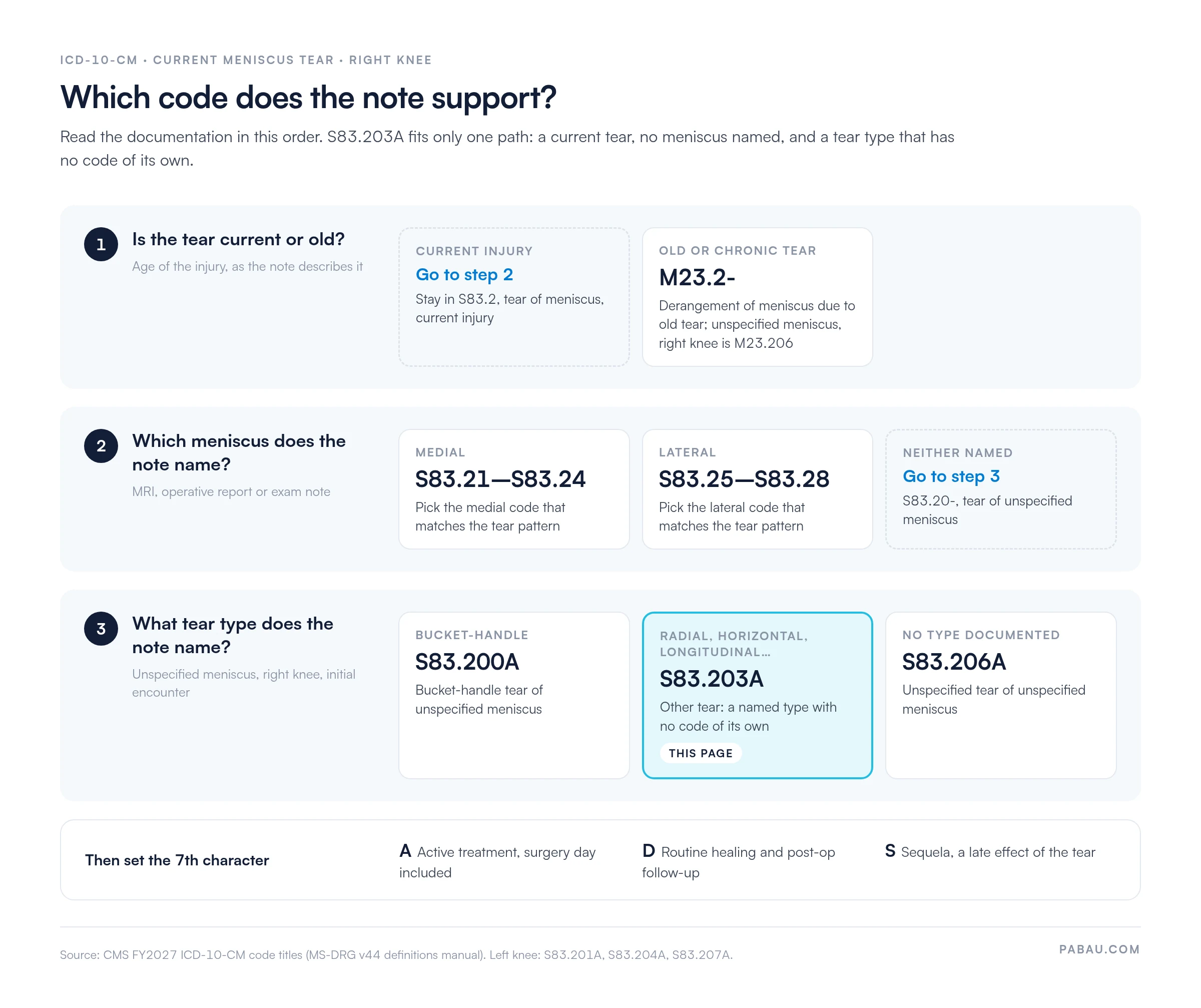
The table maps the most frequently confused codes in the S83.2 family, checked against the AAPC Codify ICD-10-CM lookup.
S83.203A is a diagnosis code, so the claim pairs it with a procedure code from the CPT code library. For meniscal tears, the most common pairings are arthroscopic procedures. The CPT code has to match the procedure performed, and the operative report has to support the CPT descriptor.
CPT 29881 is the most common pairing, and CPT 29882 applies when the surgeon repairs the meniscus instead. If the operative report names the medial or lateral meniscus, update the diagnosis to that meniscus’s code for the surgical claim. The “unspecified” designation from the first visit does not have to carry through once the documentation supports more detail.
A claim submitted with S83.203A is only as defensible as the clinical note supporting it. Auditors and payers look for the six elements below before they accept the code.
Run a documentation checklist before submitting S83.203A claims. Confirm the right knee is stated explicitly, the injury is described as acute or current, and the visit note reflects active treatment. Check that the note names a tear type, and review the MRI report for the meniscus. If imaging names the meniscus, update the code before submission rather than carrying forward the less specific one.
Coverage for meniscus tear treatment under S83.203A varies by payer type and plan. The requirements below are common patterns. Verify current local coverage determinations (LCDs) and payer-specific policies before submission, because they change and vary by jurisdiction.
S83.203A denials cluster around five root causes, each with its own corrective action. Identify which one applies before resubmitting, or the same claim goes back with the same error. Denial management starts with sorting denials by type when they arrive.
In many orthopedic practices the diagnosis code travels by hand. The surgeon documents the tear, and someone at the billing desk reads the note days later and picks a code. Whether the note named a tear type or a meniscus becomes a judgment call made away from the record. That is how S83.203A lands on a tear that should have been S83.206A or a medial code.
Pabau, the practice management platform we build, keeps the code and the note in one record. Its orthopedic claims management software pairs the ICD-10 and CPT codes as the claim is prepared. The coder works from the visit note itself.
Pabau also integrates with Claim.MD for electronic claim submission and real-time eligibility checks, so coverage is confirmed before the patient’s appointment. The medical claims clearinghouse routes claims to thousands of US payers and returns electronic remittance advice (ERAs) for payment posting.
The result is a claim that agrees with the note it came from. Fewer S83.203A claims come back for a code the documentation never supported.

Pabau connects to Claim.MD to submit ICD-10 and CPT claims electronically, run eligibility checks before the visit, and track ERAs back to the patient record. See how it works for orthopedic and sports medicine practices.

Treat S83.203A as a narrow code rather than a catch-all for right-knee meniscus tears. It needs a current tear, no named meniscus, and a named tear type that has no code of its own. If the note lacks any one of those, another code fits better.
The fix sits upstream of the claim. A provider query when the MRI comes back, and a tear type written into every meniscus note, settle the code before billing touches it. The 7th character then follows the treatment phase, staying at A through surgery day.
Pabau keeps the diagnosis, the procedure code and the visit note in one record, so the claim reflects what the surgeon documented. Book a demo to see how it handles S83.203A and related knee injury claims.

Need a refresher on how claim submissions work end-to-end? Revenue cycle management fundamentals covers the full workflow from eligibility check to payment posting.
Seeing ERA remittance data you don’t recognize? Electronic remittance advice explained breaks down 835 transaction segments and CARC denial reason codes.
Want to understand denial categories before they hit your AR? Denial codes in medical billing maps common CARC and RARC codes to corrective actions.
Treating both menisci in one session? CPT code 29880 covers arthroscopic meniscectomy of the medial and lateral menisci together.
Repairing both menisci rather than removing tissue? CPT code 29883 covers arthroscopic repair of the medial and lateral menisci in one session.
ICD-10 code S83.203A is the billable diagnosis code for other tear of the unspecified meniscus of the right knee, initial encounter. “Other tear” means the note names a tear type that has no code of its own. It is a current-injury code, so it applies only to acute or traumatic meniscal tears. Chronic or degenerative tears fall under M23.2-.
S83.203A and S83.204A are both codes for other tear of unspecified meniscus. S83.203A is for the right knee and S83.204A is for the left knee. Both apply when the note names a tear type that has no code of its own. When the tear pattern is not documented, use S83.206A for the right knee instead.
Use A (S83.203A) whenever the patient is receiving active treatment, including surgery day and all pre-operative visits. Switch to D (S83.203D) when the patient enters routine healing or post-operative follow-up and active treatment has concluded. Use S (S83.203S) only for sequelae, such as chronic instability that results from the original injury.
The most common pairing is CPT 29881 (arthroscopic partial meniscectomy, one compartment). CPT 29880 applies when both compartments are treated in the same session. CPT 29882 and 29883 are used for meniscus repair rather than excision. Verify current payer-specific Correct Coding Initiative (CCI) edits before submitting any CPT pairing.
Five reasons account for the most common S83.203A denials. The first is an acute code used when documentation describes a chronic tear, which belongs in M23.2-. The second is the wrong 7th character, D or S while active treatment is ongoing. The others are a laterality mismatch with the operative or imaging report, missing MRI support, and no prior authorization for surgery.
No. S83.203A is a current-injury code. A tear documented as chronic, degenerative or due to a past injury is coded from M23.2- instead. That range covers derangement of meniscus due to old tear or injury. The Excludes1 note at S83.2 names old bucket-handle tears specifically. For an unspecified meniscus of the right knee, the old-tear code is M23.206.