ICD-10 Code S42.444P: Medial epicondyle fracture, right humerus
ICD-10 Code S42.444P: full descriptor and code validity ICD-10 Code S42.444P car...

Last Updated: Oct 13, 2026
Billable Code Specific Code
S82.92XS is the billable ICD-10-CM code for unspecified fracture of left lower leg, sequela.
Chronic pain, stiffness, and gait trouble all qualify. Malunion and nonunion do not, because ICD-10-CM gives each of them its own 7th character. That one letter decides whether the payer reads your claim as a late effect or as an active injury.
Let Pabau's smart automation suggest the right codes, reduce claim denials, and keep your practice compliant—effortlessly.
Automate repetitive tasks and focus on what matters most—your patients.
Reduce coding errors and ensure compliance with the latest regulations.
Clean claims, fewer denials, and faster reimbursements.
Powerful insights and reporting to help your practice thrive.
HIPAA compliant SOC 2 certified GDPR-compliant Trusted by 4,000+ clinics worldwide

ICD-10 code S82.92XS is a billable FY2026 diagnosis code for an unspecified left lower leg fracture at the sequela stage.
The 7th character S means the fracture has healed and the encounter treats a late effect of it.
Malunion and nonunion are not sequelae under this code, because S82.92XP and S82.92XK cover them instead.
Chronic post-fracture pain, stiffness, and gait disturbance are the presentations that genuinely support S82.92XS.
Payers want the note to confirm the fracture healed and to tie today’s complaint back to it.
S82.92XS is valid for FY2026, the year running from October 1, 2025 through September 30, 2026. Every HIPAA-covered transaction accepts it.
The X in position 6 is a placeholder and carries no clinical meaning. The S in position 7 is what changes the claim. It tells the payer this visit is about a late effect rather than a healing fracture.
Here are the attributes a biller checks before the claim goes out.
With validity settled, the next question is what each character in the code is actually doing.
Every character in S82.92XS carries its own meaning. Reading them in order removes most of the ambiguity auditors flag on these claims.
For ICD-10-CM purposes, the lower leg means the tibia and the fibula. Reach for S82.92 when the note doesn’t say which bone broke. It also fits when both bones broke and no more specific code applies.
The 7th character S tells the payer the original injury has finished healing and that this encounter treats its consequence. No other part of the code carries that information.
Per the CMS ICD-10-CM coding guidelines, S is reserved for encounters where the fracture has reached maximum medical improvement and a residual condition remains.
S82.92 accepts 16 valid 7th characters, not three. Fifteen of them sort a fracture still under treatment by fracture type and healing status. Only S sits outside that grid.
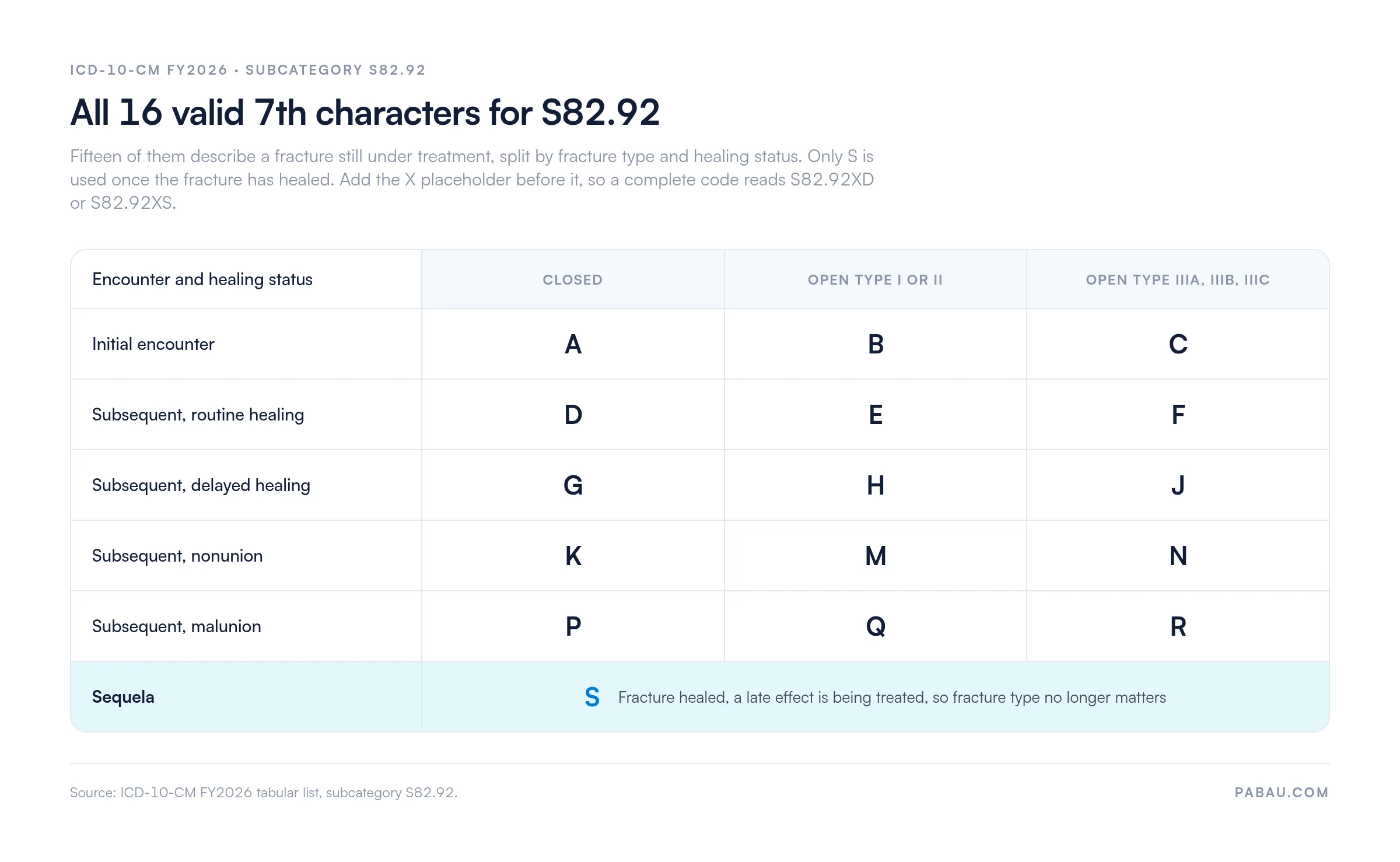
In day-to-day coding, three of those characters cover almost every encounter. The table below sets them side by side.
The stage of care decides the code, and the date on the chart has no say in it. A patient can break the left lower leg, heal fully, then return two years later with pain. That visit still takes S82.92XS.
Three questions settle the choice in about ten seconds.
“Healed” is the word doing the work. The note has to show that the fracture is no longer the active problem, and that today’s complaint grew out of it. That leaves one question: which leftover problems genuinely qualify.
S82.92XS fits when the left lower leg fracture has healed and the patient is being treated for a condition that fracture caused. Four presentations come up most often.
Two outcomes that look like sequelae are coded elsewhere. Malunion takes S82.92XP, the subsequent-encounter character for a closed fracture that healed out of position. Nonunion takes S82.92XK.
ICD-10-CM treats both as a healing outcome rather than a late effect, so the S character is wrong for either one. Where the record names the bone, a more specific code such as S82.235K replaces the unspecified version.
Aftercare and sequela split on one question: is the fracture still healing? Character D covers the healing phase. Character S takes over once healing is finished and a residual problem remains.
Picking the wrong one is a leading source of denials on S82.92 claims. The payer sees a code that contradicts the note, and the claim comes straight back.
Put the healing status in the note before anyone reaches for S82.92XS. A line such as ‘fracture healed per imaging dated [date]; patient presents with chronic pain and limited dorsiflexion’ gives the payer the link it needs. A note that says only ‘fracture follow-up’ supports no 7th character at all, and it is a leading cause of denials on this code.
S82.92XS sits at the end of a short chain. Walking up it confirms you have landed on the most specific code the record supports.
S82.92 on its own is not billable, because the 7th character is missing. Most payers reject that format before a human ever looks at it.
So append the X placeholder and the right 7th character every time. If the record does name the bone, the more precise options sit one level down in the ICD-10-CM diagnosis codes index. The CDC/NCHS ICD-10-CM web tool searches the same tabular list by code or keyword.
Providers rarely write “sequela” in a note. Several everyday phrases map to S82.92XS in the ICD-10-CM alphabetic index instead, and recognizing them saves a query.
In free text, “old fracture”, “healed fracture with residual”, and “chronic complication of a prior left leg fracture” all point the same way. “Fracture NOS” in a late-effect context maps to the unspecified subcategory S82.92.
Reviewers look for one element above all others: a documented causal link between today’s problem and the old fracture. Without it, the claim reads as an underdocumented injury visit and gets denied or downcoded.
Sequencing matters just as much as the character. ICD-10-CM puts the residual condition first and the injury code second. A claim for chronic post-fracture pain therefore lists the pain code, then S82.92XS.
The S is added to the injury code only. Never attach it to the code for the residual condition itself.
The first is reaching for S while the fracture is still being managed. If the provider is treating the bone, the character is D.
The second is filing malunion or nonunion as a sequela. Those have their own characters, P and K, and a payer will spot the mismatch against the operative note.
The third is a note that stops at “fracture follow-up”. It supports no 7th character at all, so the coder guesses or sends a query, and the claim sits in a queue either way.
Most sequela denials start well before the claim exists. The provider writes the note, the coder cannot find the healing status, and a query goes back. The claim waits while that round trip happens.
Practice management software like Pabau keeps the treatment note, the invoice, and the claim on one client record. Note templates can carry the prompts a sequela claim needs. The healing status and the causal sentence then get captured while the patient is still in the room.
From there, Pabau’s claims management software validates each claim before submission and flags missing details such as membership or authorization numbers. Live tracking shows whether a claim is pending, submitted, processing, paid, or rejected. Payments reconcile against the invoice automatically, so your finance team isn’t rebuilding the picture in a spreadsheet.
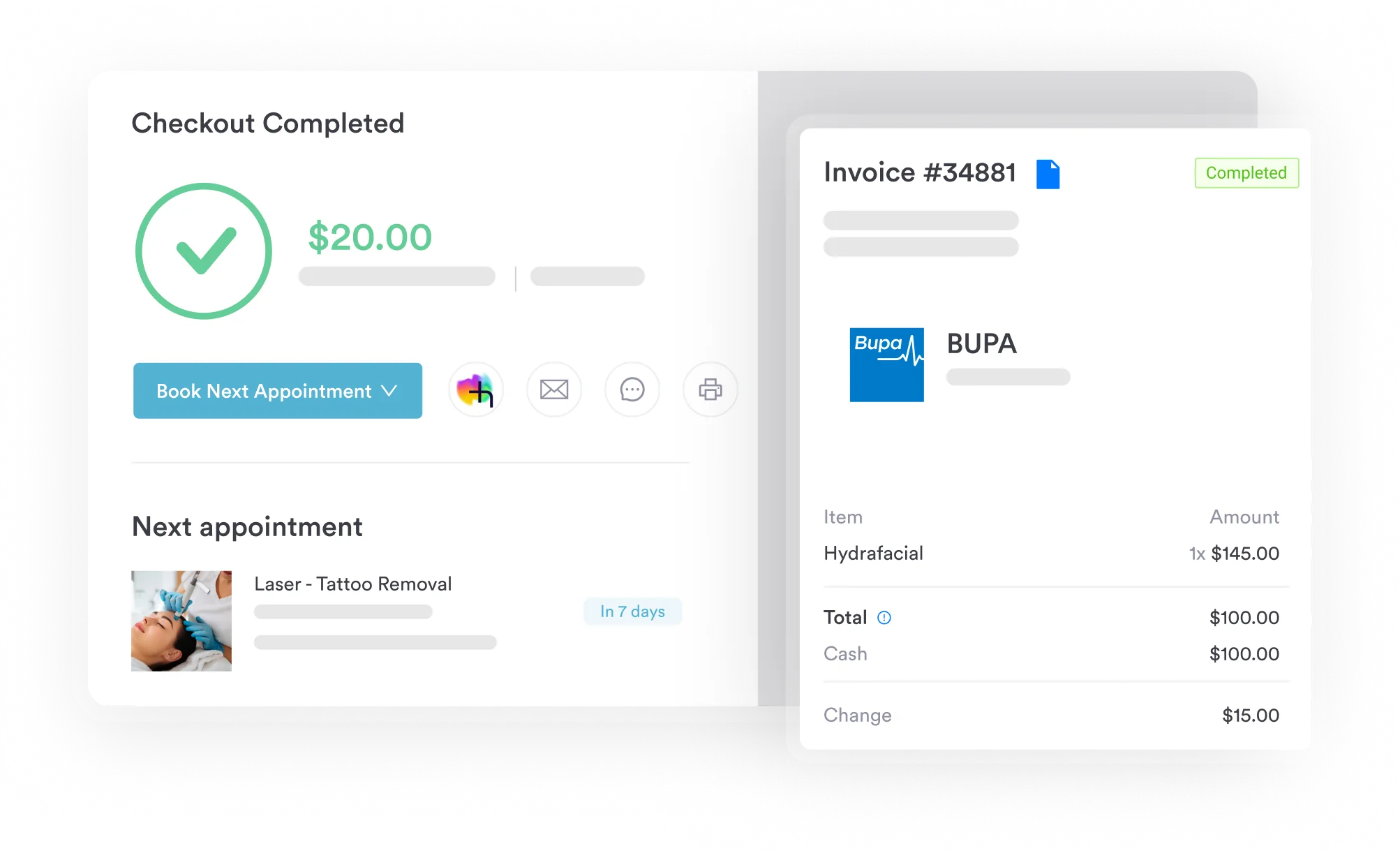

Pabau keeps treatment notes, insurance claims, and payments on one client record. Built-in validation checks every claim before it goes out, and live tracking shows exactly where each one sits.

S82.92XS becomes straightforward once you settle the healing question. If the fracture is finished and the patient is dealing with what it left behind, S is correct. If the bone is still the problem, the right character sits elsewhere in the grid.
Two habits are worth building today. Stop filing malunion and nonunion as sequelae, and add the one sentence that ties the current complaint to the old fracture. Between them, they head off most of the denials this code attracts.
The rest is keeping that documentation with the claim instead of chasing it afterwards. Book a demo to see how Pabau connects treatment notes, coding, and claim tracking on a single client record.

Need the claim to pass on the first submission? Clean claim requirements sets out what payers check before a claim can process without manual review.
Working through a stack of denials? Denial management in healthcare covers how to trace a denial back to its cause and stop it recurring.
Coding a malunion rather than a sequela? S82.52XQ shows the malunion 7th character applied to a specific ankle fracture.
Unsure whether delayed healing takes J or H? S82.855J explains how the open fracture type changes the character you pick.
Reading the payer response line by line? Electronic remittance advice explains how ERA files report payer decisions on each diagnosis code.
There is no national requirement to report external cause codes, though some payers and state registries ask for them. When you do report one alongside a sequela, that external cause code takes the 7th character S as well.
No. For injuries, ICD-10-CM replaces aftercare Z codes with the injury code plus the right 7th character. Fracture aftercare is S82.92XD, and a late effect is S82.92XS.
That is fine. The current provider records the approximate date of the injury and the fact that it healed. Treatment history held elsewhere does not block the code.
S82.91XS. The fifth character switches sides, so .91 is the right lower leg and .92 is the left.
Imaging is not always required, but an X-ray or CT report confirming union is the cleanest support you can offer. A dated line in the note referencing that report usually satisfies a reviewer.
Yes. It carries the medical necessity for the therapy codes on the claim. The note still has to show the therapy targets the late effect rather than the fracture itself.