ICD-10 Code Y76.0: Diagnostic obstetric and gynecological devices
ICD-10 Code Y76.0: Definition and billable status ICD-10 Code Y76.0 is a valid, ...

Last Updated: Oct 23, 2026
Billable Code Specific Code
S82.52XQ is the billable ICD-10-CM code for displaced fracture of medial malleolus of left tibia, subsequent encounter for open fracture type I or II with malunion.
One wrong character changes what the claim says. Q means the fracture healed badly, P means it never healed, and B means treatment is still active.
Below, the code comes apart character by character. You also get the sibling codes, the documentation payers expect, and the four errors that draw denials.
Let Pabau's smart automation suggest the right codes, reduce claim denials, and keep your practice compliant—effortlessly.
Automate repetitive tasks and focus on what matters most—your patients.
Reduce coding errors and ensure compliance with the latest regulations.
Clean claims, fewer denials, and faster reimbursements.
Powerful insights and reporting to help your practice thrive.
HIPAA compliant SOC 2 certified GDPR-compliant Trusted by 4,000+ clinics worldwide

S82.52XQ is a billable ICD-10-CM code for a displaced medial malleolus fracture of the left tibia, seen at a follow-up visit with malunion.
The 7th character Q means the bone united in the wrong position, which is not the same as nonunion (P) or sequela (S).
Q only fits when the original wound was graded open type I or II, so the first operative note decides it.
The X in position 6 is mandatory, and S82.52Q without it is an invalid code that payers reject.
S82.52XQ is billable on its own, with no extra character needed. It is valid for FY2026, effective October 1, 2025. The official description comes from the CMS ICD-10-CM FY2026 tabular list:
You can report the code as a principal or secondary diagnosis. Because it covers the follow-up phase only, it should never land on a claim for the initial acute encounter.
Software will not judge the encounter phase for you. Practice management software like Pabau runs required-field completeness checks, so its medical claims management tools catch an incomplete claim line before submission. The phase itself still comes from the physician’s note.
Every character in S82.52XQ encodes one clinical decision. Misread one and you have a different code, with a different meaning and a different payment path.
Displacement is built into the S82.52 subcategory itself, so no separate character carries it. A nondisplaced fracture of the medial malleolus of the left tibia belongs to S82.55 instead. Check which parent code applies before you go looking for a 7th character.
The X in position 6 is not optional. Drop it and you submit S82.52Q, which is not a valid ICD-10-CM code, so the payer rejects the claim. Manual entry is where this usually happens, because a coder types the code from memory rather than picking it from a validated list.
S82.52XQ sits five levels below the chapter, and each level narrows the picture. Walking that hierarchy is the fastest way to find the sibling code you actually need.
The CDC/NCHS ICD-10-CM web tool gives you the same navigation, straight from the source.
The 6-character parent S82.52 is not billable by itself. Only a completed 7th-character code in the family can go on a claim. Our ICD-10-CM code library holds the rest of the family if you need to check a neighboring code.
A clearinghouse will not flag a 7th character that is semantically wrong. What it does give you is real-time eligibility checks, electronic remittance advice, and a completeness check on the required claim fields.
Pabau submits through Claim.MD in the US on that basis, which catches format problems rather than coding judgment.
Malunion means the fracture consolidated, but in an abnormal position. The bone healed. It just healed crooked. That single finding is what separates Q from the two characters coders mix it up with most.
Q is right when imaging shows the fracture united with malalignment, and the provider says so in the note. A coder cannot infer it. The word malunion has to appear in the clinical note or the radiology report.
Nonunion (P) is the opposite finding. The fracture never consolidated, and the bone ends are still apart past the expected healing window. Swapping P and Q changes the clinical story on the claim, which can affect prior authorization for corrective surgery.
Check the imaging report before assigning Q or P. Radiology reports that state ‘delayed union’ do not automatically qualify for nonunion coding. The ICD-10-CM guidelines require the physician to document nonunion or malunion explicitly. When the report is ambiguous, query the treating physician before submitting the claim.
S82.52XQ only covers wounds graded open type I or II. Surgeons grade open fractures with the Gustilo-Anderson system.
ICD-10-CM lines its own open fracture types up with those grades. The AAPC ICD-10-CM code reference shows how the grade folds into the 7th character.
Types I and II share one 7th character because their management and coding pathways run close together. Type III gets its own. The source document is the original operative report, which fixed the wound grade on the day of injury.
So if that first note recorded a type III wound, S82.52XQ is wrong no matter how the fracture healed. Pull the initial surgical record into the chart and check it at every follow-up. Keeping it there is what stops the wound grade drifting between claims.
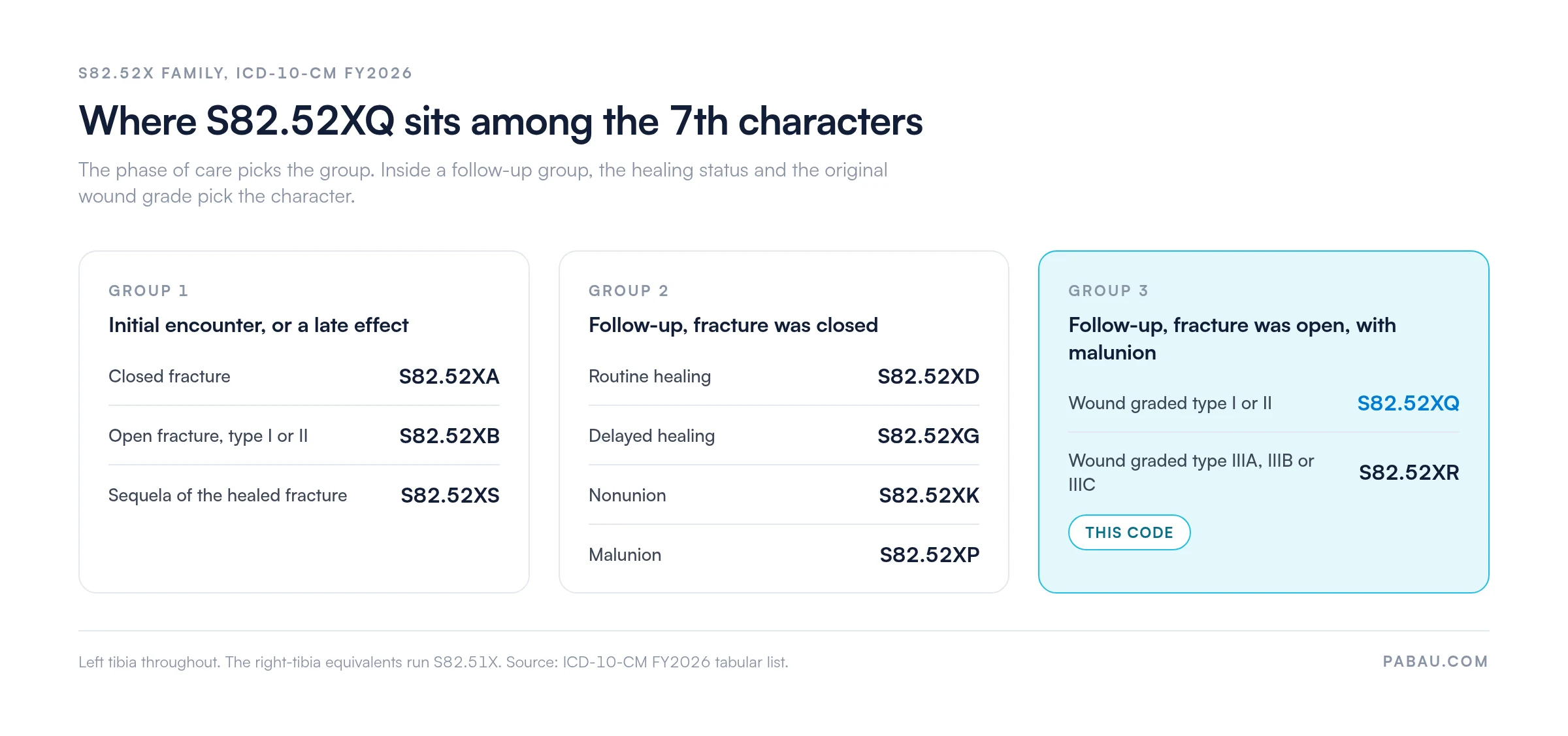
Encounter type, healing outcome, and wound grade each get their own code in the S82.52 family. The table below maps the ones coders cross-reference most often.
For the full sibling set, the S82.52XQ tabular listing shows every character in the family.
The line between S82.52XP and S82.52XQ is the one payers audit. P is for a fracture that started closed, Q for one that started open at type I or II. Open fractures carry higher acuity and a different set of expected procedure codes, so the two are not interchangeable on a claim.
The same family, regrouped by phase of care, makes the choice faster than reading down a list.
S82.52XQ needs six clinical facts on file before anyone assigns it. Miss one and the claim is exposed at audit, even if it pays first time.
When an element is missing or ambiguous, query the physician. Do not infer it from the rest of the chart, because an inference is what an auditor will pull the claim on.
A physician note may also describe a proximal fibula break with syndesmotic disruption, which is the Maisonneuve pattern. That injury carries its own code, and its open malunion follow-up uses S82.863Q.
Once the record holds all six, the claim itself still needs a short pre-flight check. Run it before the batch goes out. A rejection at the clearinghouse is quick to fix, but a payer denial goes back through the whole appeal path.
Four errors drive most denials and audit findings on S82.52XQ. Each one enters the workflow at a different point, so each one needs a different fix.
Tracking denials by code family is what turns these into a fixable pattern. A billing team that logs its reason codes usually spots a Q-versus-P habit within a couple of cycles.
Working denial management into the monthly review catches the rest before they age out of the appeal window.
Build a one-page cheat sheet for the S82.52X family. Put each 7th character next to its clinical meaning and the documentation it needs, then post it at the coding workstations. Once the table is familiar, telling Q from P and S stops being a judgment call and becomes a lookup.
At a lot of practices, the S82.52XQ decision happens in one system and the claim happens in another. The coder reads the operative note in the chart, picks the character, then re-keys the diagnosis into the billing tool. Every hop is a chance for the laterality or the placeholder to drop.
Pabau keeps the encounter, the note, and the claim on one record. Diagnosis codes attach to the visit they came from, so the claim carries the laterality and encounter phase the clinician documented. Required-field checks run before submission.
In the US the claim then goes out through Claim.MD, with eligibility checks and remittance handled in the same place. The judgment call is still yours. What changes is how much can go wrong between the note and the payer, which is where avoidable denials tend to start.

Pabau brings code lookup libraries, required-field validation, and multi-region clearinghouse submission into one record. The diagnosis you assign is the one that reaches the payer. See how orthopedic and physical therapy billing teams run it.

S82.52XQ is a narrow code, and that is the point of it. It only fits a displaced medial malleolus fracture of the left tibia. The wound had to be open at type I or II, and the bone has to be healed out of position.
So the work sits upstream of the code, in the note it comes from. Reading the original operative record before every follow-up claim is what makes the character obvious. Build that habit and the coding stops being a debate.
If the handoff between the note and the claim is where your denials start, that is worth fixing first. Book a demo to see how Pabau keeps a fracture follow-up claim together in one record.

Want to see the same Q logic on a different bone? ICD-10 code S82.032Q walks through an open left patella fracture with malunion, where the wound grade drives the character the same way.
Need to understand how clearinghouse validation reduces claim rejections? Pabau’s Claim.MD vs Office Ally comparison covers how each clearinghouse handles edit checks, ERA delivery, and payer enrollment for specialty practices.
Want a framework for managing fracture claim denials systematically? Denial codes in medical billing explains the most common claim adjustment reason codes and how to build a denial-response workflow by code category.
Looking for guidance on electronic remittance and ERA reconciliation? Electronic remittance advice (ERA) explains how 835 transactions work and how to reconcile ERA data with posted payments for fracture follow-up encounters.
Yes. S82.52XQ is billable and specific for FY2026. It is a 7-character code, and the X in position 6 is part of it. Report it as a principal or secondary diagnosis.
No. The 7th character reflects the phase of care, not the provider. A surgeon seeing the patient for the first time still reports Q when the record shows a healed, malaligned open type I or II fracture.
There is no time limit. The character follows the documented healing status, not the months elapsed. Once the physician records malunion, Q applies for as long as that malunion is being treated.
Then S82.52XQ does not apply. Query the physician first. If laterality still cannot be confirmed, the unspecified-tibia family is the fallback, and payers look hard at those claims.
Yes. It gives the diagnostic reason for corrective surgery at a follow-up encounter. The procedure itself goes on the claim as a CPT code, and the operative note has to match both.
No. The medial malleolus belongs to the tibia, so this is a tibia code. Lateral malleolus fractures of the fibula sit in the S82.6- range and take their own 7th characters.