ICD-10 Code S82.299K: Other tibial shaft fracture nonunion, unspecified leg
ICD-10 Code S82.299K: Official description and quick reference ICD-10 Code S82.2...

Last Updated: Oct 21, 2026
Billable Code Specific Code
S82.90XB is the billable ICD-10-CM code for unspecified fracture of unspecified lower leg, initial encounter for open fracture type I or II. It applies when the record confirms an open Gustilo type I or II fracture below the knee but doesn't name the bone or the side.
The code sits in category S82, fracture of lower leg, including ankle. Assignment turns on three documented facts: the Gustilo grade, the bone involved, and the side of the injury.
Let Pabau's smart automation suggest the right codes, reduce claim denials, and keep your practice compliant—effortlessly.
Automate repetitive tasks and focus on what matters most—your patients.
Reduce coding errors and ensure compliance with the latest regulations.
Clean claims, fewer denials, and faster reimbursements.
Powerful insights and reporting to help your practice thrive.
HIPAA compliant SOC 2 certified GDPR-compliant Trusted by 4,000+ clinics worldwide

S82.90XB is billable for FY 2026. It covers an open Gustilo type I or II lower leg fracture when the record names neither the bone nor the side.
7th character B applies only to Gustilo type I and II open fractures. Types IIIA, IIIB, and IIIC all map to 7th character C, so a documented type III injury is coded S82.90XC.
When no Gustilo type is documented, ICD-10-CM guidelines assign the type I or II character, which is B at the initial encounter.
Before using S82.90XB, query the physician if the bone or side might be identifiable. A named tibia, fibula, or side requires a more specific code.
Pabau’s claims management software supports ICD-10 code entry, Claim.MD clearinghouse submission, and electronic remittance advice (ERA) reconciliation. Open fracture claims reach payers with the right diagnosis linked to the right CPT.
ICD-10 code S82.90XB is the billable code for an open Gustilo type I or II lower leg fracture at the initial encounter. It applies when the record names neither the bone nor the side. It sits at the end of a five-level path. Check each level for a more specific sibling code before you assign it.
S82.90XB records three clinical facts at once. The fracture is in the lower leg, below the knee, but the record doesn’t say which bone or which side. The wound is open, and the patient is in the initial period of active treatment for a Gustilo type I or II injury.
The two “unspecified” terms in the descriptor do different jobs. “Unspecified fracture” means the record doesn’t name the bone, so no tibia or fibula code can be chosen. “Unspecified lower leg” means it doesn’t name the side, because S82.91- covers the right leg and S82.92- the left.
The typical case is a heavily comminuted injury documented only as “lower leg fracture” in an early ED note. Orthopedic and physical therapy practices meet the code most often on trauma referrals, where the imaging report predates the surgeon’s notes.
The 7th character of an S82.90X code records two facts in one position: whether the fracture is open, and which encounter this is. Coders often get it wrong in one direction. They assign B when the note describes a type III injury, which belongs to character C.
The ICD-10-CM Official Guidelines base the open fracture characters on the Gustilo classification, so the grade comes from the physician’s note. When an open fracture has no Gustilo type documented, Section I.C.19.c.1 assigns the type I or II character, which is B here.
Query the physician only when the note describes type III damage, such as extensive soft-tissue loss or vascular injury, without naming the grade.
The neighbors most often confused with S82.90XB split along four axes: fracture openness, encounter type, bone, and side. The table below gives the decision logic for each.
Decision rule for encounter type: ask whether the patient is still receiving active treatment for the fracture itself. Surgery, casting, external fixation, and wound debridement all count as active treatment. Routine outpatient physical therapy after the fracture is treated does not. Code that visit as a subsequent encounter, or as a sequela when you’re treating a late effect.
S82.90XB records the side as unspecified. In the S82.9- subcategory, the 6th character carries laterality: 0 for unspecified, 1 for right, and 2 for left. Payers may flag an unspecified code when the record clearly identifies the injured limb. ICD-10-CM Official Guidelines also require the most specific code the documentation supports.
Incomplete documentation drives many open fracture claim denials. Open fractures involve Gustilo grading, wound care, and often several specialties.
That makes the documentation behind S82.90XB more demanding than for a closed fracture code. Like any medical billing claim, it’s only as strong as the record behind it. Check each element below before you assign the code.
The CDC/NCHS ICD-10-CM tool shows the Chapter 19 instruction to add a Chapter 20 external cause code with injury codes. Under Section I.C.20, though, there’s no national mandate to report them. They become required where a state reporting rule or a payer’s claim edits ask for them.
Open fracture claims attract more payer scrutiny than closed fracture claims. Six denial patterns come up again and again with S82.90XB, and each traces back to a specific documentation or coding error. Strong denial management workflows catch most of them before the claim leaves the practice.
Our guide to CARC denial codes explains CO-11, CO-16, and the other adjustment codes these rejections arrive with.
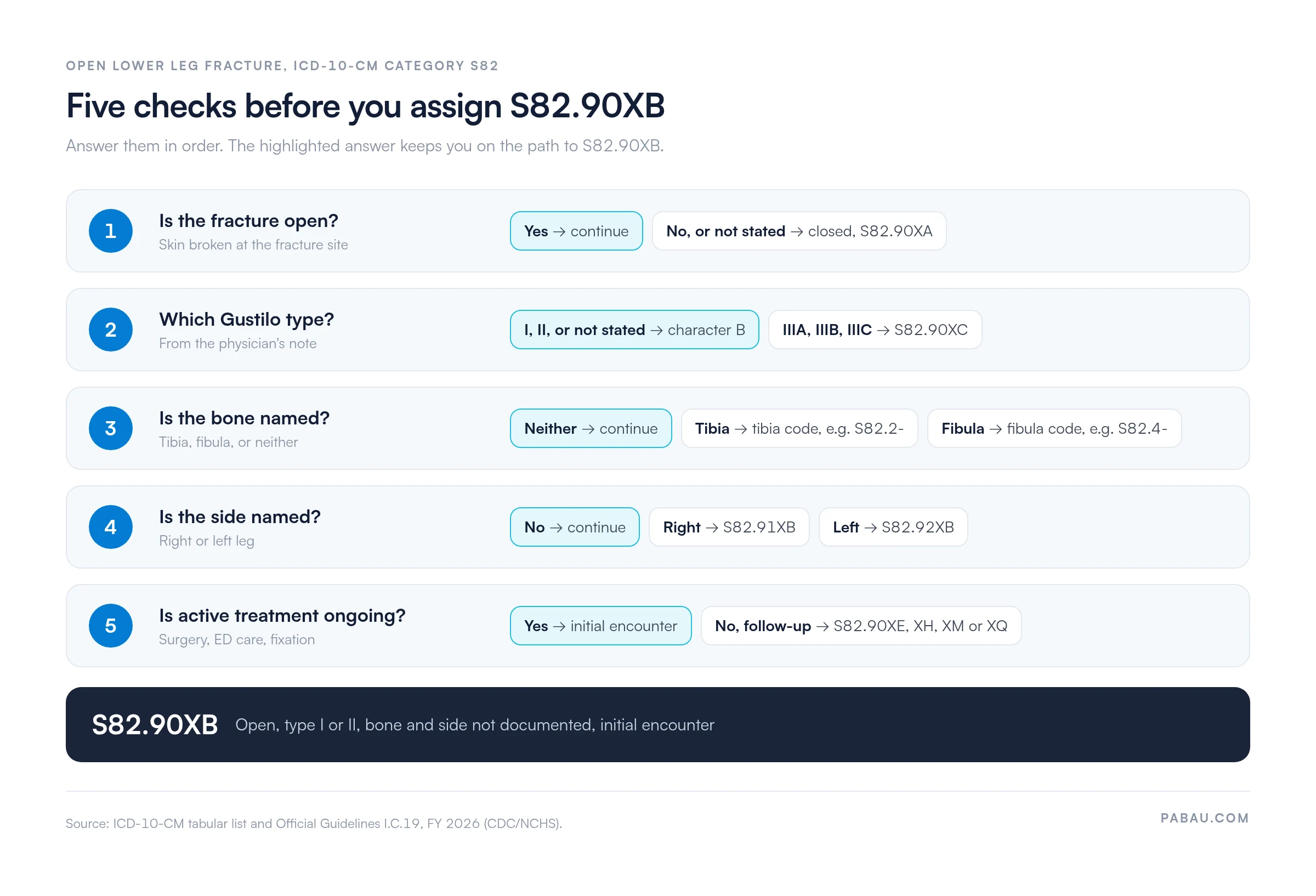
Working through each case in the same order removes most of the denial triggers above. The decision path below condenses the eight steps into five checks, with the sibling code each wrong answer leads to.
S82.90XB is most often paired with open treatment and wound management CPT codes. The table below lists the codes most often submitted with this diagnosis, with notes on bundling rules for same-day billing. Practices using orthopedic claims software can set claim rules that flag likely bundled pairs before submission.
Debridement and temporary fixation each come with their own documentation rules. The code pages for 11042 and 20690 spell out what the operative note needs for each one.
Open fracture claims often span several encounters, from ED care to definitive fixation and follow-up. Our guide to revenue cycle management shows how those visits fit into one billing workflow.
S82.90XB inherits every instructional note on category S82. Apply them before you confirm the code.
The AAPC ICD-10-CM code lookup shows these notes next to the code. Coders can review them at the point of assignment without opening the full tabular list.
Clean claim checklist for S82.90XB: the open fracture is documented, the Gustilo type is I, II or unstated, and neither bone nor side is identifiable. Confirm the encounter is initial, add an external cause code where required, and match the CPT to open fracture care. Submit through a clearinghouse with pre-validation to catch missing code pairs before adjudication.
Many orthopedic billing teams still check 7th characters by hand, key claims into a payer portal, and match remittances in a spreadsheet. Each handoff is another chance for a B to slip through where the operative note says type IIIB.
Pabau, the practice management and billing platform we build, links each ICD-10 code to its CPT on the claim. It submits 837P claims through the Claim.MD clearinghouse, with eligibility checked before the visit.
Remittances come back as ERA files with CARC denial reasons attached. Your team can correct an S82.90XB mismatch and resubmit while the case is still fresh. That keeps clean claim submission the norm for your practice.

Pabau integrates with Claim.MD to validate ICD-10 codes, submit 837P claims electronically, and reconcile ERAs. Your billing team catches character B vs C mismatches before the payer does.

S82.90XB is a narrow code. It fits an open Gustilo type I or II lower leg fracture at initial treatment, when the record names neither the bone nor the side.
Most of the judgment sits in specificity. If a query can surface the bone or the side, the extra day it takes costs less than a CO-11 denial. If it can’t, S82.90XB is the defensible choice, and the record shows why.
Book a demo to see how Pabau catches 7th character and laterality mismatches before your open fracture claims reach the payer.

Managing claims across multiple payers? Claim.MD clearinghouse overview explains how Pabau routes 837P claims to 4,000+ US payers with real-time eligibility and ERA support.
Want to reduce denials upstream? Insurance eligibility verification outlines how pre-visit benefit checks catch coverage gaps before an open fracture claim is even submitted.
ICD-10 code S82.90XB is the billable diagnosis code for an unspecified fracture of an unspecified lower leg. It covers the initial encounter for an open fracture of Gustilo type I or II. “Unspecified fracture” means the record doesn’t name the bone, and “unspecified lower leg” means it doesn’t name the side. “Type I or II” refers to the Gustilo-Anderson classification of open fracture wounds.
Yes, S82.90XB is a billable ICD-10-CM code for FY 2026. It’s a complete seven-character code, so payers accept it as a full diagnosis for claim adjudication. The documentation still has to support each element of the descriptor.
S82.90XA is for a closed fracture at the initial encounter, and S82.90XB is for an open type I or II fracture at the initial encounter. The 7th character is the only difference. Using A for an open fracture, or B when Gustilo III is documented, are both coding errors that can lead to denial.
Gustilo types I and II map to 7th character B at the initial encounter. Type I is a low-energy wound under 1 cm with minimal contamination, and type II is a laceration over 1 cm with moderate soft-tissue injury. Types IIIA, IIIB, and IIIC all map to character C instead. When no Gustilo type is documented, ICD-10-CM guidelines assign B.
No. S82.90XB is the unspecified-side code, with 0 in the laterality position. Coders must still confirm the side can’t be determined from the record. If the documentation names the right or left leg, use S82.91XB or S82.92XB, or a side-specific tibia or fibula code.
Once active treatment ends and the patient enters follow-up, S82.90XE applies for routine healing of an open type I or II fracture. S82.90XH covers delayed healing, S82.90XM covers nonunion, and S82.90XQ covers malunion. S82.90XS is the sequela code for late effects after the fracture has healed.