ICD-10 Code Y76.0: Diagnostic obstetric and gynecological devices
ICD-10 Code Y76.0: Definition and billable status ICD-10 Code Y76.0 is a valid, ...

Last Updated: Oct 23, 2026
Billable Code Specific Code
S82.855J is the billable ICD-10-CM code for nondisplaced trimalleolar fracture of left lower leg, subsequent encounter for open fracture type IIIA, IIIB, or IIIC with delayed healing.
That third element is where claims fall apart. Coders often reach for J when the operative note describes a small type I or II wound, and that scenario belongs to S82.855H. One letter separates a paid claim from a denial.
Every one of those three has to come from the physician's note.
Let Pabau's smart automation suggest the right codes, reduce claim denials, and keep your practice compliant—effortlessly.
Automate repetitive tasks and focus on what matters most—your patients.
Reduce coding errors and ensure compliance with the latest regulations.
Clean claims, fewer denials, and faster reimbursements.
Powerful insights and reporting to help your practice thrive.
HIPAA compliant SOC 2 certified GDPR-compliant Trusted by 4,000+ clinics worldwide

ICD-10 code S82.855J covers a nondisplaced trimalleolar fracture of the left lower leg. The seventh character J means a subsequent encounter, an open type IIIA, IIIB, or IIIC fracture, and delayed healing.
The character H is the one to watch. S82.855H covers the same encounter and the same delayed healing, but for a milder type I or II open wound.
S82.855J is a billable, leaf-node ICD-10-CM code and it remains active in the FY2026 code set. It cannot stand in for S82.854J (right leg) or S82.856J (unspecified side).
The letters I, L, and O never appear as ICD-10-CM seventh characters, so any source citing a character L for a fracture code is wrong.
Practice management software like Pabau supports orthopedic billing, including ICD-10 code assignment and electronic claim submission through Claim.MD.
S82.855J is a billable, leaf-node ICD-10-CM diagnosis code. It has been valid since ICD-10-CM took effect in the United States on October 1, 2015.
The code is still active in the FY2026 set published in the CMS ICD-10-CM tabular list. The table below gives the short version, field by field.
A trimalleolar fracture involves all three bony prominences of the ankle. Those are the medial malleolus (inner tibial projection), the lateral malleolus (fibular tip), and the posterior malleolus (posterior tibial lip). This is an inherently unstable injury, because it disrupts ankle mortise integrity on three sides.
Nondisplaced means the fracture fragments have not shifted out of anatomical alignment. The fracture line is present, but the bone ends stay in normal position.
That distinction changes both surgical planning and code selection, because displaced and nondisplaced trimalleolar fractures carry different codes.
The left lower leg in S82.855J refers to the left tibia and fibula, including the distal segments that form the ankle joint. Laterality comes from the imaging report or the operative note, never from an assumption.
Trimalleolar fractures usually follow high-energy mechanisms, such as motor vehicle collisions, falls from height, or a severe ankle twist under axial load.
Open variants occur when bone or a fracture fragment pierces the skin, creating a wound that connects to the fracture site.
S82.855J covers the severe end of that range, where the wound is extensive and heavily contaminated. Those injuries carry an infection risk that closed fractures do not, which is why open fracture classification drives both clinical management and coding specificity.
Every S82.855 code shares the same first six characters. The seventh alone decides the encounter type, the fracture openness, and the healing status, so it does most of the work on the claim.
Picking the wrong one is the fastest route to a medical necessity denial.
Read that list as a grid rather than an alphabet. Three columns describe the wound: closed, open type I or II, and open type IIIA to IIIC. Six rows describe the visit: initial, routine healing, delayed healing, nonunion, malunion, and sequela.
The characters then run in a fixed order. Each row of three takes the next available letters: A/B/C, D/E/F, G/H/J, K/M/N, P/Q/R, and S for sequela.
ICD-10-CM skips I, L, and O throughout, because they read too easily as the digits 1 and 0. That is why the delayed-healing row ends at J instead of I, and why character L doesn’t exist anywhere in ICD-10-CM.
At the chart, it’s quicker to work the other way round. Start from J and test the three facts it claims, one at a time.
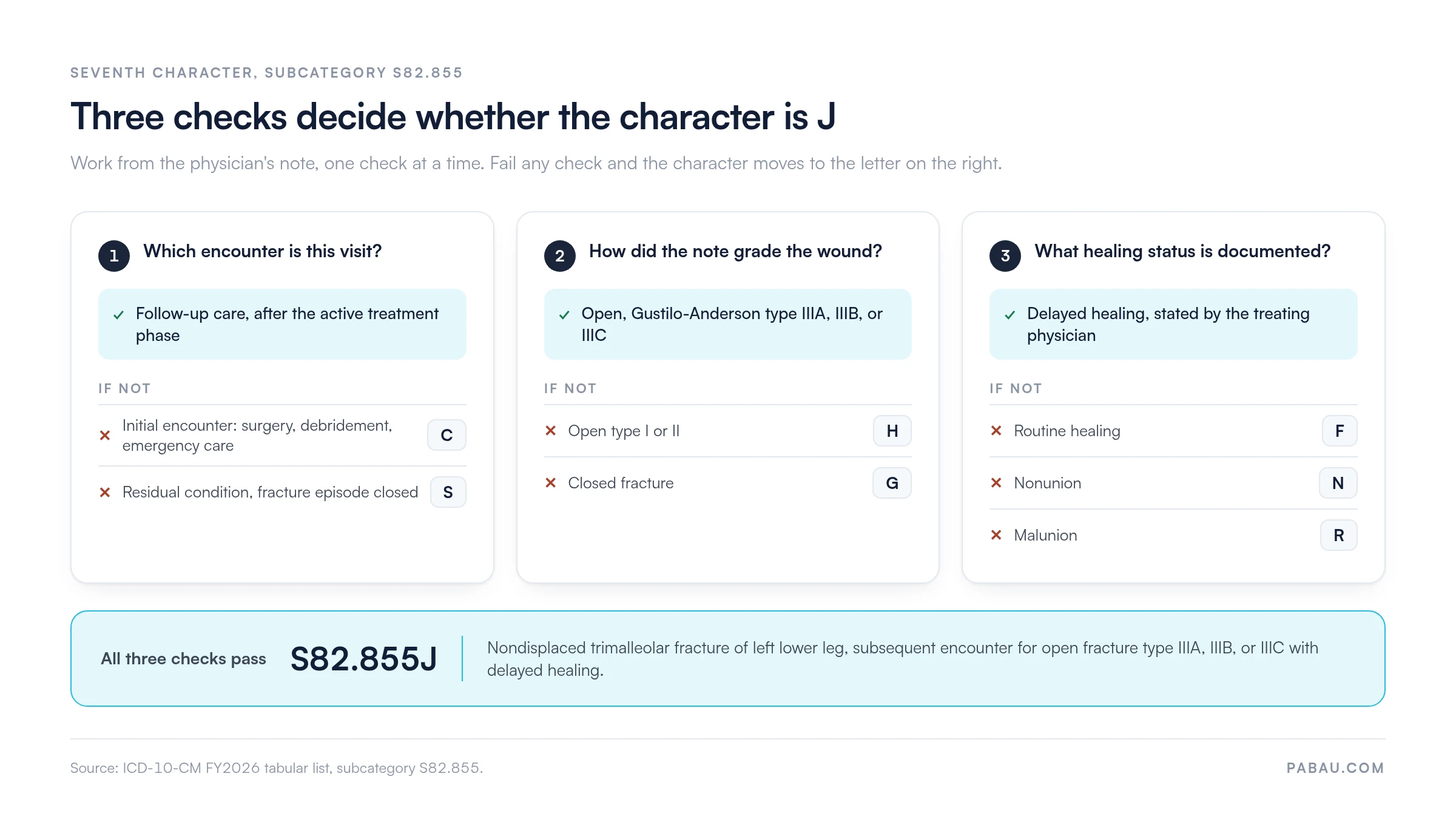
The Gustilo-Anderson classification grades open fracture severity by wound characteristics. Gustilo and Anderson set out types I, II, and III in 1976.
The IIIA, IIIB, and IIIC subtypes arrived eight years later, in the 1984 follow-up paper by Gustilo, Mendoza, and Williams. ICD-10-CM uses that grading directly in its seventh-character definitions.
S82.855J applies only to the three bolded rows above. A type I or II wound with delayed healing takes S82.855H instead, so the wound grade drives the character choice.
Healing status moves the character too. If the physician documents nonunion of a type III open fracture, the character becomes N instead. Malunion moves it to R within the same column. The operative note must state the Gustilo-Anderson type explicitly, because a coder cannot infer it from wound size alone.
The full nonunion code is S82.855N, which keeps the same stem, laterality, and Gustilo type III grade. Only the seventh character moves.
A subsequent encounter means the patient is receiving care after the active treatment phase. That covers cast changes, hardware monitoring, physical therapy supervision, and follow-up imaging. It is the correct encounter type for most outpatient orthopedic visits after the initial fracture management episode.
Delayed healing means bone union is progressing more slowly than expected for the injury and the patient. Type III open fractures raise that risk through periosteal stripping, contamination, and compromised blood supply. Even so, the physician has to state delayed healing in the record. A coder cannot assign J from a long timeline alone.
The classification tree behind S82.855J shows whether you are coding at the required level of specificity. The CDC ICD-10-CM web tool confirms the hierarchy below.
S82.855 on its own is not billable. Coding at the parent level, without a seventh character, produces a rejection. Always drill down to the full seven-character code that matches the documented scenario.
The S82.855 subcategory holds one code per combination of encounter type, wound severity, and healing status. The matrix below lays out the whole family, so you can see exactly where S82.855J sits.
The AAPC ICD-10-CM lookup and ICD List both carry browsable versions for chart review.
The easiest mix-up in this family is S82.855H. Both codes describe a subsequent encounter with delayed healing, and only the Gustilo type separates them. Pull the operative note before you choose between the two.
Laterality siblings matter just as much. S82.854J covers the right lower leg at the same encounter and healing status, and S82.856J covers unspecified laterality. The right-leg codes follow the same grid, so an initial visit for a type I or II open fracture takes ICD-10 code S82.854B.
Use S82.856J only when the record does not name a side. If the fracture is displaced rather than nondisplaced, the left-leg equivalent is S82.852J.
The mistakes below come up repeatedly on open fracture claims, and a pre-submission check catches every one of them.
One habit prevents most of these. Read the seventh character back as a full sentence, then compare that sentence against the physician’s own words in the assessment. If the note says type II, or says nonunion, the character has to change with it.
The ICD-10-CM Official Guidelines for Coding and Reporting set the documentation standard for this code. Incomplete documentation is the usual reason a claim for S82.855J comes back.
Run this check before the claim leaves the practice:
Documentation at that level is what gets the claim paid on the first pass. Practices with heavy fracture follow-up volume tend to build note templates that prompt for all six elements at every visit. When delayed healing first appears, it belongs in the assessment and plan, not buried in the history.
If the same denials keep coming back on open fracture codes, read the remittance before you change the coding. The reason code tells you whether the problem is the note or the character. Our guide to common denial codes covers the ones that surface on musculoskeletal claims.
Audit a sample of S82.855J claims from the prior quarter. Check whether the physician note for each one explicitly states five things. Those are nondisplaced, trimalleolar, left side, Gustilo-Anderson type IIIA, IIIB, or IIIC, and delayed healing. If the note describes a type I or II wound, the claim should have gone out as S82.855H. Build a fracture follow-up template that prompts for all five data points at every encounter.
S82.855J is a subsequent-encounter code, so it pairs with whatever service the physician delivers at the follow-up visit. The pairing depends on the work performed, not on the diagnosis code itself.
Payer policies vary, so treat the table below as common practice rather than guaranteed coverage.
Most delayed-healing visits land on 99213 or 99214, and the medical decision-making in the note decides which. If the plan changes at that visit, check the requirements for CPT code 99214 before you level it.
Watch the encounter character when surgical codes appear. CPT 27822 and 27823 are used at the initial operative episode. On a type IIIA, IIIB, or IIIC open fracture, they pair with character C rather than with S82.855J. The J character comes later, once the patient returns for monitoring and the physician records delayed healing.
Coding is only one step in a longer chain, and a delayed-healing claim can fail at any of them. Here is the path it takes from the exam room to the remittance.
Take one patient through it. The visit falls five months after fixation of an open left trimalleolar fracture. The surgeon graded the wound IIIB in the operative note and records slow union at this visit. The claim goes out as S82.855J with 99213, plus 73610 for the ankle films.
One handoff causes most of the trouble. The Gustilo grade sits in the operative note, while the coder often works from a shorter follow-up summary. If that summary says only “open fracture”, the defensible character is H, not J.
That chain crosses at least two systems in most practices. The note sits in the chart, and the claim sits in the billing tool. Nobody reconciles the seventh character against the original record before the claim goes out.
Practice management software like Pabau keeps those steps in one place. Orthopedic and sports medicine practices can submit S82.855J claims electronically through Claim.MD, our integrated US clearinghouse.
Claim.MD reaches thousands of US payers and returns the electronic remittance advice, known as the ERA, so you can reconcile delayed-healing encounters.
Pabau’s medical claims management software holds the diagnosis, the charge, and the claim status on one screen. A coder can read the note and check the character side by side. That way a wrong seventh character gets caught in the practice, not by the payer.
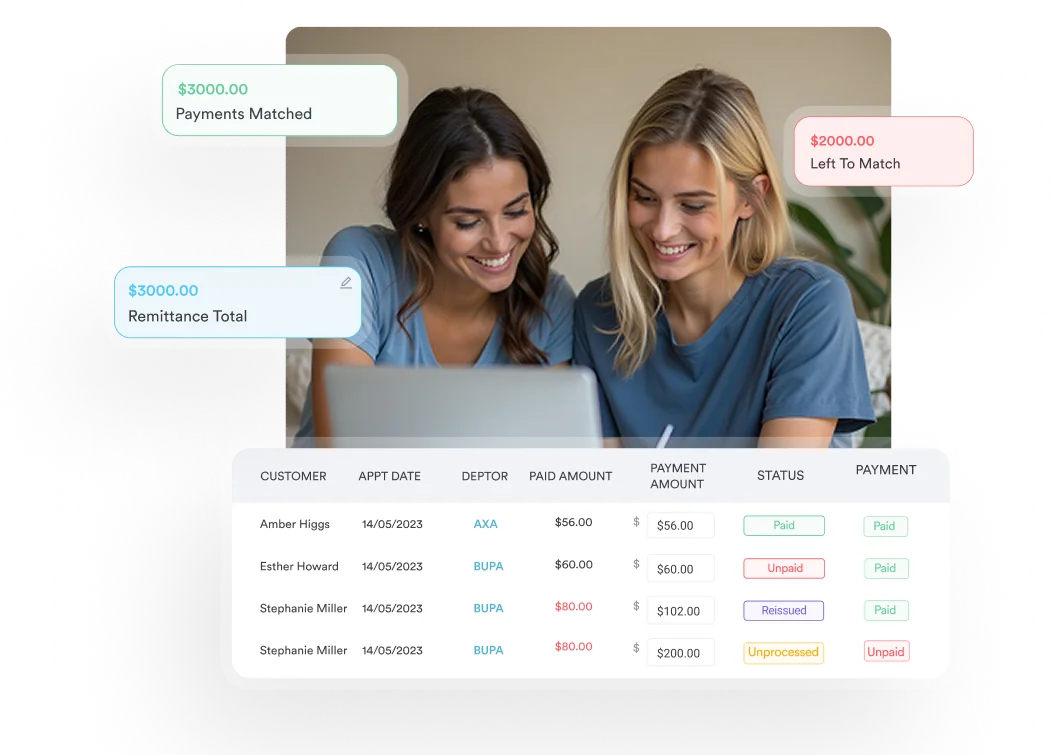

Pabau’s claims management software connects directly to Claim.MD for electronic ICD-10-CM claim submission across thousands of US payers. See how practices handle complex fracture follow-up billing in a single workflow.

Open fractures with delayed healing are among the most documentation-sensitive claims in orthopedic practice. S82.855J is the right code only when four things line up in the record.
Those four are the fracture pattern, the left side, the Gustilo type III wound, and the delayed healing. Miss one of them and the J character cannot be defended on audit.
Practices billing a high volume of fracture follow-ups should pair structured note templates with a system that checks the code before the claim leaves. Book a demo to see how Pabau handles fracture coding and claim submission in one workflow.

Need a structured approach to orthopedic billing compliance? Medical billing compliance covers the documentation and workflow standards that keep fracture claims clean.
Wondering how clearinghouse submission works for ICD-10 claims? Medical claims clearinghouse explains how electronic claims move from practice to payer and what can go wrong in transit.
Want to know what makes a claim pass on the first try? What is a clean claim sets out the fields a payer checks before it pays.
Seeing the same fracture denials come back every month? Denial management in healthcare shows how to work a denial and stop it repeating.
New to the billing side of an orthopedic practice? What is medical billing traces the process from the patient visit through to the posted payment.
Assign the character for an open type I or II fracture. The ICD-10-CM guidelines default there when the Gustilo type is missing, so a delayed-healing follow-up becomes S82.855H. Query the physician if the wound reads as more severe than that.
Yes. The external cause code takes its own seventh character to match the encounter, so it can accompany S82.855J. Place of occurrence, activity, and external cause status codes are reported only at the initial encounter.
No. Injury aftercare does not use the Z codes. You report the acute injury code with the seventh character for a subsequent encounter, and that is exactly what S82.855J is.
S is for sequela, a lasting condition left behind once the fracture episode ends. Delayed healing is still active healing, so J holds until the fracture unites or a residual problem takes over.
Yes. Open treatment codes 27822 and 27823 carry a 90-day global period. Follow-up inside that window is bundled into the surgical fee, even when healing is delayed. The office visit is usually not separately payable until day 91.