ICD-10 Code S42.444P: Medial epicondyle fracture, right humerus
ICD-10 Code S42.444P: full descriptor and code validity ICD-10 Code S42.444P car...

Last Updated: Oct 13, 2026
Billable Code Specific Code
S82.235K is the billable ICD-10-CM code for nondisplaced oblique fracture of shaft of left tibia, subsequent encounter for closed fracture with nonunion.
That single letter is the one payers check, and it only holds up when the physician has documented nonunion. Choose D or G instead and the claim describes a fracture that is still healing.
Let Pabau's smart automation suggest the right codes, reduce claim denials, and keep your practice compliant—effortlessly.
Automate repetitive tasks and focus on what matters most—your patients.
Reduce coding errors and ensure compliance with the latest regulations.
Clean claims, fewer denials, and faster reimbursements.
Powerful insights and reporting to help your practice thrive.
HIPAA compliant SOC 2 certified GDPR-compliant Trusted by 4,000+ clinics worldwide

ICD-10 code S82.235K describes a nondisplaced oblique fracture of the shaft of the left tibia, subsequent encounter for a closed fracture with nonunion.
This is a billable ICD-10-CM code valid for fiscal year 2026, effective October 1, 2025, and accepted for HIPAA-covered transactions.
The 7th character K means a subsequent encounter for a closed fracture with nonunion. Routine healing takes D, delayed healing takes G, and closed-fracture malunion takes P.
Closed-fracture malunion is P. The letter M is reserved for an open type I or II fracture with nonunion.
Documentation must confirm left laterality, an oblique pattern, a shaft location, a subsequent encounter, and established nonunion.
S82.235K is a billable ICD-10-CM diagnosis code, valid for fiscal year 2026 and effective from October 1, 2025. It sits in the S82 category and carries the full seven characters a claim needs.
Medicare, Medicaid, and commercial payers accept it on HIPAA-covered transactions, as long as the chart supports every element of the description.
The S82 category also carries Excludes2 notes, and those are worth a look before you finalize the claim. An Excludes2 note means the listed condition is not part of S82, so you may report both codes together when the chart documents both.
Three of them sit above S82.235K:
The Centers for Medicare and Medicaid Services (CMS) and the National Center for Health Statistics (NCHS) co-maintain the ICD-10-CM code set.
According to the CMS ICD-10 codes page, covered entities must use current-edition codes for diagnosis reporting. S82.235K meets that requirement for fiscal year 2026.
Read the code from left to right and each segment answers one question. Misread a segment and you land on a neighboring code instead.
S82.234K covers the right tibia and S82.236K covers an unspecified side, so a laterality slip is the quickest way to trigger an adjustment.
Note that S82.23 covers oblique shaft fractures in both displacement states. Displaced ones run from S82.231 to S82.233, and nondisplaced ones run from S82.234 to S82.236.
The distinction matters clinically as well. “Nondisplaced” means the fragments remain in anatomic alignment, which often permits non-operative management with a cast or a functional brace.
To check any of this against the official tabular list, the CDC/NCHS ICD-10-CM web tool shows descriptions and hierarchy as they are published.
K means the patient is back after active treatment ended, and the fracture has not united. Both halves of that need to be in the note.
“Subsequent encounter” on its own points to D or G. “Nonunion” on its own does not tell the payer which encounter this is.
The S82 category takes sixteen possible 7th characters. They split three ways, by fracture type, by healing status, and by whether the visit is the first one.
Here is the full set:
Nonunion vs. malunion: Nonunion (7th character K) means the fracture site shows no progressive healing at a point when union would ordinarily be expected.
Imaging usually confirms it. Malunion (7th character P) means the bone healed, but in a malaligned position. Delayed healing (G) sits between the two, where progress continues at a slower pace.
The letter M is what trips coders up here. Plenty of reference tables label M as closed-fracture malunion, and that is wrong. M belongs to an open type I or II fracture with nonunion, so it never applies to a closed fracture at all.
For a closed tibial shaft fracture that united in a bad position, the code is S82.235P.
Check the American Health Information Management Association (AHIMA) nonunion definition against your documentation first. The physician note must state nonunion explicitly. Otherwise, imaging must show an absence of bony bridging at the point healing was expected. ‘Slow healing’ or ‘incomplete healing’ with no clear nonunion diagnosis maps to G, not K.
S82.235K is one of three laterality variants that share the parent code family for a nondisplaced oblique tibial shaft fracture.
Pick the wrong sibling and the claim reports the wrong leg, which is both common and easy for an auditor to spot. Here is the S82.23 group carrying the K 7th character:
Avoid S82.236K whenever laterality is documented. Payers increasingly flag unspecified-laterality codes as lacking clinical specificity, and some Medicare Administrative Contractors include them in prepayment audits.
The operative note or the office note will almost always say left or right.
S82.235 is a header, not a billable code. It stops at six characters, and a claim submitted at that level gets rejected on the spot. Working down the tree confirms you are reporting at the level the payer expects:
Two lookups make this quick to confirm. The ICD-10-CM code reference groups the S82 family alongside the rest of the code set.
For a billable-status flag, the AAPC Codify lookup marks non-billable headers before the code reaches a claim form.
Surgeons rarely write the ICD-10-CM description word for word. The phrases below turn up in operative and office notes and all map to S82.235K, provided the rest of the specificity is documented too.
These are look-up aids, not shortcuts. Each one still needs left laterality, the shaft location, the nondisplaced oblique pattern, a subsequent encounter, and nonunion in the chart.
ICD-10-CM Official Guidelines Section I.C.19 governs fracture coding, and it is specific about subsequent encounters.
The 7th character must reflect the healing status on the date of service, not the way the injury was classified at the start. Run through these five before the code goes on the claim:
One extra field applies on the inpatient side. Present on Admission (POA) reporting is required for inpatient hospital claims, and not for outpatient or physician office claims.
Subsequent encounter codes take over once active treatment for the original injury has ended. From there, the imaging and the physician’s assessment pick the letter.
The difference between D, G, K, and P is clinical, so re-read the current note rather than copying last visit’s code forward.
Laid out on a timeline, the same fracture can pass through three of those letters in a year.
The visual below tracks a closed left tibial shaft fracture from the first cast to a documented nonunion. Two other exits sit underneath it, for malunion and sequela.
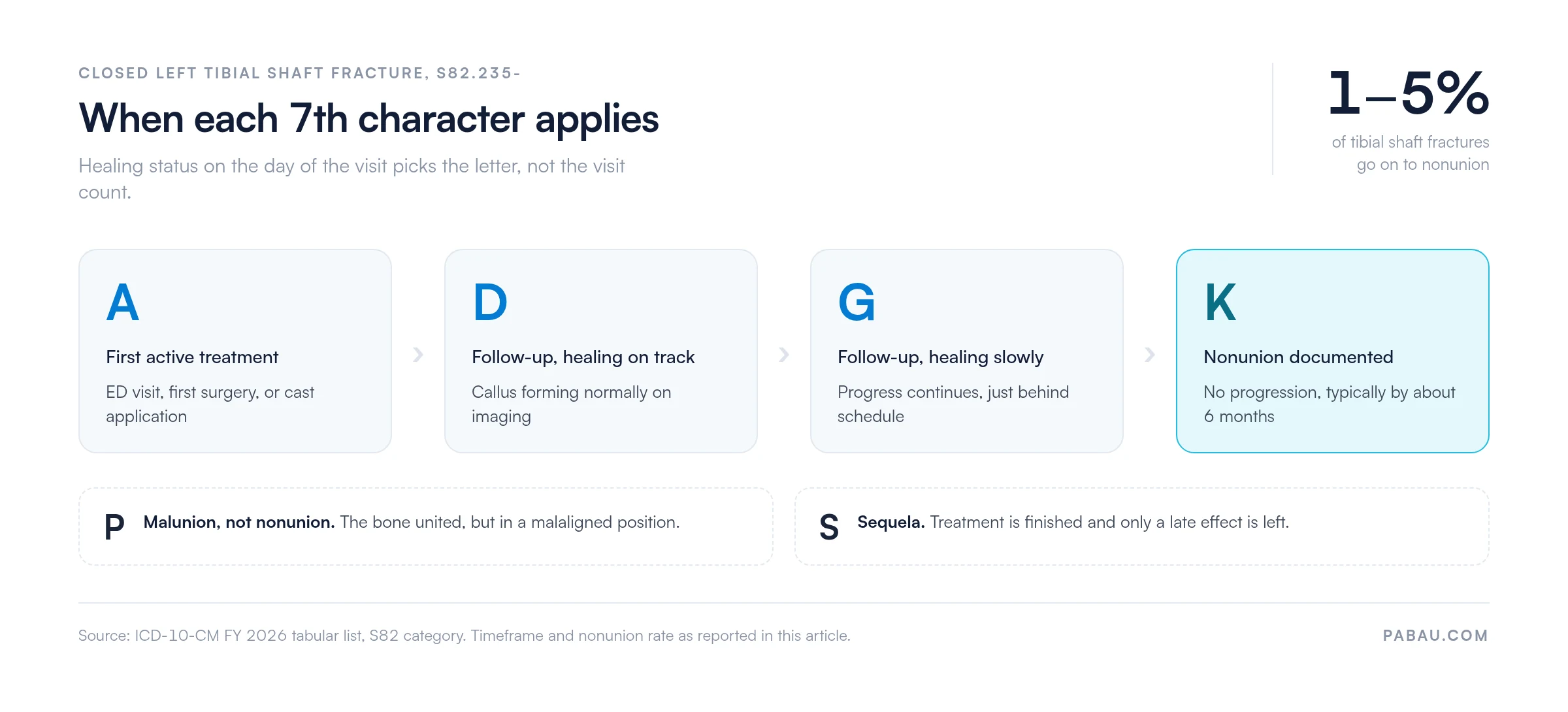
One scenario causes regular confusion. A patient presenting for bone grafting or a nail revision is starting a new treatment episode for the nonunion. K still stands for the diagnosis, because the encounter remains subsequent to the original fracture.
The surgery being the first one for the nonunion does not turn the 7th character back into A.
The diagnosis code does one job on the claim, which is to justify the procedure beside it. Nonunion management usually pairs with codes for bone grafting, hardware revision, or a bone stimulator.
Graft harvest has its own code family, and a major or large autograft is reported with CPT 20902.
From there the claim follows the usual path. Charges leave the practice as an 837P or a CMS-1500, a clearinghouse scrubs and forwards them, and the payer returns an electronic remittance advice.
Nonunion cases just repeat that loop for months, which is where small inconsistencies compound.
Two errors account for most rejections on this code. One is a stale 7th character carried forward from a previous visit. The other is an unspecified-laterality code on a chart that clearly said left.
S82.235K rarely appears on its own. The codes below show up in the same encounter or the same episode of care, depending on what the chart supports.
Tibial shaft fractures are among the most common long-bone fractures in adults, and the oblique pattern usually follows a torsional or bending force. Nondisplaced ones are often managed without surgery, using a cast or a functional brace.
Nonunion complicates roughly 1-5% of tibial shaft fractures. The rate shifts with bone contact quality, infection, and vascularity at the fracture site. Comorbidities matter too, particularly diabetes and smoking.
For coding, though, the mechanism matters less than what the chart records at each visit. Nonunion is typically defined as an absence of progressive healing at six months, and that threshold moves with the clinical guideline and the patient.
So the note has to say where healing stands today, in words a coder can act on. “No interval change in the fracture line” tells you more than “doing well.”
Document diabetes, tobacco use, osteoporosis, and medication history in the same note as the nonunion assessment. These comorbidities are legitimate additional diagnosis codes. They support medical necessity for a bone stimulator or a graft. They also explain the nonunion to a payer on review.
A nonunion case does not close after one claim. The patient returns for imaging, then perhaps for a bone stimulator, then for a graft. Each visit needs the same diagnosis code, the same laterality, and a note that still supports nonunion.
Rebuilding that context by hand, from the last claim or from memory, is where the stale 7th character creeps in.
Practice management software like Pabau keeps the encounter, the clinical note, and the claim in one patient record. The diagnosis code from the previous visit is already attached, so the next claim starts from what the chart says rather than from a re-entry.
Pabau also submits US claims electronically through Claim.MD, our integrated clearinghouse partner. Claim.MD reaches thousands of US payers and supports the CMS-1500 and 837P claim formats. It also handles real-time eligibility checks and electronic remittance advice.
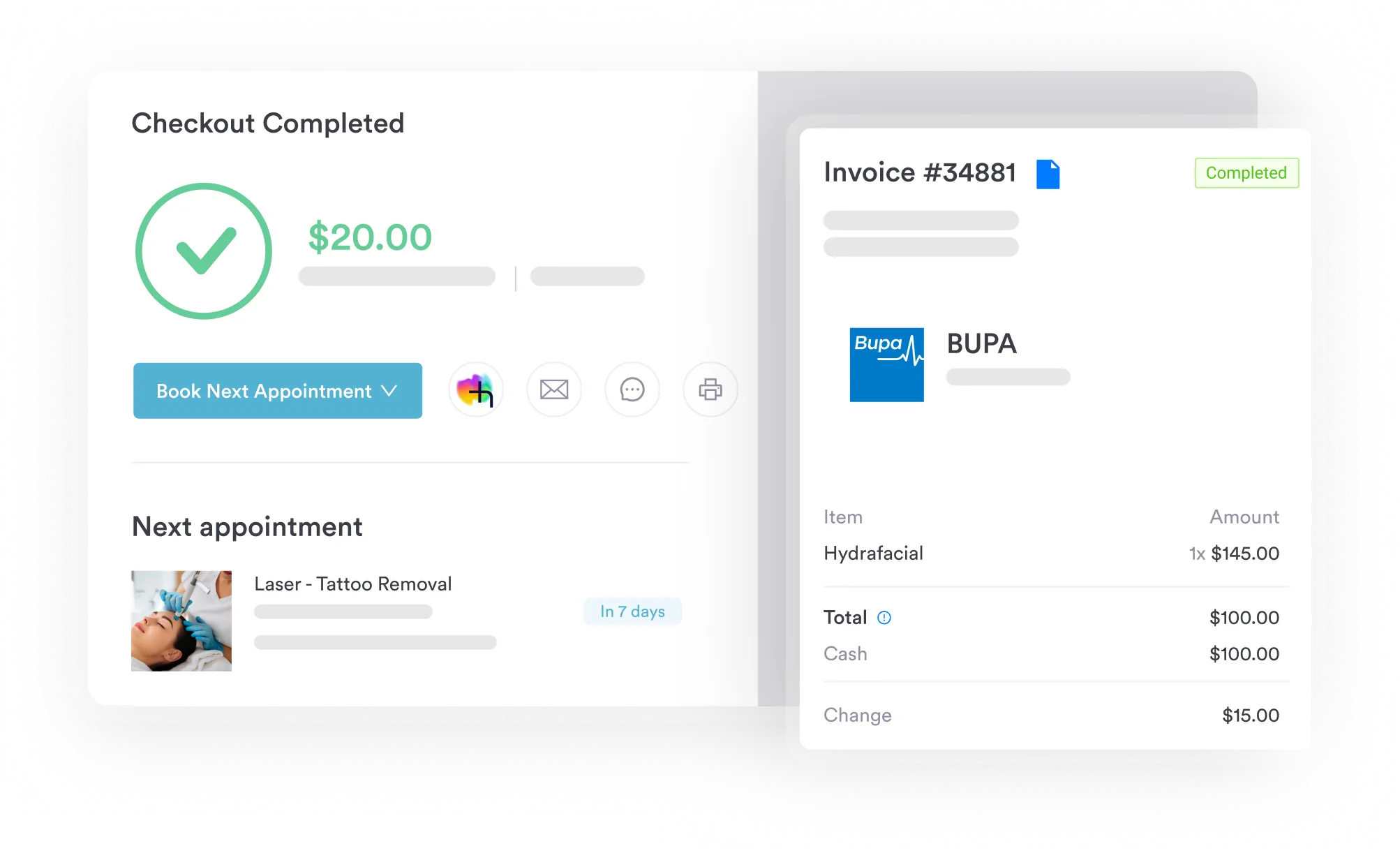
The benefit shows up on the follow-up visits rather than the first one. Claim status sits next to the appointment, so a rejected line gets caught before the patient comes back.
Pabau’s claims tracking software shows submission, rejection, and payment against the same encounter, which saves a trip to a separate portal.

Pabau links each encounter’s diagnosis code, clinical note, and claim status in a single patient record. Orthopedic teams can see where a fracture claim stands without opening a separate portal.

S82.235K is a narrow code, and that is exactly its value. It says one thing about one bone, and a payer reading the claim knows the fracture stopped healing. The work sits in the note rather than the code. Once the physician writes nonunion and names the side, the code assigns itself.
The trade-off worth remembering is the letter. D, G, K, and P describe the same bone at four different moments, and only the current chart decides which one is right. So check today’s note before you carry the last visit’s 7th character forward.
Nonunion cases run across months of claims. Pabau keeps each encounter’s diagnosis code and claim status in one record. Book a demo to see how that works for your caseload.

Need guidance on what medical billing involves? What is medical billing walks through the complete claims lifecycle from diagnosis coding to reimbursement.
Looking for denial prevention strategies? Denial management in healthcare covers common rejection triggers and how to build a cleaner submission workflow.
Want to understand revenue cycle fundamentals? Revenue cycle management explains the full financial journey from patient registration to final payment.
Yes, where the cause of the original injury is documented. Chapter 19 injury codes pair with an external cause code from Chapter 20, and that code takes its own subsequent-encounter 7th character. An external cause code is never first-listed, so S82.235K stays as the reason for the visit.
For as long as the nonunion is being treated. Every visit in that period is a subsequent encounter, so the 7th character stays as K throughout. Once treatment finishes and only a late effect remains, the encounter moves to S82.235S for sequela.
Yes, where the payer requires one. S82.235K carries laterality for the diagnosis, but the procedure line follows its own rule. Report LT on the CPT code for a left-sided procedure, and let the diagnosis code speak for the diagnosis.
Yes, when the nonunion is the reason for the encounter. Comorbidities that raise nonunion risk, such as E11.9 or Z79.01, belong in secondary positions. Sequencing a comorbidity first can make the claim look unrelated to the procedure performed.
No. The S82.235 family offers right, left, and unspecified only. When both tibias are documented, report S82.234K for the right and S82.235K for the left on the same claim.