

ICD-10 code S61.201A: Open wound of left index finger without nail damage
ICD-10 code S61.201A covers a left index finger wound of unstated type ICD-10 co...

Last Updated: Oct 16, 2026
Billable Code Specific Code
S82.855N is the billable ICD-10-CM code for nondisplaced trimalleolar fracture of left lower leg, subsequent encounter for open fracture type IIIA–IIIC with nonunion.
It applies at a follow-up visit when imaging shows that a nondisplaced trimalleolar fracture of the left ankle has failed to heal. The original injury must have been a Gustilo type IIIA, IIIB or IIIC open fracture. A closed fracture at injury takes K as the 7th character instead, and an open type I or II fracture takes M.
Let Pabau's smart automation suggest the right codes, reduce claim denials, and keep your practice compliant—effortlessly.
Automate repetitive tasks and focus on what matters most—your patients.
Reduce coding errors and ensure compliance with the latest regulations.
Clean claims, fewer denials, and faster reimbursements.
Powerful insights and reporting to help your practice thrive.
HIPAA compliant SOC 2 certified GDPR-compliant Trusted by 4,000+ clinics worldwide

S82.855N is a billable ICD-10-CM code for a nondisplaced trimalleolar fracture of the left lower leg with nonunion. It applies at follow-up visits when the original fracture was open type IIIA, IIIB or IIIC.
The 7th character N combines a subsequent encounter, nonunion, and an open type IIIA, IIIB or IIIC fracture at injury. K covers nonunion of a closed fracture, and M covers open type I or II.
Documentation must confirm a trimalleolar fracture of the left ankle, nondisplaced at injury, the open fracture type, a follow-up visit, and imaging evidence of nonunion. Missing any element risks denial.
Pabau’s claims management software routes S82.855N claims through Claim.MD for eligibility checks and clearinghouse validation before submission.
ICD-10 Code S82.855N reports a nondisplaced trimalleolar fracture of the left lower leg that has not healed, seen at a follow-up visit. The original injury was an open fracture, Gustilo type IIIA, IIIB or IIIC. Use this table to confirm the code’s attributes before submitting a claim. All details reflect the current ICD-10-CM tabular list published by CMS and NCHS.
Every character in S82.855N carries a specific clinical meaning. Misreading one character is enough to produce a wrong code and a denied claim. The breakdown below traces the code from its category to its 7th character extension.
A trimalleolar fracture breaks three parts of the ankle: the medial malleolus, the lateral malleolus and the posterior malleolus of the tibia. Nondisplaced means the fragments stayed in anatomical alignment at the time of injury.
Within S82.85, the final digit before the 7th character records both displacement and side. Digits 1 to 3 are displaced fractures, and digits 4 to 6 are nondisplaced.
The 7th character N signals three things at once. The patient is at a follow-up visit, the fracture has not healed, and the original fracture was open type IIIA, IIIB or IIIC.
Per ICD-10-CM Official Guidelines Section I.C.19.a, subsequent encounters are visits after active treatment, while the patient is in the healing or recovery phase. Nonunion means imaging or clinical examination confirms healing has stalled.
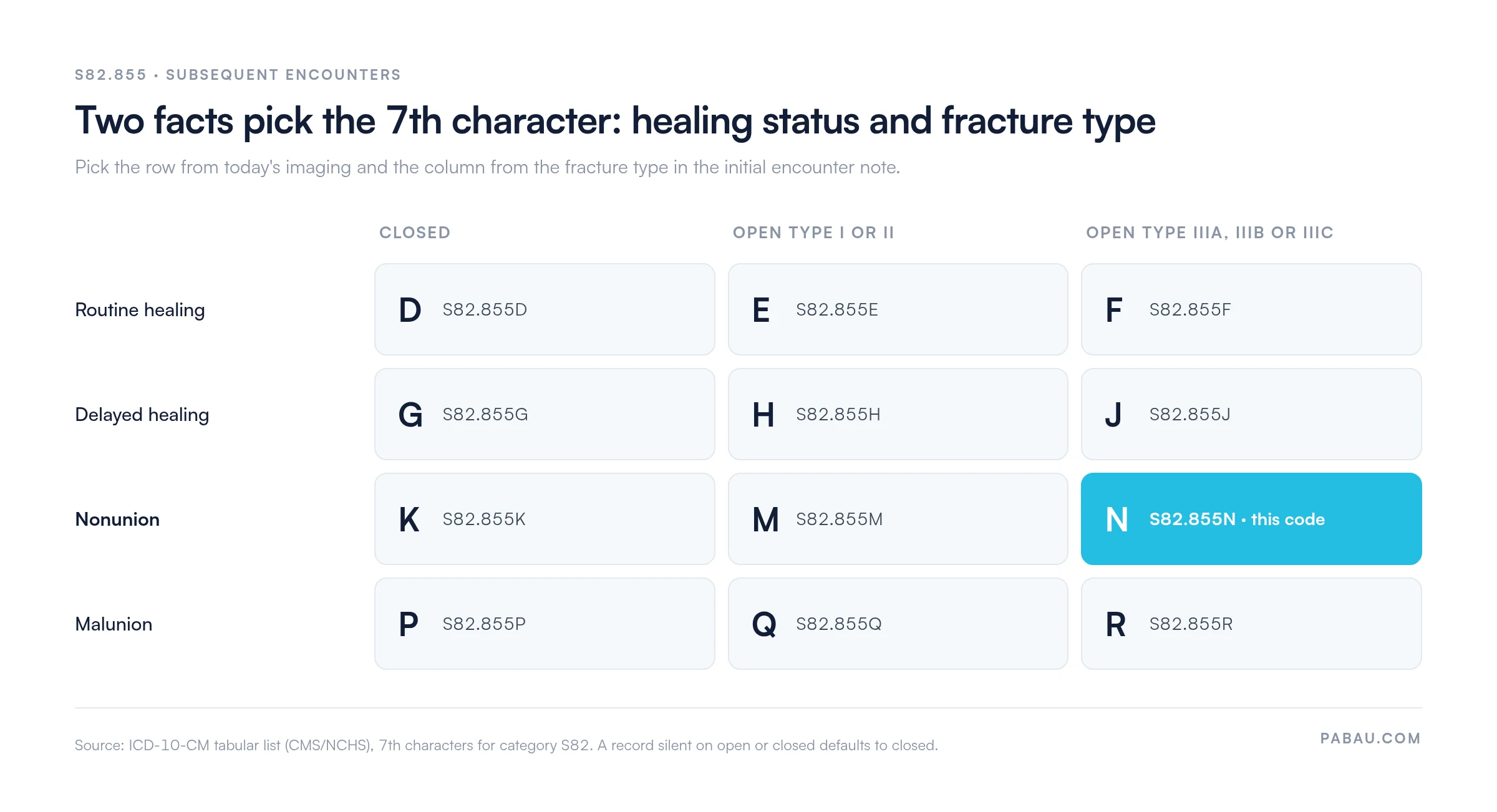
S82.855 takes 16 possible 7th characters. The table below lists each one, with the encounter type and the fracture type at injury it applies to.
The choice between K, M and N depends only on the fracture type recorded at the initial encounter. Internal fixation hardware plays no part in it. A nonunion after a closed fracture takes K, and open type I or II takes M instead.
Open type IIIA, IIIB or IIIC takes N as the 7th character. The guidelines code a fracture not documented as open or closed as closed, which makes K the default. The grid below places N among the 12 subsequent-encounter characters for S82.855.
The S82.85 subcategory contains six codes that differ by laterality and displacement. There is no bilateral code, so a patient with trimalleolar fractures of both ankles gets one code per side. The table below shows the full matrix with the N extension.
Laterality must match the physician note. If the note says “left ankle” and the claim carries S82.854N (right, nondisplaced), payer edits flag the mismatch. The CDC/NCHS ICD-10-CM web tool lets coders confirm laterality sub-codes directly against the official tabular list.
Before submitting any S82.85 code, cross-check the operative or progress note for an explicit left or right side statement. If the physician documents “ankle fracture” without laterality, query before coding. Payers routinely deny laterality mismatches on automated edits, and correcting them after a denial delays payment by weeks.
Several codes share most of their characters with S82.855N but differ in one critical dimension. The table below shows the most frequently confused codes and the single factor that distinguishes each.
ICD-10-CM Official Guidelines Section I.C.19 governs 7th character assignment for fracture codes. For S82.855N, the coder must satisfy four conditions.
The physician note supporting S82.855N must contain all of the following elements. A claim missing any one of them is open to denial.
When S82.855N is the primary diagnosis, the accompanying CPT code describes the specific service rendered at that encounter. Payers cross-reference the CPT and ICD-10 pair for medical necessity. Using claims management software with a built-in ICD-10 catalog reduces CPT-ICD mismatch errors before the claim leaves the practice.
The table below lists the CPT codes most often paired with this diagnosis.
Verify CPT-ICD pairings against current CMS National Correct Coding Initiative (NCCI) edits before submitting. The AAPC Codify ICD-10-CM lookup provides crosswalk data showing which CPT codes payers accept alongside specific ICD-10 codes.
Medicare and most commercial payers apply heightened scrutiny to nonunion claims because of the potential for extended treatment and surgical intervention. Understanding what each payer needs before you submit saves the back-and-forth of appeals. The medical billing process for nonunion cases typically involves more documentation than routine fracture follow-up.
Practices billing nonunion codes regularly should keep a payer-specific matrix of authorization rules, built around a documented prior authorization process. Good billing compliance requirements documentation reduces denials and protects against audit exposure.
Denial patterns for S82.855N are consistent across payers. Most trace back to one of six root causes. Payers return each one as a claim adjustment reason code, explained in our medical billing denial codes guide. The table below shows each denial type with the corrective action that prevents recurrence.
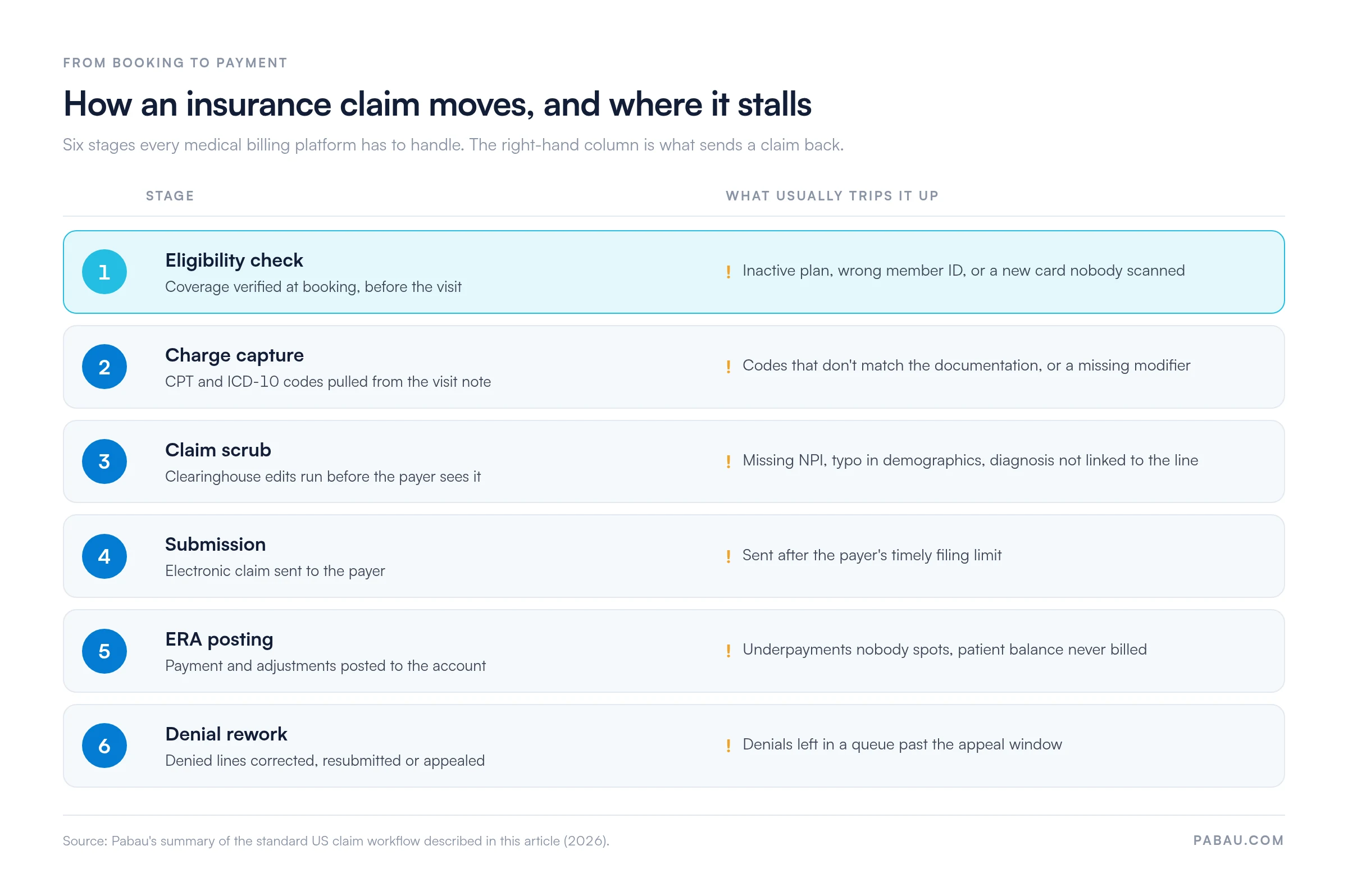
Practices that submit through a Claim.MD clearinghouse connection catch many of these errors before adjudication. Eligibility checks can also show whether the payer requires prior authorization, which helps prevent the missing authorization denial. Effective denial management workflows for orthopedic practices track denial reason codes by ICD-10 code so recurring patterns surface quickly.
Run a quarterly audit of your S82.855 claims filtered by denial reason code. If laterality mismatches cluster around one provider or coder, give that person targeted training on the S82.855 code family. Focused correction reduces denial volume faster than broad re-education.
Nonunion fracture claims carry higher audit risk than routine subsequent encounter submissions. A clearinghouse validation step before claims leave the EHR catches the CPT-ICD mismatches, missing modifiers and laterality errors that generate denials.
Pabau, the practice management and billing platform we build, integrates with Claim.MD, a US clearinghouse that connects practices to commercial and government payers. Claims submitted through the clean claim workflow run edits against NCCI and payer-specific rules before reaching the payer.
Electronic remittance advice and CARC denial reason codes post automatically. Billing staff can spot a failed S82.855N claim and recode it the same day, instead of waiting for an Explanation of Benefits in the mail.

Pabau integrates with Claim.MD to validate ICD-10 codes, run eligibility checks, and catch CPT-ICD mismatches before claims leave your practice. See how it works for orthopedic and physical therapy billing teams.

ICD-10 Code S82.855N fits one narrow scenario. The patient returns with a nondisplaced trimalleolar fracture of the left ankle that has not healed, after an open type IIIA, IIIB or IIIC injury.
Before you code it, pull the initial encounter note for the Gustilo type and the latest imaging report for nonunion. Those two documents decide between N, K and M, and between nonunion and malunion. Get them right, and the claim stands up to payer edits and audits.
Pabau’s built-in ICD-10 catalog and Claim.MD integration catch the most common S82.855N errors before they reach the payer. To see how it works for orthopedic and physical therapy billing workflows, book a demo.

Need to understand how clearinghouse validation works? Our Claim.MD clearinghouse guide explains how real-time claim edits catch ICD-10 errors before payer submission.
Dealing with repeated fracture claim denials? Denial codes in medical billing maps common CARC codes to root causes and corrective actions for orthopedic billers.
Want to streamline your ERA posting workflow? Electronic remittance advice explained covers 835 transaction files and how automated posting reduces manual reconciliation.
ICD-10 Code S82.855N is the billable diagnosis code for a nondisplaced trimalleolar fracture of the left lower leg with nonunion. It applies at subsequent encounters when the original fracture was open type IIIA, IIIB or IIIC. The record needs imaging or clinical evidence that the fracture has not healed.
In ICD-10-CM fracture codes like S82.855, the 7th character N means a subsequent encounter for nonunion of an open type IIIA, IIIB or IIIC fracture. The patient has completed active treatment, and the bone has failed to unite. It differs from K (nonunion of a closed fracture) and M (nonunion of an open type I or II fracture).
Nonunion means the fracture has failed to heal, coded with K, M or N depending on the fracture type at injury. Malunion means the fracture healed in an incorrect position, coded with P, Q or R on the same basis. The two conditions need different documentation and often different treatment, so the wrong character changes the clinical story on the claim.
No. S82.855N is specific to the left lower leg. For a nondisplaced trimalleolar fracture of the right lower leg with the same encounter and healing status, the correct code is S82.854N. Submitting S82.855N for a right-sided fracture is a laterality mismatch that payer edits will flag.
Common pairings are office visit codes (99213 or 99214) for follow-up management and ankle X-ray codes (73610, 73600) for nonunion monitoring. Open treatment of a trimalleolar fracture is reported with 27822 or 27823, and closed treatment with 27816 or 27818. A nonunion revision usually takes a different code, so confirm it against the operative note. Physical therapy encounters use 97110 or 97530 with S82.855N as a supporting diagnosis. Verify each pairing against current NCCI edits before submission.
Both codes describe nonunion of a nondisplaced trimalleolar fracture of the left lower leg at a subsequent encounter. S82.855K applies when the original fracture was closed. S82.855N applies when it was open type IIIA, IIIB or IIIC. Internal fixation hardware does not affect the choice, so check the fracture type in the initial encounter note.



