

ICD-10 code S61.201A: Open wound of left index finger without nail damage
ICD-10 code S61.201A covers a left index finger wound of unstated type ICD-10 co...

Last Updated: Oct 16, 2026
Billable Code Specific Code
S82.863Q is the billable ICD-10-CM code for displaced Maisonneuve's fracture of unspecified leg, subsequent encounter for open fracture type I or II with malunion.
It applies at a follow-up visit once imaging shows the fracture has healed out of alignment. The original open wound was graded Gustilo type I or II, or recorded with no type. A closed fracture uses S82.863P, and a type IIIA, IIIB or IIIC fracture uses S82.863R.
Let Pabau's smart automation suggest the right codes, reduce claim denials, and keep your practice compliant—effortlessly.
Automate repetitive tasks and focus on what matters most—your patients.
Reduce coding errors and ensure compliance with the latest regulations.
Clean claims, fewer denials, and faster reimbursements.
Powerful insights and reporting to help your practice thrive.
HIPAA compliant SOC 2 certified GDPR-compliant Trusted by 4,000+ clinics worldwide

S82.863Q codes a displaced Maisonneuve fracture of unspecified leg at a subsequent encounter, specifying open fracture type I or II with malunion.
The 7th character Q encodes three facts at once: subsequent encounter, Gustilo type I or II openness, and malunion rather than nonunion.
The nonunion code for the same open type I or II fracture is S82.863M. S82.863K covers a closed fracture with nonunion.
Use the unspecified leg code only when the record states no side. Use S82.861Q (right) or S82.862Q (left) when laterality is documented.
Pabau, the practice management platform we build, checks every claim for missing or invalid details before it reaches the payer.
ICD-10 Code S82.863Q is the billable ICD-10-CM code for a displaced Maisonneuve’s fracture of an unspecified leg, seen at a subsequent encounter. It applies when an open type I or II fracture has healed out of alignment, which is malunion.
The code appears in the current CMS ICD-10 annual release. It sits in category S82 (fracture of lower leg, including ankle) and carries six qualifiers across its seven characters.
Each character in S82.863Q carries a specific clinical meaning. Reading left to right, the code encodes the injury category, the anatomical subsite, the displacement status, the laterality, and the encounter-plus-complication bundle.
The 6th character in the S82.86 family carries displacement and laterality together. Displaced fractures use 1 (right), 2 (left) and 3 (unspecified leg). Nondisplaced fractures use 4, 5 and 6 in the same order. Use 3 only when the documentation states no side, never as a shortcut when laterality appears elsewhere in the chart.
A Maisonneuve fracture is a proximal fibula fracture combined with disruption of the ankle syndesmosis, typically caused by a pronation-external rotation force at the ankle. The fibular fracture occurs at or near the fibular head, often with an associated medial malleolus fracture or deltoid ligament tear.
Coders need this clinical picture for two reasons. First, the fracture may not be immediately obvious on ankle X-rays because the fibular break is at the knee level. Second, displacement and laterality must come from the imaging, operative or ED note, not from inference. A displaced fracture codes to S82.863-, and a nondisplaced one to S82.866-.
The 7th character Q in ICD-10 Code S82.863Q encodes three clinical facts at once. The visit is a follow-up, so the encounter is subsequent. The fracture was open and graded Gustilo type I or II at injury. The fracture has also healed with malunion rather than nonunion. Change any one of those facts and the 7th character changes with it.
Coders most often confuse Q with M (nonunion, open type I or II) or with R (malunion, open type IIIA, IIIB or IIIC). The openness class and the complication type must both match the record. The grid below maps every subsequent-encounter character by those two facts.
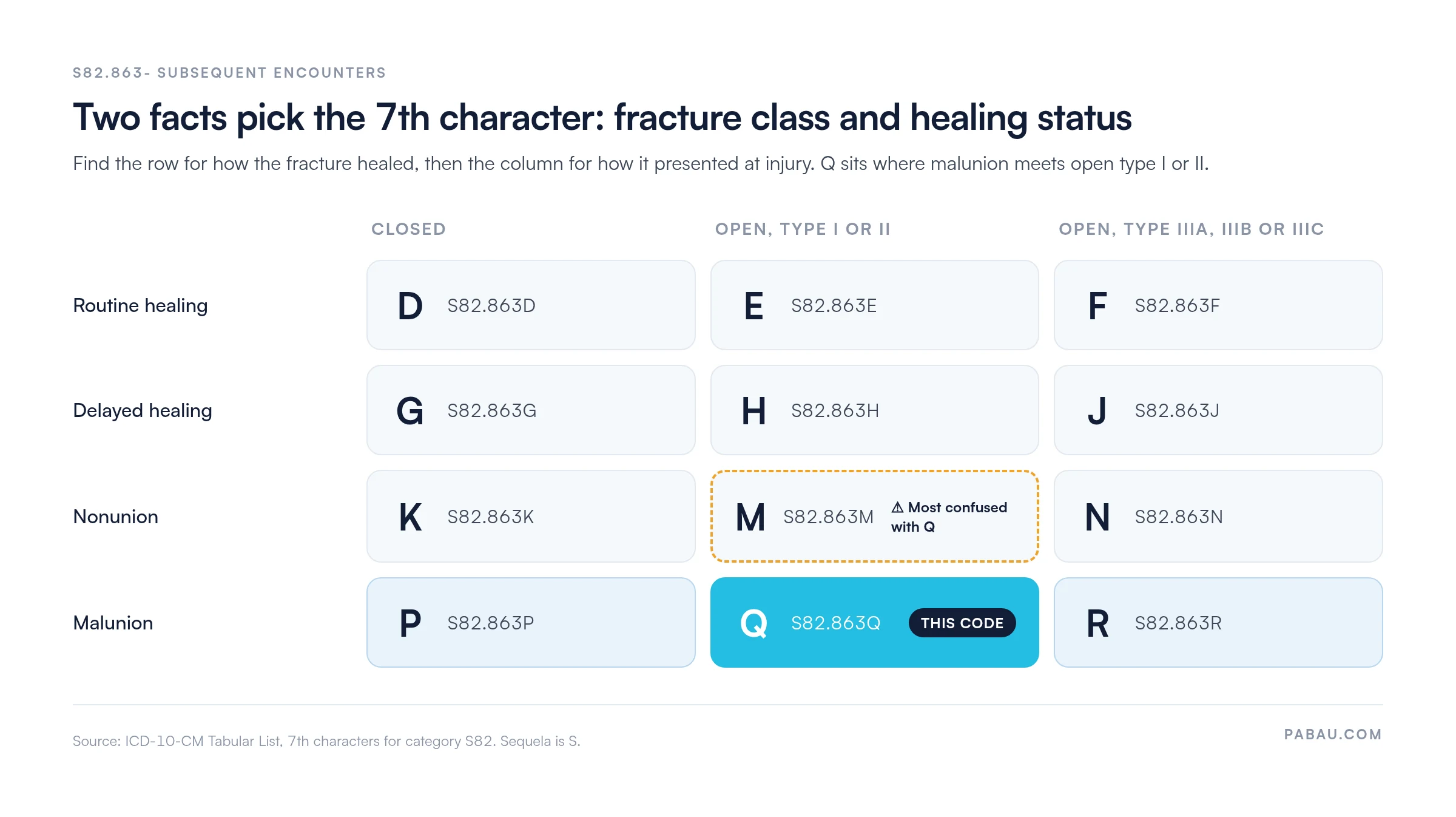
The full 7th character table for category S82 follows, from the initial encounter through sequela.
Gustilo-Anderson type I describes an open fracture with a wound smaller than 1 cm and minimal contamination. It is typically a low-energy injury where the bone pierces the skin from inside.
Type II means a wound between 1 cm and 10 cm with moderate soft tissue damage. It lacks the extensive periosteal stripping seen in type IIIA or higher.
Type IIIA, IIIB, and IIIC injuries involve wounds larger than 10 cm, high-energy mechanisms, segmental fractures, or vascular compromise requiring repair. Q never applies to those cases. They use R for malunion or N for nonunion.
When the note records an open fracture but no Gustilo type, ICD-10-CM guidelines default to the type I or II characters. A wound described like a type III injury still needs a provider query rather than the default.
Read the operative note from the initial encounter before coding the follow-up. If it says ‘open fracture’ with no Gustilo type, the guideline default of type I or II means Q stands. If the wound description reads like type III, query the provider before billing.
The ICD-10-CM Official Guidelines define encounter type by the care being given, not by visit number. An initial encounter (7th character A, B, or C) applies while the patient receives active treatment for the fracture. That can span several visits, including surgery and early postoperative care.
A subsequent encounter (D through R) applies once the fracture is healing and the provider is managing that healing, including complications like malunion.
A routine follow-up for a closed displaced Maisonneuve fracture of unspecified leg, healing as expected, codes to S82.863D. Sequela (7th character S) applies when the fracture has healed but a residual condition from the injury is being treated.
Malunion is, by definition, a complication of the healing phase. That makes it a subsequent encounter complication, which is why 7th character Q carries both “subsequent encounter” and “malunion” in its descriptor. Coding malunion with an initial encounter 7th character is a contradiction, and payers routinely deny it.
Malunion means the fracture has healed but in a poor anatomical position. Nonunion means the fracture has failed to heal within the expected timeframe. It is typically defined as no bridging callus on imaging after six months or longer, depending on the bone.
The key documentation for S82.863Q is the provider’s diagnosis of malunion, backed by imaging that shows healing with deformity or malalignment. Never assign Q from an impression the provider hasn’t documented.
ICD-10 Code S82.863Q is frequently confused with its sibling codes, which differ by only one or two characters. The table below isolates the exact variable in each case.
Verify the laterality digit first, then the 7th character. Confirm both the open fracture class and the complication type against the medical record before finalizing the code. The CDC/NCHS ICD-10-CM lookup tool lets you browse the full S82.86x family with official descriptors to cross-check each sibling code.
A claim using S82.863Q must be supported by documentation covering all six qualifiers embedded in the code. Missing even one element creates an audit risk.
Orthopedic and physical therapy practices managing Maisonneuve fracture aftercare can build these elements into their follow-up note templates. A template that prompts for each one cuts the number of provider queries.
Flag charts where the operative note describes a large or heavily contaminated wound but records no Gustilo type. Send a provider query before billing the follow-up visit. One pre-bill query takes far less time than working a denial afterward.
Medicare and commercial payers treat malunion fracture claims as medically complex, particularly when surgical correction is planned. Some local coverage determinations (LCDs) require documented failure of conservative treatment before approving surgical malunion correction. Check the applicable LCD at the time of service, because these policies change.
Prior authorization is commonly triggered when the claim involves corrective osteotomy or hardware revision for malunion.
Payers may ask for the imaging report confirming malunion, the original operative note and the Gustilo class as part of the authorization package. Claims management software with eligibility checks and claim scrubbing catches missing details before the claim leaves the practice.
For Medicaid, malunion coding requirements vary by state. Don’t assume a federal Medicare rule applies to your state Medicaid plan without checking the state program manual. Some payers also require external cause codes (V00-Y99) as companion codes, so confirm the rule with each payer.
Claims using S82.863Q are denied for a predictable set of reasons. Each one maps to a specific documentation or coding decision, so pre-bill review can catch it before an appeal is needed. Strong denial management in healthcare requires knowing which codes in a family carry the highest denial rates before claims go out.
Knowing the common denial codes in medical billing helps billers match each denial type above to its remittance reason code. That speeds up appeal preparation.
This scenario shows where ICD-10 Code S82.863Q looks right but isn’t. A patient returns 14 weeks after surgical stabilization of a Gustilo type II Maisonneuve fracture of the right leg. Radiographs show callus with a 15-degree angular deformity at the fracture site.
The operative note from the original injury documents a proximal fibula fracture with syndesmotic disruption and a 3 cm wound (Gustilo type II). The follow-up note doesn’t restate which leg was injured, and the laterality field in the billing system is blank.
Code selection reasoning: The fracture has healed (callus present) but is malaligned, which confirms malunion rather than nonunion. The encounter is subsequent, and the original fracture was open Gustilo type II. The correct code is S82.861Q, because the original operative note documents the right leg. Defaulting to S82.863Q when the episode records a side is a coding error and an audit trigger.
Add an external cause code where the payer requires one. A place-of-occurrence code is reported only at the initial encounter, so it doesn’t belong on this follow-up claim.
For medical billing teams, the example shows why ICD-10 accuracy depends on reviewing the whole chart, not only the current visit note. The follow-up documentation has to be read alongside the initial injury record.
A pre-bill check against the standards for a clean claim catches this laterality error before the payer does.
A coder working a malunion follow-up often has the operative note, the imaging report and the claim form in three different systems. Matching the side, the Gustilo class and the healing status across all three is slow, manual work.
Pabau keeps the visit, the clinical notes and the claim on one patient record. Its claim validation scrubs each claim for missing or invalid details before it goes to the clearinghouse. Prior authorizations are stored as cases that follow the appointment through to the claim.
Your team fixes a wrong character or a missing authorization while the chart is still open. That means fewer rejected follow-up claims and less time spent on appeals.

Pabau checks every claim for missing or invalid details before it reaches the payer, so complex fracture follow-ups go out right the first time.

S82.863Q is only right when three facts line up in the chart. The visit is a follow-up, the fracture was open type I or II, and imaging shows malunion. If one of them is missing, a neighboring code is the correct choice.
The habit that pays off is coding from the whole episode, not today’s note. Pull the original operative report for side and Gustilo class, and the latest imaging for healing status. That alone heads off the M-for-Q swap and the unspecified-leg denial.
Book a demo to see how Pabau stops an incomplete fracture claim before it reaches the payer.

Need to understand the broader fracture claim submission process? Claim.MD clearinghouse guide explains how electronic claim submission works from code entry to ERA receipt.
Handling a denied fracture claim? Electronic remittance advice covers how to read ERA files and match denial reason codes to the right appeal pathway.
Want to verify payer eligibility before the visit? Insurance eligibility verification outlines real-time eligibility checks that reduce claim rejections on complex orthopaedic encounters.
ICD-10 Code S82.863Q is the billable diagnosis code for a displaced Maisonneuve’s fracture of unspecified leg with malunion. It covers a follow-up visit after an open fracture graded Gustilo type I or II, or recorded with no type. Imaging must show the fracture has healed out of alignment.
Malunion means the fracture has healed in a poor position, confirmed by imaging showing callus with deformity. Nonunion means the fracture has not healed, with no bridging callus on imaging. Q is the malunion character for an open type I or II fracture, and M is its nonunion counterpart. Coding one when the record supports the other is a frequent cause of denials.
Use Q when imaging confirms malunion at a subsequent encounter for an open type I or II fracture. Use M when imaging shows nonunion for the same fracture class. Use P when a closed fracture has healed with malunion. The fracture class and the complication type must both come from the documentation, not from assumption.
The Gustilo-Anderson classification grades open fractures by wound size and contamination. Type I has a wound under 1 cm and type II a wound of 1 to 10 cm. Types IIIA to IIIC cover larger, high-energy or vascular injuries. ICD-10-CM encodes the class in the 7th character. B, E, H, M and Q cover type I or II fractures, and C, F, J, N and R cover type III. When the type isn’t documented, the guidelines default to the type I or II characters.
S82.863Q was a valid ICD-10-CM code in the CMS tabular list at the time of research. Code sets update every year on October 1. Check the current fiscal year’s release in the CDC/NCHS lookup tool before billing to confirm the code hasn’t been retired or revised.
The most common reasons are a wrong 7th character and an initial encounter character on a malunion visit. A typical wrong character is M for nonunion when imaging shows malunion. Others include a misapplied Gustilo class, unspecified laterality when the chart documents a side, and a missing payer-required external cause code. A pre-bill review of the full episode of care catches each of them.



