ICD code S82.874J – Nondisplaced right tibia pilon fracture, subsequent encounter, open type III, delayed healing
Billable Code•Specific Code
Code Definition
Billable ICD-10-CM code S82.874J covers nondisplaced pilon fracture of right tibia, subsequent encounter for open fracture type IIIA, IIIB, or IIIC with delayed healing.
It applies at follow-up visits for a right tibia pilon fracture that was a Gustilo type IIIA, IIIB or IIIC open fracture. Active treatment must be complete, and the provider must document that healing is delayed. Use F when healing is on schedule, and N once nonunion is confirmed.
Related Information
Chapter
S00-T88 Injury, poisoning and certain other consequences of external causes
Category
S82 Fracture of lower leg, including ankle
Group
S82.874 Nondisplaced pilon fracture of right tibia
Billable
Yes
Code also known as
right tibial plafond fracture, right distal tibia pilon fracture follow-up, open type III pilon fracture delayed healing
Save time. Improve accuracy. Get paid faster.
Automate coding with Pabau
Let Pabau's smart automation suggest the right codes, reduce claim denials, and keep your practice compliant—effortlessly.
Nondisplaced right tibia pilon fracture, subsequent encounter, open type III, delayed healing
Codes
Suggested by Pabau AI
S82.874JNondisplaced right tibia pilon fracture, subsequent encounter, open type III, delayed healing
ICD Code Suggestion
AI
Suggested code
S82.874JNondisplaced right tibia pilon fracture, subsequent encounter, open type III, delayed healingHigh match
Confidence score
98%
Why this code?
Matches patient diagnosis
Supported by clinical notes
Commonly used for this condition
Why practices choose Pabau
Save hours every week
Automate repetitive tasks and focus on what matters most—your patients.
Improve accuracy
Reduce coding errors and ensure compliance with the latest regulations.
Get paid faster
Clean claims, fewer denials, and faster reimbursements.
Grow with confidence
Powerful insights and reporting to help your practice thrive.
HIPAA compliant•SOC 2 certified•GDPR-compliant•Trusted by 4,000+ clinics worldwide
Key takeaways
S82.874J codes a follow-up visit for a nondisplaced pilon fracture of the right tibia that was a Gustilo type IIIA, IIIB or IIIC open fracture.
The seventh character J means delayed healing. Use F when the same fracture heals on schedule, and N once nonunion is documented.
The code rests on two records: the original encounter’s Gustilo grade and today’s note stating that healing is delayed.
Physeal fractures of the lower fibula are not pilon fractures, so they code to subcategory S89.3, never to S82.87.
Pabau, the practice management platform we build, keeps the Gustilo grade and the healing status in the chart your claim is built from.
ICD-10 code S82.874J: Full descriptor and clinical meaning
ICD-10 code S82.874J is a valid, billable ICD-10-CM diagnosis code for FY 2027. Its official descriptor is set out in full in the table below, quoted from the CDC/NCHS tabular list. Each part of that descriptor is a separate statement about the patient, and the chart has to support every one.
Code element
Value for S82.874J
Documentation needed
Official descriptor
Nondisplaced pilon fracture of right tibia, subsequent encounter for open fracture type IIIA, IIIB, or IIIC with delayed healing
The full code on the claim, all seven characters
Category
S82 Fracture of lower leg, including ankle
Clinical or imaging confirmation of the fracture
Subcategory
S82.87 Pilon fracture of tibia
Imaging showing the fracture runs into the tibial plafond, the ankle’s weight-bearing surface
Displacement and side
Nondisplaced, right (6th character 4)
Imaging stating the fragments are not displaced, plus explicit right-side notation
Fracture type
Open, Gustilo type IIIA, IIIB or IIIC
A written Gustilo grade in the original encounter record
Encounter
Subsequent (7th character J)
Active treatment is complete and this visit monitors healing
Healing status
Delayed healing
A provider statement that healing is slower than expected
A pilon fracture breaks through the plafond, the articular surface at the lower end of the tibia that sits on the talus. It usually comes from an axial load, such as a fall from height or a vehicle crash, that drives the talus up into the tibia.
ICD-10-CM gives pilon fractures their own subcategory, S82.87. The general codes for fracture of the lower end of the tibia, S82.3-, carry an Excludes1 note for pilon fracture. The two are never coded together for the same injury.
What the seventh character J means for fracture coding
The seventh character in S82.874J carries three facts at once: a subsequent encounter, an open fracture of type IIIA, IIIB or IIIC, and delayed healing. Category S82 has 16 valid seventh characters. They split by encounter phase, by closed or open fracture and its Gustilo grade, and by how healing is going.
7th character
Meaning
Use when
A
Initial encounter, closed fracture
Active treatment of a closed fracture
B
Initial encounter, open fracture type I or II
Active treatment of a type I or II open fracture, or an open fracture with no grade documented
C
Initial encounter, open fracture type IIIA, IIIB or IIIC
Active treatment of a type III open fracture, including staged surgery
Follow-up of a closed fracture healing slower than expected
H
Subsequent encounter, open type I or II, delayed healing
Follow-up of a type I or II open fracture healing slower than expected
J
Subsequent encounter, open type IIIA, IIIB or IIIC, delayed healing
Follow-up of a type III open fracture healing slower than expected
K
Subsequent encounter, closed fracture, nonunion
Nonunion of a closed fracture
M
Subsequent encounter, open type I or II, nonunion
Nonunion of a type I or II open fracture
N
Subsequent encounter, open type IIIA, IIIB or IIIC, nonunion
Nonunion of a type III open fracture
P
Subsequent encounter, closed fracture, malunion
Malunion of a closed fracture
Q
Subsequent encounter, open type I or II, malunion
Malunion of a type I or II open fracture
R
Subsequent encounter, open type IIIA, IIIB or IIIC, malunion
Malunion of a type III open fracture
S
Sequela
A late effect of the healed fracture is being treated
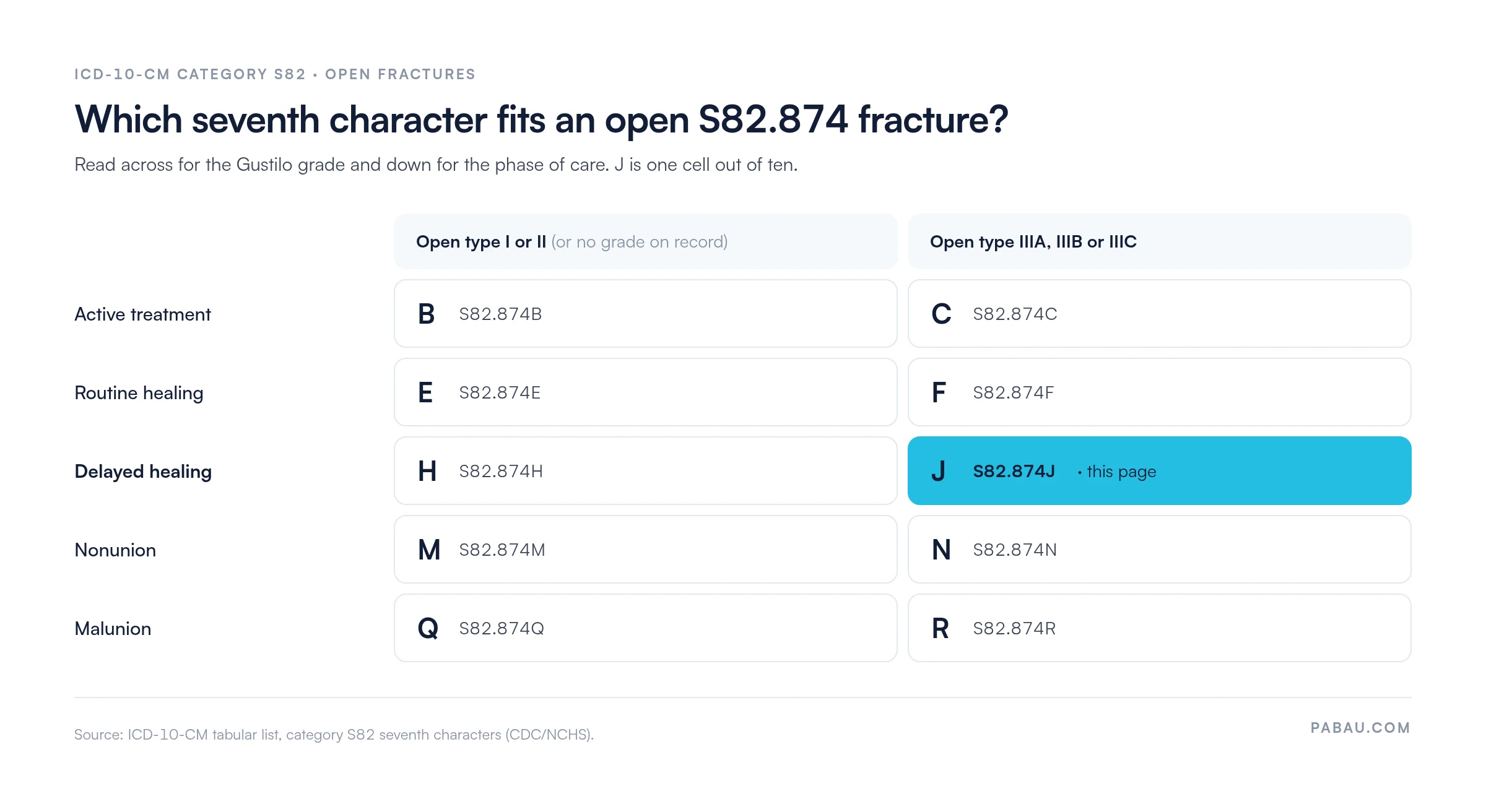
J sits in the narrowest corner of that grid. Use it only when three facts are documented: active treatment is over, the wound was graded type III, and healing is behind schedule. Change any one of those facts, and the character changes with it. The grid below sets the ten open-fracture characters side by side.
The Gustilo grade picks the column and the phase of care picks the row, so J needs a type III grade and delayed healing. Characters are from the CDC/NCHS ICD-10-CM tabular list.
Pro Tip
Before assigning J, open the original encounter note and find the Gustilo grade. Under the Official Guidelines, an open fracture with no documented Gustilo type defaults to type I or II. Without a written grade of IIIA, IIIB or IIIC, the record supports H for delayed healing, not J.
S82.874J vs S82.874C, F and H: Choosing the right character
S82.874C is the initial encounter code for the same type III open fracture. It applies at every encounter where the patient receives active treatment. For an open pilon fracture, that often means several trips to the operating room: debridement, external fixation, definitive fixation and soft-tissue coverage.
Once active treatment ends, the healing course decides the character. A patient who moves to a new orthopedic surgeon does not go back to C at the first visit. Per the ICD-10-CM Official Guidelines, Section I.C.19, the seventh character follows the phase of care, not the provider or the visit count.
Scenario
Correct code
Common mistake
Day of injury: irrigation, debridement and external fixation of a type IIIB wound
S82.874C
Coding B when the operative note grades the wound IIIB
Staged return to the operating room for definitive fixation or flap coverage
S82.874C
Switching to a subsequent character because it is a second visit
Six-week follow-up, wound closed, callus forming as expected
S82.874F
Coding J with no delayed-healing statement in the note
Twelve-week follow-up, slow bridging on imaging, surgeon documents delayed healing
S82.874J
Coding F because the visit looks routine
Same follow-up, but the original wound was graded type II
S82.874H
Coding J because the injury was severe
Surgeon documents nonunion
S82.874N
Continuing J after nonunion is confirmed
Infection of the plate and screws in the right tibia
T84.622A, the complication code
Treating hardware infection as part of routine fracture follow-up
Post-traumatic ankle arthritis years after the fracture healed
The arthritis code first, then S82.874S
Using J once the fracture has healed
Anatomy: Nondisplaced pilon fractures of the right tibia
The plafond forms the roof of the ankle joint, so a pilon fracture is an intra-articular injury of the distal tibia. Many pilon fractures also break the fibula. Code that fibula fracture separately by its own site, because the Official Guidelines code fractures individually by site.
Nondisplaced does not mean minor here. A type III open wound means extensive soft-tissue damage, so the bone can sit in alignment while the wound drives treatment and recovery time. That soft-tissue injury is also a common reason healing falls behind.
Nondisplaced: Fragments remain in anatomical alignment on imaging. A fracture not documented as displaced or nondisplaced defaults to displaced, which is S82.871-.
Right side: The 6th character 4 means nondisplaced, right. Left is 5 (S82.875J), and unspecified side is 6 (S82.876J).
Gustilo type IIIA: Extensive soft-tissue damage, but the bone is still adequately covered by soft tissue.
Gustilo type IIIB: Extensive soft-tissue loss with exposed bone, which usually needs flap coverage.
Gustilo type IIIC: An open fracture with an arterial injury that requires repair.
Delayed healing: The fracture is uniting more slowly than expected but has not been declared a nonunion.
Not a physeal fracture: Growth-plate fractures of the lower fibula code to S89.3-. The guidelines say to assign only the physeal code, with no separate code for the bone.
Related codes and common coding confusions
Most S82.874J errors are a one-character miss on displacement, laterality or healing status. The table lists the neighbors coders most often swap in. Each descriptor is taken from the CDC/NCHS tabular list.
Code
Descriptor (abbreviated)
How to differentiate
S82.874J
Nondisplaced pilon fracture, right tibia: subsequent, open IIIA/IIIB/IIIC, delayed healing
Primary code: right side, nondisplaced, type III, delayed healing
S82.871J
Displaced pilon fracture, right tibia: subsequent, open IIIA/IIIB/IIIC, delayed healing
Use when imaging shows displacement, or displacement is not documented
S82.875J
Nondisplaced pilon fracture, left tibia: subsequent, open IIIA/IIIB/IIIC, delayed healing
Same fracture on the left side
S82.876J
Nondisplaced pilon fracture, unspecified tibia: subsequent, open IIIA/IIIB/IIIC, delayed healing
Side not documented. Query the provider before using it
S82.874F
Same site: subsequent, open IIIA/IIIB/IIIC, routine healing
Healing is on schedule
S82.874H
Same site: subsequent, open type I or II, delayed healing
Wound graded type I or II, or no Gustilo grade documented
S82.874N
Same site: subsequent, open IIIA/IIIB/IIIC, nonunion
The provider has documented nonunion
S82.391J
Other fracture of lower end of right tibia: subsequent, open IIIA/IIIB/IIIC, delayed healing
Distal tibia fracture that does not involve the plafond
S89.302G
Unspecified physeal fracture of lower end of left fibula: subsequent, delayed healing
Different bone and injury type. S89 has no open-fracture characters
If the same right-sided pilon fracture was closed and displaced, delayed healing codes to S82.871G instead. The CDC/NCHS ICD-10-CM web tool lets coders browse the full S82 hierarchy and confirm each descriptor before the claim goes out.
Documentation requirements for S82.874J
Every element of the S82.874J descriptor needs a matching entry in the clinical record. Two of them, the Gustilo grade and the healing status, usually sit in different notes written weeks apart.
Pilon involvement: Imaging or the provider’s note must describe a fracture into the tibial plafond or distal articular surface. “Distal tibia fracture” alone points to S82.3-, not S82.87-.
Nondisplaced status: The imaging report must state that the fragments are not displaced. Without that statement, the guidelines default to displaced.
Right laterality: The note must name the right tibia, right ankle or right lower leg explicitly.
Gustilo grade IIIA, IIIB or IIIC: The emergency or operative note from the index encounter must record the grade. With no grade on record, the guidelines assign type I or II.
Active treatment complete: The record should show that debridement, fixation and soft-tissue coverage are done, and that this visit monitors healing.
Delayed healing: The provider must state that healing is delayed. A coder cannot infer it from a radiology report showing limited callus.
Wound and hardware status: Record the state of the wound, flap and fixation hardware. Signs of infection move the claim to a complication code.
When submitting a clean claim, make sure the date of service on the claim matches the date of the follow-up note. A date mismatch between claim and chart is an audit trigger of its own.
External cause codes to pair with S82.874J
External cause codes are not required unless a state mandate or a payer asks for them. When you do report them, the guidelines say the external cause code’s seventh character must match the injury code. On an S82.874J claim, that means D for subsequent encounter.
External cause code
Descriptor
Note
W17.89XD
Other fall from one level to another, subsequent encounter
Falls from height, a typical pilon mechanism
W11.XXXD
Fall on and from ladder, subsequent encounter
Ladder falls with an axial load through the heel
W13.9XXD
Fall from, out of or through building, not otherwise specified, subsequent encounter
Falls from a roof or balcony
V43.52XD
Car driver injured in collision with other type car in traffic accident, subsequent encounter
Footwell injuries in a frontal crash
Y92.- and Y93.-
Place of occurrence and activity
Reported once, at the initial encounter. Do not repeat them on an S82.874J claim
Use a sequela external cause code only when a late effect of the injury is being treated. A follow-up visit to assess delayed healing keeps the D character.
Common claim denial reasons for S82.874J and how to avoid them
Denials on S82.874J claims cluster around the two facts that make the code narrow: the type III grade and the delayed healing. Practices using structured denial management workflows catch most of these before submission.
No Gustilo grade on record: Payers reviewing a type III code often ask for the index operative note. If it never states IIIA, IIIB or IIIC, J has no support and H is the defensible code.
Delayed healing never stated: A note that reads “healing, return in four weeks” supports F at most. Query the surgeon when the imaging and the plan suggest delay but the note does not say so.
Wrong phase of care: Debridement, flap revision or a return to the operating room is active treatment, so the visit takes the C character. Coding J there invites a mismatch with the CPT codes on the claim.
Wrong site: Coding a plafond fracture to S82.3-, or a fibular growth-plate injury to S82.87-, fails a site review. Match the subcategory to the imaging language.
Side not named: A note that says only “ankle” will not support a right-sided code. The note for the billed date of service has to name the right leg.
External cause mismatch: Pairing S82.874J with an external cause code ending in A creates a character conflict that some payers flag automatically.
Global period errors: Follow-up inside the 90-day global period of the fixation surgery is not separately payable. Billing a full E/M for it without a valid modifier is denied.
When a denial does land, look up its CARC and RARC codes in our denial code reference. Each reason code points to the documentation fix it needs.
CPT codes commonly billed with S82.874J
A delayed-healing visit after an open pilon fracture is rarely a quick check. The surgeon is weighing imaging, wound status and whether to intervene. Pair the CPT codes with what the note shows was done that day.
CPT code
Description
Notes
99024
Postoperative follow-up visit, included in the global service
Follow-up inside the 90-day global period of the fixation surgery
99213
Office visit, established patient, low MDM
Follow-up outside the global period with a limited decision
99214
Office visit, established patient, moderate MDM
Delayed healing that prompts a change in management, documented in the note
73610
Radiologic examination, ankle, complete, minimum of 3 views
Serial films to track union at the plafond
73700
Computed tomography, lower extremity, without contrast
CT to assess bridging when plain films are inconclusive
20694
Removal, under anesthesia, of external fixation system
Frame removal once alignment and union allow it
20979
Low intensity ultrasound stimulation to aid bone healing, noninvasive
Payers often limit coverage to documented nonunion, so check policy first
97110
Therapeutic exercise, each 15 minutes
Rehabilitation once weight-bearing is permitted
A related return to the operating room during the global period takes modifier 78 on the procedure code. The diagnosis for that encounter moves back to the C character. Where a physical therapist bills for the same patient, check that the therapy claims carry the same seventh character as the surgeon’s.
Excludes notes, inclusions, and ICD-10-CM guidelines for S82.874J
S82.874J sits in category S82, whose notes govern how it interacts with other diagnoses on the same claim. The notes below are quoted from the FY 2027 tabular list.
Includes: Category S82 includes fracture of malleolus.
Excludes1: Traumatic amputation of lower leg (S88.-) is never coded with an S82 code. Subcategory S82.3- also excludes pilon fracture of distal tibia (S82.87-).
Excludes2: Fracture of foot, except ankle (S92.-), and periprosthetic fractures around an internal prosthetic ankle joint (M97.2) or knee implant (M97.1-). These can be coded alongside S82.874J when both are present.
Category notes: A fracture not documented as displaced or nondisplaced is coded as displaced. A fracture not documented as open or closed is coded as closed. Open fracture designations follow the Gustilo classification.
No aftercare Z codes: The guidelines say not to use aftercare Z codes for traumatic fractures. Assign the fracture code with the right seventh character instead.
The AAPC ICD-10-CM lookup tool shows the tabular hierarchy, Excludes notes and guideline references in one view, which helps coders check these interactions quickly.
Payer-specific coverage and reimbursement notes
Medicare has no national coverage determination specific to pilon fracture follow-up. Subsequent-encounter fracture care falls under general policy, with medical necessity set by each Medicare Administrative Contractor (MAC).
Visit frequency: Delayed healing justifies closer follow-up than a routine fracture. The note at each visit should say why the patient is being seen again and what changed.
Bone growth stimulation: Coverage for stimulators is commonly tied to documented nonunion rather than delayed healing. Check the MAC or commercial policy before ordering one.
Type III scrutiny: Open type III fractures mean long, costly episodes of care. Expect payers to request the index operative note that records the Gustilo grade.
Liability and workers’ compensation: Auto and workplace injury payers often ask for external cause codes, even where Medicare does not.
Pro Tip
Run a quarterly audit of every S82.874J claim your practice submits. For each one, confirm the index encounter records a Gustilo type IIIA, IIIB or IIIC grade. Then confirm the note for the date of service states delayed healing. Claims missing either one should be corrected before the payer’s timely-filing window closes.
How Pabau keeps S82.874J claims tied to the chart
In most orthopedic practices, the facts behind the J character live in different notes. The Gustilo grade sits in an operative note from the day of injury. The delayed-healing statement sits in a follow-up note written months later. A coder has to connect the two under time pressure.
Pabau keeps both notes in the same patient record, so the grade from the index surgery is in view when the follow-up claim is built. Its claims software for practices includes ICD-10 and CPT catalogues, so your team selects the full seven-character code instead of typing it.
Claims then go out electronically through the Claim.MD clearinghouse. Claim.MD submits 837P claims to thousands of US payers, with real-time eligibility checks for over 400 of them. ERA (835) remittances come back into the same workflow, so a denial reason lands next to the chart it concerns.
Keep fracture follow-up claims tied to the chart
Pabau keeps operative notes, follow-up documentation and claims in one patient record. Your team sees the Gustilo grade and the healing status before an S82.874J claim leaves the practice.
S82.874J is a narrow code, and it should feel narrow when you assign it. If the chart cannot show a type III grade from the index encounter and a delayed-healing statement today, a different code fits the record.
The trade-off is a few minutes now against an audit later. Querying the surgeon for a missing grade is quick, while defending J to a payer months on means pulling the whole episode of care.
Pabau puts the operative note, the follow-up note and the claim in one place, so that query happens before submission. Book a demo to see how it fits your orthopedic follow-up workflow.
Continue your research
Need a full denial management reference?Denial management in healthcare covers the full workflow for appealing, tracking, and preventing claim rejections across code types.
Looking for the clearinghouse integration overview?Claim.MD clearinghouse guide explains how the Pabau and Claim.MD integration handles 837P submission, ERA retrieval, and payer enrollment.
Want the full billing compliance checklist?Medical billing compliance outlines the documentation and submission standards that keep fracture coding claims clean across payers.
Coding the closed, displaced version of this fracture?ICD-10 code S82.871G covers a displaced right tibia pilon fracture at a follow-up with delayed healing.
Frequently asked questions
What does ICD-10 code S82.874J mean?
ICD-10 code S82.874J is the billable code for a nondisplaced pilon fracture of the right tibia at a subsequent encounter. The original fracture was open, Gustilo type IIIA, IIIB or IIIC, and healing is documented as delayed. It applies once active treatment is complete.
When should I use S82.874J versus S82.874C?
Use S82.874C at every encounter where the patient receives active treatment, such as debridement, external fixation or definitive fixation. Use S82.874J once active treatment is over and the provider documents delayed healing. Seeing a new surgeon does not reset the character to C.
What is the seventh character J in ICD-10 fracture codes?
In category S82, the seventh character J means a subsequent encounter for an open fracture type IIIA, IIIB or IIIC with delayed healing. Use F for the same fracture healing on schedule, and N once nonunion is documented. Type I or II open fractures with delayed healing take H.
Is S82.874J valid for initial fracture treatment visits?
No. Initial treatment of this fracture takes S82.874C, because the wound is a type III open fracture. Character C stays in use for every encounter with active treatment, including staged surgery. S82.874J is reserved for follow-up visits after that phase.
What documentation is required to support S82.874J on a claim?
The record needs imaging showing a nondisplaced fracture into the right tibial plafond. It also needs a Gustilo grade of IIIA, IIIB or IIIC from the original encounter. Today’s note must state that healing is delayed. Without a written type III grade, the guidelines default to type I or II.
What are common claim denial reasons for S82.874J?
Most denials trace to a missing Gustilo grade or a follow-up note that never states delayed healing. Another common cause is C and J used in the wrong phase of care. Laterality gaps and external cause codes with the wrong seventh character also cause rejections. Each one is fixed in the documentation, not the appeal letter.
Is a physeal fracture of the lower fibula coded with S82.874J?
No. S82.874J describes a pilon fracture of the right tibia. Physeal fractures of the lower end of the fibula code to subcategory S89.3, and the guidelines say to assign only the physeal code. The two codes describe different bones and different injuries.