ICD-10 code S61.201A: Open wound of left index finger without nail damage
ICD-10 code S61.201A covers a left index finger wound of unstated type ICD-10 co...

Last Updated: Oct 16, 2026
Billable Code Specific Code
S82.863D is the billable ICD-10-CM code for displaced Maisonneuve's fracture of unspecified leg, subsequent encounter for closed fracture with routine healing.
ICD-10 code S82.863D specifies a displaced Maisonneuve's fracture of unspecified leg, at a subsequent encounter for a closed fracture with routine healing.
S82.863D is valid for FY2026, effective October 1, 2025, per the CMS ICD-10-CM annual update. It sits within the S82 category, fracture of lower leg. The claim needs documented displacement status, laterality, and healing progression behind it.
Let Pabau's smart automation suggest the right codes, reduce claim denials, and keep your practice compliant—effortlessly.
Automate repetitive tasks and focus on what matters most—your patients.
Reduce coding errors and ensure compliance with the latest regulations.
Clean claims, fewer denials, and faster reimbursements.
Powerful insights and reporting to help your practice thrive.
HIPAA compliant SOC 2 certified GDPR-compliant Trusted by 4,000+ clinics worldwide

ICD-10 code S82.863D describes a displaced Maisonneuve’s fracture of unspecified leg at a subsequent encounter for a closed fracture with routine healing.
The 7th character ‘D’ is required for every follow-up visit after initial treatment, and using ‘A’ on a return visit triggers claim denials.
S82.863 without a 7th character is not billable, so append the correct encounter suffix before you submit the claim.
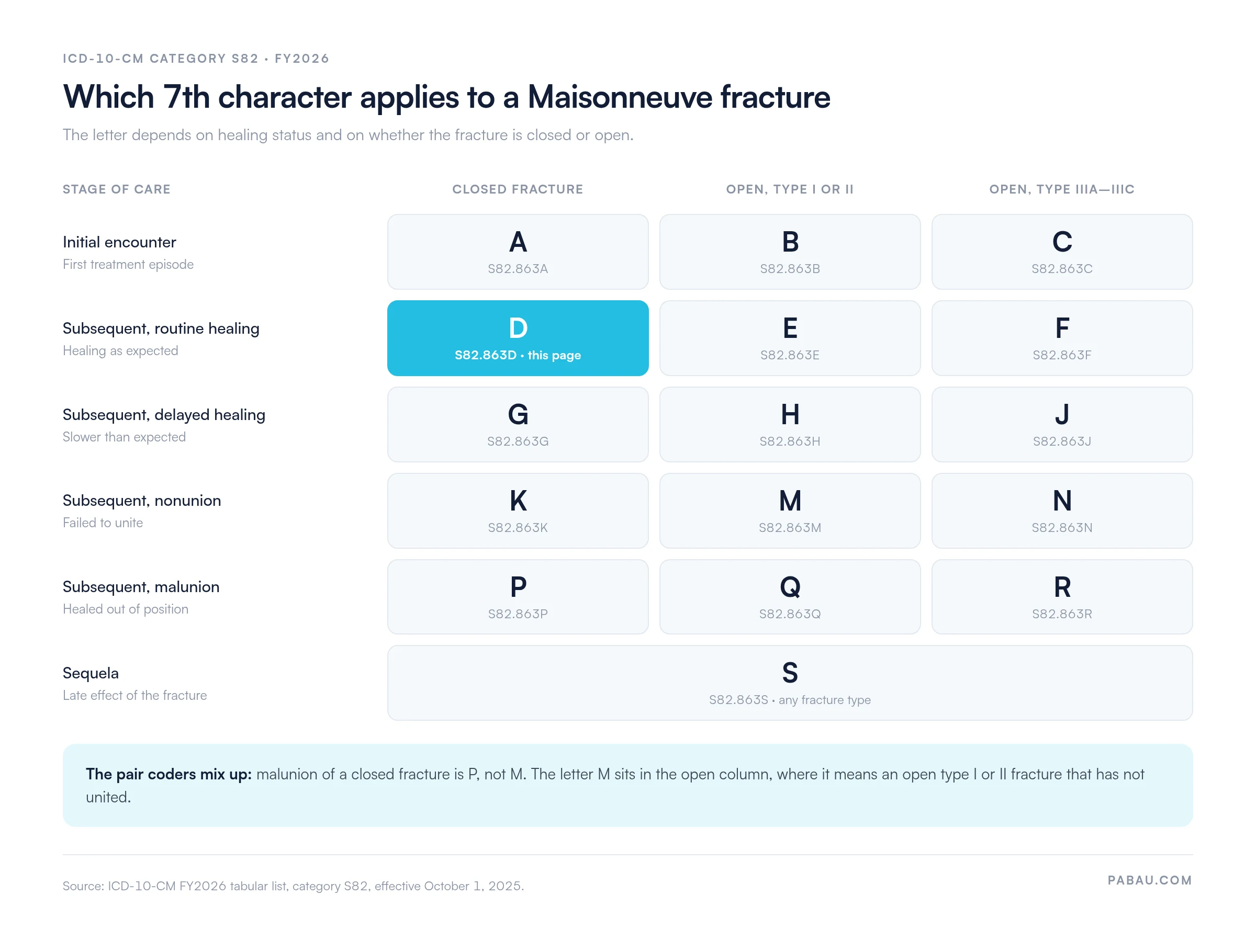
Malunion of a closed Maisonneuve fracture takes the 7th character ‘P’, not ‘M’, which belongs to open fractures with nonunion.
Practice management software like Pabau keeps displacement status, laterality, and encounter type in the note at the point of care.
Use this reference card to confirm the code before attaching it to a claim. The S82 fracture category requires all seven characters before the code becomes billable, so a six-character version will not pass a payer’s edits.
A Maisonneuve fracture is a proximal fibula fracture caused by an external rotation force at the ankle. Three structures are involved in the injury pattern:
That combination makes it an unstable ankle injury, even though the fracture sits well away from the ankle joint.
Clinically, the fracture is easy to miss. Patients present with ankle pain and swelling, but ankle-focused X-rays look normal because the fibula fracture sits at the proximal end. Full-length leg X-rays or MRI are needed for diagnosis.
That anatomy has a direct consequence for coders. The code must state displacement status and laterality, not simply “fibula fracture.”
According to the CDC/NCHS ICD-10-CM official tool, Maisonneuve fractures are indexed under S82.8, other fractures of lower leg. They do not sit with the ankle-specific codes, so searching “ankle fracture” in a lookup rarely surfaces S82.86x.
Each segment of ICD-10 code S82.863D carries clinical meaning. Understanding the hierarchy helps coders select the correct variant quickly and avoid non-specific parent codes.
S82.863 without a 7th character is not a billable code. The AAPC ICD-10-CM code reference flags the non-extended code as non-specific, and payers will reject claims submitted with it. Every claim must include the full seven-character code.
The 7th character in S82.863x is where most coding errors occur. Payers use this character to verify that the services billed match the expected stage of fracture care. Mismatching the encounter type is the single most common reason ICD-10 code S82.863D claims are rejected.
The distinction between D (routine healing) and G (delayed healing) matters for reimbursement and clinical documentation. Routine healing means the fracture is progressing as expected for a closed Maisonneuve fracture. If healing is slower than the expected timeline without reaching nonunion criteria, G is correct.
Switching from D to G mid-treatment requires updated clinical notes reflecting the change in healing status. Every character above assumes a closed fracture. An open Maisonneuve fracture draws from a separate set, so the letter depends on healing status and on whether the skin was broken. An open type I or II fracture that heals out of alignment, for example, takes ICD-10 code S82.863Q.
When laterality is documented in the clinical note, coders should use the laterality-specific codes rather than the unspecified leg code. Using an unspecified code when the chart states right or left leg is an inaccuracy that can trigger audits. Our ICD-10-CM code reference carries the rest of the S82 family if you need to cross-check a variant.
The rule is the same across every diagnostic category. The most specific code the clinical documentation supports is the correct one. Defaulting to unspecified leg when the note names a side is inaccurate, and it invites an audit.
ICD-10 code S82.863D applies to follow-up care during normal fracture healing. Knowing when to use it, and when not to, prevents the most common billing errors on Maisonneuve fracture claims. Practices treating musculoskeletal injuries need a documented healing status at every encounter, or the D character is unsupported.
Use S82.863D when:
Do NOT use S82.863D when:
When a follow-up visit also supplies a custom leg brace, that device is billed separately under an L-code such as HCPCS code L2010. The diagnosis code supports medical necessity, but it does not replace the orthosis line item.
The clinical note must support every element of ICD-10 code S82.863D. Auditors and payers check for specificity. If the note leaves out displacement status or healing progression, the code cannot be defended on review.
The ICD-10-CM Official Guidelines for Coding and Reporting govern how fracture codes in the S category are assigned. Applying them at the point of coding is cheaper than denial management after the fact, especially on musculoskeletal codes that carry audit risk.
Remittance advice is where 7th character errors show up first. Fracture-claim denials commonly cite an incorrect encounter type, so reviewing the remit codes each month catches a systematic mistake before it becomes a pattern.
Each month, audit every S82.86x claim submitted with the 7th character A on it. Any claim where the chart shows a prior visit for the same fracture is likely miscoded. The right character is D, G, K, P, or S, depending on healing status. Catching this pattern internally is far less costly than a payer audit.
Selecting the right ICD-10 code at the point of care is harder than it sounds when a clinician is working a full appointment schedule. The correct Maisonneuve code depends on displacement status, laterality, encounter type, and healing status. All four have to be in the clinical note before a coder ever sees it.
Practice management software like Pabau puts ICD-10 search inside the patient record. Clinicians attach the diagnosis code while the encounter is still in front of them. That removes the lag between documentation and coding that produces most 7th character errors.
Pabau’s automated claims management validates ICD-10 codes against the current FY2026 code set before submission. A claim carrying a non-billable parent code, like S82.863 without its 7th character, is flagged before it reaches the payer.
Claims then go out electronically through Claim.MD, Pabau’s US clearinghouse partner, which reaches more than 4,000 US payers. Each submission carries real-time eligibility checks and electronic remittance advice. A coder can also pull up the patient’s encounter history from the record, so the initial visit is easy to identify.

Pabau embeds ICD-10 code search in the clinical workflow, validates codes before submission, and processes claims through Claim.MD across 4,000+ US payers. See it working in a live demo.

Three checks settle S82.863D on almost every claim. Confirm the fracture is displaced, then confirm the encounter is a follow-up during routine healing. Use a laterality-specific code whenever the chart names a side.
The 7th character carries the payer’s signal that active treatment has ended and routine follow-up has begun. Treat it as a clinical statement, and the D-versus-P question answers itself from the healing status in the note.
If your team keeps seeing S82.86x denials, the cause is almost always a 7th character mismatch. The fix sits at the point of documentation. Book a demo to see how Pabau ties ICD-10 selection to the clinical note and validates the code before the claim goes out.

Need a reference for related musculoskeletal billing codes? Denial codes in medical billing explains the most common payer rejection reasons and how to resolve them.
Want to understand how clearinghouses process fracture claims? Claim.MD clearinghouse guide covers how electronic claim submissions work across major US payers.
Looking for broader ICD-10 documentation guidance? Medical billing compliance covers audit-readiness requirements for diagnosis coding across specialties.
S82.863D is a billable ICD-10-CM code for a displaced Maisonneuve’s fracture of unspecified leg. It applies at a subsequent encounter for a closed fracture with routine healing. The code is valid for FY2026, effective October 1, 2025.
Yes. S82.863D is a specific, billable ICD-10-CM code, valid for claim submission in FY2026. The parent code S82.863 is not billable on its own. The full seven-character code is required for reimbursement.
S82.863A is for the initial encounter – the first treatment episode for the displaced Maisonneuve fracture of the unspecified leg. S82.863D is for subsequent encounters during routine healing – all follow-up visits after the initial treatment where healing is progressing as expected. Using A on a return visit is a common error that results in claim denial.
Use S82.863D only when the documentation does not specify the right or left leg. If the chart states right leg, use S82.861D. If it states left leg, use S82.862D. The unspecified laterality code is a last resort, not a default.
Append the 7th character D to the fracture code. For a displaced Maisonneuve fracture of the unspecified leg, the full code is S82.863D. Confirm the note documents the encounter as a follow-up, that the fracture is closed, and that healing is progressing normally before applying the D suffix.
No. Maisonneuve fractures are classified under S82.86x, other fractures of lower leg, not under the ankle fracture codes. They are indexed in the ICD-10-CM tabular list under S82.8. Searching “ankle fracture” in a code lookup will typically not surface them.
No. Malunion of a closed Maisonneuve fracture is S82.863P. The character M applies to an open type I or II fracture with nonunion. Mixing the two is a common cause of rejected S82.86x claims.