

ICD-10 code S61.201A: Open wound of left index finger without nail damage
ICD-10 code S61.201A covers a left index finger wound of unstated type ICD-10 co...

Last Updated: Oct 16, 2026
Billable Code Specific Code
S82.854B is the billable ICD-10-CM code for nondisplaced trimalleolar fracture of right lower leg, initial encounter for open fracture type I or II. It applies when all three malleoli are fractured and a wound communicates with the fracture site.
Assignment turns on two details in the record. The wound must be graded as an open type I or II fracture, and the fracture must be documented as nondisplaced. This reference covers the code anatomy, the 7th character decision rule, sibling code selection, CPT pairing, and the documentation a claim needs.
Let Pabau's smart automation suggest the right codes, reduce claim denials, and keep your practice compliant—effortlessly.
Automate repetitive tasks and focus on what matters most—your patients.
Reduce coding errors and ensure compliance with the latest regulations.
Clean claims, fewer denials, and faster reimbursements.
Powerful insights and reporting to help your practice thrive.
HIPAA compliant SOC 2 certified GDPR-compliant Trusted by 4,000+ clinics worldwide

S82.854B is billable for a nondisplaced trimalleolar fracture, right lower leg, initial open-fracture encounter (type I or II).
7th character B applies only when documentation explicitly confirms an open wound at the first visit; type III open fractures use character C.
Nondisplaced status must be explicitly documented by the treating or reporting physician; the ICD-10-CM default when not stated is displaced.
Pabau, the practice management and billing platform we build, checks each claim for missing or invalid details before submission.
ICD-10 Code S82.854B is the billable code for a nondisplaced trimalleolar fracture of the right lower leg. It applies at the initial encounter for a type I or II open fracture. The code sits inside the S82 block, which covers fractures of the lower leg, including the ankle. That block falls within Chapter 19 of ICD-10-CM (injury, poisoning, and certain other consequences of external causes). The table below captures every field a coder or auditor needs at a glance.
A trimalleolar fracture involves all three bony prominences of the ankle. These are the medial malleolus (inner tibial projection), the lateral malleolus (distal fibula), and the posterior malleolus. The posterior malleolus is the posterior tibial lip, also called the Volkmann fragment or third malleolus. All three must be fractured for the code to apply.
Nondisplaced means the bone fragments have not shifted from their anatomical alignment. The treating or reporting physician must explicitly state this in the operative note or radiologist report. The ICD-10-CM Official Guidelines (CMS) make clear that the default for fractures not specified as displaced or nondisplaced is displaced. Code as nondisplaced only when the record says so.
The 7th character in ICD-10-CM fracture codes defines the care episode, not the fracture severity. Character B means the patient is receiving active treatment for the first time. The open fracture must be classified as type I or type II under the Gustilo-Anderson system.
Under Gustilo-Anderson, a type I open fracture has a clean wound under 1 cm. A type II wound measures 1 cm to 10 cm, without extensive soft-tissue damage. Type III covers wounds over 10 cm or extensive soft-tissue damage. If the operative report documents a type III open injury, use character C, not B.
S82.854B is one member of the trimalleolar nondisplaced family. The table below maps the sibling codes coders most frequently need when laterality or encounter type differs.
The bare code S82.854 without a 7th character is not billable. Every claim must carry the full 8-character code including the encounter suffix, per the CDC/NCHS ICD-10-CM official tool.
S82.854A and S82.854B describe the same fracture pattern at the same initial encounter. The only difference is wound status. Use S82.854A when no wound communicates with the fracture site. Use S82.854B only when the operative report, emergency department note, or radiologist report explicitly states an open wound or compound fracture.
Coders frequently receive a chart that says “open trimalleolar fracture” without a Gustilo-Anderson type. The ICD-10-CM guidelines do not specify a default type in that scenario. Query the physician before assigning B vs C.
The most frequent misassignment in ankle fracture coding is applying a bimalleolar code when all three malleoli are involved, or vice versa. The distinction is anatomical and must be confirmed by radiology.
Posterior malleolus involvement must be confirmed on CT imaging or explicitly stated in the radiologist’s report. Plain X-ray alone may underdetect posterior malleolus fractures.
S82.854B is a diagnosis code, so a surgical claim also carries a CPT procedure code. CPT selection depends on the fixation described in the operative report, not on the diagnosis code alone.
CPT 27822 and 27823 are most commonly paired with S82.854B, but the operative report governs. Reporting 27823 when the posterior lip was not fixed (or 27822 when it was) will produce a CPT-to-diagnosis mismatch denial.
Before assigning the CPT for a trimalleolar ORIF, check the operative report for fixation of the posterior lip. Surgeons often leave a small posterior fragment unfixed. Reporting 27823 when the record shows no posterior lip fixation mismatches the claim and can trigger a medical-necessity review.
Two documented details decide the code pair for an open trimalleolar ORIF. The wound grade picks the 7th character, and posterior lip fixation picks the CPT code.
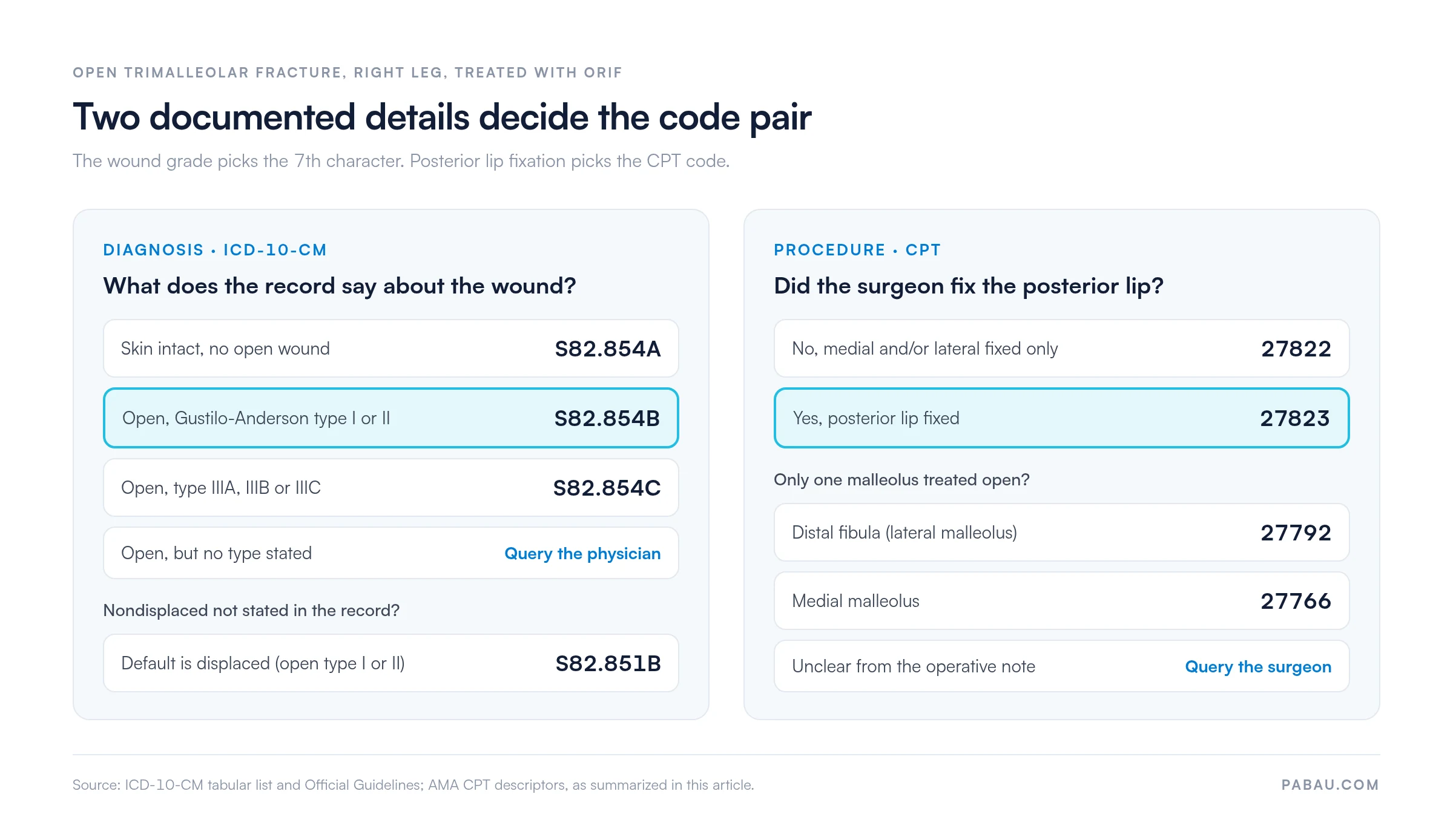
A claim carrying S82.854B will be audited against the medical record. Every element of the code’s descriptor must be explicitly supported by documentation. For advice on submitting a clean claim, each of these fields must appear in the record before coding:
Medicare covers surgical treatment of trimalleolar fractures when medical necessity is established and documentation supports the diagnosis. MAC-specific Local Coverage Determinations (LCDs) govern coverage; requirements vary by jurisdiction and should be confirmed before scheduling ORIF. Post-surgical physical therapy often needs its own authorization under commercial plans.
Commercial payer requirements for trimalleolar ORIF typically include prior authorization. Submit the request with imaging findings, the planned CPT code, and S82.854B. Practices that send claims through the Claim.MD clearinghouse can check eligibility before the date of service, which reduces denials at submission. Compliance with medical billing compliance requirements is particularly important for high-cost fracture repairs where payer scrutiny is elevated.
Trimalleolar fracture claims are denial-prone because of their layered specificity requirements. Laterality, displacement, wound type, and encounter type must all match the documentation at once. Strong denial management workflows begin at coding, not after the EOB arrives.
Reviewing electronic remittance advice systematically after every claim cycle reveals denial patterns. Often the same 7th character error repeats across a batch of trimalleolar cases from one provider.
Set up a denial tracking log specifically for S82 fracture codes. Laterality errors and wrong 7th character selections cluster by provider, not by patient. Correcting one surgeon’s documentation habit early prevents repeat denials across that caseload.
The hierarchical path explains why certain Excludes notes apply, and it is how our ICD-10-CM code pages are organized. S82.854B belongs to the following classification pathway, per the AAPC ICD-10-CM code reference:
The S82 Excludes1 note covers traumatic amputation of lower leg (S88.-). Its Excludes2 note covers fracture of foot except ankle (S92.-) and periprosthetic fracture around an internal prosthetic ankle joint (M97.2) or knee joint (M97.1-). Some payers and states require an external cause code for traumatic fractures, so add the W-series code as a secondary code when they do. Falls are a common mechanism and are coded in the W00-W19 range. Check ICD-10 lists the current W-series options by mechanism.
Without a check at submission, a missing laterality or a wrong 7th character only surfaces when the denial arrives. By then the ORIF is weeks old and the surgeon has moved on to other cases.
Pabau’s claims management software scrubs every claim for missing or invalid details before it leaves the practice. A claim with an error is flagged as Needs action, and eligibility runs through Claim.MD before the visit.
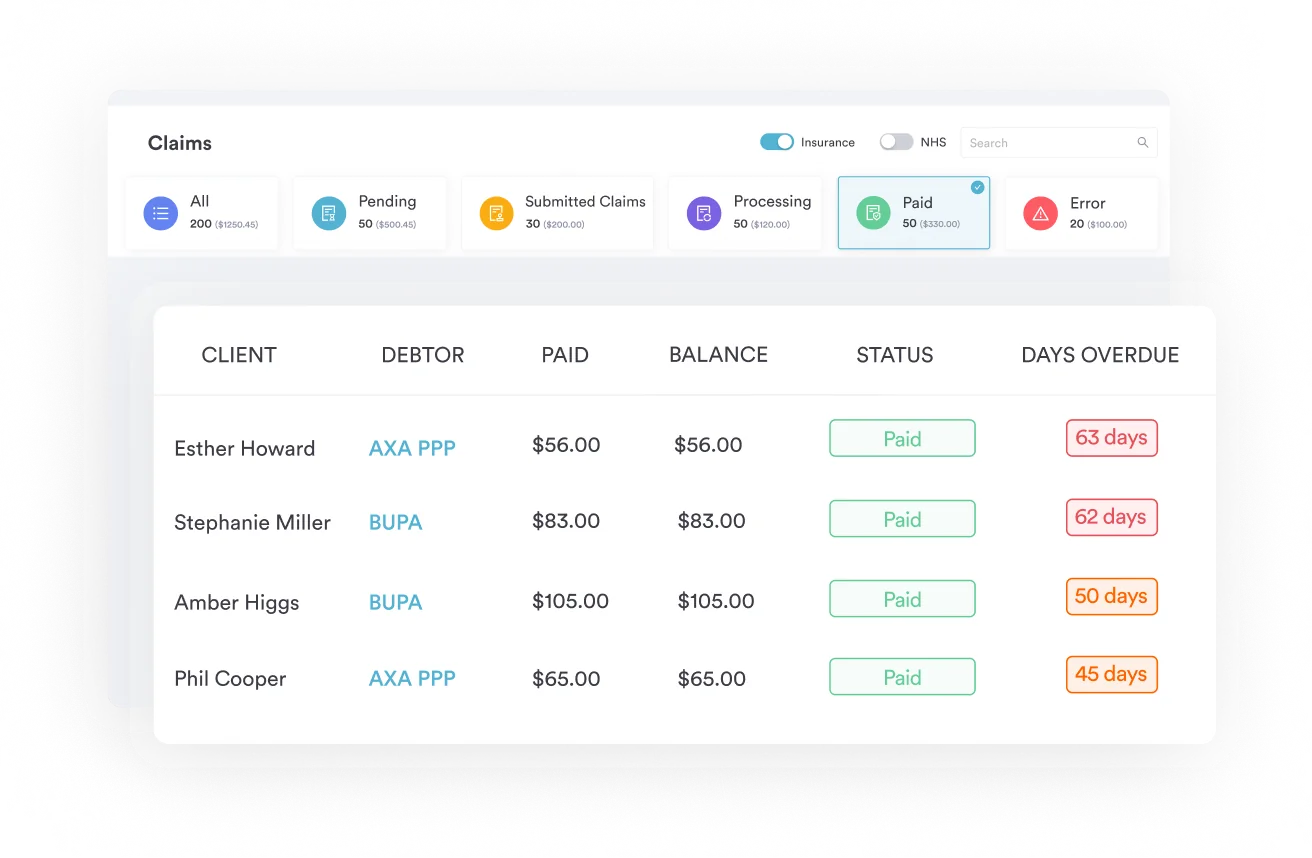
Once submitted, each claim moves through the same stages from Pending to Paid, with days overdue shown on every row. Authorization codes follow the appointment through to the claim, which keeps prior-authorized ORIF cases matched to their approval.

Pabau checks each claim for missing or invalid details, verifies eligibility through Claim.MD, and submits through a clearinghouse. Fracture claims leave the practice complete.

Code S82.854B only when the record names all three malleoli, states nondisplaced, confirms the right side, and grades the wound as type I or II. If any one of those is missing, query the surgeon before the claim goes out.
The CPT side needs the same discipline. Read the operative note for posterior lip fixation before choosing between 27822 and 27823, because that one detail decides the pairing.
Book a demo to see how Pabau checks fracture claims for missing details before they reach the payer.

Coding the left side at a later visit? S82.855N covers a nondisplaced left trimalleolar fracture at a subsequent encounter for an open type III fracture with nonunion.
Only two malleoli fractured? S82.845C covers a nondisplaced left bimalleolar fracture at the initial encounter for an open type III fracture.
Need to validate ICD-10-CM codes against active payer rules? Claim.MD clearinghouse overview explains how integrated clearinghouse validation catches coding errors before submission.
Dealing with a pattern of claim denials? Denial codes in medical billing maps common CARC denial codes to their root causes and resolution steps.
Building a complete claim package for fracture repairs? Superbill documentation guide explains what a superbill must contain so the claim built from it is complete.
ICD-10 Code S82.854B is the billable diagnosis code for a nondisplaced trimalleolar fracture of the right lower leg. It applies at the initial encounter for an open fracture type I or II. It confirms that all three ankle malleoli are fractured and the bone fragments have not shifted from anatomical position. The skin is broken by a wound communicating with the fracture, and this is the patient’s first visit for active treatment.
S82.854A covers a closed fracture (skin intact) at the initial encounter. S82.854B covers an open fracture type I or II (skin broken, wound communicates with bone) at the same encounter. The fracture pattern and laterality are identical. Use B only when documentation explicitly confirms an open wound.
Yes. S82.854B has been a valid, billable code since FY2016 (October 2015) and remains in the current ICD-10-CM code set. Confirm it against the annual CMS release before filing, because the code set is updated every October.
A bimalleolar fracture involves two malleoli, typically medial and lateral (code family S82.84_). A trimalleolar fracture involves all three: medial, lateral, and posterior (code family S82.85_). The posterior malleolus must be confirmed on CT or explicitly documented by the radiologist before coding trimalleolar.
The medical record must state right laterality, a trimalleolar pattern with all three malleoli named, and nondisplaced status. It must also document an open wound communicating with the fracture, a Gustilo-Anderson type I or II classification, and an initial encounter for active treatment. Missing any one element exposes the claim to denial on audit.
Not under the national guidelines. ICD-10-CM Official Guidelines Section I.C.20 recommends external cause codes, and they are required only where a state or payer mandates them. For a trimalleolar fracture the mechanism is often a fall. Report it as a secondary code with a W-series code such as W19.XXXA (unspecified fall, initial encounter).



