ICD-10 Code Y76.0: Diagnostic obstetric and gynecological devices
ICD-10 Code Y76.0: Definition and billable status ICD-10 Code Y76.0 is a valid, ...

Last Updated: Oct 23, 2026
Billable Code Specific Code
S82.845C is the billable ICD-10-CM code for nondisplaced bimalleolar fracture of left lower leg, initial encounter for open fracture type IIIA, IIIB, or IIIC.
The seventh character carries the weight here. Pick the wrong one and the claim describes a different injury than the one the surgeon treated, which is where the denial starts.
Let Pabau's smart automation suggest the right codes, reduce claim denials, and keep your practice compliant—effortlessly.
Automate repetitive tasks and focus on what matters most—your patients.
Reduce coding errors and ensure compliance with the latest regulations.
Clean claims, fewer denials, and faster reimbursements.
Powerful insights and reporting to help your practice thrive.
HIPAA compliant SOC 2 certified GDPR-compliant Trusted by 4,000+ clinics worldwide

S82.845C reports a nondisplaced bimalleolar fracture of the left lower leg at an initial encounter for an open fracture.
The seventh character C stands for Gustilo type IIIA, IIIB, or IIIC, and only the treating physician can assign that grade.
Parent code S82.845 is not billable, so every claim needs a valid seventh character from A through S.
When the record says open fracture with no Gustilo grade, the ICD-10-CM Official Guidelines point to character B, not C.
Practice management software like Pabau keeps the clinical note and the claim in one record, so documentation reaches billing intact.
S82.845C is a specific, billable ICD-10-CM code that goes straight onto a claim for reimbursement. The official descriptor reads Nondisplaced bimalleolar fracture of left lower leg, initial encounter for open fracture type IIIA, IIIB, or IIIC.
One caveat on versions. S82.845C belongs to ICD-10-CM, the US clinical modification, and not to the international ICD-10 maintained by the World Health Organization. US claims always follow the ICD-10-CM tabular list.
A bimalleolar fracture breaks the medial malleolus and the lateral malleolus together. The medial malleolus is the bony prominence on the inner ankle, part of the tibia.
The lateral malleolus is the outer prominence, part of the fibula. The two form the ankle mortise, the socket that holds the talus in place. Break both and the joint loses its stability.
Nondisplaced means the fragments stayed in anatomical position. The bone broke, but nothing shifted out of line. Displacement is its own coding variable in the S82 category, so the displaced version of this same injury carries a different code entirely.
Laterality is the next variable, and ICD-10-CM makes you state it. The paired codes are S82.844x (right) and S82.845x (left). A side that conflicts with the imaging or the operative report is an easy denial.
It is also an easy one to prevent, while the note is still being written.
Every S82 fracture code needs a seventh character before it can be billed. That character carries two facts at once. It states the encounter type, and for an open fracture it states the Gustilo grade.
In S82.845C, the C means an initial encounter for an open fracture of type IIIA, IIIB, or IIIC.
Two questions settle it every time. Is the fracture closed, open at grade I or II, or open at grade III? And is the patient in active treatment, healing, or living with a late effect?
The grid below maps both answers onto all 16 characters.
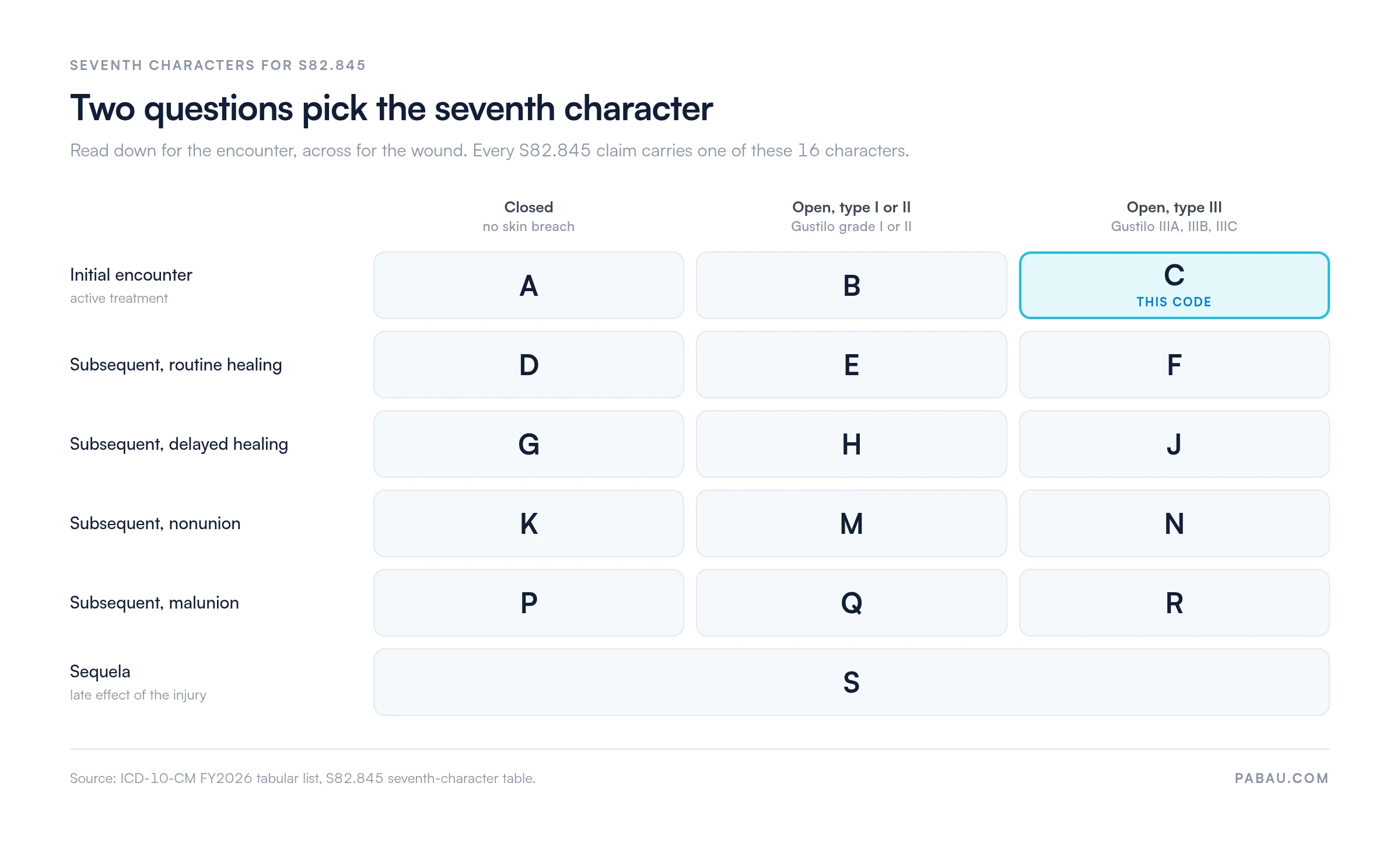
The full extension table for S82.845 sits below, in the wording a payer sees. Every one of these characters is required for a valid claim, per the CDC/NCHS ICD-10-CM web tool.
Track which seventh character went out on the initial claim. Every later encounter for the same fracture keeps the same open fracture grade. A claim that starts at grade C should not switch to grade B three visits later. Inconsistent grading across encounters invites a denial.
Gustilo and Anderson published this classification in 1976, and it still decides the seventh character. It grades open fractures by soft tissue injury, contamination, and blood supply.
The three type III subtypes share a high-energy mechanism and a heavy contamination risk. They differ by how much periosteum survives, and by whether the limb needs vascular repair.
One rule decides most of these claims. The Gustilo grade has to come from the treating physician, in the record. A coder cannot grade a wound from a description, however detailed it reads.
When the grade is missing altogether, the ICD-10-CM Official Guidelines send you to the type I or II character, which is B for this fracture.
An operative note that says only open fracture, with no grade, does not support the C character. The ICD-10-CM Official Guidelines default an ungraded open fracture to the type I or II character. That means B on this code. Query the surgeon when the wound description points to type III, then recode from the answer.
Initial encounter is the phrase coders misread most often. It does not mean the first time anyone saw this patient for this injury.
It means the patient is still receiving active treatment for the fracture. Surgical fixation, casting, external fixation, and debridement all count as active treatment.
There is a second nuance worth knowing. Each new treating provider gets its own initial encounter. A patient may move from a community hospital to a Level I trauma center for definitive care.
That first visit at the trauma center is an initial encounter, even weeks after the injury.
The hierarchy explains why S82.845 keeps coming back rejected on its own. Only the seventh-character code is billable, and every level above it is a header.
The AAPC ICD-10-CM code reference lists S82.845 as a header code rather than a claim-ready one.
Change one variable and the code changes with it. The S82.845 family covers the left ankle across every encounter type and healing stage, and S82.844 mirrors it on the right.
The malleolar count is a variable too. Add a fractured posterior malleolus on the right side, and an open type I or II injury takes ICD-10-CM code S82.854B.
Healing stage shifts the code again. A left trimalleolar version of this injury that reaches nonunion at a later visit is reported with S82.855N.
Our diagnostic codes guide indexes the same pattern in other ICD-10 chapters, for the days when the next claim is nothing like this one.
Denials on this code usually trace back to the record rather than the code choice. S82.845C carries five separate facts, and the documentation has to support all five before a coder can assign it.
S82.845C rarely fails on its own. It fails in transit, so it pays to know the route. The diagnosis is abstracted from the operative or emergency note, paired with the procedure code, scrubbed by the clearinghouse, then adjudicated by the payer.
Two checkpoints catch most of the trouble. The clearinghouse flags structural faults, such as a truncated code or a side that contradicts the procedure. The payer handles the judgment calls, and its answer lands weeks later on the remittance advice.
Before the claim goes out, confirm each of these:
Three mistakes account for most of the rework. Coders read C off a large wound instead of a documented grade. They flip between B and C across encounters for one fracture. And they keep an initial encounter character long after active treatment ended.
When a claim does come back, read the reason code before touching it, because denial management starts with the cause and not the rebill.
In most practices the operative note lives in one system and the claim is built in another. The Gustilo grade gets retyped, or summarized, or simply left behind. Detail lost in that hop shows up weeks later as a denial nobody can explain.
Practice management software like Pabau keeps both sides in the same record. Its claims management software submits and tracks claims from the chart that already holds the clinical note. Eligibility and validation checks run before the claim leaves the practice.
For an orthopedic or trauma practice, the benefit is small and repeated. Laterality, encounter status, and the Gustilo grade get captured while the patient is still in front of the clinician. The type III fracture is then coded from the record, not reconstructed from memory at billing time.

Pabau submits and tracks claims from the same record that holds the clinical note, with eligibility and validation checks before submission. See how it works for orthopedic and trauma practices.

S82.845C is a precise code, and precision cuts both ways. It is billable only when the record confirms all five elements, from left-side laterality through to a physician-documented Gustilo grade. Miss one and the right answer is a sibling code, or a query to the surgeon.
The habit worth building is a small one. Read the operative note for the grade before you pick the character, and let the record choose the code.
Book a demo to see how Pabau keeps fracture documentation and claim submission in the same place.

Want to know what happens to the claim after you hit send? Medical claims clearinghouse explains how validation catches coding problems before a payer ever sees them.
Need to decode the rejection that came back? Denial codes in medical billing lists the reason codes you will meet most often and the fix for each.
Working out how payment decisions arrive? Electronic remittance advice walks through reading an ERA line by line, including denial reasons.
Add one when the record supports it. ICD-10-CM encourages a Chapter 20 external cause code for how the injury happened, plus place of occurrence, activity, and status. CMS sets no national mandate, but state rules, trauma registries, and some payers expect them on the initial claim.
Assign B, not C. The ICD-10-CM Official Guidelines direct coders to the type I or II character whenever the Gustilo type is missing. Query the surgeon if the wound description points to type III, then recode once the grade is in the record.
Yes. ICD-10-CM has no bilateral bimalleolar code, so a patient with both ankles fractured takes S82.844C on the right and S82.845C on the left. Each side needs its own documented displacement status and its own Gustilo grade.
On an inpatient acute care claim, yes. A fracture that happened before arrival is reported as present on admission. Outpatient and physician claims do not carry the indicator at all, so it never appears on the office side of this injury.
The code moves with the finding. A displaced bimalleolar fracture of the left ankle sits in the S82.842 series, with the same seventh characters. Recode before submission if the correction lands in time, and follow the payer’s corrected claim process if it does not.