ICD-10 code T87.52: Necrosis of amputation stump, left upper extremity
ICD-10 code T87.52 at a glance: Left arm, not left leg ICD-10 code T87.52 is the...

Last Updated: Oct 26, 2026
Billable Code Specific Code
S82.491H is a billable ICD-10-CM diagnosis code. It reports other fracture of shaft of right fibula, subsequent encounter for open fracture type I or II with delayed healing.
Two facts in the clinical note carry this code, and denials usually follow when one is absent. The operative or emergency note has to grade the open wound as Gustilo type I or II. The physician has to state that healing is delayed rather than that the fracture has gone to nonunion.
Let Pabau's smart automation suggest the right codes, reduce claim denials, and keep your practice compliant—effortlessly.
Automate repetitive tasks and focus on what matters most—your patients.
Reduce coding errors and ensure compliance with the latest regulations.
Clean claims, fewer denials, and faster reimbursements.
Powerful insights and reporting to help your practice thrive.
HIPAA compliant SOC 2 certified GDPR-compliant Trusted by 4,000+ clinics worldwide

S82.491H covers the shaft of the fibula, not the tibia and not the ankle malleolus.
The H suffix means delayed healing, while a documented nonunion of the same fracture takes M instead.
S82.491H applies to the right fibula only. The left side uses S82.492H and an unspecified side uses S82.499H.
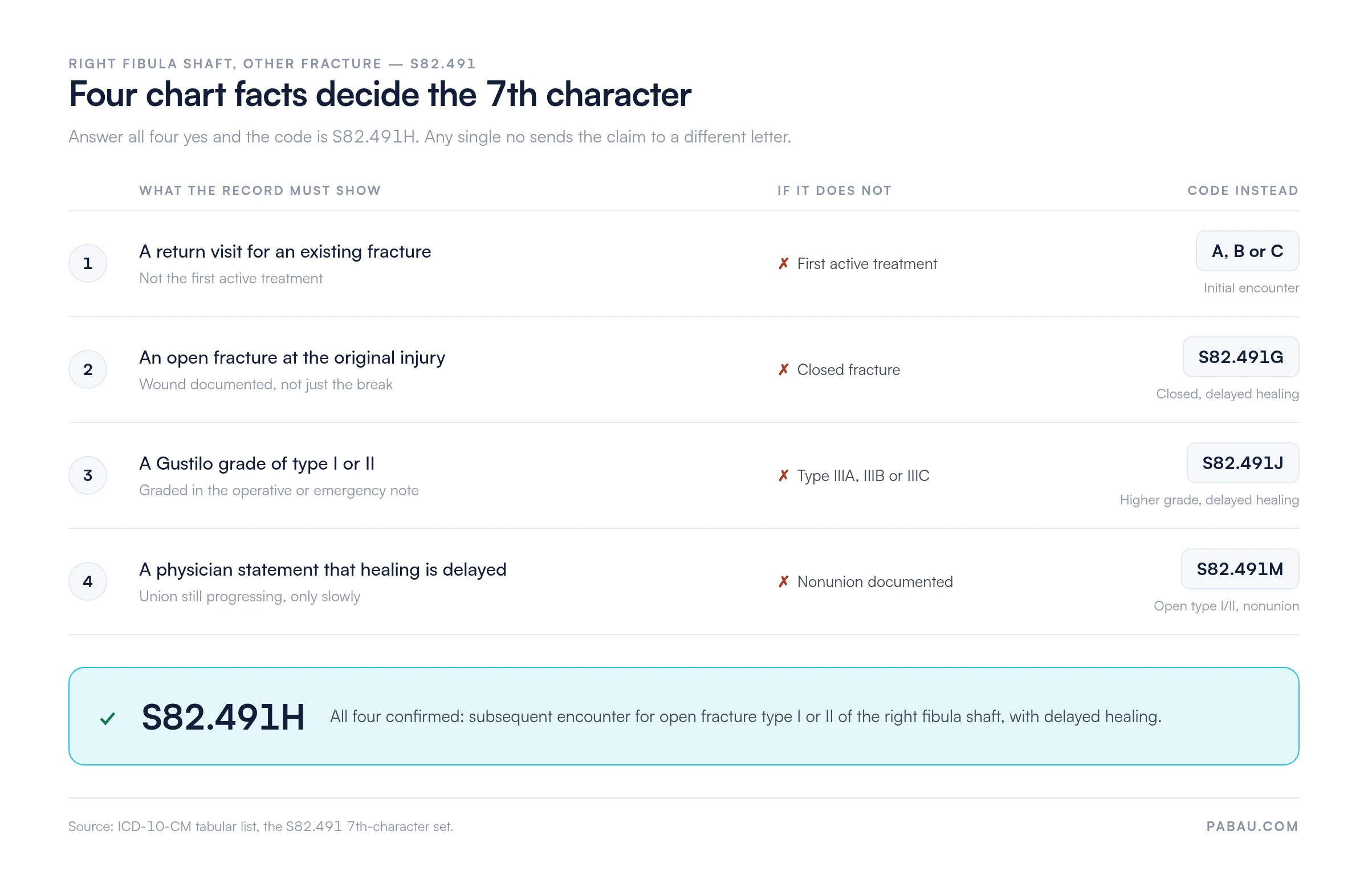
The record must show both a Gustilo type I or II open wound and a physician statement that healing is delayed.
Pabau, a practice management platform, pairs ICD-10-CM code lookup with electronic claim submission through Claim.MD.
ICD-10 Code S82.491H describes “other fracture of shaft of right fibula, subsequent encounter for open fracture type I or II with delayed healing.” The code is billable and specific under ICD-10-CM, and it is valid for the current fiscal year.
It sits within the S82.4 subcategory, which covers fractures of the shaft of the fibula. That subcategory belongs to category S82, fractures of the lower leg including ankle, inside Chapter 19. The table below shows the code’s position within the classification hierarchy.
Coders can verify the current-year validity of this code in the CDC/NCHS ICD-10-CM web tool. It is updated each October 1 to reflect the new fiscal year release.
The 7th character H means subsequent encounter for an open fracture type I or II with delayed healing. Two facts are carried in that single letter. The original wound was graded Gustilo type I or II, and the fracture is taking longer than expected to unite.
Delayed healing is not nonunion. Delayed healing means the fracture is still progressing toward union, just slowly. Nonunion means healing has stalled and is not expected to resume without intervention. That distinction moves the suffix from H to M, and payers audit for it.
The S82 7th-character set is built on two axes: encounter type and fracture status. The table below maps every suffix available to S82.491.
Three distinctions decide whether H is the right letter. First, H covers Gustilo type I or II only. A type IIIA, IIIB, or IIIC wound with delayed healing takes J instead. Second, H covers an open fracture only. A closed fracture with delayed healing takes G. Third, H covers delayed healing only. Once the physician documents nonunion, the suffix becomes M.
Add the encounter sequence to those three and the whole choice becomes a four-step check on the chart. The path below shows where each answer sends the claim.
The fibula is the slender lateral bone of the lower leg. It runs from just below the knee to the lateral malleolus at the ankle. The shaft is the long middle section between those two ends, and it is the segment S82.4 codes describe.
The fibula carries only a small share of body weight, so an isolated shaft fracture is often treated without surgery. Most are caused by a direct blow to the outside of the leg or by a twisting ankle injury. A high-energy impact that breaks the tibia at the same time is the other common mechanism.
An open wound over the fracture changes the picture, because contamination and soft-tissue damage both slow bone healing. The “other fracture” wording in S82.491H matters too. S82.4 separates displaced and nondisplaced transverse, oblique, spiral, comminuted, and segmental patterns into their own subcategories. S82.49 captures shaft fractures that match none of those named patterns, which makes the operative or radiology description the deciding document.
Open fracture classification under the Gustilo system drives the 7th character. Type I is a wound under 1 cm with minimal soft-tissue damage. Type II is a wound of 1 to 10 cm with moderate soft-tissue damage. Type III involves major soft-tissue disruption and splits into IIIA, IIIB, and IIIC based on periosteal stripping and vascular injury.
Gustilo grading belongs in the operative or emergency note. If the record says only “open fracture” with no grade, the coder cannot assign H and must query the physician. The CMS ICD-10 coding guidelines require the most specific code the documentation supports, so Gustilo classification is not optional detail.
The S82.491 family runs through the full 7th-character set, and S82.49x covers all three laterality options. The table below compares the codes coders most often confuse with S82.491H.
The AAPC’s ICD-10-CM codebook lookup cross-references each of these against the tabular index. It is a fast way to confirm exact descriptor wording before a claim goes out.
Several fracture types are excluded from S82.491H and its parent blocks. Knowing these protects against miscoding adjacent presentations.
Excludes1 means the excluded code cannot be reported with S82.491H for the same condition. Excludes2 means the two conditions are distinct and may legitimately coexist. Pathological fracture is the common Excludes1 trap: a fibular break through a bone metastasis is coded from M84.5-, never from S82.491H.
A claim carrying ICD-10 Code S82.491H must be supported by six specific documentation elements. Missing any one of them creates grounds for denial or a CDI query.
ICD-10-CM sets no week count for delayed healing, so the physician’s own statement is the source of truth. That is why “callus formation slower than expected” in a radiology impression does not code to H by itself. The treating physician has to adopt the finding in the encounter note.
When documentation is ambiguous, query before assigning the H suffix. A query answered in an addendum costs far less than a denial worked three weeks later.
The CPT codes paired with ICD-10 Code S82.491H depend on whether the encounter involves continued fracture management, imaging, bone stimulation, physical therapy, or surgical fixation. Verify current National Correct Coding Initiative (NCCI) edits before billing any combination, because bundling rules change annually.
Pairing frequency varies by payer and setting. The combinations above reflect common clinical pathways under AMA CPT guidelines. Confirm that NCCI edits do not bundle any pair before you submit. Each procedure code above has its own entry in our CPT codes library, with the full descriptor and the billing notes attached.
Claims carrying ICD-10 Code S82.491H are denied for a predictable set of reasons. Each one traces back to a detail the note left out or a letter the coder picked wrong.
A systematic approach to denial management in healthcare moves an orthopedic billing team from correcting claims to preventing them. Practices running several orthopedic providers benefit from tracking denials by 7th character, because that shows which physician notes keep omitting healing status.
The S suffix (sequela) and the H suffix (subsequent encounter) are mutually exclusive. Choosing S82.491S when H is correct is one of the audit risks flagged in ICD-10-CM Official Guidelines Section I.C.19.a.
Subsequent encounter applies while the fracture is still under active management, no matter how many months have passed. Active management includes cast or boot changes, surgical planning, bone stimulator therapy, and physical therapy aimed at the fracture. As long as the fracture itself is being treated, a subsequent encounter suffix applies.
Sequela applies only once the fracture has resolved and the patient returns with a residual late effect. A patient with chronic lateral leg pain two years after a healed fibular shaft fracture would list the pain diagnosis first, then S82.491S. The fracture is no longer the condition being treated.
One question settles S versus H: is the fracture still being treated? Cast changes, bone stimulator therapy and fracture-directed physical therapy all count as active treatment, so the H suffix still applies. Reach for S82.491S only after the fracture has healed and a separate late effect brings the patient back.
The four scenarios below follow one patient across an episode of care. Each includes the rationale for the code assignment.
Patient has a right fibular shaft fracture with a Gustilo type I open wound documented at the original presentation. Films at 16 weeks show early callus, but less than expected for the timepoint. The physician documents delayed union and continues nonoperative management.
Code assignment: S82.491H as the principal diagnosis. Add the external cause code for the mechanism with a D suffix at this subsequent encounter, for example W18.31XD. No aftercare Z code is needed, because the 7th character already reports the encounter type.
The same patient attends physical therapy for gait retraining and ankle range of motion while the fracture is still uniting slowly.
Code assignment: S82.491H as the primary diagnosis on the physical therapy claim. CPT 97110 (therapeutic exercise) or 97530 (therapeutic activities) as the procedure code, depending on what was delivered. Carry the same diagnosis across every therapy visit in the episode, and change it only when the physician’s healing statement changes.
The physician prescribes a noninvasive electrical bone growth stimulator to support union. The prescription is written at a separate office visit.
Code assignment: S82.491H as the primary diagnosis, with the appropriate E&M code for the office visit. On the separately filed DME claim, HCPCS code E0747 covers a noninvasive electrical osteogenesis stimulator for a nonspinal site. HCPCS code E0760 covers the low-intensity ultrasound device. Prior authorization is common here, so check the LCD before prescribing.
Conservative management has not produced union, and the patient is cleared for internal fixation. The pre-operative assessment is billed before the surgical encounter.
Code assignment: S82.491H as the primary diagnosis, with the appropriate E&M code for the pre-operative evaluation. The surgery itself is reported with CPT 27784 and the same diagnosis. If the surgeon’s note reclassifies the fracture as a nonunion, the diagnosis moves to S82.491M from that encounter onward.
Most coding teams work this code across three systems. The chart sits in the EHR, the code is checked in a separate reference tool, and the claim is keyed into a billing portal. A 7th character that changes mid-episode then has to be carried by hand into each one.
Pabau, a practice management platform built for orthopedic, rehabilitation and allied health practices, holds all three in one record. Its claims management software searches the ICD-10-CM set while the note is open, so the coder picks S82.491H against the documentation that supports it. Claims then submit electronically through the Claim.MD clearinghouse, with no rekeying step in between.
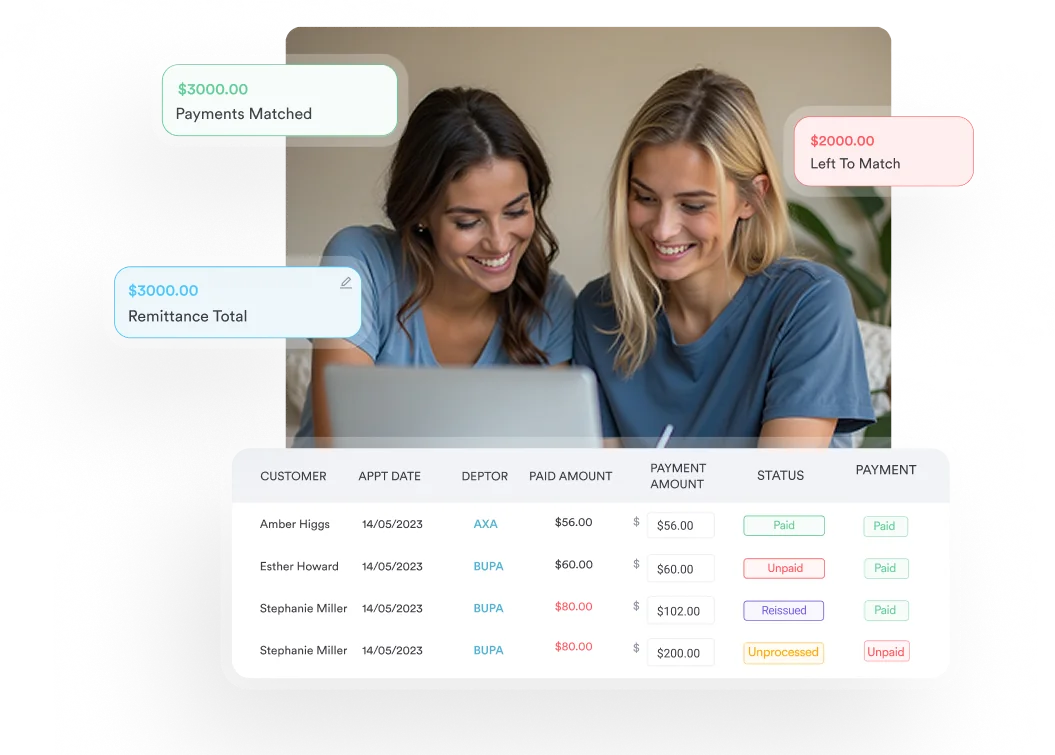
When the physician records nonunion at a later visit, the coder moves the next claim to S82.491M. The encounters already billed stay as they were. Denials come back into the same record, so a practice can sort them by 7th character and see which provider’s notes keep omitting healing status.

Pabau integrates with Claim.MD to submit clean ICD-10-CM claims electronically, with built-in code lookup and real-time eligibility verification for orthopedic and rehabilitation practices.

ICD-10 Code S82.491H is specific and billable, and it is denied most often when the record does not carry the two facts the suffix asserts. Those facts are a Gustilo type I or II open wound at the original injury, and a physician statement that healing is delayed.
Get either one wrong and the correct code is a different letter. A closed fracture takes G, a higher Gustilo grade takes J, and a documented nonunion takes the M suffix. The practical move is to set the query trigger before the claim goes out rather than after it comes back.
That habit is easier to hold when code lookup and claim submission share one record. Book a demo to see how Pabau keeps 7th-character changes in step with the chart on orthopedic claims.

Need to understand how ICD-10 claims reach payers? Medical claims clearinghouse workflows explains how electronic claims are validated and routed before adjudication.
Want fewer first-pass rejections on orthopedic claims? What makes a clean claim walks through the fields and documentation a payer checks before it pays.
Want to understand how ERA remittances inform denial patterns? Electronic remittance advice explained covers CARC codes and how to act on 835 denial data.
New to the revenue cycle behind these codes? What is medical billing sets out each step from encounter capture to posted payment.
Comparing systems to submit these claims from? Best medical billing software in the US reviews the platforms practices shortlist most often.
ICD-10 Code S82.491H is a billable ICD-10-CM diagnosis code. It reports other fracture of shaft of right fibula, subsequent encounter for open fracture type I or II with delayed healing. It sits in subcategory S82.49, which covers shaft fractures of the fibula that do not match one of the named fracture patterns. It is valid under the current fiscal year ICD-10-CM release.
The 7th character H means subsequent encounter for an open fracture type I or II with delayed healing. It asserts two separate facts: the wound was graded Gustilo type I or II, and union is slower than expected but still progressing. It is not interchangeable with E (routine healing), G (closed fracture, delayed healing), or M (open type I or II, nonunion).
Both describe a right fibular shaft fracture that was open type I or II at the original injury. H is used while healing is delayed but still moving toward union. M is used once the physician documents nonunion, meaning healing has stopped. The clinical note decides which letter applies, so the code should change at the encounter where the physician first records nonunion.
Subsequent encounter suffixes apply while the fracture is still under active treatment, regardless of how much time has passed. Sequela (S) applies only after the fracture has resolved and the patient presents with a late effect of it, such as chronic pain or deformity. The two are mutually exclusive for the same fracture episode.
The usual causes are a healing status that does not match the note and a fracture documented as closed rather than open. Missing laterality and an absent Gustilo grade account for most of the rest. Coding an ankle-level fibula fracture to the shaft subcategory is another frequent trigger. Each of these needs a physician query and a documentation addendum before rebilling.
No. S82.491H applies to the right fibula only. The equivalent left-side code is S82.492H. Where laterality is genuinely undocumented, S82.499H may be assigned, but it carries higher denial risk and should prompt a physician query to resolve the side.