ICD-10 Code S72.021D: Displaced femoral epiphysis fracture
ICD-10 Code S72.021D: code details at a glance ICD-10 Code S72.021D reports a di...

Last Updated: Oct 22, 2026
Billable Code Specific Code
S82.255S is the billable ICD-10-CM code for nondisplaced comminuted fracture of shaft of left tibia, sequela. It applies once the fracture has healed and the visit treats a late effect, such as pain, deformity or limb-length discrepancy.
The code for that residual condition is listed first and S82.255S second. Assignment depends on three documented facts: the left side, a comminuted pattern, and nondisplacement. A fracture not documented as nondisplaced defaults to displaced, which is S82.252S.
Let Pabau's smart automation suggest the right codes, reduce claim denials, and keep your practice compliant—effortlessly.
Automate repetitive tasks and focus on what matters most—your patients.
Reduce coding errors and ensure compliance with the latest regulations.
Clean claims, fewer denials, and faster reimbursements.
Powerful insights and reporting to help your practice thrive.
HIPAA compliant SOC 2 certified GDPR-compliant Trusted by 4,000+ clinics worldwide

S82.255S applies only to a nondisplaced comminuted fracture of the left tibial shaft, after healing is complete and a residual condition remains.
The seventh character S marks a sequela under ICD-10-CM Guidelines I.C.19.a, and it never replaces D for visits during active healing.
On a sequela claim, the code for the residual condition goes first and S82.255S goes second, per Guidelines I.B.10.
A fracture not documented as nondisplaced is coded as displaced, so the record must state nondisplaced to support S82.255S over S82.252S.
Pabau, the practice management platform we build, checks each claim for missing or invalid details before it reaches the Claim.MD clearinghouse.
ICD-10 code S82.255S is the billable ICD-10-CM code for a nondisplaced comminuted fracture of the shaft of the left tibia, sequela. It sits in subcategory S82.25, which covers comminuted fractures of the tibial shaft. The table below captures the reference fields coders need before building a claim.
Verify billable status against the CDC/NCHS ICD-10-CM web tool each fiscal year, as code descriptors and billable flags update annually on October 1.
A comminuted fracture is one in which the bone breaks into three or more fragments rather than two clean pieces. In the S82.2 block, “shaft” refers to the diaphysis of the tibia, the long mid-section of the bone between the proximal and distal metaphyses. Each character of S82.255S carries one part of the descriptor:
The sixth character carries displacement and laterality together. Values 1, 2 and 3 mean displaced right, left and unspecified, while 4, 5 and 6 mean nondisplaced right, left and unspecified. The grid below maps all six sequela codes in the subcategory.
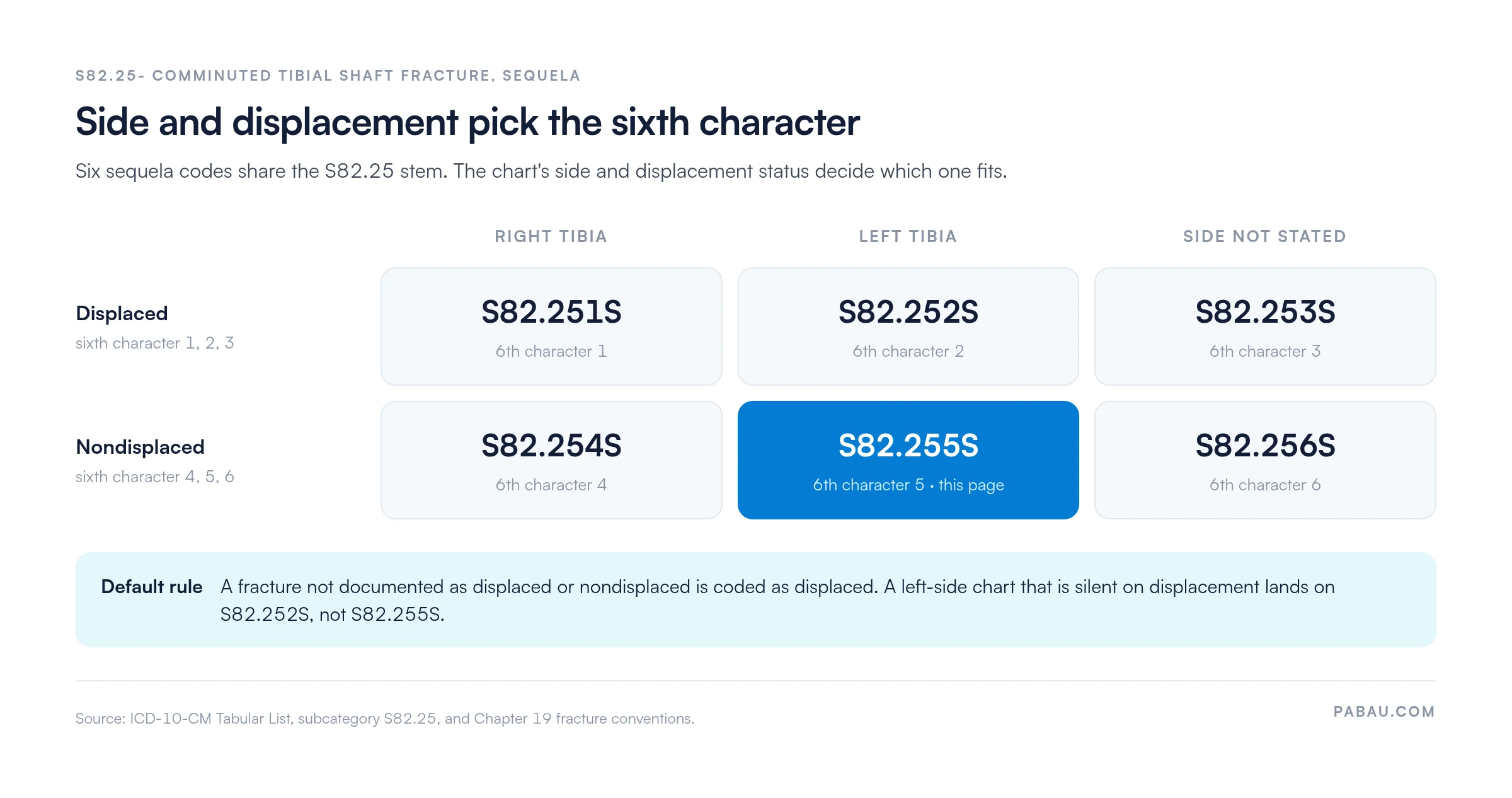
Displacement must be documented, too. ICD-10-CM instructs coders to report a fracture not indicated as displaced or nondisplaced as displaced. A radiology report that only says “comminuted fracture of the left tibial shaft” therefore leads to S82.252S, not S82.255S.
Residual conditions reported with S82.255S include pain after union, angular deformity from malunion, acquired leg-length discrepancy, stiffness, and chronic osteomyelitis after an open fracture. Each must be documented as a direct consequence of the original fracture, not as a new injury or an unrelated condition.
The seventh character S designates sequela under ICD-10-CM Official Guidelines Section I.C.19.a. It means the encounter is for a late effect of the injury after healing is complete.
Tibial shaft fracture codes in S82.2 accept more seventh characters than most injury codes. The main options are A, D and S. Further characters cover open fractures and subsequent visits for delayed healing, nonunion or malunion.
Two conditions must both be present before S is appropriate. The fracture has healed, confirmed clinically or radiographically, and the provider links a specific residual condition to the original fracture in the note. Missing either one means the claim lacks the clinical basis to support S82.255S.
D marks a subsequent encounter during routine healing, and S marks a sequela after healing. They are the two seventh characters most often confused in fracture coding. Using one where the other belongs is a common denial trigger on S82.255S claims.
Physical therapy visits during active healing take the D character. Once the provider documents union and a residual impairment drives the PT, the coder lists the residual condition first and S82.255S second. This switch causes frequent confusion on PT claims, and denial management workflows often flag S82 claims for review because of it.
Document the exact date or imaging report that confirms fracture union. Notes that say ‘healed’ without a date or supporting radiology reference give payers grounds to question the S character and deny the sequela claim. A single sentence referencing the x-ray report number is enough to protect the submission.
Subcategory S82.25 holds six sequela codes, split by laterality and displacement. Errors on S82.255S usually come from one of three choices: the side, the displacement status, or the fracture pattern.
For a full crosswalk of adjacent codes, use the AAPC Codify ICD-10-CM lookup or the ICD List browser. Both display the complete S82 code tree with parent-child relationships and excludes notes.
Nonunion means the fracture fails to heal, and malunion means it heals in an abnormal position. Both are serious outcomes of a comminuted tibial shaft fracture. Both have their own seventh characters, so S applies only once the fracture phase is over.
Nonunion during fracture care takes a subsequent-encounter character rather than the sequela one. S82.255K covers a subsequent encounter for a closed fracture with nonunion, and M and N cover open fractures.
S82.255S applies when the nonunion has been treated, the fracture phase has ended, and a residual condition drives the visit. Check current AHA Coding Clinic advice for borderline cases, as payers scrutinize these claims closely.
Malunion also has subsequent-encounter characters: P for a closed fracture, and Q or R for open fractures. Use S82.255P while the malunion is still being managed as part of fracture care. Once the fracture has healed in malalignment and the visit addresses a late effect, code that condition first and S82.255S second.
Document the relationship explicitly: “acquired leg-length discrepancy secondary to healed nondisplaced comminuted left tibia fracture with malunion.” Without that causal statement in the note, the residual condition code lacks clinical support.
Assigning S82.255S rests on five documented facts and one sequencing rule. Work through these seven steps in order.
S82.255S is never the only code on a sequela claim. ICD-10-CM Official Guidelines Section I.B.10 requires a code for the nature of the sequela, sequenced first, with S82.255S after it. Common residual-condition codes reported with S82.255S include:
Always select the most specific code the documentation supports. Confirm every supplementary code against the current CMS ICD-10-CM code files for the applicable fiscal year.
Sequela claims carry a heavier documentation burden than routine subsequent-encounter claims. Payers need to see that the original injury occurred, that healing is confirmed, and that the current treatment addresses the residual condition. For Medicare and most commercial payers, the claim must link the treatment plan to the specific sequela named in the code pairing.
Key payer expectations for S82.255S claims:
A clearinghouse with eligibility checks and claim edits catches many errors before adjudication. Pabau offers clearinghouse submission via Claim.MD to thousands of US payers, with real-time eligibility checks. Understanding medical billing fundamentals helps practice staff interpret the edit messages that come back on rejected claims.
Denials on S82.255S claims cluster around four errors. Each is preventable with the documentation steps above.
Payers explain each rejected S82.255S claim with a CARC (Claim Adjustment Reason Code), and our denial code guide decodes each one. Diagnosis problems typically surface as CO-11, meaning the diagnosis is inconsistent with the procedure.
CO-16 means the claim lacks information or has a billing error. CO-50 appears when the payer does not consider the service medically necessary.
Build a simple internal audit trigger: flag any S82.25xD claim filed 180 days or more after the initial encounter for a provider query. Comminuted tibial shaft fractures often take 16 to 26 weeks to reach radiographic union, depending on severity and fixation method. A D character well beyond that window deserves a query before it turns into a denial.
Physical therapy practices treating post-fracture rehab should also check their Medicare Administrative Contractor’s LCD for outpatient therapy. Those policies can add documentation requirements on top of the ICD-10-CM sequela rules.
Without a pre-submission check, a sequela coding error usually surfaces only when the denial arrives. The coder then rechecks the chart, corrects the seventh character or the code order, and resubmits weeks later.
Pabau’s claims management software pre-fills each claim from the invoice and scrubs it for missing or invalid details before it goes to Claim.MD. Claim statuses and remittances flow back into Pabau, and denied claims are flagged for rework.
Billing teams get one dashboard for every S82 claim that needs attention, instead of chasing denials payer by payer. The provider note still has to document union and the residual condition, but fewer claims bounce back for avoidable errors.

Pabau scrubs each claim for missing or invalid details before it goes to Claim.MD, then flags denied claims for rework. See how it works for orthopedic and physical therapy billing.

S82.255S is right only when four facts line up in the record: left side, comminuted pattern, documented nondisplacement, and a healed fracture. If any one is missing, query the provider before you code, because a sibling code or the D character will fit better.
When the facts do line up, the order on the claim decides whether it pays. List the residual condition first and S82.255S second, and make sure the note ties the two together.
Pabau’s Claim.MD clearinghouse integration checks claims before they leave the practice and tracks each one through to payment. Book a demo to see how it supports orthopedic and PT billing teams.

Need to understand how clearinghouse edits catch ICD-10 mismatches before denial? Clean claim submission standards explains what payers validate during adjudication and how edit checks prevent seventh-character errors.
Want to read the remittance behind a denied sequela claim? Electronic remittance advice covers ERA/835 remittance codes so billing teams can decode exactly why S82 claims were adjusted.
Want to see where sequela coding sits in the revenue cycle? Revenue cycle management in healthcare explains how diagnosis codes move from clinical documentation through to payment posting.
ICD-10 code S82.255S is the billable ICD-10-CM diagnosis code for sequela of a nondisplaced comminuted fracture of the shaft of the left tibia. It is used once the fracture has healed and the patient presents for a residual condition, such as chronic pain, malunion deformity, or stiffness.
Yes, S82.255S is a billable ICD-10-CM code valid for claim submission. Verify its status annually against the CDC/NCHS ICD-10-CM tool, as billable status and descriptors update on October 1 each year.
Use S when the fracture has healed (confirmed clinically or by imaging) and the visit addresses a residual condition caused by the prior fracture. Use D when the fracture is still healing and the visit is for routine fracture care. Switching from D to S requires explicit documentation of fracture union in the provider note.
D (subsequent encounter) applies while the fracture is still healing, and S (sequela) applies only after healing is complete and a specific residual condition exists. They are mutually exclusive. If the bone is still consolidating, D is correct even if the patient has pain. Once union is confirmed and a late effect drives the visit, S is required.
Common sequelae include residual pain, angular deformity from malunion, and acquired leg-length discrepancy. Chronic osteomyelitis after an open fracture and muscle atrophy from long immobilization also qualify. Each must be documented as causally related to the original injury, and each is coded first, ahead of S82.255S.
No, not on a sequela visit. The code for the residual condition, such as M79.662 for left lower leg pain, is listed first and S82.255S second, per ICD-10-CM Guidelines I.B.10. During active healing, S82.255D is the correct code and can be listed first. Medicare LCD policies for PT medical necessity evaluate the diagnoses on the current encounter, so the order matters.