ICD-10 Code S82.033P: Displaced transverse patellar fracture, malunion
ICD-10 Code S82.033P: Quick reference and billable status ICD-10 Code S82.033P i...

Last Updated: Oct 15, 2026
Billable Code Specific Code
S82.242H is the billable ICD-10-CM code for a displaced spiral fracture of the left tibial shaft with delayed healing. It applies at a subsequent encounter for an open fracture, type I or II.
Most errors with S82.242H come from the 7th character. Coders often assign E (routine subsequent encounter) instead of H, even when the note shows the fracture healing more slowly than expected. That swap is one of the most common reasons this code family draws a denial.
Let Pabau's smart automation suggest the right codes, reduce claim denials, and keep your practice compliant—effortlessly.
Automate repetitive tasks and focus on what matters most—your patients.
Reduce coding errors and ensure compliance with the latest regulations.
Clean claims, fewer denials, and faster reimbursements.
Powerful insights and reporting to help your practice thrive.
HIPAA compliant SOC 2 certified GDPR-compliant Trusted by 4,000+ clinics worldwide

S82.242H is a billable ICD-10-CM code for a displaced spiral fracture of the left tibial shaft with documented delayed healing. It applies at follow-up visits for an open fracture, Gustilo type I or II.
The 7th character H carries three facts: subsequent encounter, open fracture type I or II, and delayed healing. A closed fracture with delayed healing takes G, and a type III open fracture takes J.
Documentation must state that healing is slower than expected, backed by imaging. That statement is what justifies H over E, the routine healing character.
Pabau’s claims management software, integrated with the Claim.MD clearinghouse, helps orthopedic practices submit S82.242H claims accurately and track delayed-healing documentation requirements.
ICD-10 Code S82.242H designates a displaced spiral fracture of the left tibial shaft with delayed healing. It applies at a subsequent encounter for an open fracture, Gustilo type I or II.
It sits in category S82, which covers fractures of the lower leg, including the ankle. The code is valid under ICD-10-CM for the current fiscal year.
A displaced spiral fracture of the tibial shaft results from a rotational or torsional force on the lower leg. It produces an oblique fracture line that spirals around the bone’s long axis. The shaft is the diaphysis, the straight middle portion of the tibia between the proximal and distal metaphyses.
“Displaced” means the fracture fragments have shifted out of anatomic alignment. That distinction matters for code selection, because S82.244, S82.245, and S82.246 cover nondisplaced spiral tibial shaft fractures. Using S82.242H on a nondisplaced fracture is a coding error that may pass initial submission but create audit exposure.
Delayed healing, the healing status encoded by the 7th character H, means the fracture is not progressing through the expected healing trajectory.
The ICD-10-CM Official Guidelines set no timeframe for delayed healing. It is a clinician determination documented in the medical record, usually supported by serial imaging that shows too little callus for the time since injury.
For adult tibial shaft fractures, clinical literature often links delayed healing to a lack of bridging callus at 12 to 16 weeks. Treating physicians may still identify it earlier or later, based on nutrition, comorbidities, smoking status, and fixation stability.
Coders should reflect the physician’s documented assessment rather than apply an arbitrary cutoff. A follow-up note template that asks the physician to state healing status at each visit puts that assessment on the page before coding starts.
An open fracture is one where the broken bone has pierced the skin, or a wound communicates with the fracture site. ICD-10-CM splits open fractures by the Gustilo-Anderson classification, and the 7th character records the grade the physician documented.
Types I and II share one set of 7th characters, which is why H covers both. Types IIIA to IIIC share another, so a type III fracture with delayed healing takes J instead.
Two ICD-10-CM defaults shape the choice. A fracture not documented as open or closed is coded as closed, which makes G the right character. An open fracture documented without a Gustilo grade defaults to type I or II, which keeps H in play.
The open or closed status is fixed at the injury. A type II wound that has fully closed by the twelve-week visit is still an open fracture for coding. The follow-up keeps H and never switches to G.
The 7th character H carries three facts at once. This is a subsequent encounter, after the initial treatment phase. The original fracture was open, graded Gustilo type I or II. The treating clinician has documented delayed healing. The record must support each of the three to justify H over its neighbors.
Per the CMS ICD-10-CM coding guidelines, a subsequent encounter covers visits after the patient has received active treatment for the condition.
The most common error is assigning E, routine healing for a type I or II open fracture, when the note describes concerns about healing pace. S82.242E fits only when the physician records healing on schedule.
The reverse error is assigning H when the note has no explicit physician statement about delayed healing. A third is reaching for G, the closed-fracture character, because the skin has healed by the follow-up visit. In each case the physician’s documentation decides the character, and coder inference cannot stand in for it.
The grid below shows how two facts, the wound status at injury and the healing status at this visit, settle every subsequent-encounter character for S82.242.
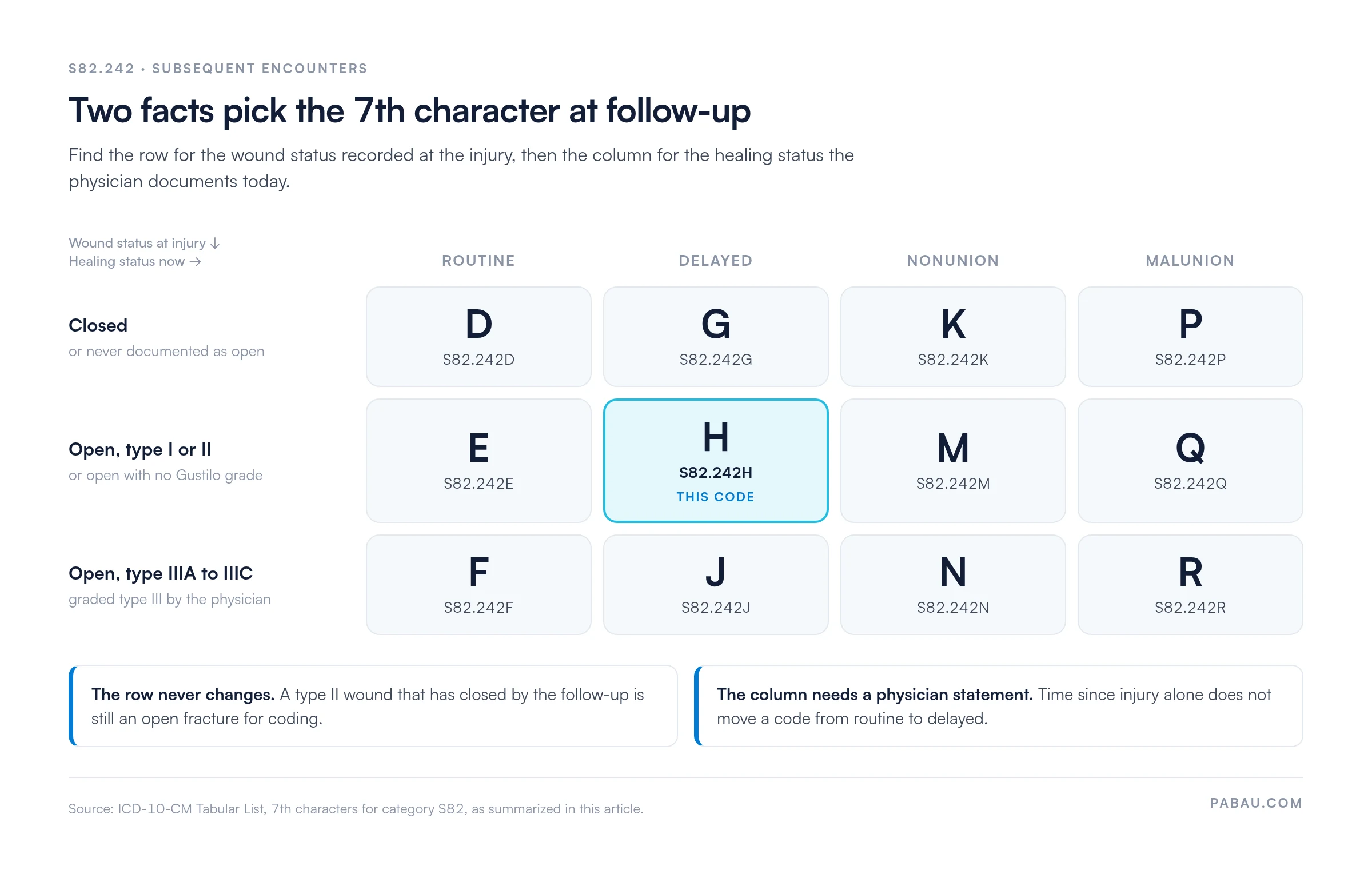
S82.242H sits within the displaced spiral tibial shaft subgroup (S82.241 through S82.249). Laterality, open or closed status, Gustilo grade, and healing status all split the family, and each split is a common miscoding point.
S82.242H includes tibial shaft fractures that meet every element of the descriptor. The fracture is displaced, spiral, in the shaft, and on the left side. It was open, Gustilo type I or II, and this is a subsequent encounter with documented delayed healing.
Several fracture types are excluded from this code. Per ICD-10-CM tabular guidance, the S82 category excludes periprosthetic fractures of the knee (M97.-) and pathological fractures (M84.5-). It also excludes fractures due to osteoporosis (M80.-) and traumatic amputation of the lower leg (S88.-).
Tibial fractures described as “stress fractures” fall under M84.36-, not S82. Applying S82.242H to a stress fracture is an excludes1 violation.
Check whether the operative or radiology report specifies fibula involvement. A concurrent fibular shaft fracture needs its own code from S82.4-, because S82.242H describes the tibia only. When imaging shows both bones broken, a claim with only the tibial code understates the injury.
Documentation that supports ICD-10 Code S82.242H must address five elements. Missing any one of them creates either a coding error or a claim denial trigger.
For practices wanting structured documentation that prompts these elements consistently, a fracture follow-up note template can reduce the time spent chasing addenda. See Pabau’s guidance on clean claim submission for orthopedic billing contexts.
Most payers, including Medicare, do not require prior authorization for routine follow-up of a tibial shaft fracture. Procedures often billed alongside delayed healing, such as bone stimulation, repeat fixation, or bone grafting, frequently do. ICD-10 Code S82.242H is the diagnosis that supports medical necessity for those requests.
Medicare covers noninvasive electrical bone stimulation for long bones (HCPCS E0747) under the DME MAC Local Coverage Determination for osteogenesis stimulators.
That policy is written around nonunion: two sets of radiographs at least 90 days apart showing no clinically significant healing. A delayed-healing diagnosis alone may not meet it, so check the current LCD before billing a stimulator with S82.242H.
Commercial payers commonly require the following before accepting S82.242H as the primary diagnosis on intervention-related claims:
Using Pabau’s claims management software, practices can attach supporting documentation directly to claims and track prior authorization status against the encounter. That cuts the back-and-forth that delayed-healing cases usually generate.
Most S82.242H denials trace back to a mismatched 7th character or a note that never states delayed healing. The table below maps each common denial pattern to its root cause and fix.
Proactive denial management workflows resolve these cases faster when they route S82.242H denials to a fracture-coding specialist instead of a general queue. Pabau’s Claim.MD clearinghouse integration surfaces payer acceptance signals and ERA denial reason codes, known as CARC codes, as they come back.
Your team can then spot the specific 7th character or documentation denial before the 60-day appeal window closes. For the reason codes that most often appear on S82.242H remittances, see this guide to medical billing denial codes.
The CPT codes billed alongside ICD-10 Code S82.242H depend on what intervention the surgeon or treating physician performs at the encounter. Delayed healing often triggers a review or secondary intervention that changes the procedure code from a simple follow-up.
When the follow-up encounter includes only evaluation and management without a procedure, the E/M code (99213 or 99214) carries S82.242H as the primary diagnosis.
Practices can review electronic remittance advice patterns on these paired claims to see whether payers keep downgrading the E/M level. Repeated downgrades usually mean the note under-documents medical decision-making, and recoding the diagnosis won’t fix that.
When billing bone stimulation (HCPCS E0747) with S82.242H, attach the physician’s healing assessment and the dates of both comparison X-ray series. Medicare’s LCD expects two series at least 90 days apart showing no clinically significant healing. Submitting without that evidence is the most predictable denial on delayed-healing tibial fracture claims.
Coding S82.242H correctly depends on facts recorded weeks apart. The Gustilo grade sits in the initial encounter note, the delayed-healing statement in a later progress note, and the comparison imaging in the radiology report. When those records live in separate systems, coders rebuild the story by hand at every follow-up.
Pabau’s practice management platform keeps the patient’s notes, forms, and claims in one record. Custom note templates can prompt the physician to record the open fracture grade and healing status at each visit. Pabau’s claims management software then lets the biller attach those notes and imaging reports to the claim before it goes out.
Claims route through the Claim.MD clearinghouse integration, so payer rejections and ERA denial codes come back into the same record. A wrong 7th character gets caught and corrected while the appeal window is still open.

Pabau keeps clinical notes, imaging reports, and claims in one patient record, with Claim.MD clearinghouse integration built in. Your team can check the 7th character against the note before the claim leaves the practice.

S82.242H holds up on audit when the record proves five facts. The fracture is displaced, spiral, and on the left side. It was open and graded type I or II, and the physician states that healing is delayed. Lose one and the right code is a different letter. That means G for a closed fracture, J for type III, E for routine healing, or M once nonunion is confirmed.
The habit worth building is to open the initial encounter note before choosing any subsequent character. The Gustilo grade is set on the day of injury, and every follow-up code inherits it, even after the wound has closed.
Book a demo to see how Pabau keeps fracture notes, imaging reports, and claims in one record for orthopedic practices.

Need to understand how clearinghouse rejection codes map to your denials? Pabau’s Claim.MD clearinghouse guide explains how thousands of US payers process claims and how ERA denial codes surface in your remittance workflow.
Want a reference for common denial reason codes on fracture claims? Revenue cycle management for medical practices covers the end-to-end billing process including denial patterns and resolution strategies.
Looking to verify ICD-10-CM code accuracy before submission? Medical billing fundamentals outlines the documentation requirements that support accurate diagnosis code selection across specialties.
ICD-10 Code S82.242H is the diagnosis code for a displaced spiral fracture of the left tibial shaft with delayed healing. It applies at a subsequent encounter for an open fracture, Gustilo type I or II. The record must support each element: displaced, spiral, left tibial shaft, open type I or II, and delayed healing documented at a follow-up visit.
The 7th character H in ICD-10-CM fracture codes means subsequent encounter for an open fracture type I or II with delayed healing. Its neighbors split by wound and healing status. G is a closed fracture with delayed healing, and J is an open type III fracture with delayed healing. E is the same type I or II fracture healing routinely. The physician must document delayed healing explicitly, since coders cannot apply H based on elapsed time alone.
S82.242A is the initial encounter code for a closed displaced spiral left tibial shaft fracture. For an open type I or II fracture, the initial encounter takes S82.242B instead. S82.242H applies at later visits, once that open type I or II fracture is healing more slowly than expected. After initial treatment ends, the 7th character moves to E, H, M, Q, or S, depending on the documented healing status.
Use S82.242H when the original fracture was open, Gustilo type I or II, and the patient now has documented delayed healing at a follow-up visit. Use S82.242G when the original fracture was closed, or was never documented as open. The wound status at the initial encounter decides between them, even if the skin has fully healed by the follow-up. Check the initial encounter record before assigning H or G.
Common CPT pairings include 27750 or 27752 for nonoperative fracture management and 27756 for percutaneous fixation. When delayed healing prompts surgery, 27758 covers plating and 27759 covers intramedullary nailing. 20902 covers bone graft harvest, and 99213 or 99214 covers an E/M-only follow-up. The procedure the physician performs at the encounter decides the CPT code, not the diagnosis alone.
The most frequent denials come from four errors. Coders use E when the note documents delayed healing. Others apply H to a closed fracture (G) or a type III fracture (J). Laterality errors creep in from copy-forward templates, and some notes lack a physician statement of delayed healing. Bone stimulation billed with S82.242H also fails when the record lacks the 90-day radiograph evidence the LCD expects.