ICD-10 Code S42.444P: Medial epicondyle fracture, right humerus
ICD-10 Code S42.444P: full descriptor and code validity ICD-10 Code S42.444P car...

Last Updated: Oct 13, 2026
Billable Code Specific Code
S82.242E is the billable ICD-10-CM code for displaced spiral fracture of shaft of left tibia, subsequent encounter for open fracture type I or II with routine healing.
E means routine healing, so it never describes malunion, nonunion, or delayed union. Each outcome has its own letter in the same family, and the wrong pick turns a clean claim into a denial.
This page walks the code character by character and lists all sixteen seventh characters S82.242 accepts. The Gustilo grades, the CPT pairings, and the documentation that holds E up come after that.
Let Pabau's smart automation suggest the right codes, reduce claim denials, and keep your practice compliant—effortlessly.
Automate repetitive tasks and focus on what matters most—your patients.
Reduce coding errors and ensure compliance with the latest regulations.
Clean claims, fewer denials, and faster reimbursements.
Powerful insights and reporting to help your practice thrive.
HIPAA compliant SOC 2 certified GDPR-compliant Trusted by 4,000+ clinics worldwide

ICD-10 code S82.242E covers a displaced spiral fracture of the shaft of the left tibia at a subsequent encounter. The open type I or II fracture is healing routinely.
The seventh character E means routine healing, not malunion. Malunion of the same fracture at the same Gustilo grade is S82.242Q, and nonunion is S82.242M.
S82.242 accepts sixteen seventh characters. They cover initial encounters, sequela, and four healing outcomes across closed, type I or II, and type III fractures.
A routine healing follow-up pairs with office visit and imaging codes. Repair codes for nonunion or malunion, such as 27720 and 27722, do not belong on this claim.
The note must document laterality, spiral morphology, displacement, Gustilo grade, encounter sequence, and healing status before the code holds up.
S82.242E is a billable ICD-10-CM code, valid for diagnosis reporting in HIPAA-covered transactions. The official description reads:
Displaced spiral fracture of shaft of left tibia, subsequent encounter for open fracture type I or II with routine healing.
Per CMS ICD-10 coding guidance, a code that requires a seventh character is invalid on a claim without one. The base code S82.242 is not billable on its own.
The letter is what makes the code valid, so every character in it is worth reading on its own.
Reading the code from left to right lets a coder check pattern, side, and encounter type before the claim goes out. Here is what each position says.
Displacement and laterality share the sixth character, so one digit answers two questions. The fifth character carries the fracture pattern, and a spiral pattern comes from rotational force rather than a direct blow.
The CDC ICD-10-CM web tool lists each pattern under S82.2.
The seventh character states the encounter sequence, the open fracture grade, and the healing outcome. S82.242 accepts sixteen of them, running A to S but skipping I, L, and O.
Three questions settle which one belongs on the claim.
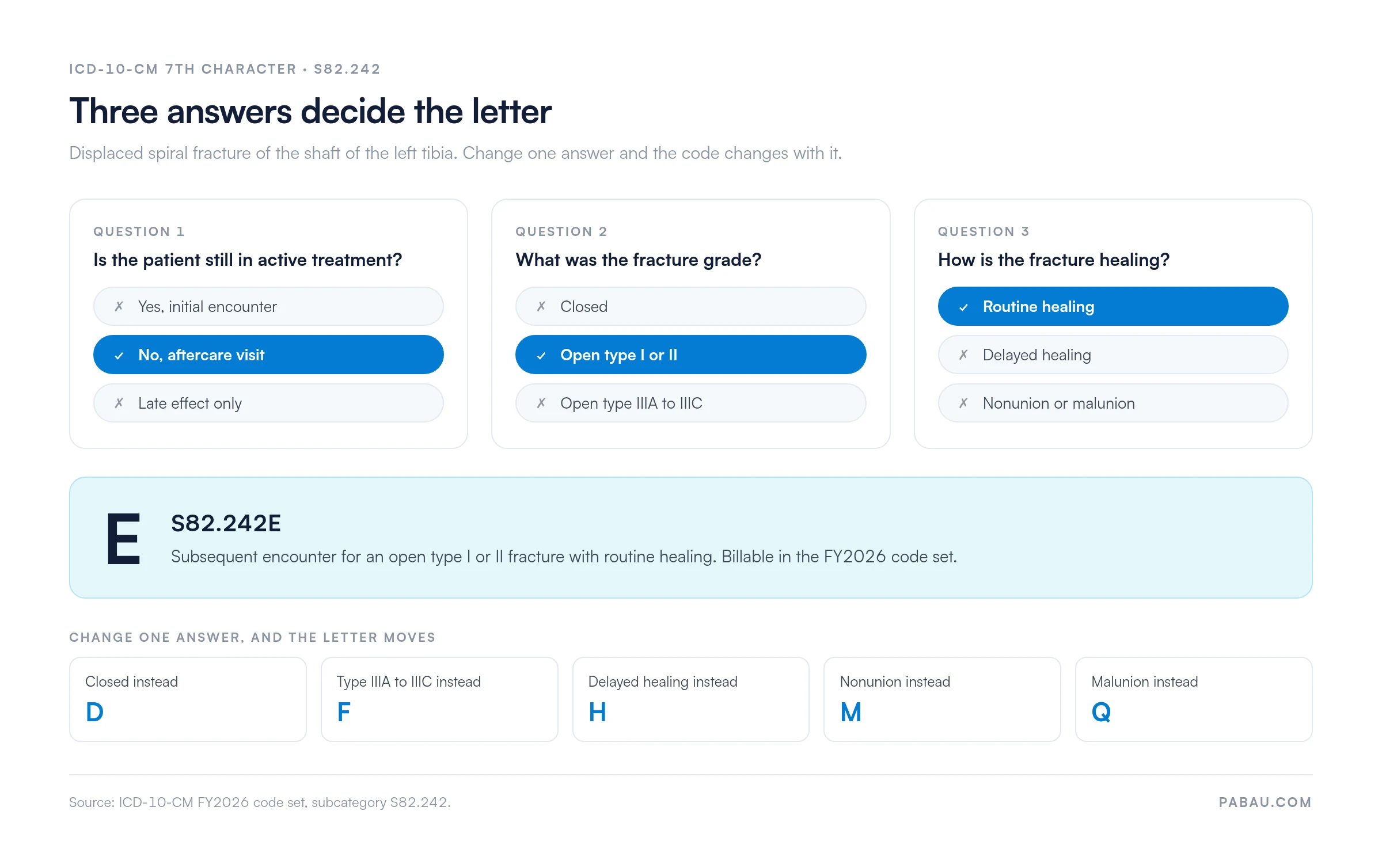
E therefore sits at one precise intersection. The encounter is not the first. The fracture was open at Gustilo type I or II, and healing is on track.
Change any one of those three facts and the letter changes with it. A closed fracture healing routinely is D, and a type III fracture healing routinely is F.
The Gustilo-Anderson classification grades open fractures by wound size, contamination, and soft tissue damage.
Gustilo and Anderson described it in 1976, and the ICD-10-CM seventh characters group along the same lines.
Gustilo grading is a physician judgment made from intraoperative findings. The operative report has to state the grade, because a coder cannot assign type I or II from a wound description alone.
S82.242E is the routine healing code, so the other three outcomes sit under different letters. Which one applies is a physician determination recorded in the clinical or imaging note. A coder never infers it from the procedures billed.
Read across the row for the healing outcome, then down the column for the fracture grade. For an open type I or II fracture of the left tibial shaft, routine healing is S82.242E and malunion is S82.242Q.
S82.242E needs the note to show healing on track. Look for callus formation, progressive union, maintained alignment, or a wound that healed without complication. Words such as angulated, malpositioned, or healed in deformity point to S82.242Q instead. Absent callus or a persistent fracture line points to S82.242M. Query the physician when the note describes progress in vague terms.
A subsequent encounter with routine healing is ordinary aftercare, not a complication visit. The patient has finished active treatment and returns so the surgeon can confirm the tibia is uniting as expected.
In practice, that is one of five visits.
Each of these is aftercare during the healing phase, which is what subsequent encounter means in ICD-10-CM. Active treatment of the injury itself takes an initial encounter character instead.
S82.242E sits in a tight code family, and most miscodes on this diagnosis come from one of the codes below. Six of them change only the seventh character, so the difference is encounter grade or healing status.
One trap sits inside this list. The unspecified laterality code is S82.243E, not S82.249E. The sixth character in this subcategory runs 1 to 6, so it never ends in 9. Digit 4 in that range is the nondisplaced right tibia. With an open type IIIA to IIIC fracture healing routinely, that combination gives S82.244F.
For the type III nonunion version of the same fracture, see ICD-10 code S82.242N. The AAPC ICD-10-CM lookup carries the full seventh-character list.
S82.242E is the last step in a chain that starts at a whole body region. Each level adds one fact, and only the seven-character version can go on a claim.
Providers rarely write the code description word for word. These phrases in a follow-up note all point to S82.242E, provided the Gustilo grade and the healing status appear somewhere in the record.
Synonyms help a coder recognize the diagnosis in free text. They do not replace the documented Gustilo grade, laterality, displacement, and healing status.
A routine healing follow-up is an evaluation and imaging encounter, so the procedure list is short. The codes below fit the aftercare that S82.242E describes.
Payer bundling and global period rules still apply, so check coverage policy before submission.
Three codes get attached to this diagnosis by mistake. CPT 27720 and 27722 describe repair of nonunion or malunion of the tibia. Either one contradicts a routine healing seventh character.
CPT 27758 covers open treatment of a tibial shaft fracture, which is active treatment. That belongs with an initial encounter character such as B.
Six facts must appear in the record before this code is defensible. Missing any one of them produces a physician query, a less specific code, or a denial.
The ICD-10-CM Official Guidelines are explicit that aftercare Z codes do not apply to injuries. Follow-up care for a fracture uses the injury code with a subsequent encounter seventh character.
That is exactly what S82.242E does. Build these six checks into the follow-up template and the code stops depending on anyone’s memory.
These are the error patterns that generate denials and audit flags on this code. Each one starts in documentation rather than in the billing office.
Picking the letter is only the first step. Take a patient who returns six weeks after fixation of an open type II spiral fracture of the left tibia. Here is the path that claim takes.
Two of those steps fail more often than the rest. Step two breaks when the note never states the Gustilo grade, which leaves E and F indistinguishable. Step five breaks when the procedure contradicts the diagnosis.
The remittance then comes back carrying one of the standard denial codes instead of a payment.
The documentation list above covers the note. This one covers the claim itself, and it takes about a minute.
Run that check once and most denials on this code never happen. Running it on every follow-up, for every patient, is the harder part.
Follow-up coding usually breaks down in the handoff between the exam room and the biller. The surgeon records that the tibia is uniting. Days later a coder rebuilds the seventh character from a note written for a clinical reader, not for a claim.
Practice management software like Pabau keeps the diagnosis, the charge, and the note on one patient record. Built-in ICD-10 and CPT catalogs let staff select S82.242E at the point of charge entry.
The seventh character then comes from a list instead of memory. Follow-up templates carry the six facts the code needs, which keeps the query rate down.
Our claims software for practices then files the claim, tracks its status, and posts the remittance against the same visit. When a denial does come back, it lands on the encounter that caused it. The fix therefore reaches the person who writes the note.

Pabau keeps ICD-10 and CPT selection, clinical notes, and claim submission on one record, with electronic filing and remittance built in. Book a demo to see how orthopedic follow-up billing runs end to end.

ICD-10 code S82.242E is a routine healing code, and that single fact shapes the rest of the claim. The encounter is aftercare, the original fracture was open at Gustilo type I or II, and the bone is uniting on schedule. The letter describes no complication at all.
Read the seventh character wrong and the claim tells a clinical story the note cannot support. Malunion and nonunion have their own letters for that reason. Keep laterality, morphology, displacement, Gustilo grade, encounter sequence, and healing status in the follow-up template, and the code assigns itself.
To see how Pabau handles fracture coding, claim submission, and denial follow-up in one system, book a demo with our team.

Need to understand how ICD-10 coding integrates with claim submission? Claim.MD clearinghouse guide explains how electronic claims flow from diagnosis code to payer remittance.
Reviewing denial patterns on fracture and orthopedic claims? Denial codes in medical billing covers common CARC codes and appeal workflows for musculoskeletal claims.
Want to understand the 837P claim file behind ICD-10 submissions? 837 file guide explains the electronic transaction structure used for professional claims including fracture diagnoses.
Want fewer follow-up claims coming back rejected? Clean claim guide sets out what a payer needs on first submission, from coding detail to eligibility checks.
No. Stress fractures of the tibia belong to M84.36-, with M84.362 for the left tibia. S82.242E covers a traumatic spiral fracture from a single injury, not a fatigue fracture built up over time.
Not by default. ICD-10-CM sets no national requirement for external cause code reporting, so it depends on your state, payer, or registry mandate. When you do report one, match its seventh character to the encounter.
Yes. On a visit that exists to check the fracture, S82.242E is the reason for the encounter, so it goes first. List every other condition the visit addressed after it.
Through the healing phase, for as long as the fracture is still uniting. Once healing finishes, a later visit for a residual problem takes the sequela character S, which is S82.242S here.
No, it codes the tibia only. A fibula shaft fracture takes its own code from S82.4-, reported alongside S82.242E with the seventh character that fits its own healing status.