ICD-10 Code S82.255S: Sequela of nondisplaced comminuted left tibial shaft fracture
ICD-10 code S82.255S at a glance ICD-10 code S82.255S is the billable ICD-10-CM ...

Last Updated: Oct 22, 2026
Billable Code Specific Code
S82.236K is the billable ICD-10-CM code for nondisplaced oblique fracture of shaft of unspecified tibia, subsequent encounter for closed fracture with nonunion.
Coders assign it at a follow-up visit when the provider documents that a nondisplaced oblique tibial shaft fracture has failed to heal. It applies only when the record doesn't say which leg is affected. Seventh character K separates nonunion from routine healing (D), delayed healing (G), and malunion (P). That choice rests entirely on the provider's note, so a vague note leaves the coder unable to support K.
Let Pabau's smart automation suggest the right codes, reduce claim denials, and keep your practice compliant—effortlessly.
Automate repetitive tasks and focus on what matters most—your patients.
Reduce coding errors and ensure compliance with the latest regulations.
Clean claims, fewer denials, and faster reimbursements.
Powerful insights and reporting to help your practice thrive.
HIPAA compliant SOC 2 certified GDPR-compliant Trusted by 4,000+ clinics worldwide

S82.236K codes a nondisplaced oblique tibial shaft fracture, unspecified leg, at a subsequent encounter where nonunion is documented.
Seventh character K requires the provider to document nonunion explicitly. Imaging findings alone don’t support it without a clinician statement.
Unspecified laterality (.236) is valid only when documentation genuinely omits left or right. Payers may deny or downcode when laterality can be inferred from the record.
Open fractures with nonunion take M or N instead of K, based on the Gustilo type the treating surgeon documented.
Pabau, the practice management and billing platform we build, puts ICD-10-CM code search inside the clinical workflow and flags CPT-ICD mismatches before claim submission.
ICD-10 Code S82.236K carries the full official descriptor: “Nondisplaced oblique fracture of shaft of unspecified tibia, subsequent encounter for closed fracture with nonunion.” Each character encodes a distinct clinical fact, so one wrong character produces a different code that the documentation doesn’t support.
Per the CMS ICD-10-CM coding updates, all codes in the S82 category cover fractures of the lower leg. The S82.2 subcategory restricts this further to the tibial shaft (diaphysis), excluding the proximal plateau and distal epiphysis.
The sixth character encodes displacement and laterality together. For nondisplaced oblique fractures, .234 is right leg, .235 is left leg, and .236 is unspecified leg. Codes .231 to .233 are the displaced oblique codes.
Seventh character K means the patient is at a follow-up visit (subsequent encounter) for a closed fracture that has failed to achieve bony union. Section I.C.19.a of the ICD-10-CM Official Guidelines governs how seventh characters are applied. The CDC ICD-10-CM code tool lists six seventh characters for closed fractures of the tibial shaft: A, D, G, K, P, and S.
There is no single clinical cutoff for nonunion. The most widely cited definition comes from the FDA, as summarized in StatPearls. It requires at least nine months since injury and no visible progress toward healing over three consecutive months. StatPearls calls this a loose definition, because bones heal at different rates.
Medicare’s NCD 150.2 applies its own, shorter test for bone stimulator coverage, and the ICD-10-CM guidelines set no time cutoff at all.
What distinguishes K from G (delayed healing) is the provider’s clinical judgment, documented explicitly in the note. A radiograph showing persistent fracture lucency is necessary evidence, but it isn’t enough on its own to justify K on the claim. The provider must state that nonunion is present.
S82.236 without a seventh character is not a billable code. Every encounter must append one of the following seventh characters. The table covers closed-fracture variants.
Open-fracture seventh characters apply when the Gustilo classification is documented by the treating surgeon. B (open type I or II) and C (open type IIIA, IIIB, or IIIC) cover the initial encounter. E, F, H, J, M, N, Q, and R cover subsequent encounters.
The code S82.236A is appropriate for every visit during the active treatment phase, regardless of how many visits that entails. Once active treatment ends and the patient moves to monitoring, the coder switches to D, G, K, or P based on the progress note. Switching back from K to D is not appropriate unless documentation explicitly describes new healing activity.
Choosing S82.236K means confirming four documented facts in order. They are the fracture pattern and site, displacement, laterality, and healing status. The chart below shows where the code goes when the note says something else at any step.
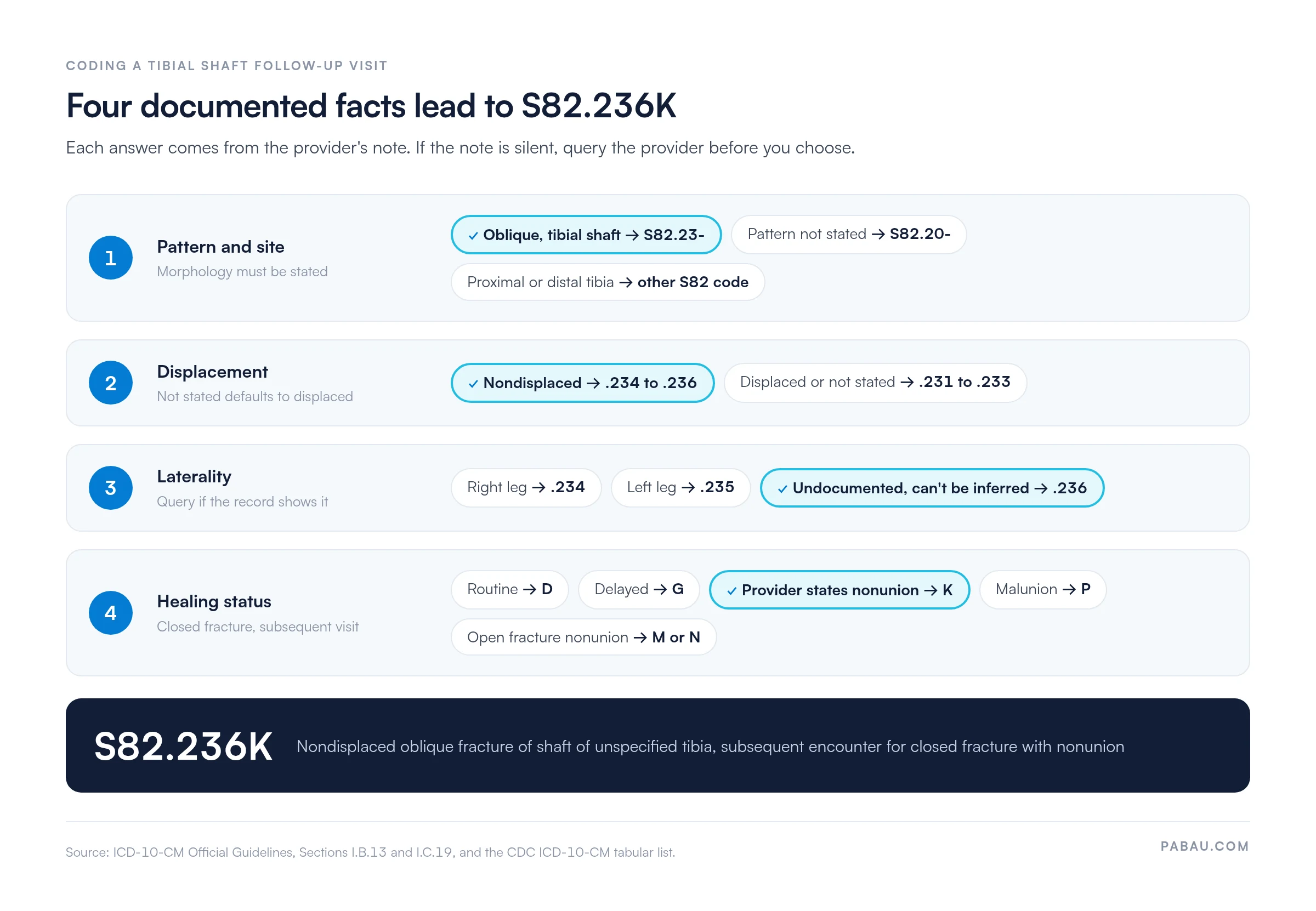
Unspecified laterality (.236) is valid when the documentation genuinely does not specify left or right leg. ICD-10-CM Official Guidelines Section I.B.13 instructs coders to assign the unspecified code only when the information is not available. Laterality must be queried from the provider if it can be determined from the record and was merely omitted from the note.
Many payers, including Medicare Advantage plans, flag unspecified laterality on musculoskeletal claims for additional review or deny outright, so resolving it upfront saves appeals.
Nonunion (seventh character K) and malunion (seventh character P) are not interchangeable. Nonunion means the fracture has failed to heal. The fracture gap persists on imaging, and the provider confirms there is no bridging callus. Malunion means healing has occurred but the bone has consolidated in an angulated, rotated, or shortened position.
Assigning K when the provider documents malunion, or P when nonunion is stated, constitutes a coding error that can trigger a medical necessity denial. The two conditions need separate clinical and radiographic documentation, and neither can be assumed from the other.
When a note calls the fracture ‘not healing well’ without naming nonunion or malunion, query the provider before assigning K or P to the claim. Coding guidance requires explicit clinician documentation of the healing complication. A vague phrase does not satisfy the specificity requirement and risks a post-payment audit.
A tibial shaft fracture nonunion claim that carries S82.236K must be supported by progress notes and imaging that establish five elements. Missing any one of them gives an auditor grounds to downcode or deny.
S82.236K assumes a closed fracture. If the original fracture was open, alternate seventh characters apply based on the Gustilo-Anderson classification documented by the treating surgeon. Open tibial shaft fractures with nonunion use the following seventh characters instead of K.
Gustilo classification must be documented by the surgeon who treated the open wound. Coders must not infer the Gustilo type from soft tissue description alone. If open fracture type is not documented, assign the closed-fracture seventh character (K) per the default-to-closed rule in ICD-10-CM Guidelines Section I.C.19.c.
Claims carrying S82.236K often go through medical necessity review, because nonunion treatment tends to involve surgery or durable medical equipment. A clearinghouse that validates CPT-ICD pairings before transmission catches a mismatch before the payer does.
The CPT and HCPCS codes most frequently paired with S82.236K reflect the clinical interventions for tibial shaft fracture nonunion. Medical necessity for each pairing must be individually established in the documentation.
A visit that only monitors the nonunion is billed with an established-patient office visit code, such as 99213. The E/M level follows the medical decision-making or total time documented for that visit.
For bone stimulator claims (E0747), Medicare and most commercial payers require a Local Coverage Determination (LCD)-compliant note. It must show failure of conservative treatment and physician attestation of nonunion. It must also show at least 3 months without healing, documented on serial radiographs at least 90 days apart (Medicare NCD 150.2).
Verify the applicable LCD by Medicare Administrative Contractor (MAC) jurisdiction, as policies vary across regions.
S82.236K denials cluster around six root causes. Each one traces back to a specific weakness in the record, so coders can fix it before submission instead of after.
Good denial management workflows start at coding, not at remittance. Every claim should also pass as a clean claim before it leaves the practice. That means no missing fields, correct modifiers, and matched CPT-ICD pairs.
When one of these slips through, the remittance carries a claim adjustment reason code that names the failure. Our list of common medical billing denial codes explains what each one means and how to correct it.
Run a pre-submission audit on all claims pairing E0747 with S82.236K. Medicare NCD 150.2 treats a long bone fracture as a nonunion only after 3 or more months with no healing. The notes must show this on at least two sets of radiographs taken at least 90 days apart.
Section I.C.19 of the ICD-10-CM Official Guidelines governs all injury and fracture coding. CMS and the National Center for Health Statistics (NCHS) at the CDC publish the guidelines each year. ResDAC explains how these diagnosis codes appear in Medicare claims files.
Staying current with medical billing compliance requirements means reviewing these guidelines with each annual ICD-10-CM update. The rules most relevant to S82.236K are summarized below.
Without a coding check at the point of care, a nonunion claim usually gets reviewed after the visit. A biller compares the note with the codes, then chases the provider for a missing laterality or nonunion statement. By then, the patient has left and the details are harder to recall.
Pabau moves that check into the visit. Clinicians search ICD-10-CM codes from inside the patient record, and each diagnosis links straight to its invoice and procedure line. Pabau’s claims management software then flags a CPT-ICD mismatch, such as E0747 billed without S82.236K, before the claim goes out.
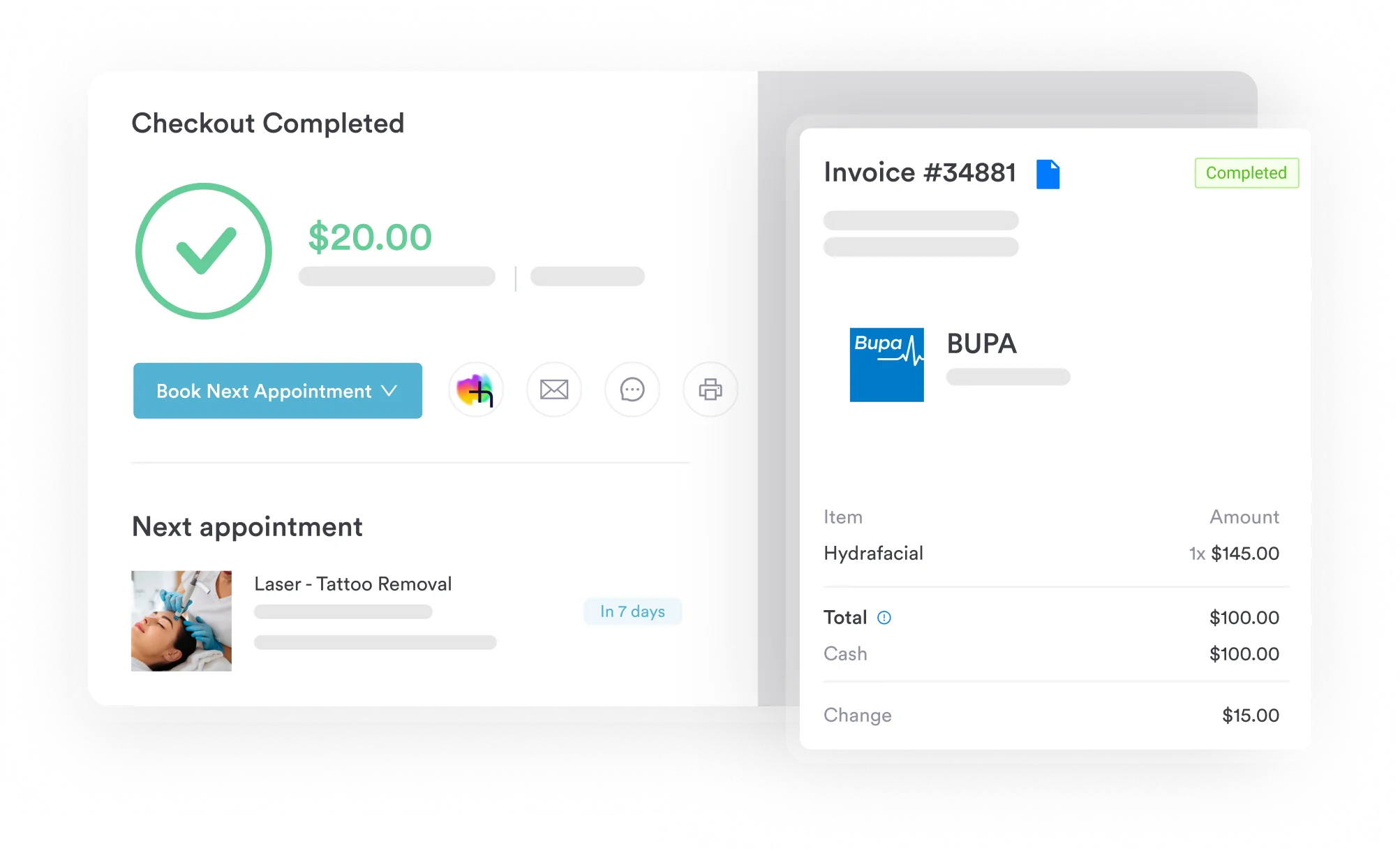
Clean claims go out through Pabau’s Claim.MD clearinghouse integration, which connects to thousands of US payers and runs real-time eligibility checks. Your team fixes a weak note while the provider still remembers the visit, instead of after the denial arrives.

Pabau links ICD-10 diagnosis codes directly to invoices and procedure lines, flags CPT-ICD mismatches at entry, and submits clean claims through the Claim.MD clearinghouse. See how it fits your orthopedic or multi-specialty workflow.

S82.236K comes down to one habit. Read the note for an explicit nonunion statement before you choose the seventh character, and query the provider if it isn’t there. Inferring K from an X-ray is how these claims get denied.
Apply the same discipline to laterality. An unspecified leg is valid only when the record doesn’t say which tibia is affected, so check earlier encounters before you settle for .236.
Building these checks into the visit means fewer claims come back for rework or appeal. Book a demo to see how Pabau links each nonunion diagnosis to its claim before it leaves your practice.

Need to understand how clearinghouse validation reduces denials? Claim.MD clearinghouse overview explains how real-time claim scrubbing catches ICD-CPT mismatches before payer submission.
Looking to understand the full 837 claim submission workflow? 837 file guide covers the EDI transaction format used to submit ICD-10-coded claims electronically.
Want to verify insurance eligibility before a follow-up fracture encounter? Insurance eligibility verification guide outlines the process for confirming coverage before a subsequent-encounter visit.
ICD-10 Code S82.236K is the billable diagnosis code for a nondisplaced oblique tibial shaft fracture, unspecified leg, that has failed to heal (nonunion). It is used for follow-up visits after the active treatment phase when the provider documents that bony healing has not occurred.
S82.236A is used during the initial, active treatment phase of the fracture (surgery, casting, emergency visit). S82.236K is used at a subsequent follow-up encounter where the provider documents nonunion. The seventh characters A and K are mutually exclusive. A applies during active care, and K applies once the patient is in the monitoring phase and healing has failed.
Seventh character K designates a subsequent encounter (follow-up visit) for a closed fracture with nonunion, meaning the fracture has not achieved bony healing. It is distinct from D (routine healing), G (delayed healing), P (malunion), and S (sequela), all of which describe different healing outcomes at subsequent visits.
Nonunion (seventh character K) means the fracture has not healed at all. The gap persists with no bridging callus. Malunion (seventh character P) means the fracture has healed but in a mechanically incorrect position, such as angulation or shortening. The two require different documentation and cannot be coded interchangeably.
Always use the subsequent-encounter code for a fracture follow-up, never an aftercare Z code. Per Guidelines Section I.C.19.a, aftercare Z codes are not used for injuries at all. Assign the fracture code with the seventh character for the current healing status (D, G, K, or P). Visits where healing is routine take D.
A frequent denial trigger is a provider note that does not explicitly state nonunion, since imaging alone is insufficient. Claims also fail when the seventh character does not match the documented healing status. Unspecified laterality is another trigger when left or right can be determined from the record. So is a CPT procedure code that does not align with a nonunion diagnosis. Each issue requires a documentation correction or provider query before resubmission.