ICD-10 Code Y76.0: Diagnostic obstetric and gynecological devices
ICD-10 Code Y76.0: Definition and billable status ICD-10 Code Y76.0 is a valid, ...

Last Updated: Oct 23, 2026
Billable Code Specific Code
S82.142D is the billable ICD-10-CM code for displaced bicondylar fracture of left tibia, subsequent encounter for closed fracture with routine healing. It applies at follow-up visits after active treatment ends, such as a cast change, a healing X-ray or a medication adjustment.
The code rests on six facts in the note: left side, both condyles, displacement, closure, finished active treatment and routine healing. Miss one and the claim belongs to a sibling code, or comes back for a 7th-character mismatch. Each fact can be confirmed before the claim leaves the practice, and the sections below show how.
Let Pabau's smart automation suggest the right codes, reduce claim denials, and keep your practice compliant—effortlessly.
Automate repetitive tasks and focus on what matters most—your patients.
Reduce coding errors and ensure compliance with the latest regulations.
Clean claims, fewer denials, and faster reimbursements.
Powerful insights and reporting to help your practice thrive.
HIPAA compliant SOC 2 certified GDPR-compliant Trusted by 4,000+ clinics worldwide

S82.142D is the billable ICD-10-CM code for a displaced bicondylar fracture of the left tibia at a routine-healing follow-up visit.
The 7th character D applies after active treatment is completed, during routine care such as cast changes, healing X-rays and medication adjustments.
Reporting S82.142A at a follow-up visit instead of S82.142D is a frequent coding error, because A signals active treatment.
Side, both condyles, displacement, closure and healing status all need to be clear in the note before the code is assigned.
When the side is not documented, S82.143D is the unspecified fallback, but a physician query should come first.
ICD-10 code S82.142D is the billable ICD-10-CM code for a displaced bicondylar fracture of the left tibia, at a subsequent encounter with routine healing. In practice, that means a follow-up visit after surgery or casting, when the fracture is mending as expected.
The code narrows in steps. S82 covers fractures of the lower leg, S82.1 the upper end of the tibia, and S82.14 bicondylar fractures. S82.142 adds the left side, and the 7th character D marks routine healing. The code is active in the FY2025, FY2026 and FY2027 ICD-10-CM releases.
A bicondylar fracture breaks both the medial and lateral condyles of the proximal tibia. That is the flared top of the bone, which forms the lower half of the knee joint. Displaced means the fragments have shifted out of alignment. A nondisplaced break, with alignment preserved, codes to S82.145x instead.
These injuries usually follow high-energy trauma, such as a car crash or a fall from height. Patients tend to arrive with joint-line tenderness, heavy swelling and an inability to bear weight.
Laterality is mandatory in ICD-10-CM. S82.142x codes apply to the left tibia only, and right-side fractures use S82.141x. An unspecified-side displaced bicondylar fracture uses S82.143x (displaced bicondylar fracture of unspecified tibia). That fallback should prompt a coder query first. You can compare every sibling in our ICD-10-CM reference for coders.
Closure status matters too. S82.142D assumes a closed fracture. Open fractures take their own 7th characters, based on the Gustilo classification.
The 7th character D means routine care during the healing or recovery phase, after active treatment is completed. ICD-10-CM Official Guidelines Section I.C.19.a gives examples such as cast changes or removal, X-rays to check healing, and medication adjustments. Other aftercare and follow-up visits after treatment of the injury qualify too.
Here is where D sits among the other 7th characters for S82.142x.
Delayed healing, nonunion and malunion are clinical calls. A coder can’t infer them from the notes, so each needs explicit physician documentation before G, K or P is assigned.
S82.142D sits in a crowded sibling group. A wrong pick typically comes down to encounter type, laterality or displacement. The decision path below runs the checks in the order a coder reads the note.
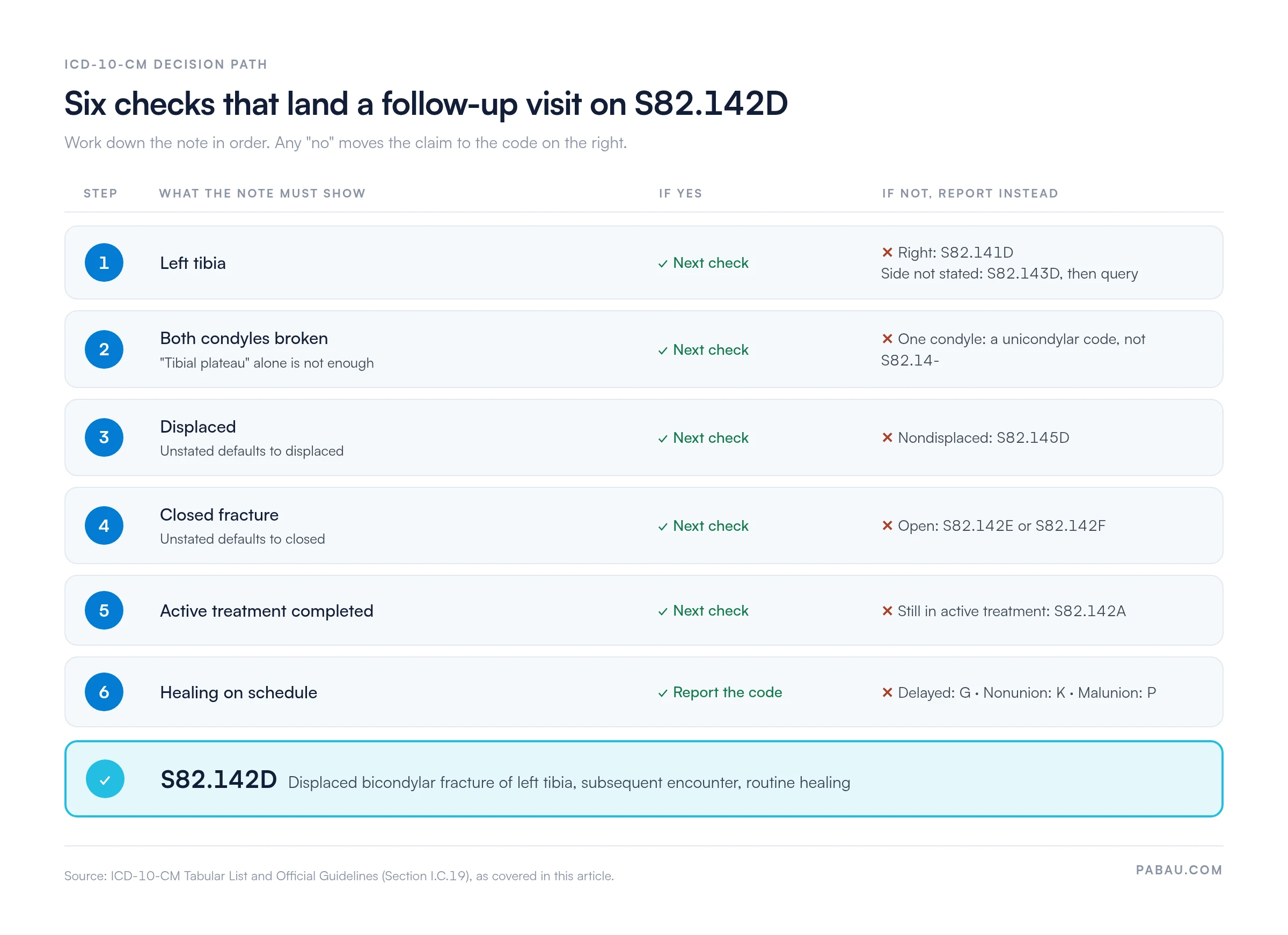
The table lists the same siblings, with the mistake that usually lands a claim on each one.
A patient had open reduction and internal fixation for a left bicondylar plateau fracture six weeks ago. Today’s note reads: “Left tibia, both condyles, displaced, closed. Callus on X-ray, healing as expected. Weight-bearing advanced.”
All six checks pass, so the visit codes to S82.142D. The surgeon’s operative claim carried S82.142A. Had the note said “healing slower than expected,” the code would move to S82.142G instead.
Six elements need to be clear in the note before a coder assigns S82.142D. A missing one either triggers a query or forces a less specific code.
When documentation says ‘tibial plateau fracture’ without specifying condyle count, query the physician before defaulting to a bicondylar code. A unicondylar plateau fracture codes differently, and the distinction affects surgical CPT selection as well as the ICD-10 assignment.
Because S82.142D marks a subsequent encounter, its CPT partners are follow-up and management services. The operative codes, 27535 and 27536 for open treatment of tibial plateau fractures, go with S82.142A on the surgical claim.
Check the global period before billing a visit. The surgeon’s routine post-op visits fall inside the 90-day global package and aren’t billed separately. Medicare pays diagnostic X-rays outside that package, but commercial rules vary, so confirm the contract.
NCCI edits also update quarterly. Confirm the active version before you bill imaging alongside an office visit.
Payer rules for S82.142D change by program and service type, and they change every year. Use the points below as a starting map, then confirm against the current plan policy.
Run a real-time eligibility check through your clearinghouse ahead of each visit, confirming active coverage before the patient arrives. A lapsed plan is far easier to fix at check-in than after a denial lands.
The same denial patterns keep returning on this code. Each one has a documentation or submission fix.
Tracking the CARC on each denial shows which pattern keeps recurring. A structured denial management process then fixes the cause upstream, so the same claim isn’t resubmitted again and again.
Run a monthly audit of S82.14x claims for the 60 days after each patient’s initial fracture visit. Flag any later claim still carrying A when the note shows active treatment had ended. These are your quickest resubmission wins.
The S82 category carries instructional notes that decide which codes can sit beside S82.142D. Reading them first prevents both undercoding and coding conflicts.
Excludes1 note at S82: traumatic amputation of the lower leg (S88.-) is an Excludes1 exclusion. S82 and S88 codes can’t be reported together, so if an amputation occurred, only the amputation code applies.
Excludes2 notes at S82: fracture of foot (S92.-) and periprosthetic fracture around an internal prosthetic implant of the knee (M97.-) are Excludes2 exclusions. These conditions can coexist with a tibial fracture and be coded together when both are documented.
“Code also” for open wounds: if an associated open wound is present, the tabular instructs the coder to add a code for the wound. That holds at subsequent encounters while the wound is still being managed.
Fibula fractures: S82.142D covers the tibia only. A documented fibula fracture needs its own code, for example from S82.4x (fibula shaft) or S82.6x (lateral malleolus). Don’t assume the tibia code captures both bones.
For the full tabular list and its notes, use the CDC’s ICD-10-CM web tool. The AAPC Codify ICD-10-CM lookup adds clinical crosswalk context for harder scenarios.
CMS’s ICD-10 codes page carries the annual update files and coding guidelines. The ResDAC ICD codes resource shows how these codes appear in Medicare claims data, which helps with compliance audits.
Clean S82.142D claims depend on consistent 7th characters across the whole episode. Each follow-up claim should read logically next to the earlier A-character claim in the patient record.
A fracture episode means the same admin at every visit. Staff re-key the diagnosis, re-check coverage and chase each remittance by hand.
Pabau, the practice management and billing platform we build, pre-fills each claim from the patient record. The diagnosis already on the problem list lands on the claim form. Its claims software for practices checks required fields before sending. It also runs eligibility checks, ERA posting and claim tracking through Claim.MD.
Choosing the 7th character stays a coding decision, made from the note. The time around it shrinks, with fewer manual steps per visit and denials that are easier to trace.

Pabau pre-fills claims from the patient record, checks required claim fields and runs Claim.MD eligibility checks before submission. Your team spends less time rekeying and chasing follow-up visits.

S82.142D is narrow by design. It fits a left bicondylar tibial fracture that is past active treatment and healing on schedule.
The habit worth keeping is simple: re-check the 7th character at every visit of the episode. The note changes as healing progresses, and the code has to follow it.
For practices with a steady flow of orthopedic follow-ups, software can take the repeat work off each claim. Pabau’s claims management software pre-fills claims from the record and provides ICD-10-CM and CPT code lookup. It also checks required claim fields and runs eligibility checks via Claim.MD before submission.
Book a demo to see how it handles your fracture follow-up billing.

Seeing the same denials every month? Denial management in healthcare shows how to build a tracking and resubmission workflow that recovers revenue.
Want fewer edits before claims leave the practice? What is a clean claim walks through the structural checks that stop rejections early.
Unsure when orthopedic follow-ups need approval? The prior authorization process explains how requests move and where they stall.
Curious what happens between submission and payment? What is a medical claims clearinghouse covers how claims are checked and routed to payers.
No. ICD-10-CM guidelines (Section I.C.21.c.7) say aftercare Z codes aren’t used for injuries where a 7th character identifies subsequent care. For aftercare of this fracture, report the injury code itself, S82.142D.
It depends on the treatment stage, not the provider. Guideline I.C.19.a bases the 7th character on whether the patient is receiving active treatment. A new surgeon taking over a healing fracture still reports S82.142D.
They can. An external cause code, such as one for a fall, can be reported at each encounter while the injury is treated. Its 7th character matches the injury code. Place of occurrence (Y92) and activity (Y93) codes are reported only once, at the initial encounter.
Routine removal of an internal or external fixation device is one of the guidelines’ own D examples, so S82.142D still applies. If the hardware failed, loosened or became infected, a complication code from T84.- applies instead.
Yes. S82.142D is active in the FY2027 ICD-10-CM code set, which took effect October 1, 2026. It was also valid in FY2025 and FY2026, so the code holds across an episode that spans the update.