Pabau Engage inbox

Pabau Engage is here: every patient conversation in one inbox.

Learn more
ICD-10-CM Code

ICD code S82.034H – Nondisplaced right patella fracture

Billable Code Specific Code


Code Definition

S82.034H is the billable ICD-10-CM code for nondisplaced transverse fracture of right patella, subsequent encounter for open fracture type I or II with delayed healing. It applies to follow-up visits after active treatment of a Gustilo type I or II open fracture of the right kneecap.

The 7th character H needs a physician note stating that healing is slower than expected. A closed fracture with delayed healing takes S82.034G instead, and a left-sided injury takes S82.035H.

Chapter
S00-T88 Injury, poisoning and certain other consequences of external causes
Category
S82 Fracture of lower leg, including ankle
Group
S82.034 Nondisplaced transverse fracture of right patella
Billable
Yes
Code also known as
broken right kneecap, right patella fracture
Save time. Improve accuracy. Get paid faster.
Automate coding with Pabau

Let Pabau's smart automation suggest the right codes, reduce claim denials, and keep your practice compliant—effortlessly.

  • AI-powered code suggestions
  • Real-time compliance checks
  • Faster claims, fewer denials
Why practices choose Pabau
Save hours every week

Automate repetitive tasks and focus on what matters most—your patients.

Improve accuracy

Reduce coding errors and ensure compliance with the latest regulations.

Get paid faster

Clean claims, fewer denials, and faster reimbursements.

Grow with confidence

Powerful insights and reporting to help your practice thrive.

HIPAA compliant SOC 2 certified GDPR-compliant Trusted by 4,000+ clinics worldwide

Key takeaways

Key takeaways

S82.034H is a billable FY2027 ICD-10-CM code for a nondisplaced transverse fracture of the right patella, open type I or II, with delayed healing.

The 7th character H carries three facts at once: a subsequent encounter, an open Gustilo type I or II fracture, and physician-documented delayed healing.

A closed fracture with delayed healing takes G instead, and an open type IIIA, IIIB, or IIIC fracture with delayed healing takes J.

S82.034H covers the right kneecap only; a left-sided injury takes S82.035H, and a record with no laterality takes S82.036H.

Pabau, the practice management platform we build, submits fracture claims through its Claim.MD integration and tracks denials by code.

ICD-10 Code S82.034H: Quick reference

ICD-10 Code S82.034H reports a follow-up visit for a nondisplaced transverse fracture of the right kneecap. The fracture was originally open, Gustilo type I or II, and the physician has documented that it is healing more slowly than expected.

The code sits in the S82 category (fracture of lower leg, including ankle). The table below lists the fields to check before submitting a claim.

FieldValue
CodeS82.034H
Full descriptorNondisplaced transverse fracture of right patella, subsequent encounter for open fracture type I or II with delayed healing
BillableYes – specific, valid for claim submission
Fiscal year validityFY2027 (October 1, 2026 through September 30, 2027); verify against the CDC/NCHS annual release
Code categoryS82 – Fracture of lower leg, including ankle
Parent blockS80-S89 – Injuries to the knee and lower leg
Anatomical siteRight patella (kneecap)
Fracture patternTransverse, nondisplaced
Encounter typeSubsequent encounter (active treatment complete)
Original injuryOpen fracture, Gustilo type I or II
Healing statusDelayed healing (physician-documented)

What does S82.034H mean? Breaking down the code

S82.034H is a seven-character alphanumeric code where each position narrows the clinical picture, from body region to fracture pattern to encounter context. Understanding the structure helps coders catch errors before submission rather than after denial.

Character(s)ValueMeaning
S82CategoryFracture of lower leg, including ankle
S82.0SubcategoryFracture of patella
S82.03Fracture patternTransverse fracture of patella
S82.0346th character = 4Nondisplaced transverse fracture of right patella (1-3 = displaced right, left, unspecified; 5 = nondisplaced left; 6 = nondisplaced unspecified)
H7th characterSubsequent encounter for open fracture type I or II with delayed healing

In the S82.03 family, the 6th character carries both displacement and laterality. Values 1 to 3 are displaced fractures of the right, left, and unspecified patella, and values 4 to 6 are the nondisplaced equivalents.

The nondisplaced designation is clinically significant. The fracture fragments stay in anatomical position, so the extensor mechanism is usually intact.

Selecting a displaced code (S82.031H) when imaging shows alignment is miscoding and creates audit exposure. The reverse also matters: the tabular list codes a fracture not documented as displaced or nondisplaced to displaced.

Anatomical site: The right patella

The patella, or kneecap, is the largest sesamoid bone in the body. It sits inside the quadriceps tendon at the front of the knee and glides in the trochlear groove of the femur. It protects the front of the knee joint and lengthens the lever arm of the quadriceps, which makes knee extension more efficient.

A transverse fracture runs horizontally across the patella, splitting it into an upper and a lower fragment. It often follows a sudden, forceful quadriceps contraction with the knee bent.

A direct blow, such as a fall onto the knee or a dashboard impact, is the other common cause. Because the patella sits just under the skin, a direct blow can also break the skin and turn the injury into an open fracture.

Key clinical facts that affect coding accuracy at orthopedic and physical therapy follow-up visits:

  • A transverse pattern (S82.03-) is distinct from osteochondral (S82.01-), longitudinal (S82.02-), and comminuted (S82.04-) patella fractures. The imaging report must name the pattern.
  • Nondisplaced status should be confirmed on imaging, and a fragment that displaces during follow-up changes the code to the displaced equivalent.
  • Delayed healing after an open patella fracture is linked to wound contamination, infection, smoking, diabetes, and loading the knee too early.
  • The 6th character (4 = right, 5 = left, 6 = unspecified for nondisplaced fractures) must match the documentation exactly. A laterality mismatch is a common reason S82.034H claims are flagged.

Understanding the 7th character H: Open fracture with delayed healing

The 7th character H tells the payer three facts. The patient is past active treatment, and the original fracture was open, Gustilo type I or II. The treating physician has also documented that healing is slower than expected.

Per the CMS ICD-10-CM Official Guidelines, subsequent encounter characters apply to every visit after active treatment, whichever provider sees the patient.

The open or closed status always describes the original injury. A type I or II open fracture keeps its open-fracture 7th character at every follow-up visit, even once the wound has fully closed. Gustilo type I is a clean wound under 1 cm, and type II is a 1 to 10 cm wound without extensive soft tissue damage.

The guidelines also set two defaults. A fracture not documented as open or closed is coded as closed, which points to G at a delayed-healing visit. An open fracture with no Gustilo type documented takes the type I or II character, so it stays on S82.034H.

Delayed healing is a distinct finding from nonunion and malunion. Healing is delayed when the fracture is still progressing toward union, but more slowly than normal. Nonunion means healing has stopped.

The table below lists the full 7th character family for S82.034, one row per encounter type and healing status. Choosing the character is one step in the wider medical billing workflow, and an error here follows the claim through every later step.

7th characterMeaningWhen to use
AInitial encounter for closed fractureActive treatment of a closed fracture
BInitial encounter for open fracture type I or IIActive treatment of a Gustilo type I or II open fracture (or an open fracture with no type documented)
CInitial encounter for open fracture type IIIA, IIIB, or IIICActive treatment of a Gustilo type III open fracture
DSubsequent encounter for closed fracture with routine healingFollow-up after active treatment; closed fracture healing normally
ESubsequent encounter for open fracture type I or II with routine healingFollow-up of a type I or II open fracture healing normally
FSubsequent encounter for open fracture type IIIA, IIIB, or IIIC with routine healingFollow-up of a type III open fracture healing normally
GSubsequent encounter for closed fracture with delayed healingClosed fracture; physician documents slower-than-expected healing
HSubsequent encounter for open fracture type I or II with delayed healingType I or II open fracture; physician documents slower-than-expected healing
JSubsequent encounter for open fracture type IIIA, IIIB, or IIIC with delayed healingType III open fracture; physician documents slower-than-expected healing
KSubsequent encounter for closed fracture with nonunionClosed fracture; physician diagnoses nonunion
MSubsequent encounter for open fracture type I or II with nonunionType I or II open fracture; physician diagnoses nonunion
NSubsequent encounter for open fracture type IIIA, IIIB, or IIIC with nonunionType III open fracture; physician diagnoses nonunion
PSubsequent encounter for closed fracture with malunionClosed fracture healed in a position of deformity
QSubsequent encounter for open fracture type I or II with malunionType I or II open fracture healed in a position of deformity
RSubsequent encounter for open fracture type IIIA, IIIB, or IIIC with malunionType III open fracture healed in a position of deformity
SSequelaLate effect of the fracture (such as post-traumatic arthritis); code the sequela condition first

Pro Tip

Delayed healing requires the physician to state it in the record. Phrases like ‘healing progressing’ or ‘fracture visible on X-ray’ do not support the H character. The note must say something like ‘healing delayed,’ ‘slower than expected healing,’ or ‘delayed union.’ The original open-fracture type must also be traceable in the record, usually in the initial encounter note.

S82.034H vs S82.034G vs S82.034E vs S82.034M: Choosing the right code

The most commonly confused sibling codes share the same site and fracture pattern but differ on open or closed status and healing status. Selecting the wrong one is the most common error on claims billed under ICD-10 Code S82.034H.

CodeOriginal injury and healing statusDocumentation requiredCommon error
S82.034EOpen type I or II, routine healingFollow-up note; no healing complication mentionedUsing E when the note says “slow healing” or “delayed union” (H is correct)
S82.034GClosed, delayed healingExplicit delayed-healing statement; no open wound at the time of injuryUsing G for an open fracture because the wound has since healed (H is correct)
S82.034HOpen type I or II, delayed healingExplicit physician statement of delayed healing; open-fracture type documented at the initial encounterUsing H without delayed-healing language, or for a closed fracture; laterality errors
S82.034JOpen type IIIA, IIIB, or IIIC, delayed healingDelayed-healing statement plus a documented Gustilo type III injuryUsing H when the initial note records a type III open fracture
S82.034MOpen type I or II, nonunionPhysician diagnosis of nonunion; imaging showing no bridging boneAssigning M when the record only supports delayed healing (H)

The practical decision rule takes two questions. First, was the original fracture closed, open type I or II, or open type III? That picks the G, H, or J column. Second, does the physician say “delayed union” (H), “nonunion” (M), or describe normal progress (E)? When the note is ambiguous, query the provider rather than defaulting to the H character. The grid below lays out the full set of subsequent-encounter answers for S82.034.
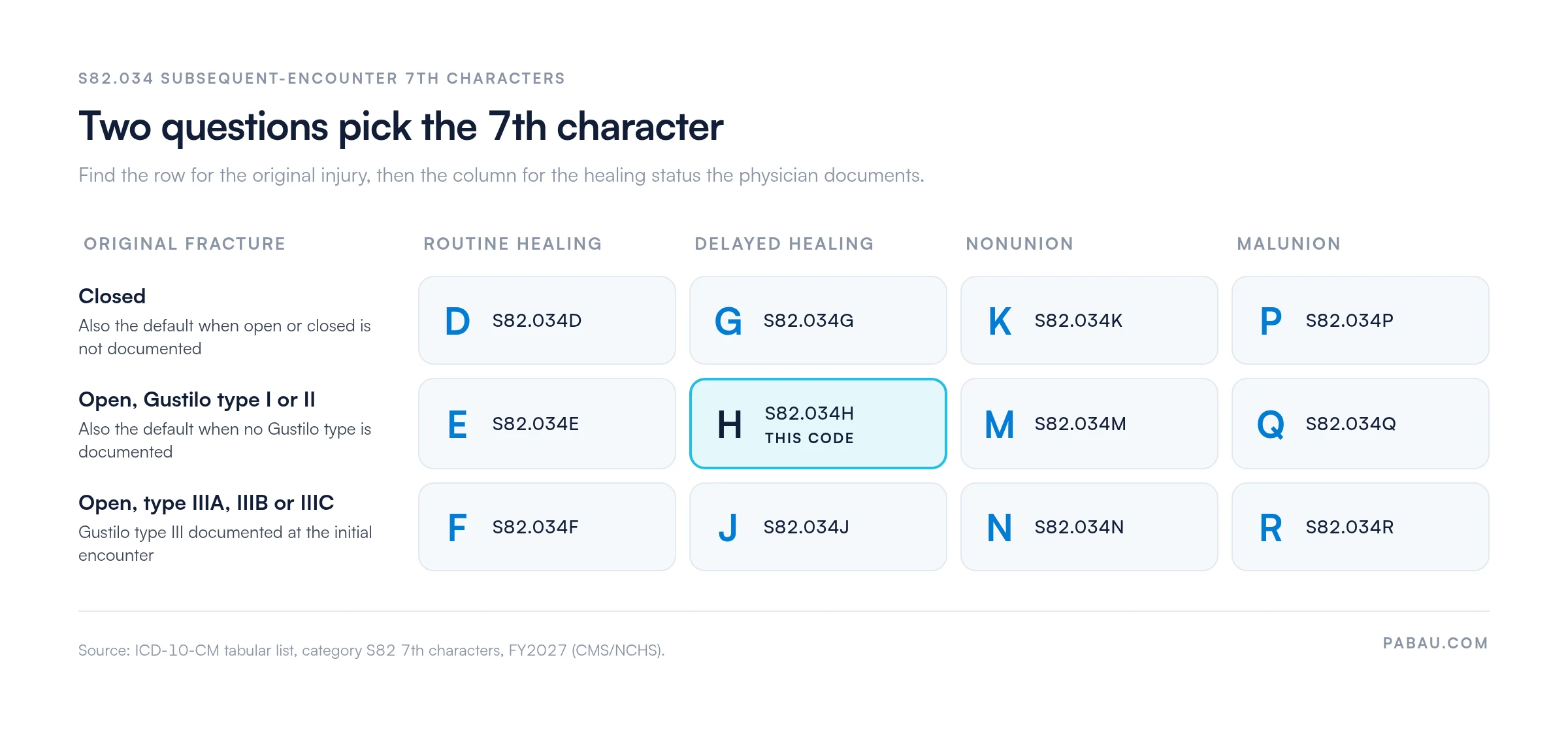
Grid of S82.034 subsequent-encounter 7th characters by original fracture and healing status
S82.034H sits where an open type I or II fracture meets documented delayed healing. A change in either answer moves the claim to a neighboring cell. Codes from the FY2027 ICD-10-CM tabular list.

The S82 category carries tabular notes that govern when these codes can be used. Per the CDC/NCHS ICD-10-CM web tool, the S82 category includes fracture of the malleolus and requires a 7th character for all codes in the category.

  • Includes: Fracture of malleolus
  • Excludes1 (cannot be coded together with S82.034H): Traumatic amputation of lower leg (S88.-)
  • Excludes2 (may be coded alongside when both exist): Fracture of foot, except ankle (S92.-), and periprosthetic fracture around an internal prosthetic ankle or knee joint
  • Category notes: A fracture not documented as displaced or nondisplaced is coded as displaced. One not documented as open or closed is coded as closed.

Related codes coders should have on hand when working in the S82.03 family:

CodeDescriptionRelationship
S82.035HNondisplaced transverse fracture of left patella, subsequent encounter for open fracture type I or II with delayed healingLeft-sided equivalent; confirm laterality before selecting
S82.036HNondisplaced transverse fracture of unspecified patella, subsequent encounter for open fracture type I or II with delayed healingUse only when laterality is not documented
S82.031HDisplaced transverse fracture of right patella, subsequent encounter for open fracture type I or II with delayed healingSame site and pattern but displaced; verify imaging before selecting
S82.034GNondisplaced transverse fracture of right patella, subsequent encounter for closed fracture with delayed healingClosed-fracture equivalent
S82.034MNondisplaced transverse fracture of right patella, subsequent encounter for open fracture type I or II with nonunionRequires a physician nonunion diagnosis; more severe than delayed healing
S82.044HNondisplaced comminuted fracture of right patella, subsequent encounter for open fracture type I or II with delayed healingDifferent fracture pattern; check the imaging description

Documentation requirements for billing S82.034H

Supporting documentation for ICD-10 Code S82.034H must confirm five elements, from the fracture itself to its laterality. Error-checking claims management software compares the claim with payer edits before submission, so a missing element is fixed before the payer sees it.

Each element has its own record requirement:

  • Fracture site, pattern, and displacement: An imaging report (X-ray, CT, or MRI) confirming a transverse fracture of the right patella with nondisplaced alignment. The attending physician’s note should reference the imaging and its date.
  • Open-fracture type: The initial encounter note should record that the fracture was open and give its Gustilo type, or leave the type unstated. A documented type III injury points to J, not H.
  • Encounter phase: The note must make clear that active treatment, such as wound debridement, antibiotics, and fixation or immobilization, has already occurred. The subsequent encounter starts with the first follow-up after that active treatment.
  • Delayed healing: A physician or NPP note explicitly stating delayed healing, delayed union, or healing slower than expected. Imaging showing inadequate bone healing at the expected point strengthens the record. Under the ICD-10-CM Official Guidelines, this rests on the provider’s documentation, so the coder cannot infer it.
  • Laterality: The note must specify the right patella. A record with no laterality takes the unspecified code (S82.036H). Bilateral injuries are coded separately for each side, with S82.034- for the right and S82.035- for the left.

A clean claim submission for S82.034H also needs the diagnosis code in the right position on the claim form. The date of service must fit the subsequent-encounter phase of the injury timeline. Structured clinical documentation reduces the ambiguous notes that cannot support the 7th character selected.

CPT codes commonly paired with S82.034H

S82.034H explains why the patient is being seen. The CPT code describes what was done at the visit. Delayed-healing follow-ups for an open patella fracture usually pair the diagnosis with one or more of these services:

CPT codeServiceCoding note
99212-99215Established patient office visitLevel depends on medical decision making or total time on the date of service
99024Postoperative follow-up visitUsed instead of an E/M code for routine follow-up inside a surgical global period
73560, 73562, 73564Knee radiographs (1-2, 3, or 4 or more views)Supports the delayed-healing finding with imaging
20979Low-intensity ultrasound stimulation to aid bone healing, noninvasiveCoverage varies; many payers limit it to documented nonunion and require prior authorization
97110Therapeutic exercise, each 15 minutesCommon in physical therapy for knee range of motion and quadriceps strength

Check each pairing against current NCCI edits and the payer’s own policy before submission, as bundling rules change each quarter.

Common claim denial reasons and how to avoid them

Claims billed under ICD-10 Code S82.034H deny more often than the S82.034E (routine healing) counterpart. The H character needs documentation that many follow-up notes do not explicitly provide. The denial management workflows that matter most for this code address five root causes.

  • Wrong healing status (H vs E): This is the most common denial. A note describing a follow-up visit with unremarkable healing supports E rather than the delayed-healing code. Prevention: add a prompt to orthopedic follow-up templates asking the physician to state healing status explicitly.
  • Wrong open or closed status (H vs G): Coders sometimes switch to G once the wound has healed. The open-fracture character follows the original injury, so a type I or II open fracture keeps the H character. Prevention: carry the open-fracture type forward from the initial encounter note.
  • H billed during active treatment: S82.034H cannot be used while the open fracture is still under active treatment, which takes the 7th character B instead. Prevention: confirm the claim history shows the initial encounter before H appears.
  • Laterality mismatch: Applying S82.034H (right patella) when the record says left patella. Claim edits do not always catch this because the code itself is valid, so it surfaces on pre-payment review or audit. Prevention: make laterality confirmation a mandatory step for all S82.03- codes.
  • H-to-M upcoding: Using M (nonunion) when the record supports H (delayed healing). Payers and RAC auditors target nonunion codes where the clinical timeline suggests delayed healing. Prevention: require imaging confirmation and explicit nonunion language before assigning M.

Practices managing ongoing fracture follow-up claims benefit from tracking denial patterns by 7th character. When H-code denials spike, check the follow-up template before retraining coders.

A template with no healing-status prompt is the usual cause. The denial codes reference lists the CARC codes behind these rejections and how to resolve each one.

Payer-specific guidelines: Medicare, Medicaid and commercial insurers

Payer requirements for subsequent-encounter fracture claims vary, and the documentation threshold for delayed healing is not uniform across contracts. Running insurance eligibility verification and checking applicable Local Coverage Determinations before the encounter reduces the risk of a claim failing payer edits.

  • Medicare (CMS): CMS does not publish a specific LCD for delayed healing of patellar fractures. For subsequent encounters, Medicare expects the date of service to fit the post-active-treatment phase. If the fracture was fixed surgically, routine follow-up inside the global surgical period is covered by the original procedure and billed with 99024. Treatment of a complication that needs a return to the operating room is reported separately.
  • Medicaid: State Medicaid plans follow CMS coding guidelines but may add prior-authorization requirements for extended fracture management or bone growth stimulation. Verify state-specific rules before billing S82.034H for encounters more than 90 days after injury.
  • Commercial insurers: Major commercial payers, including Anthem, UnitedHealthcare, and Aetna, generally follow the ICD-10-CM guidelines for subsequent encounter coding. Some plans flag delayed-healing codes with no imaging on file, so attaching the radiology report to the electronic claim reduces these edits. Verify current payer policies directly, as they change each year.

Pro Tip

Check the ICD-10-CM Official Guidelines for Coding and Reporting (Section I.C.19) before finalizing documentation standards for fracture follow-up encounters. The guidelines define initial vs subsequent encounter by the phase of treatment, not the provider. A physical therapist treating a delayed-healing open patella fracture therefore uses H, just as the orthopedic surgeon does.

How Pabau supports accurate coding for patella fracture follow-ups

Most coding errors on S82.034H start upstream of the claim. The open-fracture type is recorded at the first visit, and the delayed-healing statement appears months later. The coder then has to stitch the two together from separate notes.

In Pabau’s EHR and billing software, the initial encounter note, imaging, follow-up notes, and claim sit in one patient record. Customizable follow-up templates can prompt the physician to state healing status and laterality at every visit.

Claims go out electronically through the Claim.MD integration. Denials can be tracked by code, so a template that never asks for healing status gets caught early.

Streamline orthopedic claims from documentation to submission

Pabau’s claims management integrates with Claim.MD to validate ICD-10 codes, track denials by code, and submit clean claims electronically. Practices spend less time reworking fracture follow-up claims.

Pabau claims management dashboard

Conclusion

S82.034H is rarely the wrong code because of the fracture itself. It goes wrong when the 7th character drifts away from the record: H billed without delayed-healing language, or switched to G once the wound closes.

Anchor each follow-up claim to two documents: the initial note that records the open-fracture type, and the current note that states healing status and laterality. If either is missing, query the provider before submission. That step costs minutes, and a denied or audited claim costs far more.

Book a demo to see how Pabau links fracture documentation to clean, accurately coded claims for orthopedic and physical therapy practices.

Continue your research

Continue your research

Need to understand how clean claims reduce rework? Clean claim best practices covers the documentation and submission steps that keep fracture claims out of the denial queue.

Want to track denial patterns across your orthopedic caseload? Revenue cycle management fundamentals explains how to set up code-level denial tracking within a structured billing workflow.

Looking for the Claim.MD clearinghouse pricing breakdown? Claim.MD pricing guide details the fee structure and what’s included for orthopedic and multi-specialty practices.

Coding a closed fracture with delayed healing? S42.494G shows how the G character works on a nondisplaced distal humerus fracture.

Need a paper backup for insurance submissions? Medical insurance claim form template gives you a printable claim form to keep on file for insurance submissions.

Frequently asked questions

What does ICD-10 Code S82.034H mean?

ICD-10 Code S82.034H is the billable diagnosis code for a nondisplaced transverse fracture of the right patella. It is reported at a subsequent encounter for an open fracture, Gustilo type I or II, with delayed healing. It applies after active treatment, once the physician has documented that the fracture is healing more slowly than expected.

What is the 7th character H in ICD-10 fracture codes?

In the S82 category, the 7th character H means a subsequent encounter for an open fracture type I or II with delayed healing. G is the closed-fracture equivalent, and J covers open type IIIA, IIIB, or IIIC fractures. The character reflects the phase of care, the original open or closed status, and the healing status.

Is S82.034H a billable ICD-10-CM code?

Yes. S82.034H is a billable, specific ICD-10-CM code that is valid for claim submission in FY2027. It needs no further characters. Confirm it against the CDC/NCHS tabular list at the start of each fiscal year, since codes and descriptors can change on October 1.

What is the difference between S82.034H and S82.034G?

Both codes describe a nondisplaced transverse right patella fracture with delayed healing at a subsequent encounter. The difference is the original injury. S82.034H is for an open fracture, Gustilo type I or II, while S82.034G is for a closed fracture. The open designation stays with the fracture for every follow-up visit, even after the wound has healed.

When should I use S82.034H instead of S82.034E?

Use S82.034H when the physician explicitly documents delayed healing or delayed union of the open fracture. Use S82.034E when the follow-up note describes routine healing. A long timeline alone does not justify H, so query the provider when the note is ambiguous.

How do I avoid claim denials when billing S82.034H?

Confirm four facts before you submit. The note states delayed healing, and the original fracture was open, type I or II. The visit also falls after active treatment, and the record says right patella. A missing delayed-healing statement is the most common trigger. A healing-status prompt in follow-up templates prevents most of these errors.

Avatar photo
Anja Dodevska
Content Writer

Anja Dodevska writes about healthcare, dermatology, and the day-to-day realities of running a medical practice for Pabau. She enjoys breaking down complex topics into clear, accessible content and has a soft spot for the often-overlooked aspects of clinic life. When she's not writing, she's exploring cafes, walking her dog, or spending time with friends and family.
×