ICD-10 Code S42.444P: Medial epicondyle fracture, right humerus
ICD-10 Code S42.444P: full descriptor and code validity ICD-10 Code S42.444P car...

Last Updated: Oct 13, 2026
Billable Code Specific Code
S82.013B is the billable ICD-10-CM code for displaced osteochondral fracture of unspecified patella, initial encounter for open fracture type I or II.
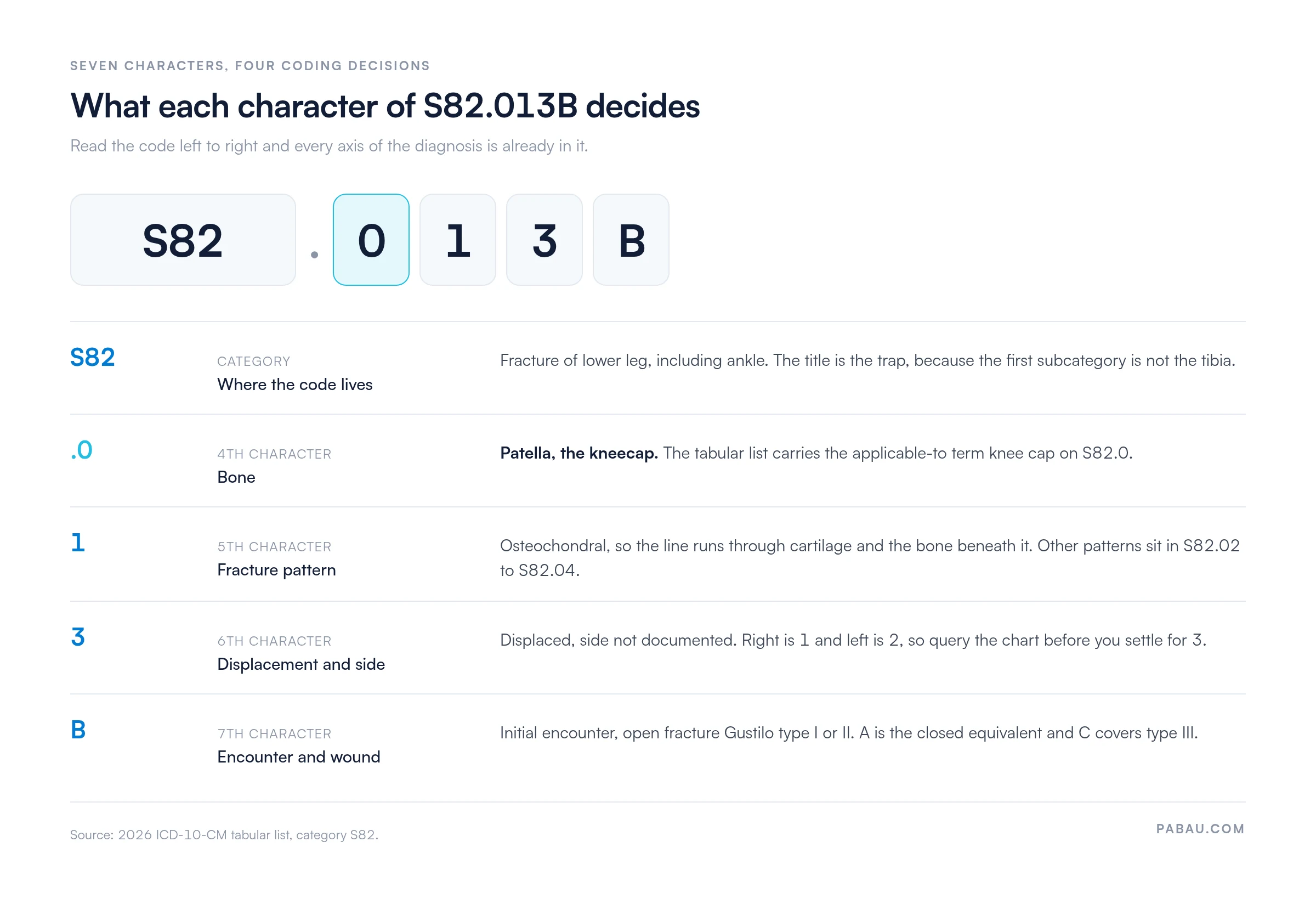
Category S82 is titled fracture of lower leg, including ankle, and that title misleads coders every year. Its first subcategory is the kneecap. The code also carries four separate decisions inside seven characters. They are the fracture pattern, the bone, the laterality, and the open fracture grade.
The official 2026 ICD-10-CM descriptor reads: Displaced osteochondral fracture of unspecified patella, initial encounter for open fracture type I or II. The code entered the set on October 1, 2015. It has not been revised in any annual update since, according to the CDC/NCHS ICD-10-CM tool.
Let Pabau's smart automation suggest the right codes, reduce claim denials, and keep your practice compliant—effortlessly.
Automate repetitive tasks and focus on what matters most—your patients.
Reduce coding errors and ensure compliance with the latest regulations.
Clean claims, fewer denials, and faster reimbursements.
Powerful insights and reporting to help your practice thrive.
HIPAA compliant SOC 2 certified GDPR-compliant Trusted by 4,000+ clinics worldwide

ICD-10 code S82.013B is a displaced osteochondral fracture of the unspecified patella, initial encounter for open fracture type I or II.
The patella is the kneecap. Subcategory S82.0 covers patella fractures and S82.01 narrows that to osteochondral fractures, despite the S82 category being named for the lower leg.
The digit 3 in S82.013 means the record did not document a side. Right is S82.011B and left is S82.012B, so query the chart before you settle for the unspecified code.
The 7th character B marks an initial encounter for a Gustilo type I or II open fracture. Character A is the closed equivalent and C covers type III.
Pabau’s claims management software integrates with Claim.MD to validate S82.013B and submit clean orthopedic claims to thousands of US payers.
Each element of this descriptor is a separate coding decision. Misreading any one of them lands the claim on a different code.
Laid out position by position, the seven characters show which decision each one records.
The patella sits directly under the skin with almost no soft tissue cover. A direct blow to a bent knee can break the bone and open the skin in the same movement. Dashboard injuries, falls onto hard ground, and motorcycle crashes are the mechanisms behind most open patellar fractures.
S82.013B should be rare on a finished claim. Laterality is the one axis a knee examination almost always settles, so an unspecified-side code usually signals a documentation problem rather than genuine clinical uncertainty.
The ICD-10-CM Official Guidelines allow unspecified codes where they most accurately reflect what the record shows at that encounter. A knee that has been examined, imaged, and often taken to the operating room does have a documented side somewhere. Four checks usually find it.
The Gustilo-Anderson system grades open fractures by wound size, soft tissue damage, and contamination. ICD-10-CM folds types I and II together under the 7th character B. Types IIIA, IIIB and IIIC all map to character C instead. Conflating the two groups carries a direct billing consequence.
The tabular note under category S82 states that the open fracture designations are based on the Gustilo classification. The same note directs that a fracture not documented as open or closed is coded as closed. Grading is most reliable once the wound has been formally debrided, so the operative report usually carries the final type.
The 7th character is the most frequently misapplied element in fracture coding. Every code in the S82.01 subcategory takes one of sixteen characters, which combine encounter phase with fracture type. Choosing A instead of B for an open type I or II fracture is a common and avoidable error.
The ICD-10-CM Official Guidelines, published jointly by CMS and NCHS, tie the 7th character to the phase of treatment at the current encounter. A patient returning for a wound check after a type I open patella fracture takes character E, not B.
Only the full seven-character code is billable. Submitting S82.013, S82.01, or S82.0 on their own will be rejected for lack of specificity, because each of them has more detailed codes underneath.
The S82.0 entry carries the applicable-to term knee cap in the tabular list. That single annotation is the fastest way to confirm that this branch of S82 covers the kneecap and not the tibia. Proximal tibia fractures sit in S82.1 instead.
Provider documentation rarely uses the tabular wording. Any of these phrases in an operative report or emergency note should prompt a review against S82.013B, subject to a full record check.
Notes describing a loose body, an osteochondral fragment, or a flake fracture of the patella also point to the S82.01 subcategory. Confirm displacement, laterality, and open fracture status before settling on a code.
Knowing the adjacent codes prevents laterality errors, displacement errors, and open or closed mismatches. These are the codes most often confused with S82.013B.
The AAPC ICD-10-CM code lookup carries the full descriptor set for each of these, along with the annotations attached to their parent codes.
The transverse patterns in S82.03 turn on the same axes, so side, wound grade, and encounter phase each move the code. At the initial encounter, a displaced transverse fracture with no side documented and a type III open wound is S82.033C. A displaced transverse fracture of the right patella, closed and still the initial encounter, is S82.031A.
Before you submit a claim for S82.013B, audit the record for three elements. They are the documented wound size, a statement that the wound reached the fracture site, and the assigned Gustilo type. Then search every note in the chart for the injured knee. If any one of them names a side, S82.011B or S82.012B replaces S82.013B.
Four documentation elements have to be present before S82.013B holds up in an audit. The ICD-10-CM Official Guidelines for Coding and Reporting govern each of them.
Practices using claims management software with built-in ICD-10-CM catalogs can validate S82.013B while the claim is being built. Validation flags missing characters and invalid combinations before the claim ever leaves the practice.
Practice management software like Pabau integrates with the Claim.MD clearinghouse to route these claims to thousands of US payers. The clearinghouse then applies diagnosis-to-procedure crosswalk edits, which catch laterality and encounter-type mismatches.
The clean claim submission framework recommends checking all seven characters of a fracture code before the claim is generated. Catching it afterward costs a resubmission cycle.
An osteochondral fracture of the patella takes off a fragment of articular cartilage with the bone directly under it. Because the injury sits on the joint surface, it changes both the treatment plan and the follow-up imaging schedule.
Three features separate these fractures from the other patella patterns.
An open patellar fracture is treated as a surgical emergency. Irrigation, debridement, antibiotics, and fixation or removal of the fragment usually happen on the day of presentation. That operative report is where the Gustilo grade, the displacement, and the injured side all appear together. It is the single most useful document for coding S82.013B correctly. The AAOS OrthoInfo overview of patellar fractures sets out the surgical options in more detail.
Sports injuries are a common mechanism, so practices treating adolescent athletes meet these codes often. Orthopedic documentation templates that prompt for wound status, laterality, and displacement at the point of care remove the query later.
Salter-Harris or growth plate wording in a knee note does not point to S82.01. Physeal injuries around the knee have their own series in S89, so a Salter-Harris type I fracture of the upper right tibia is S89.011A. Osteochondral fractures of the patella stay in S82.01 whatever the patient’s skeletal maturity, and proximal tibia fractures belong in S82.1 rather than S82.0.
S82.013B is normally the principal diagnosis when the fracture is the reason for the visit. Several additional codes and sequencing rules apply alongside it.
On inpatient claims, S82.013B groups to MS-DRG 562 or 563 under version 43.1 of the grouper. Those cover fracture, sprain, strain and dislocation outside the femur, hip, pelvis and thigh. Cases with multiple significant trauma group to 963 through 965 instead.
NCHS and CMS update the ICD-10-CM code set every October 1. S82.013B has carried the same descriptor since 2015. Coders should still confirm its status against the current fiscal year files before processing a claim. Practices with high orthopedic volumes also benefit from tracking denials by reason code.
A laterality or 7th character error usually surfaces weeks after the encounter. A payer rejects the claim and a biller pulls the chart. The clinician who treated the patient then gets asked what the record should already have said. By then the visit is months behind everyone involved.
Pabau moves that check to the point of claim build. The ICD-10-CM and CPT catalogs sit inside the billing screen, so an incomplete or invalid code cannot be saved onto a claim. The Claim.MD integration then runs clearinghouse edits before submission, including the diagnosis-to-procedure crosswalk checks that catch encounter-type mismatches.
The practical outcome is that the coder sees the problem while the chart is still open in front of them. Denials on orthopedic trauma claims fall, and the rework cycle gets shorter for every fracture code the practice bills.

Pabau integrates with Claim.MD to validate ICD-10-CM codes including S82.013B before submission. Built-in CPT and ICD-10 catalogs flag invalid character combinations, missing laterality, and encounter type errors across thousands of US payers.

S82.013B is a displaced osteochondral fracture of the patella with a Gustilo type I or II open wound. It is coded at the initial encounter, with no side documented. The category name sends coders toward the tibia. The subcategory is the kneecap, and getting that right is the whole job.
Get the four axes right, and query the chart for laterality before you accept the unspecified code. Pabau validates S82.013B and its siblings against payer edits before submission, through its Claim.MD integration. To see how Pabau handles fracture code validation and clean claim workflows, book a demo with the team.

Need to understand denial management for fracture claims? Denial management in healthcare covers how to identify, appeal, and prevent common denial patterns including diagnosis code specificity errors.
Looking for guidance on clean claim requirements? Electronic remittance advice explains how ERA data helps practices track and resolve S82-category denials using 835 remittance codes.
Want to understand how ICD-10-CM interacts with billing? Superbill documentation covers how diagnosis codes including fracture codes are captured at the point of care for downstream claim submission.
S82.013B is the ICD-10-CM code for a displaced osteochondral fracture of the unspecified patella, initial encounter for open fracture type I or II. The patella is the kneecap. The code records four things. The fracture is displaced and runs through cartilage and the bone beneath it. The patella side is not documented, the encounter is the initial one, and the wound is Gustilo type I or II.
No, S82.013B is a patella code. The confusion comes from the category name, because S82 is titled fracture of lower leg, including ankle. Its first subcategory, S82.0, is fracture of patella. Proximal tibia fractures code to S82.1x instead, and growth plate injuries of the upper tibia use the Salter-Harris series in S89.0x.
Neither one specifically. The digit 3 in S82.013 means unspecified patella, so the code applies where the record does not name a side. Use S82.011B for the right patella and S82.012B for the left. Check the operative note and the imaging order before defaulting to the unspecified code, because both usually state the side.
Yes. S82.013B is a billable and specific ICD-10-CM code, valid for reimbursement since October 1, 2015. The parent codes S82, S82.0, S82.01 and S82.013 are not billable, because each has more detailed codes beneath it. Only the full seven-character code can go on a claim.
The two codes differ only in the 7th character, which records the fracture type at the initial encounter. S82.013A covers a closed fracture with no open wound. S82.013B covers an open fracture graded Gustilo type I or II. Using A on an open fracture, or B on a closed one, will trigger a claim edit or a denial.
An osteochondral fracture of the patella breaks off a fragment made of articular cartilage and the bone directly beneath it. Most follow an acute lateral dislocation of the kneecap, which shears the medial facet against the femur. A direct blow to a bent knee is the other common cause. Because cartilage does not show on plain radiographs, MRI or CT often makes the diagnosis.