ICD-10 Code S82.242H: Displaced spiral tibial shaft fracture, delayed healing
ICD-10 Code S82.242H: Definition and code details ICD-10 Code S82.242H designate...

Last Updated: Oct 15, 2026
Billable Code Specific Code
S82.033P is the billable ICD-10-CM code for displaced transverse fracture of unspecified patella, subsequent encounter for closed fracture with malunion.
It belongs to category S82 (fracture of lower leg, including ankle). The 7th character "P" shows that the patient is at a follow-up visit for a closed fracture that has healed out of alignment. Its closest sibling, S82.033K, covers a closed fracture that has failed to unite (nonunion). Mixing up K and P, or using the initial-encounter suffix "A" at a follow-up visit, commonly leads to claim denials on patellar fracture cases.
Let Pabau's smart automation suggest the right codes, reduce claim denials, and keep your practice compliant—effortlessly.
Automate repetitive tasks and focus on what matters most—your patients.
Reduce coding errors and ensure compliance with the latest regulations.
Clean claims, fewer denials, and faster reimbursements.
Powerful insights and reporting to help your practice thrive.
HIPAA compliant SOC 2 certified GDPR-compliant Trusted by 4,000+ clinics worldwide

S82.033P is a billable 7-character ICD-10-CM code, valid from FY2016 through the current FY2027 code set.
The 7th character P means a subsequent encounter for a closed fracture with malunion: the patella has healed, but out of alignment.
Common errors include an initial-encounter suffix (A) at follow-up, confusing P with K (closed nonunion), or using P for an open fracture.
Pabau’s claims management software supports ICD-10 code lookup and claim submission through Claim.MD, so orthopedic practices see fewer denials on follow-up fracture claims.
ICD-10 Code S82.033P is a valid, billable ICD-10-CM code, effective from October 1, 2015 (FY2016) and unchanged in the current FY2027 code set.
It reports a follow-up visit for a closed, displaced transverse kneecap fracture that has healed out of alignment, side unspecified. It carries a full 7-character structure and is accepted for diagnosis reporting on CMS-1500 and 837P claims.
S82.033P describes a displaced transverse patellar fracture, side unspecified, seen at a follow-up visit. The original fracture was closed, and it has since healed with malunion. Each character carries a distinct clinical meaning, and misreading any one of them produces the wrong code.
Note that S82.033 encodes unspecified laterality. Right-side displaced transverse patellar fractures use S82.031-, and left-side fractures use S82.032-. If the operative report or imaging specifies a side, use the laterality-specific code rather than S82.033P.
The 7th character “P” means a follow-up visit for a closed fracture that imaging shows has healed out of alignment. The ICD-10-CM Official Guidelines published by CMS direct coders to report fracture complications with a subsequent-care 7th character. Nonunion takes K, M, or N, and malunion takes P, Q, or R.
Malunion means the fracture has united, but in a position that alters alignment or the joint surface. On the patella, that often shows as an articular step-off behind the kneecap.
Nonunion is the opposite problem: the fracture has failed to unite at all. That distinction, plus whether the original fracture was closed or open, drives the 7th character.
Key distinction: For a closed patellar fracture that has failed to unite, the correct code is S82.033K, not S82.033P. P applies only when a closed fracture has healed, but in a malaligned position.
If the original fracture was open, malunion moves to Q (type I or II) or R (type IIIA, IIIB, or IIIC). The grid below maps every follow-up letter by fracture type and healing status.
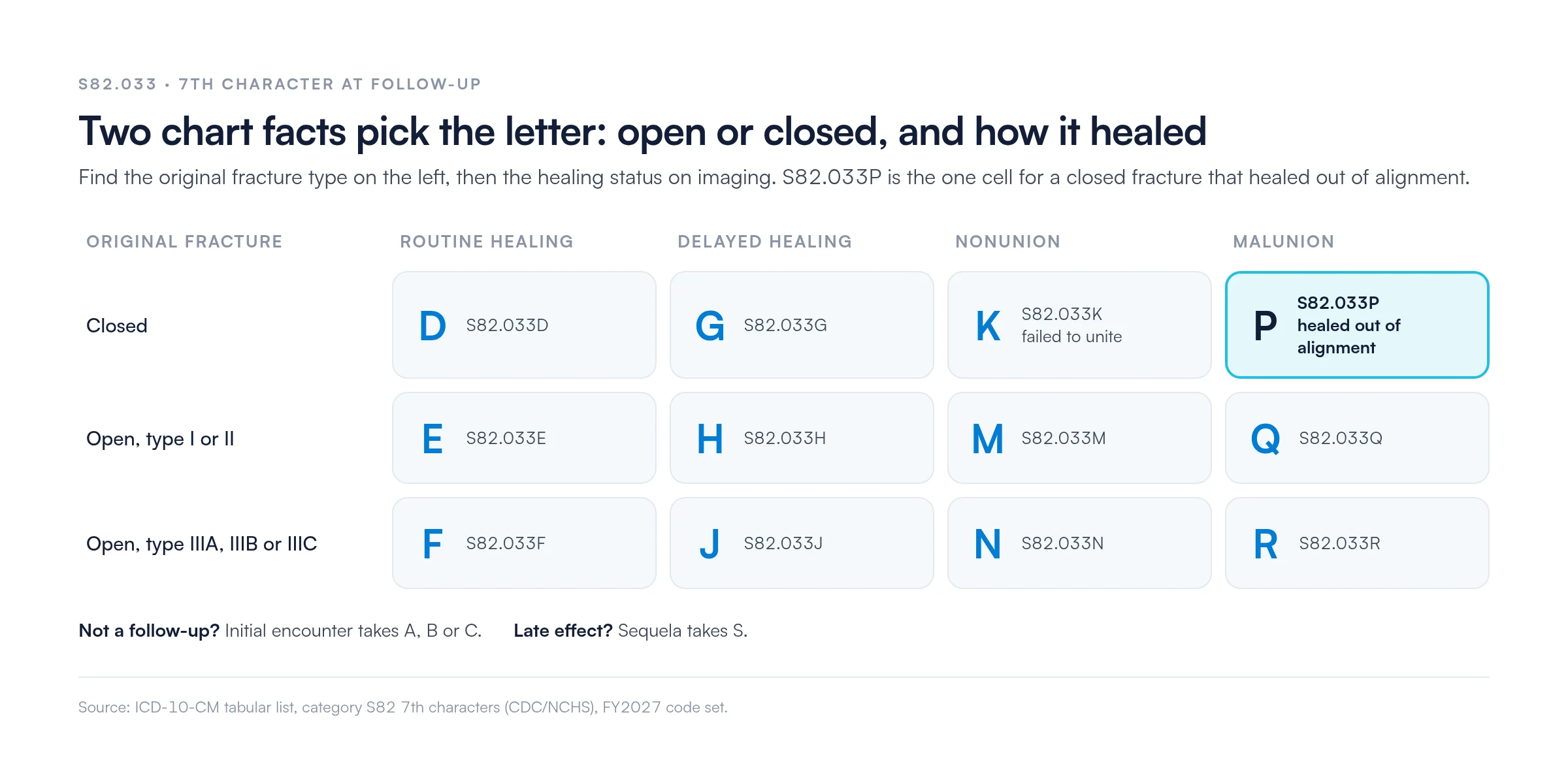
The S82.033 subcategory covers displaced transverse fractures of the unspecified patella across every encounter type and healing status. The table below lists every valid variant according to the CDC/NCHS ICD-10-CM code tool.
Check two facts before you pick the 7th character at follow-up: was the original fracture open or closed, and does imaging show union? A closed fracture that united out of alignment is P. If the chart does not say open or closed, query the surgeon before you submit.
A patient returns for orthopedic follow-up five months after a closed displaced transverse patellar fracture was fixed with tension band wiring. X-rays show the fracture has united, but with an articular step-off. The patient reports anterior knee pain on stairs.
The surgeon documents malunion and plans a corrective osteotomy with hardware revision. This is the scenario S82.033P was built for. Bone grafting to stimulate healing belongs to nonunion care, not to this code.
Work through the selection logic in sequence:
A claim with ICD-10 Code S82.033P needs a medical record that supports each part of the code. Medicare and most commercial payers expect the record to confirm malunion, not only a follow-up visit, before they pay for corrective surgery.
The record must contain all of the following:
Missing any of these elements raises the risk of a medical necessity denial or a request for additional documentation from Medicare. Practices using claims management software with built-in ICD-10 code validation can flag incomplete documentation before the claim leaves the office.
The S82 category and Chapter 19 carry notes that restrict how S82.033P is used. Applying this code when an exclusion applies produces an invalid claim.
Excludes 1 (cannot be coded together):
Excludes 2 (not included here; code additionally if present):
Chapter 19 instructions:
The S82 codes cover traumatic fractures only. A patellar fracture caused by disease, such as osteoporosis or metastatic bone disease, or by repetitive stress is coded in category M84 instead. The documentation must establish a traumatic cause before S82.033P applies.
These five errors recur on displaced transverse patellar fracture claims at subsequent encounters. Each one is visible in the code itself, so a pre-submission check catches it.
Medicare pays physician services for subsequent-encounter fracture care under the Physician Fee Schedule. For malunion cases billed with ICD-10 Code S82.033P, payers expect medical necessity documentation. It should show how the malalignment affects function and what correction is planned.
Common reasons Medicare and commercial payers deny S82.033P claims include:
Corrective surgery for malunion, such as an osteotomy or hardware revision, often requires prior authorization, depending on the payer. Submit the imaging report, the surgeon’s assessment, and the original fracture care claims as supporting documentation.
Pabau’s Claim.MD clearinghouse integration keeps that packet moving. It checks eligibility in real time, submits the claim electronically, and brings claim statuses and remittance advice back into Pabau.
ICD-10 Code S82.033P is a diagnosis code. It pairs with CPT codes that describe the services provided at the subsequent encounter. The table below lists CPT codes commonly billed alongside S82.033P, based on the CMS Physician Fee Schedule and AMA CPT guidelines.
Imaging usually comes first on a malunion claim. CPT 73564 reports the four-view knee series that confirms the malalignment. If the correction starts with taking out old tension band wiring, CPT 20680 reports that hardware removal.
Local coverage determinations (LCDs) vary by Medicare Administrative Contractor. Always verify that the planned CPT code is covered for S82.033P under the relevant MAC’s LCD before submitting.
Pabau sends claims through a medical claims clearinghouse, so a rejected CPT and diagnosis pairing comes back to the same billing record.
ICD-9-CM did not have 7th character specificity for encounter type or healing status, so the crosswalk from S82.033P to ICD-9 is approximate.
According to ResDAC’s ICD coding guidance for Medicare files, General Equivalence Mappings (GEMs) are one-to-many by design. One ICD-10 code often maps to several ICD-9 candidates.
Do not use GEM crosswalks for active billing. They exist for historical data analysis and research purposes. For current claims, always code from the ICD-10-CM tabular list directly.
When payers request medical records for a malunion claim, attach the initial-encounter note confirming a closed fracture. Add the latest imaging report describing the malalignment and the surgeon’s plan of care. This three-document set answers the most common medical necessity questions on S82.033P claims in a single appeal.
Malunion denials usually start where the chart and the claim disagree. The surgeon documents a closed fracture that healed out of alignment, but the claim goes out with a K, an A, or an unspecified side.
Pabau keeps the clinical note, the imaging attachments, and the ICD-10 code in the same patient record. Your coder checks the 7th character against the surgeon’s words before billing. Claims then go out through the Claim.MD integration, with eligibility checks, claim statuses, and remittances tracked in one place.
The result is fewer resubmissions on follow-up fracture claims and faster payment for corrective care.

Pabau integrates with Claim.MD to submit ICD-10-coded claims electronically and verify eligibility in real time. Claim statuses and remittances flow back into Pabau, so your orthopedic practice gets paid faster.

S82.033P is narrow by design. It fits only a closed, displaced transverse patellar fracture that has healed out of alignment, at a visit for that complication. Get the closed status, the malunion finding, and the side right in the record, and the code follows.
Let the surgeon’s findings choose the letter. A follow-up visit alone never justifies P, but malunion documented on imaging does.
Pabau’s denial management workflows help orthopedic practices track S82.033P claims through Claim.MD and resubmit cleanly. To see how Pabau keeps malunion claims clean from chart to payment, book a demo.

Need to understand how claim denials are categorized? Denial codes in medical billing covers the CARC and RARC codes payers attach to rejected fracture claims and how to act on them.
Looking for guidance on the full claim submission workflow? What makes a clean claim walks through the data elements payers validate before adjudicating, including ICD-10 code completeness and encounter-type consistency.
ICD-10 code S82.033P is the billable diagnosis code for a displaced transverse fracture of unspecified patella, subsequent encounter for closed fracture with malunion. It applies when a closed kneecap fracture has healed in a malaligned position and the patient returns for care of that complication.
Yes. S82.033P is a valid, billable 7-character ICD-10-CM code, active since FY2016 and unchanged in the current FY2027 code set. It is reportable on CMS-1500 and 837P claims as a principal or secondary diagnosis when the clinical documentation supports it.
Both codes apply to a closed displaced transverse patellar fracture at a subsequent encounter. S82.033K means nonunion: the fracture has failed to unite. S82.033P means malunion: the fracture has united, but in the wrong position. The imaging report and the surgeon’s note decide which one applies.
Nonunion means the fracture failed to heal, while malunion means it healed in an incorrect anatomical position. For S82.033, the letters K, M, and N code nonunion, and P, Q, and R code malunion. Within each set, the letters split closed, open type I or II, and open type IIIA, IIIB, or IIIC fractures.
The record must establish a displaced transverse patellar fracture in an imaging report or operative note. It must confirm that the original fracture was closed, and follow-up imaging must show malunion. It must also confirm that this visit is not the initial active treatment episode.
Yes. S82.033P may be listed as the principal diagnosis when the encounter is for evaluation or treatment of the malunited displaced transverse patellar fracture. Code additional diagnoses, such as associated injuries or comorbidities, as secondary codes per ICD-10-CM sequencing guidelines.