ICD-10 code S61.201A: Open wound of left index finger without nail damage
ICD-10 code S61.201A covers a left index finger wound of unstated type ICD-10 co...

Last Updated: Oct 16, 2026
Billable Code Specific Code
S82.033C is the billable ICD-10-CM code for displaced transverse fracture of unspecified patella, initial encounter for open fracture type IIIA, IIIB, or IIIC.
Coders most often confuse it with S82.033A, the closed-fracture initial encounter. The laterality-specified variants S82.031C and S82.032C are the other frequent mix-up. Both errors trigger automated payer edits and claim denials.
Let Pabau's smart automation suggest the right codes, reduce claim denials, and keep your practice compliant—effortlessly.
Automate repetitive tasks and focus on what matters most—your patients.
Reduce coding errors and ensure compliance with the latest regulations.
Clean claims, fewer denials, and faster reimbursements.
Powerful insights and reporting to help your practice thrive.
HIPAA compliant SOC 2 certified GDPR-compliant Trusted by 4,000+ clinics worldwide

S82.033C is a billable FY2026 ICD-10-CM code in the S82.0 patella fracture subcategory.
The 7th character C means a Gustilo type IIIA, IIIB, or IIIC open fracture on initial encounter.
Character A covers the closed-fracture initial encounter, and character B covers open type I or II.
Unspecified laterality means S82.033C applies only when the record omits which side was fractured.
Pabau’s claims management software flags incomplete laterality and 7th-character documentation before a claim is submitted.
ICD-10 Code S82.033C is the specific, billable ICD-10-CM diagnosis code for a displaced transverse fracture of unspecified patella.
The 7th character C narrows it to an initial encounter for open fracture type IIIA, IIIB, or IIIC. The code is valid for FY2026 and sits within the S82.0 (fracture of patella) subcategory of category S82, fracture of lower leg including ankle.
The code’s position in the ICD-10-CM hierarchy matters for both coding accuracy and payer editing. A coder who selects S82.033C asserts four points at once:
Each word in the descriptor of ICD-10 Code S82.033C carries a coding obligation. Misreading any element produces an incorrect code selection that payers will reject.
A displaced transverse patellar fracture in the open type III category is a high-energy injury. Motor vehicle collisions, falls from height, and direct blunt trauma are the most common mechanisms.
Wound contamination, soft tissue loss, and possible vascular involvement characterize Gustilo type III injuries. That combination sets this fracture apart from lower-grade open fractures and almost always calls for surgery.
The 7th character is the most coding-sensitive component of ICD-10 Code S82.033C. Three 7th characters apply to initial encounters in the S82.033 subcategory. Choosing the wrong one is the single most common denial trigger for patellar fracture claims. The same encounter-type logic runs through the whole S82 category, so the table below transfers to every lower-leg fracture code.
The Gustilo-Anderson classification grades open fractures by wound size, contamination, periosteal stripping, and vascular involvement. ICD-10-CM groups all three type III sub-classes under a single 7th character C, because the code set does not sub-divide them further. The clinical distinction still matters for operative planning, but the coding outcome is the same for all three.
The operative report or emergency department note must document the Gustilo grade explicitly. Without a documented grade, the coder has no basis for character C and must default to character B instead. When grading is absent, query the attending surgeon before assigning a higher-acuity character.
The 5th character in S82.033 encodes laterality. Character 1 is the right patella, 2 is the left patella, and 3 is unspecified. ICD-10 Code S82.033C should only be assigned when the medical record provides no laterality information. Medicare and many commercial payers run automated edits that flag unspecified laterality codes when a more specific alternative exists.
If the operative report names the side, such as “right knee explored,” the coder must use S82.031C. Using S82.033C when laterality is documented but overlooked is a specificity error. Some payers treat that error as a medical necessity mismatch.
The side is not the only detail that changes the code. When the record names the right patella and describes a closed wound, assign S82.031A, because the 7th character becomes A.
When in doubt, query the surgeon rather than defaulting to “unspecified.” The wound grade and the documented side are the only two questions that decide the code, and they resolve like this.
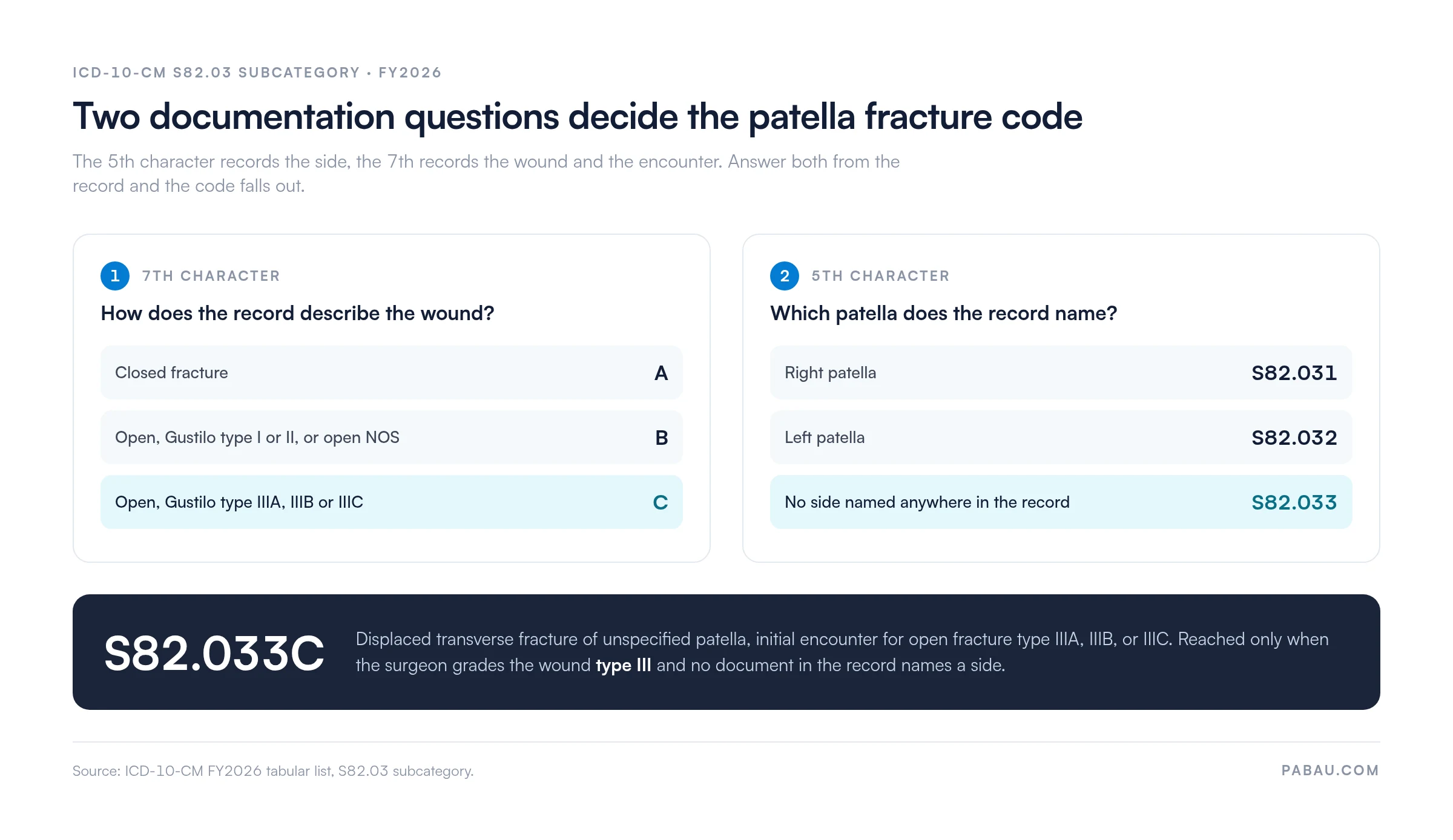
The S82.0 subcategory contains several displaced patellar fracture codes. Picking the wrong descriptor, whether transverse, comminuted, or osteochondral, is a common specificity error. ICD-10-CM uses parallel logic across every fracture site, so the same displaced, nondisplaced, and laterality conventions apply throughout.
Imaging determines whether the pattern is transverse or comminuted, and the operative note confirms it. Imaging language such as “stellate fracture,” “butterfly fragment,” or “multi-fragment” signals comminuted and rules out S82.033C.
Six documentation elements must appear in the medical record before a coder can confidently assign ICD-10 Code S82.033C. Missing any one of them requires a physician query before claim submission.
When documentation is incomplete, query the attending surgeon before submission rather than defaulting to a lower-specificity code. An S82.033A submitted in place of S82.033C understates clinical severity and may affect case-mix weighting, DRG assignment, and quality reporting.
Getting all six elements onto the record the first time is what makes a clean claim submission possible for this code. A query answered before submission takes minutes. An appeal after a denial takes weeks.
Open fractures of the patella at Gustilo type III severity almost always require surgical management. The CPT code on the claim must be clinically consistent with the ICD-10 diagnosis.
A payer that sees S82.033C paired with CPT 27520, closed treatment without manipulation, will flag the combination as a medical necessity mismatch. Verify current CPT descriptors and RVU values against the CMS Physician Fee Schedule before billing.
The AAPC ICD-10-CM and CPT crosswalk lists the procedure codes that pair with each diagnosis. Bundling edits between debridement codes and the primary fracture CPT vary by payer. Review your MAC’s local coverage determination before appending a -59 modifier.
Denials on ICD-10 Code S82.033C cluster around six predictable errors, and each has a clear correction path. Reading the common denial codes a payer returns tells you which edit fired before you start rebuilding the claim.
External cause codes (V00-Y99) are strongly recommended by the CDC/NCHS ICD-10-CM guidelines for all traumatic injuries. A growing number of commercial payers now require them. Common pairings for a patellar fracture are:
Activity codes (Y93.xx) and external cause status codes (Y99.xx) may also be appended where the payer’s LCD requires them. Review the current CMS ICD-10 coding guidelines and your MAC’s LCD for the requirements in your jurisdiction.
For appeals, read the CARC denial reason codes returned in your ERA to identify which edit fired. Then build the appeal around the documentation correction rather than the code itself. Fracture care also carries a 90-day global period, which changes how follow-up visits are billed alongside the initial encounter code.
Run a three-point check before submitting any S82.033C claim. Confirm the 7th character matches the encounter type in the visit note. Verify the Gustilo grade is documented. Confirm the CPT code reflects an open surgical approach. These three checks catch most patellar fracture denials before they reach the payer.
In most practices the coder finds a missing Gustilo grade or an absent laterality statement after the claim has already gone out. The denial comes back weeks later, and the correction competes with that week’s new work.
Practice management software like Pabau moves that check forward. Its cleaner claims management workflow compares the diagnosis and procedure codes on a claim against the documentation attached to the encounter. Where the 7th character, the laterality statement, or the Gustilo grade is missing, the claim is held for review instead of submitted.
Claims then go out through Claim.MD, our US clearinghouse partner, which runs its own payer edits before the file reaches the insurer. Orthopedic and urgent care teams get the correction request while the surgeon is still reachable.

Pabau’s claims management software flags incomplete laterality documentation and 7th-character mismatches before a claim leaves your practice. See how orthopedic and urgent care teams use Pabau to submit cleaner claims on the first pass.

S82.033C is a narrow code, and most of the work that earns it happens before the coder opens the chart. The surgeon’s Gustilo grade and one explicit line about the injured side decide whether the claim clears on the first pass.
The trade-off worth remembering is timing. A query sent while the patient is still in the department takes one message. The same query after a denial takes a resubmission, an appeal, and a month of held revenue.
Pabau checks documentation against the codes on the claim while the encounter is still open. Book a demo to see how orthopedic and urgent care teams cut S82.033C denials before submission.

Need to understand how clearinghouse edits catch coding errors before payers do? Claim.MD clearinghouse overview explains how real-time claim validation works for ICD-10 fracture codes.
Want to reduce denial turnaround time on complex fracture claims? Electronic remittance advice (ERA) guide covers how to read CARC denial codes and build targeted appeals.
Looking for ICD-10-CM eligibility verification before treatment? Insurance eligibility verification outlines how pre-visit checks reduce fracture care claim rejections.
ICD-10 Code S82.033C is billable in ICD-10-CM. It covers a displaced transverse fracture of unspecified patella, initial encounter for open fracture type IIIA, IIIB, or IIIC. It sits in the S82.0 (fracture of patella) subcategory and is valid for FY2026 claim submission.
S82.033A is the initial encounter for a closed fracture. S82.033B covers an open fracture of type I or II, or open NOS. S82.033C covers an open fracture meeting Gustilo-Anderson type IIIA, IIIB, or IIIC criteria. The 7th character reflects both encounter type and fracture severity, and using the wrong one is the leading denial trigger for this code family.
Yes. S82.033C is a specific, billable ICD-10-CM code and does not require an additional specificity code beneath it. However, payers usually expect an appropriate external cause code (V00-Y99) alongside it. On surgical encounters they also expect a clinically consistent CPT procedure code.
Use S82.033C only when the medical record genuinely does not identify which patella was fractured. If the operative report, imaging order, or any other document names the side, assign S82.031C for right or S82.032C for left. Submitting S82.033C when laterality is documented invites payer specificity edits and potential denials.
Five triggers account for most of them. The first is the wrong 7th character, usually A on a type III open fracture. The second is unspecified laterality when a side is documented. The third is a missing external cause code. The fourth is pairing S82.033C with a closed-treatment CPT code. The fifth is an operative note that never states the Gustilo grade.
Medicare may accept S82.033C, but MAC-level local coverage determinations vary by jurisdiction. Many automated edits flag unspecified laterality for review when a more specific code exists. Verify your MAC’s current LCD before submitting S82.033C, and use S82.031C or S82.032C whenever the medical record supports laterality specificity.