ICD-10 code S61.201A: Open wound of left index finger without nail damage
ICD-10 code S61.201A covers a left index finger wound of unstated type ICD-10 co...

Last Updated: Oct 16, 2026
Billable Code Specific Code
S79.911D is the billable ICD-10-CM code for unspecified injury of right hip, subsequent encounter.
Leaving the A from the initial visit in place is the biggest source of denials on these claims, and each one costs a rework cycle.
This page covers the validity dates, the A, D, and S rules, and the code hierarchy. It also covers the sibling codes, the documentation payers expect, and the errors worth auditing for.
Let Pabau's smart automation suggest the right codes, reduce claim denials, and keep your practice compliant—effortlessly.
Automate repetitive tasks and focus on what matters most—your patients.
Reduce coding errors and ensure compliance with the latest regulations.
Clean claims, fewer denials, and faster reimbursements.
Powerful insights and reporting to help your practice thrive.
HIPAA compliant SOC 2 certified GDPR-compliant Trusted by 4,000+ clinics worldwide

S79.911D is a billable ICD-10-CM code for unspecified injury of right hip, subsequent encounter.
The code is valid for HIPAA-covered transactions from October 1, 2025 through September 30, 2026.
The 7th character D means active treatment has ended and the patient is now in follow-up care.
Submitting A instead of D at a follow-up visit is the most common denial trigger on these claims.
S79.911 is not billable on its own, so append A, D, or S before the claim goes out.
S79.911D is a billable ICD-10-CM diagnosis code, and its full description is unspecified injury of right hip, subsequent encounter. It sits in the S70-S79 range for injuries to the hip and thigh. That range belongs to the S00-T88 injury chapter maintained by the Centers for Medicare and Medicaid Services (CMS).
The parent code S79.911 is not billable on its own, because a 7th character has to be appended first. S79.911D is valid for HIPAA-covered transactions for fiscal year 2026, which runs from October 1, 2025 through September 30, 2026. The CDC/NCHS ICD-10-CM web tool confirms the current edition each year.
Record the side, the phase of care, and the reason a specific injury type is not available. Then build the code from the note rather than from memory.
The ICD-10-CM Official Guidelines define three 7th character options for traumatic injury codes, and each one marks a different phase of care. Pick the wrong letter and the claim describes a visit that never happened.
The line between A and D is active treatment, not the number of visits. A patient treated in the emergency department after a fall gets S79.911A.
The same patient returning two weeks later for a rehabilitation assessment gets S79.911D. The AAPC Codify ICD-10-CM reference sets out the sequencing rules for each option.
Sequela works differently again. S covers a condition caused by the injury after the injury itself has resolved, such as chronic stiffness. Sequence the sequela condition first, then the code with the S suffix as the cause.
S79.911D is the only billable level of its branch. Every level above it is a grouping rather than a diagnosis, so a claim carrying one of them comes back unpaid.
Confirm the level at the encounter rather than at intake. Both the injury type and the phase of care can change between the booking and the note, and the code has to follow the note.
Three billable children sit under S79.911, and the left hip and unspecified hip codes mirror them. Coders usually want to see the set together while they check which side the record actually supports.
When the record names the right hip, S79.911D is correct. When laterality is genuinely undocumented, S79.919D applies, although payers query unspecified laterality more often than a documented side.
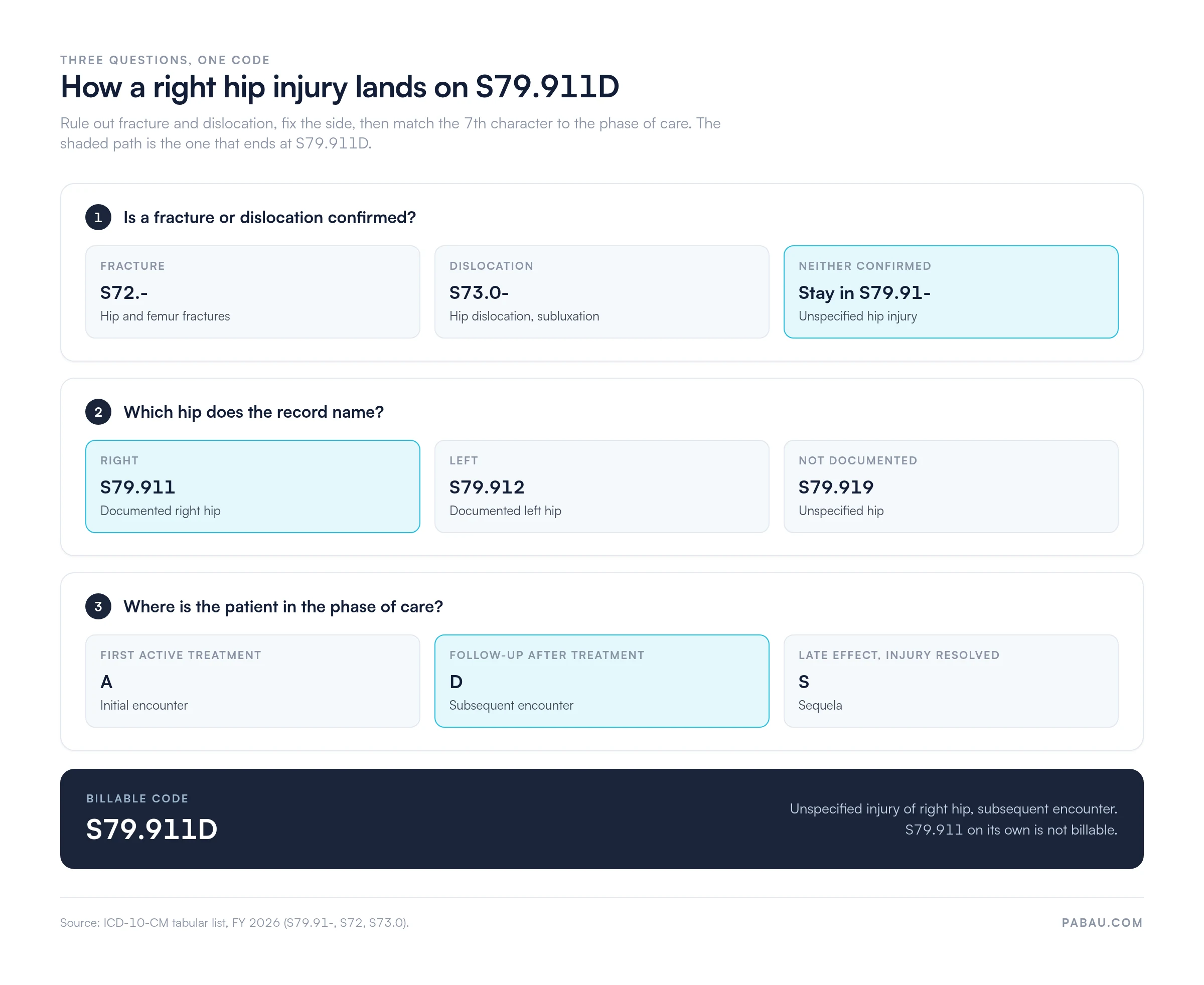
Two checks and one judgment call sit between a hip injury and its code. The path below runs through them in the order a coder should ask them.
S79.911D carries no Excludes1 note and no Excludes2 note. Neither S79.911 nor the S79 category adds one, so no other diagnosis is barred from sitting beside it on the same claim.
What the code does inherit are the annotations sitting above it in the tabular list:
That external cause code is the one coders forget at follow-up. It carries a 7th character of its own, and it follows the same phase of care. A follow-up after a fall therefore pairs S79.911D with W19.XXXD, not with W19.XXXA.
The mechanism in the note decides which Chapter 20 code you attach. A hip injury that happened while the patient stepped off a golf cart pairs with V86.49XD at that follow-up.
The fracture boundary is a specificity rule rather than an exclusion. Once imaging confirms a fracture, the diagnosis belongs to the femur fracture family. A confirmed dislocation moves the claim in the same way, so a right obturator dislocation at follow-up is coded as ICD-10 code S73.024D.
Codes such as S72.91XH carry a 7th character set that runs well past A, D, and S alone. Verify any of this against the CDC/NCHS ICD-10-CM tabular list, which is where these annotations come from.
Use S79.911D at any encounter that happens after the patient has finished active treatment for the injury. The phase of care decides it, not the visit count, so a long recovery can carry D across many appointments.
Reach for the code when all of these are true:
Two exceptions are worth naming. The first active treatment encounter is S79.911A. A chronic complication left behind once the injury has resolved is S79.911S.
Write the encounter phase into the note, not just the diagnosis. “Follow-up for right hip injury, active treatment completed, now in rehabilitation phase” beats “hip injury follow-up” every time. That one habit settles the D versus A question before the claim reaches the billing team.
An unspecified code has to be defensible in the note. Payers ask why a more specific injury code was not selected, especially when imaging or a specialist letter is already in the record.
Update the code as soon as the picture changes. If an MRI later confirms a labral tear, the tear becomes the diagnosis. Leaving S79.911D on the claim after that creates a contradiction an auditor will find.
A documented blood vessel injury moves the claim out of S79 in the same way. Where the note places that vessel injury at hip and thigh level on the right, the follow-up visit codes to S75.901D.
The expensive errors on hip injury claims are rarely typos. They are habits, repeated by every coder on every claim, until somebody reviews a batch of denials and spots the pattern.
Errors one and two account for most of the traffic. Review a month of musculoskeletal denials together rather than one claim at a time. Then read the denial codes as a group, because the same rule is usually behind them.
Six lines in the note decide whether this claim pays. Read them in order before you submit:
Any line you cannot tick is easier to fix now than after the payer answers.
Most practices split this work across two systems. The clinician writes the note in one place, the biller re-keys the diagnosis somewhere else, and the phase of care goes missing between them. By the time a denial arrives, nobody remembers which visit was which.
Practice management software like Pabau keeps the diagnosis on the encounter that produced it. A coder opening the follow-up appointment can see what the previous visit recorded.
The choice between A and D then comes from the record instead of memory. Keeping the code, the encounter phase, and the claim in one place is what claims management without rework looks like day to day.
For US practices, claims leave through the Claim.MD clearinghouse, which validates codes for correct formatting before submission. A formatting problem caught there is cheaper than a denial.
The diagnosis, the note, and the claim status all stay in the same client record afterwards.
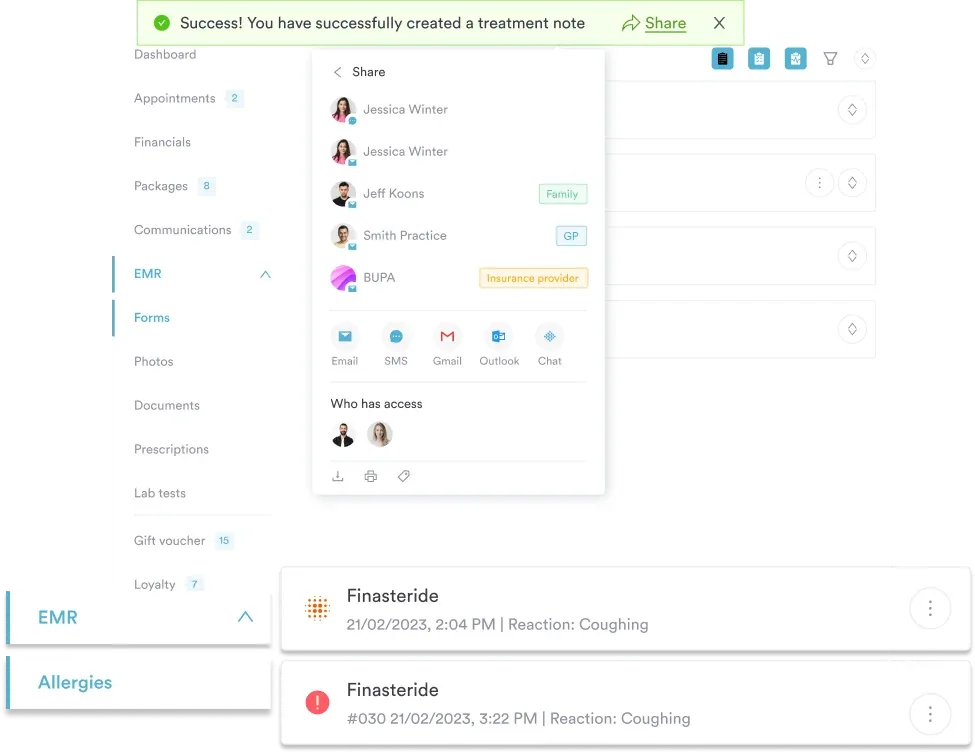
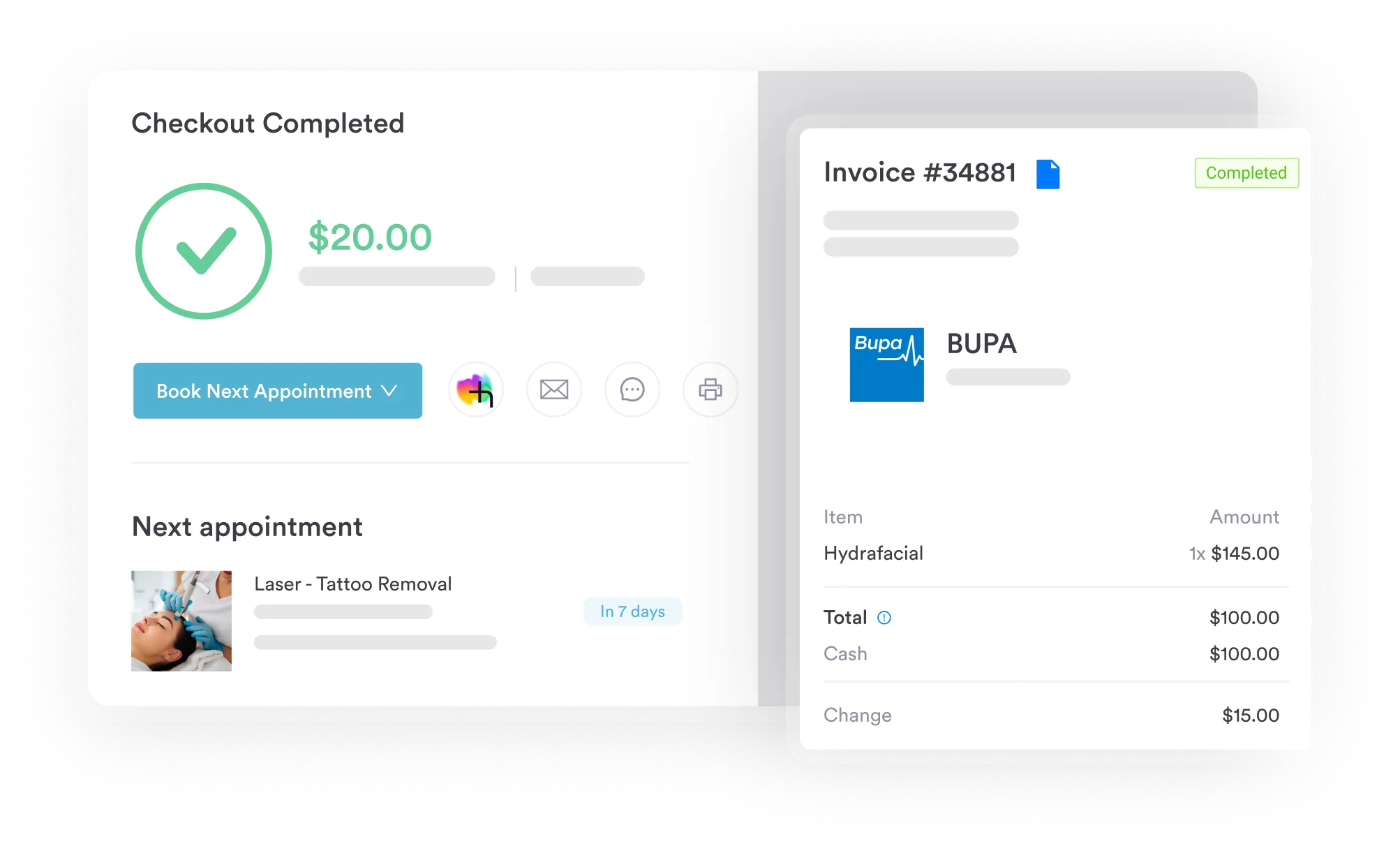

Pabau holds the encounter note, the ICD-10-CM code, and the claim in the same client record, and submits through the Claim.MD clearinghouse for US practices. Your coders work from the documentation instead of re-keying it.

The 7th character is the whole job on this code. Take it from the phase of care in the note, keep the side explicit, and S79.911D behaves like any other billable diagnosis.
Practices that stop seeing these denials are the ones that made the note carry the answer. Encounter phase goes in the note template, laterality goes in the clinician’s own words, and the external cause code travels with both.
Book a demo to see how Pabau keeps documentation and claims together for hip injury follow-ups.

Imaging came back showing a fracture? Femur fracture ICD-10 codes: the S72 family and S72.91XH explains the wider 7th character set that fracture codes use.
Coding a soft-tissue injury further down the leg? Adductor muscle injury ICD-10 S76.202D applies the same subsequent encounter logic to the thigh.
Want the claim to pay on the first pass? What is a clean claim in medical billing? sets out the checks that keep a diagnosis code from bouncing.
Working through a batch of rejections? Denial management in healthcare covers how to group denials by cause instead of chasing them one by one.
Need to see where coding sits in the wider process? What is revenue cycle management (RCM)? follows the claim from the encounter through to reimbursement.
S79.911D is a billable code for an unspecified injury of the right hip at a subsequent encounter. Use it for follow-up care once active treatment has ended.
Yes. It is valid for HIPAA-covered transactions from October 1, 2025 through September 30, 2026. The parent code S79.911 needs a 7th character before you can bill it.
A covers the first active treatment visit. D covers every follow-up visit after that. S covers a late effect once the injury itself has resolved.
No. Neither the code nor the S79 category adds one. The S70-S79 block does exclude burns, frostbite, and venomous bites, which belong in the T codes instead.
The tabular list directs you to add a secondary Chapter 20 code for how the injury happened. At a follow-up visit, that code takes D as well, as in W19.XXXD.
Office follow-ups usually pair it with 99213 or 99214, depending on medical decision-making. Physical therapy visits often use 97110 or 97530. The note has to support both codes.