

ICD-10 code S61.201A: Open wound of left index finger without nail damage
ICD-10 code S61.201A covers a left index finger wound of unstated type ICD-10 co...

Last Updated: Oct 16, 2026
Billable Code Specific Code
S73.024D is the billable ICD-10-CM code for obturator dislocation of right hip, subsequent encounter. It covers follow-up care while the injury heals, after the initial reduction or surgery.
The code is HIPAA-valid for covered electronic transactions. The S73.02x obturator dislocation codes have been in effect since October 1, 2015, and FY2026 is the current annual revision. Assignment turns on the 7th character: D marks routine care during healing, A the first active treatment, and S a late complication.
Let Pabau's smart automation suggest the right codes, reduce claim denials, and keep your practice compliant—effortlessly.
Automate repetitive tasks and focus on what matters most—your patients.
Reduce coding errors and ensure compliance with the latest regulations.
Clean claims, fewer denials, and faster reimbursements.
Powerful insights and reporting to help your practice thrive.
HIPAA compliant SOC 2 certified GDPR-compliant Trusted by 4,000+ clinics worldwide

S73.024D is the billable ICD-10-CM code for obturator dislocation of the right hip at a subsequent encounter.
The 7th character D applies to routine care during healing, not to the first active treatment and not to a late complication.
The note must state laterality, dislocation type, and encounter stage before a coder can support S73.024D on a claim.
S73.025D is the left-hip equivalent, and S73.004D is the fallback when the note never names the dislocation subtype.
Practice management software like Pabau links diagnosis codes to the treatment record, so coders read the note rather than retype it.
ICD-10 Code S73.024D is the ICD-10-CM diagnosis code for obturator dislocation of the right hip at a subsequent encounter.
The femoral head has displaced anteriorly through the obturator foramen, and the patient is now back for follow-up care rather than initial treatment. The code is specific and billable, so it is valid for HIPAA-covered electronic transactions on CMS-1500 and 837P claim submissions.
Selecting the right code depends on two things the documentation must make explicit: which hip (laterality) and which stage of care (7th character). S73.024D satisfies both. “Right” is embedded in the base code, and “D” locks the encounter type to subsequent. Miss either element in the note, and the claim is heading for a laterality or specificity denial.
According to the CMS ICD-10-CM coding resources, the FY2026 edition is the authoritative version for claims with service dates on or after October 1, 2025. That is the current annual revision rather than a new code. The S73.02x obturator dislocation codes have been in effect since October 1, 2015. Verify the edition year on each claim cycle anyway, because annual updates can shift code validity windows.
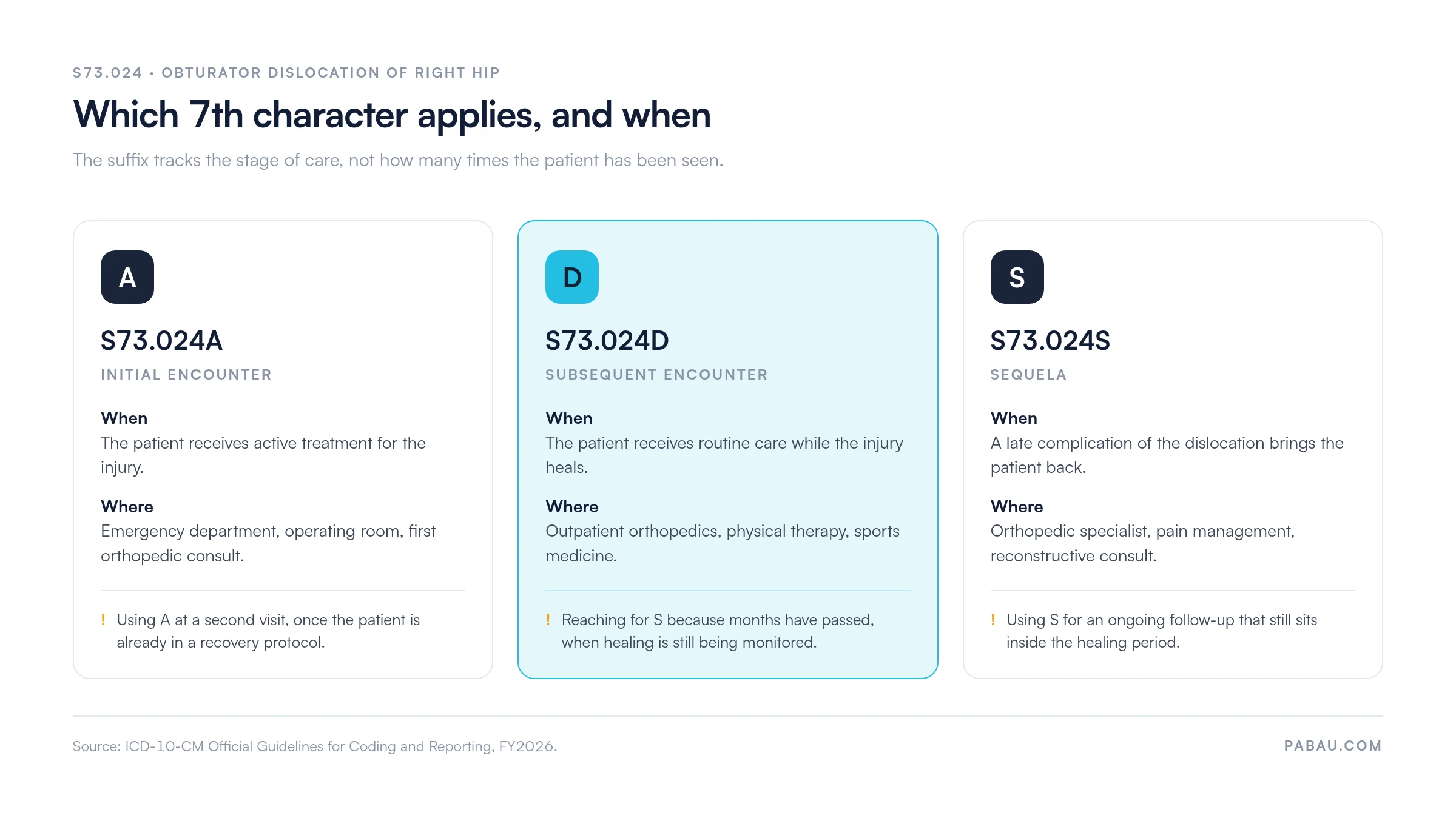
The 7th character in S73.024D signals the encounter type to the payer. Selecting the wrong one is the single most auditable error on traumatic hip dislocation claims. Each suffix has a precise clinical meaning defined by the ICD-10-CM Official Guidelines. The suffix does not track the number of visits, and it does not track whether the patient is improving.
The distinction between D and S is timing and causation, not the number of elapsed weeks. A follow-up visit four months after reduction still uses “D” when the provider is monitoring bone healing. A visit where the chief complaint is avascular necrosis uses “S” instead, because that complication arose as a long-term consequence of the dislocation. The sequela code for the complication itself is usually reported alongside it.
All three variants share the same base code, S73.024, obturator dislocation of the right hip. The 7th character then determines whether a claim is correctly coded or flagged for review. This is the comparison coders and auditors run first when a hip dislocation claim is questioned.
Consider a patient originally treated in an emergency department (S73.024A) who then transfers to a sports medicine practice for rehabilitation. Every visit at that practice codes as S73.024D. The encounter type follows the purpose of the visit, not the provider who first treated the injury. The three cards below set each 7th character against the stage of care it belongs to.
S73.024D sits at the most specific level of a six-tier code tree. Each level narrows the clinical meaning from a broad injury chapter down to the exact laterality, dislocation type, and encounter stage. The hierarchy tells a coder which parent code to fall back on when documentation is thin. It also shows which billable code to reach for when the note is thorough.
Every traumatic diagnosis in chapter S00-T88 follows this same structure, so coders who work across injury code families will recognize the hierarchy immediately. S73.024D cannot be reported without its 7th character. The six-character base code S73.024 is not billable on its own and rejects at the clearinghouse edit.
Run a payer eligibility check before the first subsequent-encounter visit. Some payers require a referral or authorization update when a patient transitions from acute management (S73.024A) to rehabilitation-phase follow-up (S73.024D). A single missing pre-authorization on that transition is one of the most common denial triggers for hip dislocation codes.
S73.024D belongs to a family of codes that cover both sides, all dislocation subtypes, and all three encounter stages. Coders selecting from this family need to match laterality, dislocation mechanism, and encounter type simultaneously. The table below covers the siblings and adjacent codes an orthopedic coder reaches for most often.
The AAPC ICD-10-CM code range lookup helps when a provider note records an anterior, posterior, or central hip dislocation without naming the obturator variant. Default to the most specific code the documentation supports. Never assign a subtype the provider did not explicitly document.
An obturator hip dislocation is an anterior dislocation in which the femoral head displaces through or near the obturator foramen. That foramen is the large opening in the anterior pelvis bounded by the pubic and ischial bones. It is one of the rarer traumatic hip dislocation subtypes, since posterior dislocations make up the majority of traumatic cases. Anterior dislocations, the obturator variant included, follow forced abduction and external rotation of the hip. High-energy vehicular trauma and sports impacts are the usual mechanisms.
Clinically, the limb presents in a characteristic position: externally rotated, abducted, and often flexed. Reduction is usually performed under sedation in the emergency setting. Imaging then confirms the reduction and rules out associated fractures. Physical therapy and orthopedic follow-up make up the subsequent-encounter phase, which is exactly what S73.024D is built to capture.
Three elements have to be in the provider note before S73.024D survives an audit: laterality, dislocation subtype, and encounter stage. None of the three can be inferred from the other two. Each one has to appear explicitly in the note itself.
A note template that prompts for laterality and encounter stage at the point of care removes most of this risk. The prompt lands while the provider is still with the patient, not weeks later when a coder is reading a finished note. Laterality omissions and encounter-type mismatches are the two rejection reasons coders meet most often on S-code claims, from Medicare Advantage and commercial payers alike.
A short pre-billing checklist catches most of these errors before the claim goes out. Confirm laterality, confirm that imaging documents the subtype, and check the encounter stage against the visit date relative to initial treatment. Give the coder access to the post-reduction imaging report, which is where the obturator subtype is usually confirmed.
S73.024D tells the payer what condition is being managed. The CPT procedure code on the same claim tells the payer what was done at the visit. Mismatching the two is one of the fastest routes to a medical necessity denial on hip dislocation claims. Our CPT codes reference covers the procedure side in full. The codes below are the ones most often paired with S73.024D at a subsequent-encounter visit. Payer coverage still varies, so verify each pairing against the relevant LCD or NCD.
CPT codes 27250 and 27252 cover the reduction itself, so they belong with the initial-encounter code S73.024A. Pairing a reduction CPT with the subsequent-encounter diagnosis is a classic audit trigger. At a subsequent-encounter visit the appropriate CPT is usually an E/M code or a therapy code, depending on the provider and the services rendered.
Clearinghouses validate ICD-10 and CPT pairings before the payer ever sees them. Our guide to the clean claim covers the edit types that apply to injury codes like S73.024D. Practices that re-key codes between a documentation system and a separate billing platform are the most exposed to these mismatches on orthopedic dislocation claims.
Check whether your payer requires a modifier when billing therapeutic CPT codes (97110, 97530) alongside an E/M code for the same visit. Some payers apply NCCI bundling edits to physical therapy codes billed on the same day as an office visit without the appropriate modifier. Verify this before submitting subsequent-encounter hip rehabilitation claims.
In most practices the S73.024D claim is reconstructed after the visit. A coder opens the note, hunts for the word “obturator”, works out whether the visit was a follow-up, and then picks the 7th character. Anything the provider left implicit turns into a query, and the claim waits.
Practice management software like Pabau removes that second pass. The diagnosis code is attached to the encounter inside the patient record, so the note and the code are written together. Pabau’s claims management software then submits the claim and files the payer’s response back against the same record.

The outcome is fewer rework loops on injury claims. Laterality and encounter stage are captured once, at the point of care, so the coder reads the note rather than retyping it. When a payer rejects a pairing, the rejection lands next to the note that produced it.

Pabau links clinical notes directly to diagnosis codes. Laterality, encounter type and associated injuries are captured at the point of care, not reconstructed at the billing stage.

S73.024D is not a difficult code, but it is an unforgiving one. Laterality, dislocation subtype, and the 7th character all have to agree with the note before the claim clears first-pass edits.
Two failure points are worth watching. One is a D that should have been an S. The other is a note that says “hip dislocation” without saying which hip. Both are fixed upstream, in the template the provider writes into, rather than downstream in a coder’s queue.
Connect note-writing directly to claim submission and the specificity S73.024D needs is built into the encounter. Book a demo to see how Pabau handles orthopedic and injury-code billing end to end.

Want fewer denials on injury-code claims? Denial management in healthcare covers how to catch and rework rejections before they age out.
Want to understand how clean claims reduce denial rates? What is a clean claim breaks down the edit checks that apply to ICD-10 and CPT pairings before a claim reaches the payer.
New to the billing cycle behind these codes? What is medical billing walks through the path from encounter to payment, step by step.
ICD-10 Code S73.024D is the billable ICD-10-CM diagnosis code for obturator dislocation of the right hip at a subsequent encounter. It applies when a patient returns for routine care during the healing phase. That covers a follow-up orthopedic visit or a physical therapy session after the initial reduction or surgery.
Yes. S73.024D is a billable, specific ICD-10-CM code valid for HIPAA-covered electronic transactions, including CMS-1500 and 837P claim submission. The six-character base code S73.024 is not billable on its own. The 7th character D is what makes it a complete, submittable code.
A subsequent encounter, 7th character D, applies while the patient is receiving routine care during the healing phase. Monitoring recovery, attending physical therapy, and checking imaging all fall under that suffix. A sequela, 7th character S, applies when the patient presents with a late complication of the original injury. Avascular necrosis developing months after hip reduction is the classic example. D means the injury is still healing, and S means a new condition has arisen from it.
S73.024A is used at the first active-treatment encounter. That is the emergency department reduction, the first orthopedic consult, or the surgical intervention. S73.024D applies to every routine follow-up visit after that, while the hip is healing. The clinical condition is the same obturator dislocation of the right hip, and only the encounter stage changes. Using S73.024A at a follow-up visit is an audit trigger.
The closest siblings are S73.024A, the same injury at the initial encounter, and S73.024S, the same injury as a sequela. S73.025D is the left-hip equivalent, obturator dislocation of the left hip at a subsequent encounter. Within the wider S73 category, S73.014D covers posterior dislocation of the right hip and S73.034D covers other anterior dislocation. S73.004D is the fallback when the note never names the dislocation subtype.
Established-patient E/M codes 99213 to 99215 are the most common pairing at an S73.024D visit. Physical therapy visits usually carry 97110 for therapeutic exercises or 97530 for therapeutic activities. The reduction codes 27250 and 27252 belong with the initial-encounter code S73.024A. Pairing a reduction CPT with a subsequent-encounter diagnosis is an audit risk.



