ICD-10 code S61.201A: Open wound of left index finger without nail damage
ICD-10 code S61.201A covers a left index finger wound of unstated type ICD-10 co...

Last Updated: Oct 16, 2026
Billable Code Specific Code
S75.901D is the billable ICD-10-CM code for unspecified injury of unspecified blood vessel at hip and thigh level, right leg, subsequent encounter.
The sixth digit 1 already fixes the laterality as the right leg, so only the vessel type is unspecified. The seventh character D covers wound checks, physical therapy and post-operative monitoring while the injury is still healing. Coders who apply A to those follow-up visits generate the most common denial on this code.
Let Pabau's smart automation suggest the right codes, reduce claim denials, and keep your practice compliant—effortlessly.
Automate repetitive tasks and focus on what matters most—your patients.
Reduce coding errors and ensure compliance with the latest regulations.
Clean claims, fewer denials, and faster reimbursements.
Powerful insights and reporting to help your practice thrive.
HIPAA compliant SOC 2 certified GDPR-compliant Trusted by 4,000+ clinics worldwide

S75.901D codes an unspecified injury to an unspecified blood vessel of the right leg, at hip and thigh level.
The sixth digit 1 already fixes the laterality as the right leg, so only the vessel type is unspecified.
The seventh character D applies while active treatment continues after the initial encounter, and using A instead triggers most denials.
Query the record for the injured vessel before billing this code, because S75.001D and S75.801D name the vessel and survive specificity edits.
Practice management software like Pabau flags seventh-character mismatches and vessel-specificity conflicts before the claim is submitted.
ICD-10 Code S75.901D is a seventh-character extension of the parent subcategory S75.901.
That subcategory covers an unspecified injury of an unspecified blood vessel at hip and thigh level, right leg. The “D” extension designates a subsequent encounter. The patient is still in the active treatment and healing phase, but has already been seen at least once for the acute injury.
Per the CMS ICD-10-CM coding guidelines, a code from category S75 applies to traumatic vascular injuries at the hip and thigh. It does not apply to nontraumatic vascular conditions such as atherosclerosis or chronic venous insufficiency.
The code sits within Chapter 19 of ICD-10-CM (Injury, Poisoning and Certain Other Consequences of External Causes, S00-T88). It is fully billable as a standalone diagnosis code and needs no additional code from another chapter to be valid. External cause codes (W, V, X, Y) should still accompany it when the mechanism of injury is known.
The S75 category covers traumatic injuries to blood vessels at the hip and thigh level. That includes the femoral artery, the femoral vein, and the great saphenous vein at the thigh. When the subcategory is “.9”, the documentation has not identified which vessel was injured. That position is legitimate when the operative report or trauma note cannot confirm whether the damaged structure was artery or vein.
Two boundary notes apply. Injury of the popliteal artery is excluded from S75 and is captured under S85, which covers blood vessels at lower leg level. Nontraumatic femoral artery conditions, such as femoral artery aneurysm or peripheral artery disease, are coded outside Chapter 19 entirely.
The seventh character “D” signals a subsequent encounter. The CDC/NCHS ICD-10-CM guidelines define that as any encounter where the patient receives active treatment for the injury after the initial encounter phase has ended. Wound checks, vascular repair follow-ups, physical therapy visits and post-operative monitoring all qualify, provided the injury is still healing.
One documentation trap recurs. The provider writes “follow-up for femoral artery repair” without stating the healing status, which leaves the seventh character undecided. Coders should query whether the wound is still healing or whether the patient is now being treated for a sequela. Per ICD-10-CM Official Guidelines Section I.C.19.a, the seventh character reflects the nature of the current encounter, not the provider’s specialty or the visit number.
S75.901D already carries the laterality, so the codes worth checking against it are the ones that name the vessel. The AAPC ICD-10-CM code reference notes that unspecified codes belong only in records that genuinely lack the information. Where a provider query would resolve which vessel was injured, the query comes first.
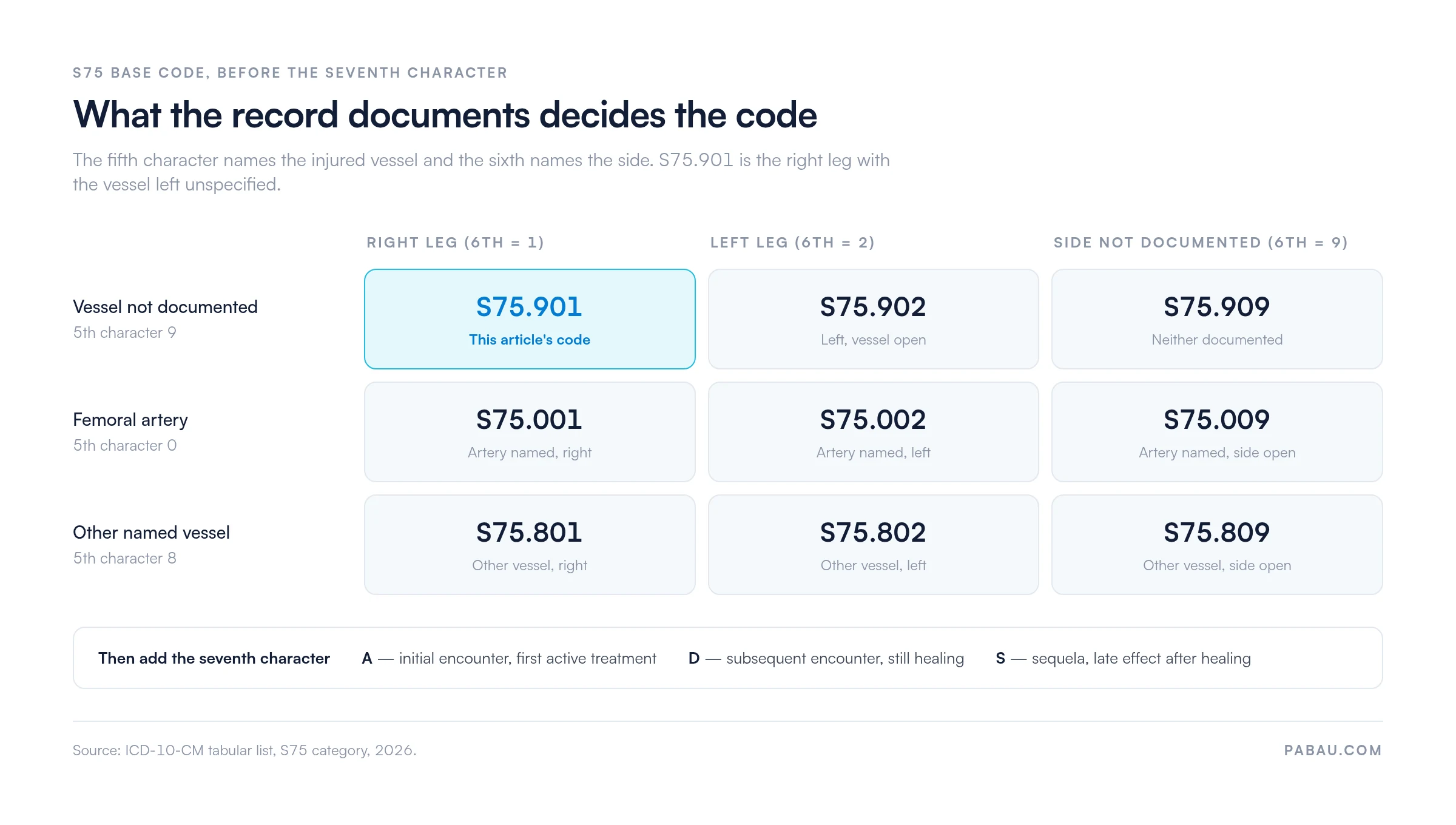
Two digits carry the specificity in this family, and reading them in order settles most code selections. The fifth character names the vessel, and the sixth names the side. A sixth digit of 1 means the right leg, 2 means the left, and 9 means the record does not say. The grid below maps both axes onto the base code before the seventh character is added.
A claim carrying ICD-10 Code S75.901D must be backed by a medical record that establishes five facts. Each one lives in a different part of the chart. A coder who reads only the current visit note will usually miss at least one.
The external cause code carries its own seventh character, and it should match the encounter type on the injury code. A right thigh vessel injury from stepping off a golf cart, for example, pairs with V86.49XD at the follow-up visit.
Before assigning S75.901D, pull the initial encounter note. If it names the specific vessel, a more specific code is available: S75.001D for the femoral artery, S75.801D for another named vessel. Query the provider rather than settling for the unspecified-vessel code, because most payers treat it as inappropriate when the record holds the answer.
Medicare and most commercial payers accept S75.901D on outpatient and inpatient claims when the documentation supports the subsequent encounter designation. The payer-facing requirements are consistent across major carriers, though state Medicaid programs may add LCD-level restrictions.
Denial patterns on this code cluster around three coding errors, and each one has a different fix. Our reference on medical billing denial codes shows which CARC codes map to which error. The correction then comes from the remittance rather than from a guess.
The electronic remittance advice on a denied claim names the CARC reason. That reason tells you whether the fix is a seventh-character change, a vessel query, or an external cause code. Rolling those reasons up by code, rather than reading one remit at a time, is what denial management in healthcare turns into a repeatable routine. The pattern shows up long before the write-offs do.
The CPT codes billed alongside S75.901D reflect the aftercare the patient is receiving during the subsequent encounter phase. Pairing the wrong CPT code with the diagnosis is a second denial vector, independent of the seventh-character issue. So is failing to document medical necessity for the procedure itself.
The five pairings below cover most subsequent encounter claims carrying this code, from active repair through to wound care and rehabilitation.
ICD-11 has been adopted by WHO and is in limited implementation internationally. The United States has not set a mandatory transition timeline as of the 2026 fiscal year. CMS continues to mandate ICD-10-CM for all HIPAA-covered transactions. Nothing about femoral vascular injury coding moves away from the S75 category in the meantime. The WHO ICD-10 browser remains the reference for international coding contexts.
ICD-11 does capture traumatic vascular injuries at the thigh level, with greater anatomical specificity than the S75 category offers. Practices that tighten their vessel-type and laterality documentation now will face a shorter transition curve whenever US adoption is mandated.
In most practices, the seventh character is decided at the end of the day. A coder reads a visit note written hours earlier and infers the healing status from it. The initial encounter note that names the vessel sits in a different record, often under a different provider. Nothing connects the two until a payer does it for you, on a remittance.
Practice management software like Pabau closes that distance by building the claim from the encounter itself. The patient’s earlier encounters, the operative report, and the diagnosis history sit on the same record the coder is working in. The side and the vessel documented in January are still visible in March. Pabau’s claims management software then validates the seventh character and the CPT-to-ICD pairing before the claim leaves the practice.
The outcome for a vascular or trauma billing team is fewer claims coming back for a correction they could have made in seconds. Every subscription includes the full feature set, so claim validation is not something you add on later.

Pabau validates ICD-10 seventh characters, laterality and CPT pairings before your claims reach the payer. See how the workflow fits your vascular and trauma billing team.

S75.901D is more specific than it looks. The laterality is already decided, so the only open question the code leaves is which vessel was injured. Treat it as a placeholder for laterality and you will keep billing it on left-leg injuries that belong to S75.902D.
The two errors worth engineering out are the seventh character and the unnamed vessel. Both are decided by what somebody wrote in an earlier note, which means the fix is a pre-submission check rather than a coder working harder. Practices that add that check stop re-coding the same claim twice.
To see how claim validation fits your vascular and trauma billing workflow, book a demo.

List Item #1
List Item #2
S75.901D is the billable diagnosis code for an unspecified injury of an unspecified blood vessel at hip and thigh level, right leg, subsequent encounter. It applies when a patient is still receiving active treatment for a traumatic vascular injury. The patient has already been seen at least once for the acute phase.
S75.901A designates the initial encounter, meaning the first time the patient receives active treatment for the injury. An emergency department visit or a first vascular surgery both qualify. S75.901D designates a subsequent encounter, meaning any later visit where the injury is still healing and active treatment continues. Wound checks, vascular clinic follow-ups and physical therapy evaluations all fall here. The seventh character reflects the encounter type, not the visit count.
Yes. The sixth digit 1 in S75.901 designates the right leg, so the laterality is already specified. S75.902D is the left-leg code and S75.909D is the code for a record that does not state the side. Only the vessel type is left unspecified in S75.901D, which is why a provider query about the injured vessel is often the right next step.
Three errors account for most of them. The first is the wrong seventh character, such as A instead of D on a follow-up visit. The second is a laterality conflict with an earlier claim that used a left-leg or unspecified-leg code. The third is a missing external cause code for the injury mechanism. Payers may also flag the unspecified vessel designation when the record names the femoral artery or vein.
Yes. It can be the principal diagnosis on an outpatient claim when the visit’s main reason is active treatment of the ongoing vessel injury. On inpatient claims it more commonly appears as a secondary diagnosis. The acute traumatic repair would typically have been the reason for the original admission.
Common pairings include office visit codes 99213-99214 for vascular clinic follow-ups, 97161-97163 for physical therapy evaluations, and 35226 or 35286 for active vascular repair procedures. Code 97597 covers wound debridement when the traumatic wound needs ongoing management. Each pairing requires documentation of medical necessity specific to the procedure performed at that encounter.