ICD-10 Code V28.01XD: E-bike driver noncollision accident, nontraffic, subsequent encounter
ICD-10 Code V28.01XD: Definition and billable status ICD-10 Code V28.01XD is the...

Last Updated: Oct 20, 2026
Billable Code Specific Code
S75.092A is the billable ICD-10-CM code for other specified injury of femoral artery, left leg, initial encounter.
The code also requires that this visit is the patient's first encounter for that injury. An operative report, an emergency department note, or the attending physician's documentation can each supply that detail.
The CMS ICD-10 codes page confirms the FY2026 edition took effect on October 1, 2025. S75.092A is billable and specific, so you can submit it without a more granular child code. From here, the reference covers the hierarchy, the 7th character, laterality, documentation, and the errors that trigger denials.
Let Pabau's smart automation suggest the right codes, reduce claim denials, and keep your practice compliant—effortlessly.
Automate repetitive tasks and focus on what matters most—your patients.
Reduce coding errors and ensure compliance with the latest regulations.
Clean claims, fewer denials, and faster reimbursements.
Powerful insights and reporting to help your practice thrive.
HIPAA compliant SOC 2 certified GDPR-compliant Trusted by 4,000+ clinics worldwide

S75.092A is a billable FY2026 code for other specified injury of the femoral artery, left leg, initial encounter.
The 7th character carries the encounter type, where ‘A’ means initial, ‘D’ means subsequent, and ‘S’ means sequela.
Laterality is mandatory, so submitting the unspecified code S75.099A when the record names the left side invites a denial.
The parent code S75.092 is not billable on its own, because it carries no 7th character.
Practice management software like Pabau validates ICD-10 codes through its Claim.MD integration before a claim reaches the payer.
Here is the complete code descriptor that coders and billing teams need for quick reference. All values align with the CDC/NCHS ICD-10-CM web tool for FY2026.
S75.092A sits inside a precise breadcrumb structure in the ICD-10-CM injury chapter. Reading it from the top down explains why the code cannot be billed without a 7th character. Other hip and thigh trauma codes such as S72.345C follow the same descent from chapter to billable code.
The digit 2 in the sixth position encodes left-side laterality, which separates this code from S75.091A and S75.099A. The 7th character A then makes the code billable by naming the encounter type. Without it, S75.092 cannot be submitted for reimbursement. The breakdown below maps each character to what it encodes, and to the code you get if you change one.
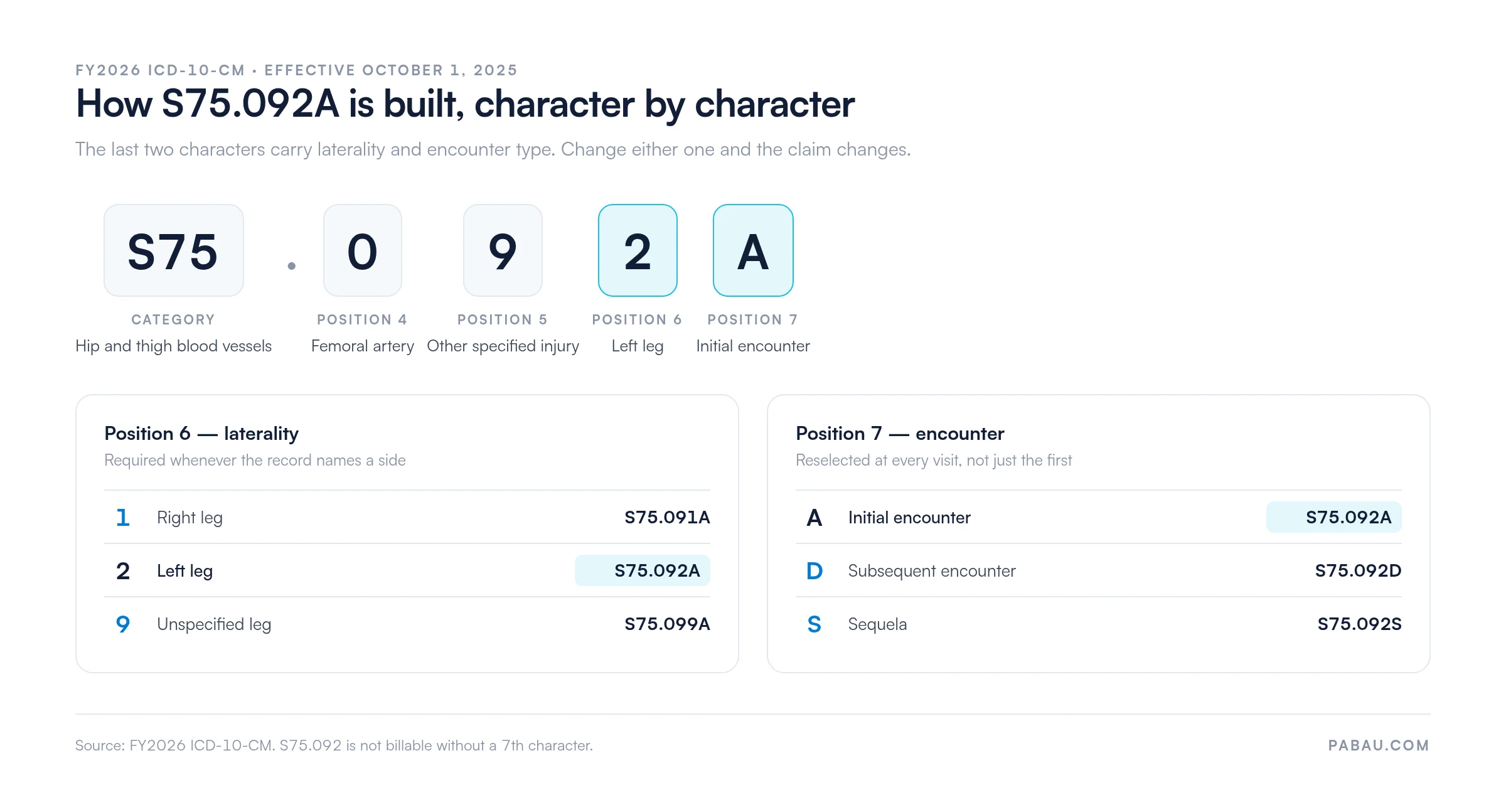
Choose the 7th character from where the patient sits in the care episode. Visit count does not decide it. That makes it the most commonly misapplied element in Chapter 19 injury codes.
The AAPC ICD-10-CM coding reference notes that coders must reselect it at every encounter, not just the first. The same rule governs sibling codes such as S12.131D, where the D marks a later visit.
Key rule: initial encounter does not mean the patient’s first visit to any provider. It means the patient is still receiving active treatment for the injury.
Someone who sees a specialist two weeks after the trauma remains in the initial-encounter phase if treatment is ongoing. Once the injury has healed and only residual effects remain, sequela coding applies, as it does for S60.152S.
Laterality is a non-negotiable documentation requirement here. Submitting an unspecified code when the record names a side is an error that payers flag during audit review. The three options for other specified femoral artery injury at an initial encounter are:
If an operative report describes the surgical site as left groin with repair of the femoral artery, S75.092A is correct. If the attending note says femoral artery injury without naming a side, query the provider.
Where that is impossible before submission, S75.099A is the only defensible choice. Querying always beats defaulting to unspecified.
S75.092A covers femoral artery injuries that the record describes specifically, but that do not match a named injury type inside the S75.0 subcategory. Other specified is a precise term in ICD-10-CM, not a catch-all.
Coders in trauma, vascular surgery, orthopedic, and sports medicine settings meet this category most often. Documentation in this group commonly describes:
What this code does not include: unspecified femoral artery injuries, right-leg injuries, and injuries to other hip and thigh vessels. Use S75.099A when no side is documented, and S75.091A for the right leg.
The femoral vein and great saphenous vein each sit in a different S75 subcategory. Fully described penetrating or laceration injuries may warrant S75.01 or S75.02 instead, depending on the depth of documentation.
Four elements decide whether S75.092A survives review. The record must name the femoral artery and state the left side. It also has to describe an injury type that reads as other specified, then confirm the encounter stage.
Medical billing compliance rules turn on exactly that specificity, so vascular trauma cases feel it quickly. Confirm all four before you apply the code:
Structured SOAP note templates with fields for anatomical site, laterality, injury mechanism, and encounter stage cut the risk of an incomplete record. When those fields get populated at every visit, coders can apply S75.092A without another provider query.
Before submitting a claim with S75.092A, run a laterality check. Search the operative report and the progress note for the words left and right. If neither appears next to femoral artery, query the provider before filing. Defaulting to S75.099A without querying carries real compliance exposure.
Knowing the surrounding family prevents miscoding and helps you report bilateral injuries or several damaged vessels accurately. The table below covers the siblings and neighbors coders reach for most. Digit-position conventions hold across injury categories, so injury categories, so S46.921A reads the same way in the shoulder and upper arm.
The ICD-10-CM Official Guidelines for Coding and Reporting, Chapter 19, govern how S00-T88 injury codes are applied. Coders who work from code descriptions alone generate avoidable denials, which is where denial management starts costing time. Most S75 errors trace back to one of these five:
Each avoidable denial costs a rework cycle and delays payment by 30 to 60 days. Teams that treat revenue cycle management as part of coding, rather than a downstream problem, catch these before submission.
Flag every S75 claim for external cause code review before submission. Trauma cases almost always have a documentable cause, whether a collision, a fall, or a penetrating injury. An accurate V or W code paired with S75.092A satisfies payer medical-necessity review far better than the injury code alone.
Practices handling vascular trauma face two jobs at once. They have to capture the clinical specificity S75.092A needs, and keep note-writing quick enough that providers actually finish it. Practice management software like Pabau handles both sides through its claims management software.
Pabau’s structured clinical note templates carry fields for anatomical site, laterality, injury description, and encounter stage. When a provider records left femoral artery, other specified injury, initial encounter, that structured data maps straight to the code. Nobody has to interpret free-text narrative after the fact, so provider queries drop and billing moves faster.
On the claims side, Pabau’s Claim.MD integration validates ICD-10 codes, applies payer-specific rules, and processes electronic remittance advice. That is where a missing laterality digit or the wrong 7th character gets caught.
Clean claim rules sit inside the same workflow, so a submission is checked before it leaves the practice. Teams new to medical billing gain the most, because the software encodes rules they would otherwise learn from denials.

Pabau’s built-in ICD-10 code search and Claim.MD integration validate codes like S75.092A before submission. Laterality and encounter-type errors get caught before they reach the payer.

S75.092A is a narrow code, and that is what makes it useful. Two characters carry the whole decision, so the work happens in the note rather than in the coding software. Get the left side and the encounter stage into the physician’s own words, and the code follows without a query.
The trade-off worth remembering is that S75.099A is always available and almost never right. Reaching for it saves a phone call today and invites a recoupment later. Book a demo to see how Pabau’s structured notes and Claim.MD validation keep S75 claims clean on the first pass.

Billing a laparoscopic gallbladder removal? Laparoscopic cholecystectomy billing guide explains how a single coding decision, such as whether cholangiography was done, prevents a clean claim from being denied.
Coding a diagnostic laparoscopy? Diagnostic laparoscopy billing guide covers the code for minimally invasive abdominal exams, with or without specimen collection by brushing or washing.
Need a 7th character other than A, D, or S? S52.042Q shows how fracture codes extend the same position to healing status.
ICD-10 code S75.092A is a billable ICD-10-CM diagnosis code for other specified injury of the femoral artery, left leg, initial encounter. It belongs to category S75, injury of blood vessels at hip and thigh level. The code took effect on October 1, 2025 for FY2026 billing.
Yes, S75.092A is a billable and specific ICD-10-CM code. You can submit it for reimbursement without a more specific child code. The parent code S75.092 is not billable on its own, because it carries no 7th character.
S75.092A applies to other specified injury of the femoral artery on the left leg. S75.091A covers the same injury type on the right leg. The sixth-position digit carries laterality, where 2 encodes left and 1 encodes right. Both still require a 7th character for the encounter type.
Use S75.092A while the patient is receiving active treatment for the femoral artery injury. That includes the initial surgical repair and any ongoing treatment of the acute injury. Use S75.092S once the injury has healed and only residual effects remain. Chronic ischemia and limb dysfunction from the original trauma both qualify.
The record must carry four elements. It has to name the femoral artery as the injured vessel, and the treating physician must state left-side laterality. The injury type has to read as other specified rather than a named laceration grade. Finally, the visit must be an initial active treatment encounter, not follow-up care or sequela management.
Yes. S75.092A is valid for the FY2026 edition of ICD-10-CM and took effect on October 1, 2025. It has not been revised or retired in the current fiscal year release.