ICD-10 Code Y74.2: General hospital and personal-use implant failure
ICD-10 code Y74.2: Definition, descriptor, and billable status ICD-10 code Y74.2...

Last Updated: Oct 29, 2026
Billable Code Specific Code
S72.402D is the billable ICD-10-CM code for unspecified fracture of lower end of left femur, subsequent encounter for closed fracture with routine healing. It applies once active treatment is over and the patient returns for follow-up while the bone heals normally.
A common denial trigger is using the initial-encounter character A when active treatment is already over. Coders also confuse S72.402D with the right-side code S72.401D and the delayed-healing code S72.402G.
Let Pabau's smart automation suggest the right codes, reduce claim denials, and keep your practice compliant—effortlessly.
Automate repetitive tasks and focus on what matters most—your patients.
Reduce coding errors and ensure compliance with the latest regulations.
Clean claims, fewer denials, and faster reimbursements.
Powerful insights and reporting to help your practice thrive.
HIPAA compliant SOC 2 certified GDPR-compliant Trusted by 4,000+ clinics worldwide

S72.402D covers the left femur only: The right side uses S72.401D, and the unspecified side uses S72.409D.
The 7th character D requires that active treatment is complete and the fracture is healing routinely, without delay, malunion, or nonunion.
Missing laterality documentation or using character A instead of D for a follow-up visit are the two most common denial triggers for this code.
Pabau’s claim validation checks each claim for missing or invalid details before submission, so fixes happen before the payer sees it.
ICD-10 code S72.402D reports a follow-up visit for a closed fracture of the lower end of the left femur that is healing on schedule. The record doesn’t name the fracture pattern, which is why the code is “unspecified.” The table below confirms its core details.
S72.402D is a seven-character code, and each segment carries a distinct clinical meaning. Reading the characters left to right gives coders the anatomy, the fracture specificity, the laterality, and the encounter type in a single string.
The digit “2” in position six signals the left femur. The parallel right-side code is S72.401D, and S72.409D covers cases where laterality is not documented. Coders shouldn’t default to S72.409D just because the current note is vague. If the operative or imaging report states “left,” the code must reflect it.
The lower end of the femur, also called the distal femur, encompasses the supracondylar region and the femoral condyles just proximal to the knee joint. Fractures here are anatomically complex because the bone flares outward and sits close to major neurovascular structures, the popliteal artery in particular.
“Unspecified” in the code descriptor means the documentation does not differentiate between fracture subtypes such as supracondylar, unicondylar medial, unicondylar lateral, or comminuted patterns. Physical therapists treating post-fracture rehabilitation see this code often, because the imaging details from the acute episode are not always restated in follow-up notes.
Common causes and patient populations for lower-end femur fractures include:
Because S72.402D applies only to closed fractures with routine healing, any open fracture follow-up or complicated healing pattern must use a different 7th character. The clinical record has to support whichever character the coder picks.
The 7th character for S72.402 determines encounter type and healing status. Character D specifically means the patient is in the subsequent-encounter phase for a closed fracture that is healing without complication. S72.402 takes 16 valid 7th characters. The most common are listed below.
Characters H, J, M, N, Q, and R cover open-fracture subsequent encounters with delayed healing, nonunion, and malunion respectively. Character S (sequela) applies only after the fracture itself has fully resolved. The visit then addresses a residual condition caused by it, such as chronic knee stiffness.
S72.402D applies when active treatment of the fracture is complete and the patient attends a follow-up visit during which the fracture is healing on schedule. The ICD-10-CM Official Guidelines for Coding and Reporting set this out in Section I.C.19. The subsequent encounter phase begins once the visit’s main purpose is monitoring a healing fracture rather than delivering active treatment.
A different provider treating the same fracture at a follow-up visit still uses the D character. The 7th character tracks the phase of care for the injury, whichever provider sees the patient. The three questions below take the full choice in order, from laterality to healing status.
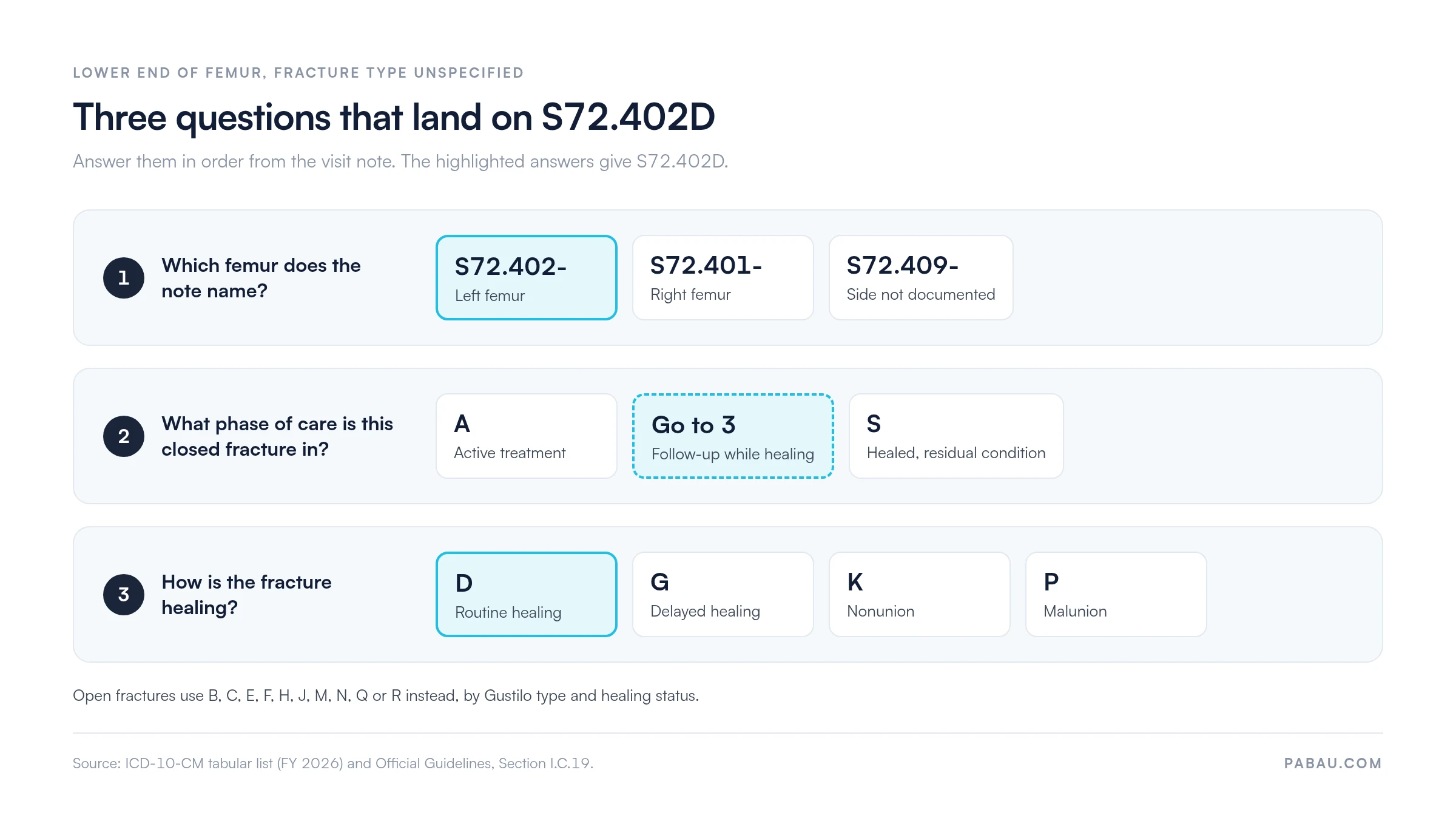
Several codes share almost identical descriptors with S72.402D but differ in a single variable, such as laterality, fracture specificity, or healing status. Selecting the wrong one creates a claim that may pass automated edits but fail a post-payment audit.
The S72 category carries coding notes that apply to every code in the family, including S72.402D. Coders must review these before submitting any claim in this category.
Pairing S72.402D with the correct CPT code is essential: Payers cross-reference the diagnosis code against the procedure code to confirm medical necessity. The table below maps the most common procedures to the care phase where S72.402D typically appears.
Understanding the full medical billing process for orthopedic follow-up helps practices choose the right CPT-diagnosis pairing from the outset, rather than correcting denials after submission.
CPT 27511 (open treatment, supracondylar/transcondylar fracture without intercondylar extension) and CPT 27513 (with intercondylar extension) are surgical codes billed at the initial encounter. Pairing either with S72.402D requires confirmation that a new procedure happened at a subsequent visit, which is uncommon. Check NCCI edits before billing a surgical CPT code with a subsequent-encounter ICD-10 code.
CMS and most commercial payers expect the clinical record to demonstrate that the visit is medically necessary as a monitoring encounter. For subsequent-encounter fracture claims, “medically necessary” means the provider is actively assessing healing progress, managing a complication, or directing a defined course of rehabilitation.
Request a copy of the applicable MAC LCD for fracture management before your first S72.402D claim. LCD policies differ by jurisdiction on visit frequency and documentation standards. A wrong assumption about coverage can lead to a recoupment demand months after payment.
S72.402D denials are predictable. The same small set of errors drives the majority of rejections, and each one has a documentation-level fix that prevents it before submission. Practices with strong denial management workflows catch these at the coding review stage rather than the appeals stage.
Each trigger above comes back on the remittance as a payer reason code. Decoding the denial codes tells you which fix to apply. Catching the error at the pre-submission review keeps each S72.402D visit a clean claim from the start.
Solid documentation for S72.402D does two jobs. It justifies the subsequent-encounter character D, and it separates routine healing (D) from delayed healing (G), nonunion (K) or malunion (P). Coders rely on the provider’s clinical language to make this call.
Strong medical billing compliance in orthopedic and PT settings comes down to documentation habits that support the code at every follow-up visit.
The clinical record for each S72.402D encounter must include:
When the provider notes ‘delayed healing’ or ‘non-healing’ at a follow-up visit, the code upgrades from D to G or K respectively. Build a coder checklist that prompts a review of healing language on every subsequent-encounter orthopedic claim. It catches the character change before submission instead of after a denial.
On a busy orthopedic or PT schedule, the follow-up claim often reuses the code from the first visit. The 7th character stays at A, or the side slips to unspecified, and the denial arrives weeks later.
Pabau, the practice management and billing platform we build, keeps the clinical note and the claim in the same system. Pabau’s claim validation checks each claim for missing or invalid details before submission, so fixes happen before the payer sees it. That check is built into Pabau’s error-checking claims management.
Validated claims then go out electronically through the Claim.MD clearinghouse, Pabau’s US clearinghouse partner, which routes to thousands of US payers. Your billing team spends its time on new claims instead of appeals.

Pabau’s claim validation checks each claim for missing or invalid details before it reaches Claim.MD. See how it works for orthopedic and PT practices.

ICD-10 code S72.402D has a narrow scope: Closed, left-side, lower-end femur fracture, follow-up visit, healing on schedule. Each part of that description is a coding criterion, and the visit note has to prove every one.
The two most common denial triggers, the 7th character and laterality, are both fixable before the claim leaves the practice. Update the character at the first follow-up visit and confirm the side in that visit’s own note. When imaging shows slow healing, move to G before submission instead of defending D on appeal.
Pabau’s claim validation checks each claim for missing or invalid details before submission, so fixes happen before the payer sees it. Book a demo to see how Pabau handles orthopedic and PT follow-up claims from the visit note to payment.

Need a framework for managing claim denials across your practice? Denial management in healthcare covers the full workflow from root-cause analysis to appeals and prevention.
Want to understand how the Claim.MD clearinghouse routes your ICD-10 claims? How the Claim.MD clearinghouse works explains payer routing, 835 remittance, and eligibility verification.
Building a compliant billing workflow for your orthopedic or PT practice? What is revenue cycle management maps the full process from patient registration through payment posting.
Billing insurance for post-fracture physical therapy? Insurance billing for therapists is a step-by-step guide to getting therapy claims paid.
ICD-10 code S72.402D is the billable diagnosis code for a follow-up visit for an unspecified fracture of the lower end of the left femur. It covers a closed fracture with routine healing. The patient has finished active treatment, and the fracture is healing without complication.
S72.402A is the initial-encounter code, used when the patient is receiving active treatment for the fracture (surgery, casting, ED management). S72.402D is the subsequent-encounter code, used once active treatment is complete and the patient attends follow-up visits during the healing period. Using A on a follow-up visit is one of the most common denial triggers for this code family.
Yes, S72.402D is a fully billable ICD-10-CM code confirmed in the CMS ICD-10-CM tabular list. It can be used as a standalone diagnosis code on claims for orthopedic follow-up visits, physical therapy, and imaging encounters during the fracture healing period.
S72.402 has 16 valid 7th characters. A, B and C cover the initial encounter. D, E and F cover follow-up with routine healing, and G, H and J cover delayed healing. K, M and N cover nonunion, and P, Q and R cover malunion. S is sequela. Within each set of three, the first letter means a closed fracture, the second open Gustilo I/II, and the third open Gustilo IIIA/B/C.
S72.402D indicates routine healing, meaning the fracture is progressing on the expected timeline. S72.402G indicates delayed healing, where imaging or clinical assessment shows the fracture is healing more slowly than expected. S72.402P indicates malunion, where the fracture has healed but in a position that causes functional impairment. Each requires distinct documentation: D needs a positive healing assessment, G needs evidence of slow progress, and P needs imaging confirming malalignment after union.
The clinical record must explicitly state left-side laterality and confirm that active fracture treatment is complete. It should also assess healing status, such as callus formation on X-ray or maintained alignment. The note then sets out the provider’s plan for the rest of the healing period. Vague language like “patient doing well” does not confirm the routine-healing criterion that the D character requires.