S72.424B is the billable ICD-10-CM code for nondisplaced fracture of lateral condyle of right femur, initial encounter for open fracture type I or II.
It applies while the patient receives active treatment for an open wound the surgeon grades Gustilo-Anderson type I or II. A closed fracture takes S72.424A, a type III wound takes S72.424C, and a displaced fracture takes S72.421B. The left femur uses S72.425B.
Related Information
Chapter
S00-T88 Injury, poisoning and certain other consequences of external causes
Category
S72 Fracture of femur
Group
S72.424 Nondisplaced fracture of lateral condyle of right femur
Billable
Yes
Code also known as
lateral condyle femur fracture, distal femur fracture, open femur fracture, Gustilo type I femur fracture
Save time. Improve accuracy. Get paid faster.
Automate coding with Pabau
Let Pabau's smart automation suggest the right codes, reduce claim denials, and keep your practice compliant—effortlessly.
S72.424BNondisplaced lateral condyle femur fractureHigh match
Confidence score
98%
Why this code?
Matches patient diagnosis
Supported by clinical notes
Commonly used for this condition
Why practices choose Pabau
Save hours every week
Automate repetitive tasks and focus on what matters most—your patients.
Improve accuracy
Reduce coding errors and ensure compliance with the latest regulations.
Get paid faster
Clean claims, fewer denials, and faster reimbursements.
Grow with confidence
Powerful insights and reporting to help your practice thrive.
HIPAA compliant•SOC 2 certified•GDPR-compliant•Trusted by 4,000+ clinics worldwide
Key takeaways
S72.424B covers a nondisplaced fracture of the right femur’s lateral condyle. The left side is S72.425B, and ICD-10-CM has no bilateral femur code, so code each side.
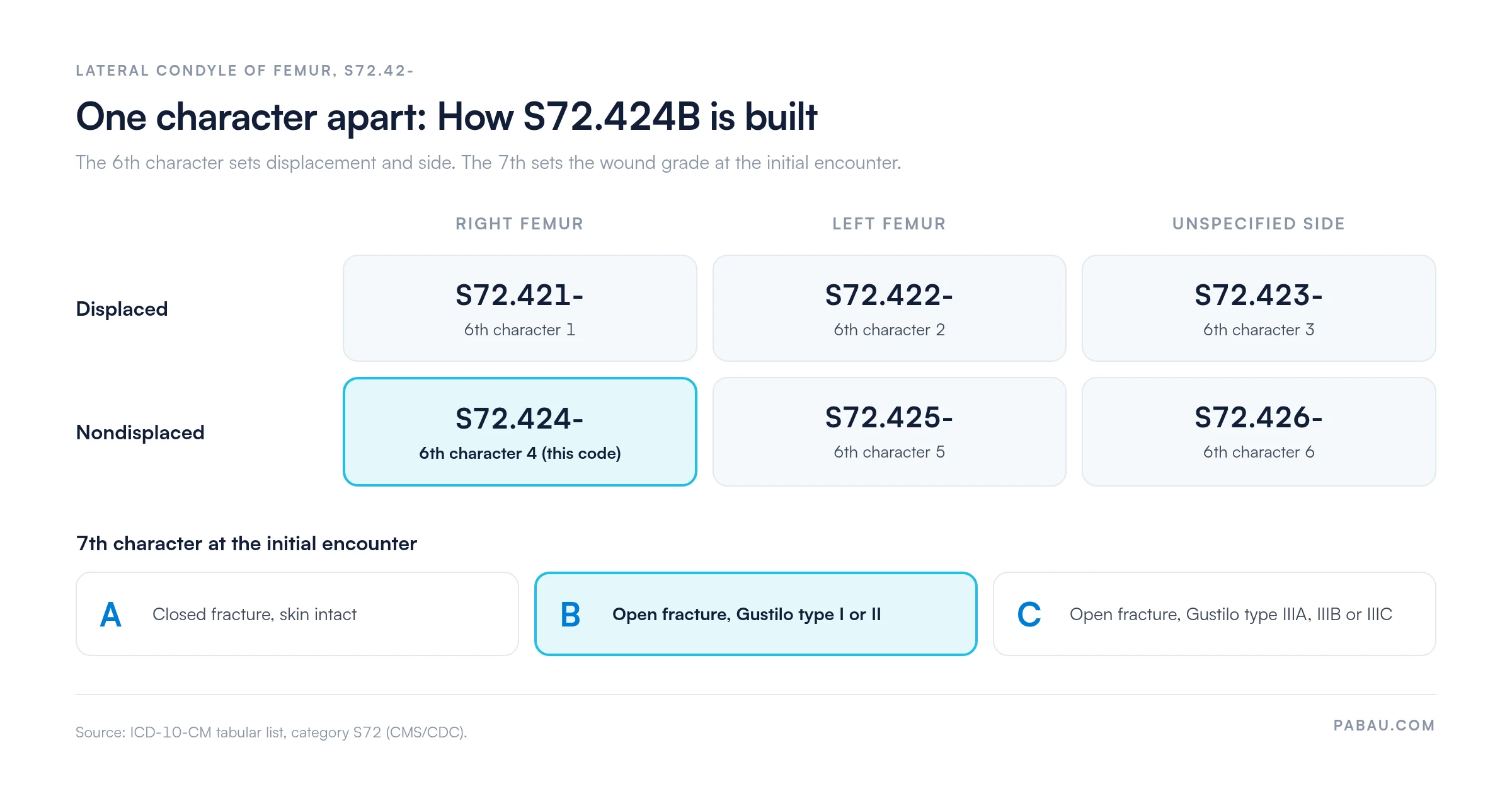
The 7th character B means initial encounter for an open fracture, Gustilo-Anderson type I or II. Use A for closed fractures and C for type IIIA, IIIB or IIIC, while D, E and F are subsequent encounters.
The operative or emergency department note must state the Gustilo-Anderson grade, because coders cannot assign the grade themselves.
A fracture the record does not call nondisplaced defaults to displaced, which moves the claim to S72.421B.
Pabau’s claims management software submits S72.424B claims through its Claim.MD integration, which checks the diagnosis-procedure pairing and eligibility first.
ICD-10 code S72.424B: Quick reference
Field
Value
Code
S72.424B
Full descriptor
Nondisplaced fracture of lateral condyle of right femur, initial encounter for open fracture type I or II
Code system
ICD-10-CM (Clinical Modification)
Category
S72 Fracture of femur, in block S70-S79 (Injuries to the hip and thigh)
Billable status
Yes, billable (verify against the current fiscal year’s CMS tabular list)
7th character
B, initial encounter for open fracture type I or II
Laterality
Right femur (6th character 4 = nondisplaced, right)
What S72.424B covers: Full code descriptor explained
Each segment of the S72.424B descriptor carries a specific clinical meaning. Misreading any one of them produces a miscoded claim.
S72: Fracture of femur. The S72 category covers traumatic femur fractures from the femoral head and neck (S72.0-) through the distal condyles (S72.4-).
.4: Fracture of lower end of femur. The fourth character places the fracture at the distal femur rather than the shaft or proximal end.
.42: Fracture of lateral condyle of femur. The fifth character narrows the site to the lateral condyle. That is the bony prominence at the outer edge of the distal femur, part of the knee joint. A medial condyle fracture at the same level uses .43 (S72.43-). S72.41- is the unspecified condyle code.
4 (6th character): Nondisplaced fracture, right femur. In S72.42-, 1, 2 and 3 are displaced right, left and unspecified. 4, 5 and 6 are nondisplaced right, left and unspecified. Left nondisplaced is S72.425B.
B (7th character): Initial encounter, open fracture type I or II. This character carries both the encounter type (active treatment) and the open fracture grade (Gustilo-Anderson type I or II).
Displaced vs. nondisplaced: Nondisplaced means the fracture fragments have not moved from their normal anatomical alignment. The fracture shows on imaging, but the cortical surfaces stay apposed. The ICD-10-CM guidelines code a fracture to displaced when the record does not say which it is. Without the word “nondisplaced” in the note, the claim belongs on S72.421B.
The six codes in the S72.42- subcategory differ only in their 6th character, and the 7th character then sets the wound grade.
A wrong side or a missing “nondisplaced” moves the claim one cell over, so check both before the 7th character. Codes from the ICD-10-CM tabular list.
Understanding the 7th character B: Initial encounter for open fracture
The 7th character B designates the initial encounter for an open fracture classified as Gustilo-Anderson type I or II. Under the ICD-10-CM Official Guidelines for Coding and Reporting (Section I.C.19.a), initial encounter means the patient is receiving active treatment. It does not depend on whether this provider has seen the patient before.
7th character
Meaning
When to use
A
Initial encounter, closed fracture
Active treatment, skin intact over fracture site
B
Initial encounter, open fracture type I or II
Active treatment, wound communicates with fracture, Gustilo grade I or II documented
C
Initial encounter, open fracture type IIIA, IIIB, or IIIC
Active treatment, Gustilo grade III documented
D
Subsequent encounter, closed fracture with routine healing
Routine care after active treatment phase ends
E
Subsequent encounter, open fracture type I or II with routine healing
Routine care, original fracture was Gustilo I or II
F
Subsequent encounter, open fracture type IIIA, IIIB, or IIIC with routine healing
Routine care, original fracture was Gustilo III
G to R
Subsequent encounter with delayed healing (G, H, J), nonunion (K, M, N) or malunion (P, Q, R)
Follow-up visit where a healing complication is documented
S
Sequela
Late effect of the fracture, not active treatment
Gustilo-Anderson classification and open fracture type selection
The Gustilo-Anderson classification grades open fractures by wound size, contamination level, and soft-tissue damage. The treating physician, not the coder, assigns the grade. Coders abstract the grade from the operative note or emergency department documentation.
Gustilo grade
Wound characteristics
ICD-10-CM 7th character (S72 fractures)
Type I
Wound less than 1 cm, low energy, minimal contamination
B (initial) / E (subsequent)
Type II
Wound 1-10 cm, moderate soft-tissue damage, minimal contamination
B (initial) / E (subsequent)
Type IIIA
Wound greater than 10 cm, adequate soft-tissue coverage remains
C (initial) / F (subsequent)
Type IIIB
Extensive periosteal stripping, soft-tissue loss requiring flap coverage
C (initial) / F (subsequent)
Type IIIC
Arterial injury requiring repair
C (initial) / F (subsequent)
S72.424B vs. similar codes: How to choose the right code
The codes below differ from S72.424B by a single character, and each describes a different injury. Payers check every one of those characters against the record.
Code
Descriptor
Key differentiator
S72.424B
Nondisplaced, lateral condyle, right femur, open I/II, initial
The target code. Site, displacement, side, wound grade and encounter must all match.
S72.424A
Nondisplaced, lateral condyle, right femur, closed, initial
Skin intact over the fracture site, with no wound communication
S72.424C
Nondisplaced, lateral condyle, right femur, open IIIA/B/C, initial
Gustilo grade III documented in operative note
S72.421B
Displaced, lateral condyle, right femur, open I/II, initial
Fragments displaced on imaging, or displacement not documented
S72.425B
Nondisplaced, lateral condyle, left femur, open I/II, initial
Left side, every other parameter identical
S72.434B
Nondisplaced, medial condyle, right femur, open I/II, initial
Medial condyle, the inner femoral condyle rather than the outer one
Pro Tip
When the operative note says ‘open fracture’ without explicitly stating the Gustilo-Anderson grade, query the operating surgeon before assigning the 7th character. Coding the grade from wound size alone without physician documentation is a compliance risk. Document the query and response in the coding record.
Excludes notes and coding conventions for S72.424B
ICD-10 code S72.424B inherits tabular notes from two levels, the S72 category and the S72.4 subcategory. They decide which codes may sit alongside it on the claim.
Category scope: S72 covers fractures of the whole femur, from the head and neck (S72.0-) and the trochanteric region (S72.1-) to the lower end (S72.4-). Lateral condyle fractures sit under S72.4-, fracture of lower end of femur.
Excludes1 (S72 level): Traumatic amputation of hip and thigh (S78.-). An Excludes1 note means the two conditions are never coded together.
Excludes2 (S72 level): Fracture of lower leg and ankle (S82.-), fracture of foot (S92.-), and periprosthetic fracture of a prosthetic hip implant (M97.0-). These are not part of S72, so both codes may be reported when both injuries are present.
Excludes (S72.4 level): Fracture of the femoral shaft (S72.3-) and physeal fracture of the lower end of the femur (S79.1-). A growth-plate fracture in a child goes to S79.1-, not S72.424B.
Open wound (general guidance): The 7th character B captures the wound. A separate wound code is not usually added unless the wound is distinct from the fracture site.
Clinical presentation and documentation requirements
A valid assignment of ICD-10 code S72.424B requires the medical record to explicitly support each element of the descriptor. Coders who rely on inference rather than explicit documentation expose claims to audit risk.
The medical record must contain:
Mechanism of injury: High-energy trauma (motor vehicle collision, fall from height, sporting impact) consistent with a distal femur fracture. A low-energy mechanism in an older patient may point to a pathological fracture, which is coded in M80-M84 instead of S72.
Imaging findings: X-ray or CT confirming fracture at the lateral condyle, with a note stating nondisplaced or “fragments in anatomical alignment.” The radiologist’s report or the treating physician’s interpretation must use this language.
Laterality confirmation: The note must identify the right limb. A note that says “femoral condyle fracture” without specifying a side requires clarification before coding S72.424B.
Open wound documentation: The emergency department or operative note must show that the wound communicates with the fracture. Visible bone, a wound that probes to bone, or an explicit statement that the fracture is open all qualify.
Gustilo-Anderson grade: The surgeon or emergency physician must state the grade. It can sit in the operative note, the ED note or a documented query response. “Open fracture, Gustilo type II” or “type I open injury” satisfies this requirement.
Every entry should also be dated and signed by the responsible provider. Cross-check the operative and radiology reports so both describe the same side, site and displacement.
Procedures commonly reported with S72.424B
Open fractures of the lateral femoral condyle almost always need surgery. The CPT codes below are commonly reported with S72.424B. Check each pairing against the current National Correct Coding Initiative (NCCI) edits before submission. A sound medical billing workflow confirms these pairings on every claim, not once per template.
CPT code
Description
Pairing notes
27514
Open treatment of femoral fracture, distal end, medial or lateral condyle, includes internal fixation, when performed
The standard pairing for ORIF of an isolated lateral condyle fracture. Internal fixation is included, so it is not reported separately.
27511
Open treatment of femoral supracondylar or transcondylar fracture without intercondylar extension, includes internal fixation, when performed
Not a condyle code. A supracondylar fracture pairs with S72.45-, and one with intercondylar extension uses 27513 with S72.46-.
20690
Application of uniplane external fixator, unilateral
Temporary stabilization before definitive ORIF; may be separately reportable depending on timing and payer policy
20900
Bone graft, any donor area; minor or small
Reported when bone grafting is performed at the fracture site; verify CCI edits for bundling with ORIF codes
97597
Wound debridement, open wound, first 20 sq cm
Selective wound care, usually at later visits. Excisional debridement of the open fracture site itself is reported with 11010-11012.
When the surgeon stages treatment, the temporary frame is reported with 20690 and the definitive ORIF with 27514 at a later surgery. Both dates of service carry S72.424B, because the patient is still in active treatment.
Payer requirements: Medicare and commercial insurer rules
Medicare coverage for distal femur fracture repair follows national coverage policy. Where they apply, Local Coverage Determinations (LCDs) from the regional Medicare Administrative Contractor (MAC) add to it. LCDs vary by contractor and are revised over time. Check the current version for your region before submitting a claim.
Admission diagnosis vs. principal diagnosis: S72.424B is typically the inpatient principal diagnosis. That holds when, after study, the open condyle fracture is chiefly responsible for the admission.
DRG assignment: Without an OR procedure, a femur fracture admission groups to MS-DRG 533-534 (fractures of femur). Once ORIF is performed, the stay groups to the hip and femur procedure DRGs 480-482. Check the output of the current grouper before transmission.
Prior authorization: ORIF of an open fracture is urgent, so it rarely needs advance authorization. Many commercial payers still expect notification within 24 to 48 hours of admission. Check your payer contract for exact timelines.
Medical necessity documentation: Imaging must confirm the fracture. The record also needs a physician attestation that surgery was medically necessary, plus an operative note detailing the fixation approach.
Each check sits inside the wider revenue cycle management process, which runs from the coded encounter to the final payment.
Common denial reasons and how to avoid them
ICD-10 code S72.424B claims deny for predictable reasons. Each one takes minutes to fix in the operative note and hours to fix in an appeal.
Wrong 7th character (most common): Assigning A (closed) to an open fracture, or C (Gustilo III) when the note documents type I or II. Both errors trigger medical necessity or coding validity denials. Fix: Confirm the Gustilo grade in the operative note before selecting the 7th character.
Displaced vs. nondisplaced miscoding: S72.421B (displaced) and S72.424B (nondisplaced) are frequently swapped when the imaging report uses vague language. Fix: The radiologist or treating physician’s note must explicitly state “nondisplaced” or “in anatomical alignment.” Query the provider if the record is ambiguous.
Missing Gustilo grade in operative note: Auditors look for an explicit Gustilo grade on open fracture claims. A note that says only “open fracture” without the grade will not support B vs. C selection. Fix: Implement a documentation template in your orthopedic practice that includes a Gustilo grade field in every open fracture operative report.
Laterality mismatch: Submitting S72.424B (right) when the operative site is the left femur (use S72.425B). Fix: Cross-reference the operative note laterality statement against the code’s laterality character before submission.
Debridement reported with ORIF: Payers often bundle debridement into the fracture repair. Fix: Check the NCCI column 1/column 2 edits for the specific CPT pair. Append modifier 59 only when the debridement is separate and distinct from the repair.
Structured denial management workflows tag each reason code back to the original claim. Billing teams can then see which pattern keeps recurring and fix it at the source. Common payer denial codes on fracture claims include CO-4 (modifier inconsistent with the procedure) and CO-11 (diagnosis inconsistent with procedure). CO-22 (care may be covered by another payer) also turns up.
Pro Tip
Run a monthly coding audit on all S72.4xx claims. Pull a sample of 20 claims and verify the 7th character against the operative note in each. If more than 5% miss on displacement or open fracture grade, schedule coder education. Then revise your operative documentation template.
How Pabau keeps S72.424B claims accurate
A fracture claim usually passes through three people. The surgeon dictates the operative note, and a coder reads it for side, displacement and Gustilo grade. A biller then keys the claim into a clearinghouse portal. Each handoff is a chance for B to become A, or right to become left.
Pabau, the practice management and billing platform we build, submits S72.424B claims electronically through its Claim.MD integration. The integration validates diagnosis-procedure pairings and checks eligibility before the claim goes out.
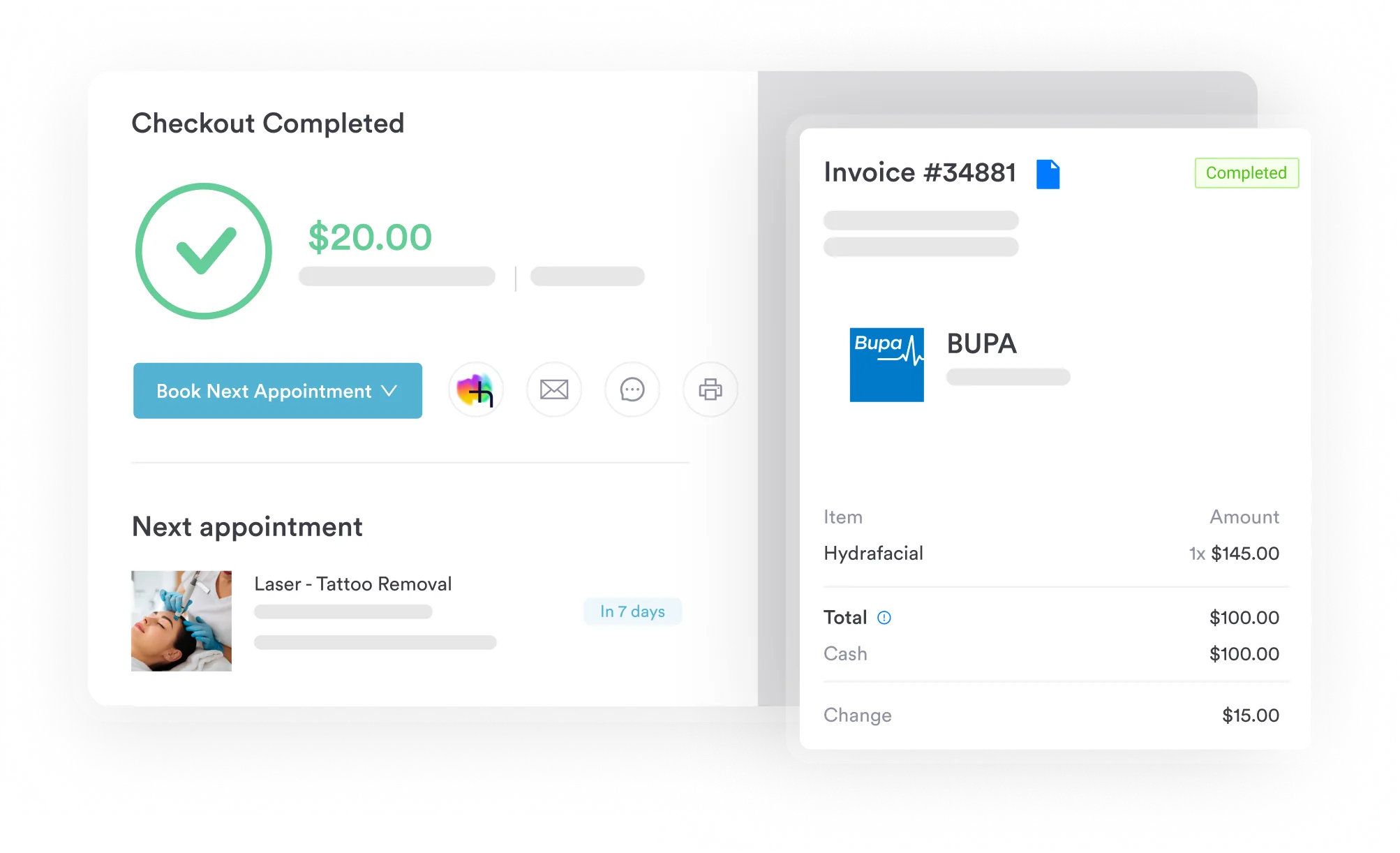
Pabau’s checkout closes the visit with an invoice billed to the insurer, so the fracture claim starts from the same record as the coded encounter.
Electronic remittance advice comes back into Pabau as well, so denial reasons show beside the claim instead of in paper EOBs. Your billing team can trace a CO-11 to the note that caused it and correct the template, not just the claim.
Streamline your orthopedic claims workflow
Pabau’s integrated claims management connects diagnosis coding, electronic submission, eligibility checks and ERA retrieval in one platform. S72.424B claims reach the payer with the right documentation attached.
S72.424B is only correct when the record states four facts in so many words. The fracture is on the right, it is nondisplaced, it is open, and the surgeon graded it type I or II. If any one of them is missing, query the provider before you code, because the defaults point elsewhere.
The trade-off is a short delay at coding against weeks lost to a denial and appeal. A Gustilo field in the operative template and a laterality check at charge entry remove most of that delay.
Book a demo to see how Pabau checks fracture claims for pairing and eligibility before they reach the payer.
Continue your research
Need guidance on denial prevention across all claim types?Medical billing compliance covers the audit and documentation standards that protect claims from common payer challenges.
Want to understand how clearinghouse submission works end to end?Electronic remittance advice explains how ERAs map denial reason codes back to individual claim lines so billing teams can act fast.
Exploring how to verify coverage before fracture surgery claims are submitted?Insurance eligibility verification outlines the pre-submission checks that reduce avoidable denials on high-value surgical claims.
Frequently asked questions
What does ICD-10 code S72.424B mean?
ICD-10 code S72.424B is the billable diagnosis code for a nondisplaced fracture of the right femur’s lateral condyle. It applies at the initial encounter for an open fracture, Gustilo-Anderson type I or II. Each element must be documented explicitly to support the code. That means nondisplaced, lateral condyle, right femur, open, type I or II, and initial encounter.
What is the difference between S72.424A, S72.424B, and S72.424C?
S72.424A covers the same fracture site as a closed fracture (skin intact). S72.424B covers an open fracture Gustilo type I or II at the same site. S72.424C covers an open fracture Gustilo type IIIA, IIIB, or IIIC. The fracture site and displacement are identical across all three. Only the wound status and, for open fractures, the Gustilo grade differ.
What is the 7th character B in ICD-10 fracture codes?
The 7th character B in ICD-10-CM fracture codes designates the initial encounter for an open fracture classified as Gustilo-Anderson type I or II. Initial encounter means the patient is actively receiving treatment for the fracture, not that it is the provider’s first encounter with the patient. Subsequent encounters for the same open type I/II fracture use the 7th character E.
What documentation is required to support S72.424B?
The medical record must explicitly state five elements. The first three are (1) fracture of the lateral condyle, (2) right femur laterality, and (3) nondisplaced or anatomical alignment. The other two are (4) a wound communicating with the fracture and (5) a physician-documented Gustilo-Anderson grade of I or II. Missing any one element is grounds for payer denial or audit recoupment.
How does S72.424B differ from intertrochanteric fracture coding?
S72.424B codes a distal femur fracture at the lateral condyle. Intertrochanteric fractures (S72.14-) occur at the proximal femur, between the greater and lesser trochanters. They are anatomically distinct regions, carry separate code families, and typically pair with different surgical procedures and DRG groupings.
What are common denial reasons for S72.424B claims?
The most frequent denials involve the wrong 7th character, such as closed vs. open or Gustilo II vs. III. Others come from a displaced/nondisplaced mismatch, a missing Gustilo grade, or a laterality error. Reason codes commonly seen on fracture claims include CO-11 (diagnosis inconsistent with procedure) and CO-4 (modifier inconsistent with the procedure).