

ICD-10 Code S42.444P: Medial epicondyle fracture, right humerus
ICD-10 Code S42.444P: full descriptor and code validity ICD-10 Code S42.444P car...

Last Updated: Oct 13, 2026
Billable Code Specific Code
S72.091Q is the billable ICD-10-CM code for other fracture of head and neck of right femur. It applies to a subsequent encounter for an open fracture type I or II with malunion.
The code became effective October 1, 2025 under the FY2026 ICD-10-CM edition. Its 7th character carries three specifications at once: encounter type, open fracture grade, and healing status. All three must be documented before the code holds up on a claim.
Let Pabau's smart automation suggest the right codes, reduce claim denials, and keep your practice compliant—effortlessly.
Automate repetitive tasks and focus on what matters most—your patients.
Reduce coding errors and ensure compliance with the latest regulations.
Clean claims, fewer denials, and faster reimbursements.
Powerful insights and reporting to help your practice thrive.
HIPAA compliant SOC 2 certified GDPR-compliant Trusted by 4,000+ clinics worldwide

S72.091Q is billable for FY2026 and valid in all HIPAA-covered transactions from October 1, 2025.
The 7th character Q encodes three facts at once: subsequent encounter, open fracture type I or II, and malunion.
Gustilo-Anderson grade type I or type II must be documented by the treating physician to support this code.
A type IIIA, IIIB, or IIIC open fracture with malunion takes character R, so grade and healing status are read together.
Pabau keeps the 7th character consistent from the clinical note through to the submitted claim.
ICD-10 code S72.091Q is a valid, billable ICD-10-CM diagnosis code in the 2026 edition, effective October 1, 2025, and accepted in all HIPAA-covered transactions. According to the CMS ICD-10-CM code files, S72.091Q sits within Chapter 19, covering injury, poisoning and certain other consequences of external causes. Within that chapter it falls under category S72, fracture of femur.
The full official descriptor is: Other fracture of head and neck of right femur, subsequent encounter for open fracture type I or II with malunion. Every word in that descriptor carries coding weight.
Each character position in S72.091Q carries a specific clinical meaning. Coders who understand the anatomy of the code are less likely to select a sibling code by mistake.
The 5th character 9 places this fracture in the “other” subcategory under S72.09. That subcategory sits alongside several more specific siblings in the S72.0 range, each with its own 5th character.
Read the operative or clinical note for the exact anatomical region before settling on S72.09. The “other” subcategory is correct only when the documented site does not match one of the named siblings above.
The 7th character Q encodes three simultaneous clinical facts. The encounter is a subsequent (follow-up) visit, and the original fracture was open and graded Gustilo-Anderson type I or type II. The fracture has since healed with malunion. Each of those facts requires physician documentation to support the code.
The Gustilo-Anderson classification grades open fractures by wound size, degree of soft tissue injury, and vascular involvement. ICD-10-CM splits those grades into two 7th-character groups: type I or II in one group, and type IIIA, IIIB, or IIIC in the other. S72.091Q belongs to the first group, so the note must place the original fracture at type I or type II.
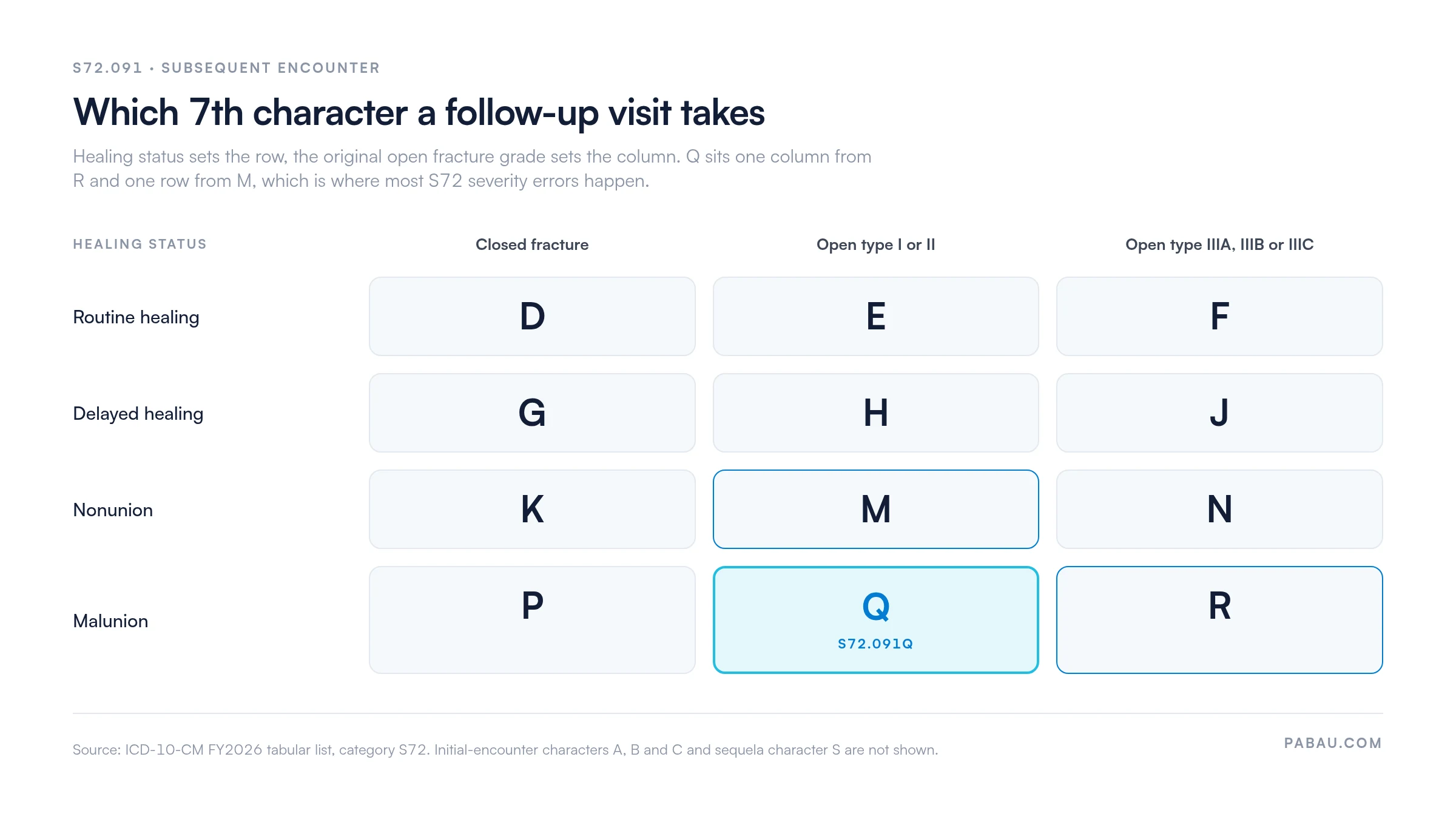
Types I and II share one set of 7th characters, and Q is the malunion member of that set. A fracture documented as Gustilo type IIIA, IIIB, or IIIC maps to a different set. There the malunion outcome takes character R rather than Q.
Malunion means the fracture has healed but in an abnormal position. Nonunion means the healing process has stalled and bone union has not occurred. These are mutually exclusive outcomes, and the 7th character distinguishes them precisely. The grid below plots every subsequent-encounter character for S72.091 against the two facts that select it.
A radiographic report confirming the malunion finding is the strongest documentation for this code. A note reading “fracture healing, mild displacement” states no malunion conclusion, so it may not survive audit.
The full set of 7th character options for S72.091 covers initial encounters, subsequent encounters by fracture openness, and healing outcomes. Subsequent encounter codes (D through R) are the ones most commonly used in orthopedic follow-up billing.
When a patient presents at a follow-up appointment and the chart does not specify healing status, query the treating physician before assigning a 7th character. On a type I or II open fracture, character E means routine healing, Q means malunion, and M means nonunion. Defaulting to routine healing when the chart actually shows malunion is a common audit vulnerability.
S72.091Q belongs to a hierarchy of increasingly specific codes. Understanding the full code tree helps coders navigate to the correct level and identify sibling codes when laterality or fracture subtype differs.
The CDC/NCHS ICD-10-CM tool lets coders browse the full S72 hierarchy in tabular and index views. Our diagnostic code library covers the same codes with the billing detail set out beside each one.
Use S72.099Q (unspecified femur) only when laterality is genuinely not determinable from the documentation. Payers flag it in medical necessity reviews when a laterality-specific code could reasonably have been assigned.
The following clinical terms and phrases are recognized as synonymous with S72.091Q. These are the terms most likely to appear in operative notes, radiology reports, and discharge summaries when this code applies.
These synonym phrasings appear most often in orthopedic surgery discharge summaries and radiology follow-up reports. When the note uses language from this list without stating the ICD-10 code, the coder must confirm laterality and healing status first. The physician note has to support every component of the selected code.
Five elements must be present in the physician’s documentation to support S72.091Q. Missing any one of them shifts the code to a less specific or incorrect alternative.
Fracture site decides the category before any 7th character applies. A note placing the fracture below the lesser trochanter belongs in the subtrochanteric group instead. On the left side, a displaced closed subtrochanteric fracture with delayed healing at follow-up is coded S72.22XG. A displaced subtrochanteric fracture of the left femur that is open type I or II and healing routinely carries S72.22XE.
Section I.C.19 of the FY2026 CMS ICD-10-CM Official Guidelines for Coding and Reporting addresses fracture coding directly. It requires the 7th character to reflect the fracture’s status at each encounter. A fracture coded with routine healing at an earlier visit may be updated to malunion at a later one. That switch holds as long as imaging confirms the outcome and the physician’s note supports it.
S72.091Q is a diagnosis code and must be paired with a procedure code (CPT) that reflects the service rendered at the encounter. Revision surgery after a malunited proximal femur fracture is often billed under 27130, so the diagnosis and the procedure have to describe the same encounter.
The CPT codes below are the ones most commonly billed alongside S72-category diagnosis codes in orthopedic settings. Verify every code and payment amount against the current AAPC ICD-10-CM and CPT crosswalk resources and the CMS Physician Fee Schedule.
Open type I and II fractures carry an infection risk that can extend treatment past the surgical episode. When that course of IV antibiotics runs at home, the per diem service is billed under HCPCS S9500.
S72.091Q is valid for Medicare, Medicaid, and commercial payer claims under HIPAA-covered transactions. This is a subsequent encounter code for a high-acuity open fracture with a complication, so payers may request supporting documentation during claims review. Sending the radiology report with the first submission usually settles that request before it is made.
Submitting S72.091Q through a clearinghouse catches code-level edits before the claim reaches the payer. Practice management software like Pabau sends electronic claims through Claim.MD, its US clearinghouse partner. That route supports CMS-1500 and 837P submissions and validates the ICD-10 code before it leaves the practice.
Validation matters most when one patient returns for several follow-up encounters. Each healing stage carries its own 7th character, so the same fracture can be billed under E, then H, then Q across a single recovery.
Pabau’s claims management software also returns electronic remittance advice (ERA) through Claim.MD’s 835 process. Billing teams match payments and read denial reasons at the claim line level. Tracked across a run of S72 claims, those line-level reasons show which 7th character a given payer keeps rejecting.

Do not assert specific reimbursement dollar amounts for S72.091Q; actual payment rates vary by payer contract, geographic adjustment factor, and CMS fee schedule updates. Refer to the CMS Physician Fee Schedule and individual payer contracts for current reimbursement rates.
Six errors account for most claim rejections and audit findings on S72.091Q. Each one starts at a different point, some in the clinical note and some in the billing workflow.
Practices that build these six checks into the documentation workflow catch the errors before submission rather than after denial. A recurring 7th character rejection shows up quickly once denials are grouped by reason code. The fix then belongs in the clinical note, not in the billing queue.
Orthopedic billing teams using Pabau can attach ICD-10 diagnosis codes directly to clinical notes at the point of care. The coder then receives a pre-populated encounter record carrying the treating physician’s own diagnosis selection. This reduces transcription-based 7th character errors that occur when coders reconstruct the clinical picture from a scanned paper note.
Pabau’s built-in ICD-10 search supports code-string lookup (S72.091Q) and plain-language search alike. Clinicians find the correct code without memorizing the full hierarchy.
Because the diagnosis, the claim, and the remittance sit in one system, the previous encounter’s 7th character is visible when the next one is coded. A coder updating E to Q can see what was billed last time instead of rebuilding the history from scans.

Pabau helps orthopedic and musculoskeletal practices capture the clinical detail needed to support specific diagnosis codes like S72.091Q at every encounter.

Two readings of the chart carry almost all the risk on S72.091Q. The Gustilo-Anderson grade separates Q from R. The healing outcome separates Q from M, which is nonunion, and from E, which is routine healing. A note that settles only one of the two will not support this code.
The practical move is to settle both at the visit rather than at the coding desk. Query the treating physician while the imaging is still in front of them, and the 7th character stops being a judgment call weeks later. Coders inherit a decision instead of making one.
Pabau carries the grade and the healing outcome from the clinical note into the claim itself. To see how the platform handles fracture coding across a run of follow-up encounters, book a demo.

Need to understand how claims move from coding to payment? Pabau’s Claim.MD clearinghouse guide explains how electronic claim submission works for US orthopedic practices.
Wondering how to reduce open fracture claim denials? Denial management in healthcare covers the most common denial patterns and how to address them at the documentation level.
Want fewer rejections on first submission? Submitting a clean claim sets out what payers check before a claim is accepted.
ICD-10 code S72.091Q is a billable ICD-10-CM diagnosis code for other fracture of the head and neck of the right femur. It covers a subsequent encounter for an open fracture type I or II with malunion. It became effective October 1, 2025 under the FY2026 edition and is valid for all HIPAA-covered transactions.
Yes. S72.091Q is a specific, billable ICD-10-CM code valid for claim submission in all HIPAA-covered transactions. Non-billable parent codes in the S72.091 hierarchy (such as S72 and S72.09) cannot be submitted on claims and require a 7th character to become billable.
The 7th character Q indicates three things at once. The encounter is a subsequent (follow-up) visit, and the original fracture was graded Gustilo-Anderson type I or type II. The fracture has also healed with malunion, meaning in abnormal alignment. All three conditions must be documented before Q is assigned. A type IIIA, IIIB, or IIIC fracture with malunion takes character R instead.
Malunion (7th character Q for open type I or II fractures) means the bone has healed but in a misaligned or abnormal position. Nonunion on that same fracture class takes 7th character M, and it means the healing process has failed and bone union has not occurred. These are distinct healing outcomes and must not be used interchangeably. The physician’s note or radiology report must specify which applies.
The Gustilo-Anderson classification grades open fractures from Type I (small wound, minimal contamination) through Type IIIC (arterial injury requiring repair). For ICD-10 7th character selection, Types I and II map to different characters than Types IIIA, IIIB, and IIIC. S72.091Q specifically requires the original fracture to have been graded Gustilo type I or type II. A type IIIA, IIIB, or IIIC fracture with the same malunion outcome is coded S72.091R.
An initial encounter (7th character A, B, or C) covers visits during which the patient receives active treatment for the fracture. A subsequent encounter (D through R) covers follow-up visits during active recovery, including cast changes, medication adjustments, and monitoring of healing. A sequela encounter (S) applies when a new condition arises as a late effect of the healed fracture. S72.091Q is a subsequent encounter code and should not be used at the initial treatment visit or for true sequela conditions.




