ICD-10 code S61.201A: Open wound of left index finger without nail damage
ICD-10 code S61.201A covers a left index finger wound of unstated type ICD-10 co...

Last Updated: Oct 16, 2026
Billable Code Specific Code
S72.22XG is the billable ICD-10-CM code for displaced subtrochanteric fracture of left femur, subsequent encounter for closed fracture with delayed healing. It applies to follow-up visits after active treatment, when the provider documents that the fracture is healing more slowly than expected.
The subtrochanteric region is the part of the femur within 5 centimeters below the lesser trochanter. The 7th character G separates delayed healing from routine healing (D) and nonunion (K), so the note from each visit decides which one you report.
Let Pabau's smart automation suggest the right codes, reduce claim denials, and keep your practice compliant—effortlessly.
Automate repetitive tasks and focus on what matters most—your patients.
Reduce coding errors and ensure compliance with the latest regulations.
Clean claims, fewer denials, and faster reimbursements.
Powerful insights and reporting to help your practice thrive.
HIPAA compliant SOC 2 certified GDPR-compliant Trusted by 4,000+ clinics worldwide

S72.22XG is billable for FY2026 ICD-10-CM and covers the left femur only. The right side takes S72.21XG, and an unspecified femur takes S72.23XG.
The 7th character G means a follow-up visit for a closed fracture with delayed healing. Confusing it with D or K is a common denial trigger.
Documentation must show prior fracture treatment, clinical or imaging evidence of delayed healing, and a follow-up encounter rather than active treatment.
Practice management software like Pabau runs eligibility checks and submits and tracks claims through the Claim.MD clearinghouse, which keeps long follow-up episodes billing on schedule.
ICD-10 Code S72.22XG is a valid, billable ICD-10-CM code for fiscal year 2026, effective October 1, 2025. The CDC/NCHS ICD-10-CM web tool gives the official descriptor as Displaced subtrochanteric fracture of left femur, subsequent encounter for closed fracture with delayed healing. It is a specific, leaf-level code with no further subdivisions.
The code sits in category S72 (fracture of femur), within Chapter 19 of ICD-10-CM (injury, poisoning and certain other consequences of external causes). An external cause code can record how the fracture happened. ICD-10-CM carries no national requirement to report one, though some payers and state data systems ask for it.
Each of the seven character positions in S72.22XG carries part of the diagnosis. Reading them in order is the quickest way to catch a wrong side, a wrong displacement status or a missing placeholder before submission.
The X placeholder is required. S72.22 has only five characters, and every code in category S72 needs a 7th character. The X fills position 6 so that G can sit in position 7. A claim submitted as S72.22G comes back as an invalid code rejection before any clinical review.
In subcategory S72.2, the 5th character records two facts at once: displacement and side. Digits 1 to 3 are displaced fractures of the right, left and unspecified femur. Digits 4 to 6 are the nondisplaced versions, in the same order.
The record must support both facts. The official guidelines code a fracture as displaced when the record doesn’t say either way. Picking an unspecified-side code when the imaging report names the left femur is a coding accuracy defect that can draw audit attention.
The 7th character G describes one clinical scenario. The patient has finished active treatment and is back for follow-up of a closed fracture. Healing is slower than expected for the fracture type and the patient. Nonunion takes 7th character K, and swapping the two is a significant coding error. If the fracture was open, delayed healing takes H or J instead of G.
The CMS ICD-10-CM Official Guidelines treat a visit as a subsequent encounter once the patient has completed active treatment. That covers fracture follow-up, physical therapy visits and orthopedic check-ups. Record the healing status at every visit, because the same fracture carries different 7th characters as treatment moves on. A follow-up visit for the same left fracture, open type I or II with routine healing, takes S72.22XE instead.
Key clinical triggers for 7th character G (delayed healing):
G and K are separate diagnoses. Nonunion (K) means the fracture has failed to heal and is unlikely to without intervention. Delayed healing (G) means the fracture is still healing, only more slowly than expected. G still applies to a fracture that is progressing, even slowly. Using K when G is correct overstates clinical severity and may trigger medical necessity reviews.
Every code in the S72.22X series describes the same injury, a displaced subtrochanteric fracture of the left femur. Only the 7th character changes, and it follows the encounter type and healing status at that visit. The AAPC ICD-10-CM lookup lists the full S72.22 family.
The choice between D and G matters most for orthopedic billing teams, and it rests on the treating provider’s note from that visit. Without documented delayed healing, the claim should carry D. The guide below turns the table into a check you can run at each follow-up.
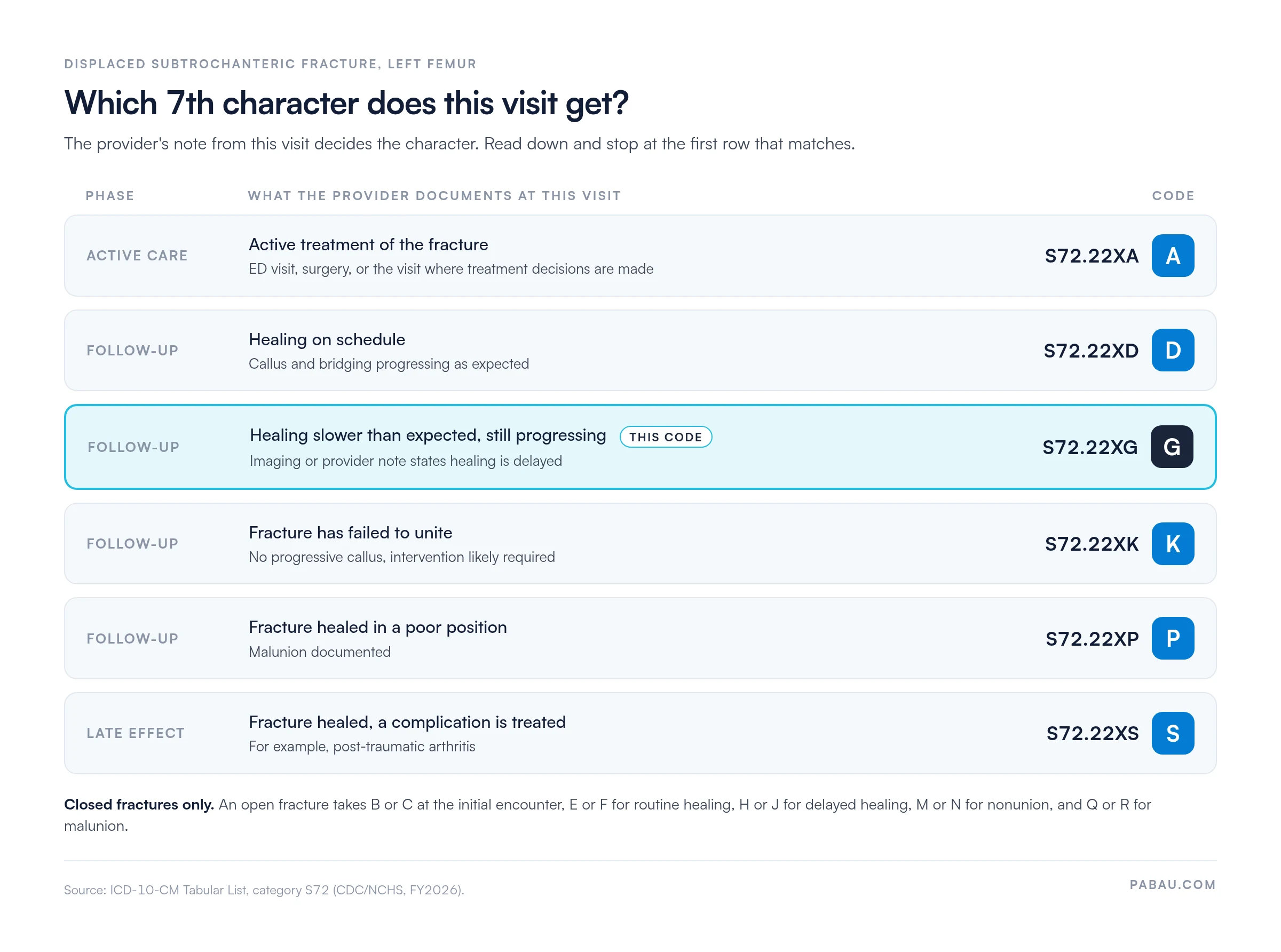
Claims submitted with ICD-10 Code S72.22XG need a clinical record that establishes three elements. The first is a prior fracture at this site that received active treatment. The second is a follow-up encounter rather than a new treatment visit, and the third is objective or clinical evidence of delayed healing. Missing any one of them typically leads to a denial or a request for medical records.
When billing checks are built into the EHR note, a missing element gets flagged while the provider is still in the chart. The following elements must appear in the record for S72.22XG to hold up on audit.
Flag a claim for documentation review when the follow-up note contains generic language such as ‘patient doing well’ or ‘fracture healing’ without specifying healing rate. These phrases point to routine healing, which takes the D character. Ask the provider for an addendum before submitting S72.22XG, and you avoid a denial that needs an appeal.
Medicare and most commercial payers cover follow-up fracture management encounters when medical necessity is established through the clinical record. S72.22XG does not carry a blanket prior authorization requirement across payers, but specific services billed alongside it may. Practices billing orthopedic and physical therapy services should verify prior authorization service by service, rather than by diagnosis code alone.
Under Medicare, services billed with S72.22XG are judged against national policy and any Local Coverage Determination (LCD) your Medicare Administrative Contractor (MAC) publishes for them. Where an LCD exists, it sets the medical necessity and documentation criteria. The CMS Physician Fee Schedule lookup provides reimbursement rates by procedure code and locality for services paired with S72.22XG. Policies for delayed-healing encounters vary by MAC and commercial payer, so confirm them directly.
A real-time eligibility check through your clearinghouse confirms active coverage before each follow-up appointment. That matters for subtrochanteric fracture follow-up, because the care episode spans months. Coverage or an authorization window may have changed since the initial encounter.
S72.22XG applies in any setting where a follow-up fracture encounter happens. That includes an orthopedic office (POS 11), an ambulatory surgery center (POS 24) or a skilled nursing facility (POS 31). The place of service code affects reimbursement and can change a payer’s documentation requirements. The payer’s electronic remittance advice (ERA) shows whether POS drove any adjustment.
Most S72.22XG denials are preventable, and they fall into five patterns. Knowing them helps a billing team fix a denial quickly and stop the next one before submission.
The placeholder error (S72.22G instead of S72.22XG) behaves differently from the others. It triggers a front-end rejection, so the claim never reaches a reviewer. Submitting a clean claim means catching it at the encoder, before the file is generated. A clearinghouse that checks code format can also stop it in the scrubbing pass.
Before appealing a denied S72.22XG claim, identify the adjustment reason code the payer returned. The denial codes guide explains each one. On this diagnosis, CO-11 (diagnosis inconsistent with the procedure), CO-50 (not medically necessary) and CO-16 (missing information) come up most. Each one needs a different appeal.
S72.22XG appears as the diagnosis on subsequent encounter claims across several CPT service categories. The pairings below are common in orthopedic and musculoskeletal practices, coverage depends on payer policy and the services rendered at that visit. Use the AAPC CPT-to-ICD-10 crosswalk to check medical necessity linkage for your MAC. Always confirm the procedure code matches the service the provider performed.
CPT 27245 warrants special attention. It is a surgical code for the original fracture repair. It rarely belongs on a follow-up claim unless delayed healing sends the patient back to the operating room. Billing 27245 at a routine follow-up visit with no surgery is a significant error. Check the operative log against the claim before submission to catch it.
When billing physical therapy with S72.22XG, the PT’s visit note must document the delayed healing on its own. The orthopedic surgeon’s note from a separate visit doesn’t support the PT claim. Each billing provider must support the diagnosis code with their own documentation from the same date of service.
A delayed-healing fracture can run through months of follow-up visits, each with its own note, eligibility check and claim. When those live in separate tools, the 7th character or the side on the claim can drift from what the provider documented.
Practice management software like Pabau keeps the patient record, the follow-up appointment and the claim in one system. Its claims management software connects to the Claim.MD clearinghouse. It runs eligibility checks before the visit, then submits the claim and tracks its status.
Your coders still choose the 7th character from the provider’s note. With the note, the diagnosis and the claim status in one patient record, they can check a denial against the visit without switching systems.

Pabau runs eligibility checks and submits and tracks claims through the Claim.MD clearinghouse, with the visit note and claim status in one patient record. See how orthopedic practices keep months-long follow-up billing on schedule.

S72.22XG belongs on a claim only when the provider’s note from that visit says healing is delayed. If the note reads like routine progress, report D. Save G for the visit where imaging or the provider’s assessment supports it.
The format errors are cheap to prevent. Keep the X placeholder, match the left side across every record, and use G only for a closed fracture. The documentation errors cost more, because they return as denials that need an addendum and an appeal. Build delayed-healing language into your follow-up note template and you’ll write far fewer of those appeals.
Book a demo to see how Pabau handles eligibility checks, claim submission and claim tracking for your fracture follow-up visits.

Need to understand how denials are tracked and resolved? Denial management in healthcare covers the full workflow from CARC code interpretation to appeal filing.
Want to verify claim accuracy before submission? Submitting a clean claim outlines the pre-submission checks that prevent front-end rejections like invalid code formats.
Looking for clearinghouse integration details? Medical claims clearinghouse explains how clearinghouses validate codes, manage 837 files, and return ERA responses.
ICD-10 Code S72.22XG is the billable code for a displaced subtrochanteric fracture of the left femur, subsequent encounter for closed fracture with delayed healing. It is used at follow-up visits after active treatment, when the record shows healing is slower than expected.
The record must show prior active treatment for the closed left femur fracture and a current follow-up encounter. It must also carry clinical or imaging evidence of delayed healing. Generic phrases about the fracture healing are not enough. The provider must state that healing is delayed, citing imaging findings where available.
The usual causes are a missing X placeholder, the wrong 7th character or a laterality mismatch with the record. Unmet medical necessity criteria for the services billed are another. A wrong 7th character often means D was used when the note supports G, or G was used without delayed-healing documentation. Format rejections are fixed by correcting the code. Clinical denials usually need a provider addendum and an appeal.
No, S72.22XG has no required place of service. It applies wherever a follow-up visit for the closed fracture happens. That includes orthopedic offices (POS 11), ambulatory surgery centers (POS 24) and skilled nursing facilities (POS 31). The POS code does affect reimbursement and can change prior authorization rules, so confirm each payer’s policy.