

ICD-10 Code S53.013D: Anterior subluxation of unspecified radial head
ICD-10 Code S53.013D: Quick reference summary Use the table below as your first ...

Last Updated: Nov 6, 2026
Billable Code Specific Code
S72.091K is the billable ICD-10-CM code for other fracture of head and neck of right femur, subsequent encounter for closed fracture with nonunion.
It applies when a patient returns for active management of a closed right femoral head or neck fracture whose bone ends have failed to unite. The 7th character K separates it from its neighbors. M and N cover nonunion after an open fracture, and P, Q and R cover malunion.
Let Pabau's smart automation suggest the right codes, reduce claim denials, and keep your practice compliant—effortlessly.
Automate repetitive tasks and focus on what matters most—your patients.
Reduce coding errors and ensure compliance with the latest regulations.
Clean claims, fewer denials, and faster reimbursements.
Powerful insights and reporting to help your practice thrive.
HIPAA compliant SOC 2 certified GDPR-compliant Trusted by 4,000+ clinics worldwide

S72.091K is a billable ICD-10-CM code for a subsequent encounter for a closed fracture of the right femoral head or neck with nonunion. The left femur takes S72.092K, and malunion of a closed fracture takes S72.091P.
The 7th character K applies only after active treatment has begun, and only to a closed fracture. Nonunion after an open fracture is S72.091M or S72.091N.
Using character A (initial encounter) on a follow-up visit is a common coding error that triggers denials.
The physician’s note must state nonunion explicitly. Imaging alone does not support the K character, so payers expect a clinical statement alongside the radiographic evidence.
Pabau’s claims management software checks every claim for missing or invalid details before it leaves Pabau, which cuts K-character denials at the source.
ICD-10 code S72.091K is the billable diagnosis code for a follow-up visit for a closed right femoral head or neck fracture with nonunion. It sits in category S72 (fracture of femur) in the ICD-10-CM tabular list. The CDC/NCHS ICD-10-CM web tool shows no billable restriction flag on the code. It is valid for reimbursement on dates of service in the current fiscal year.
“Other fracture” in the S72.091 descriptor means the fracture sits in the femoral head-and-neck zone but fits none of the named S72.0 subcategories. Those siblings are S72.01 (intracapsular), S72.03 (midcervical), S72.04 (base of neck), S72.05 (head, unspecified) and S72.06 (articular head). Coders land on S72.09- when the orthopedic documentation places the fracture in the head or neck without specifying it further.
Understanding the medical billing workflow around this code starts with one fact. S72.091K is exclusively a subsequent-encounter code. Any visit coded S72.091K must follow an initial treatment episode already documented under the A character.
The 7th character in S72.091K is K, which denotes a subsequent encounter for a closed fracture with nonunion. ICD-10-CM’s Official Guidelines for Coding and Reporting (Section I.C.19.c) govern the 7th characters for traumatic fractures. In category S72, the subsequent-encounter characters are grouped by healing outcome.
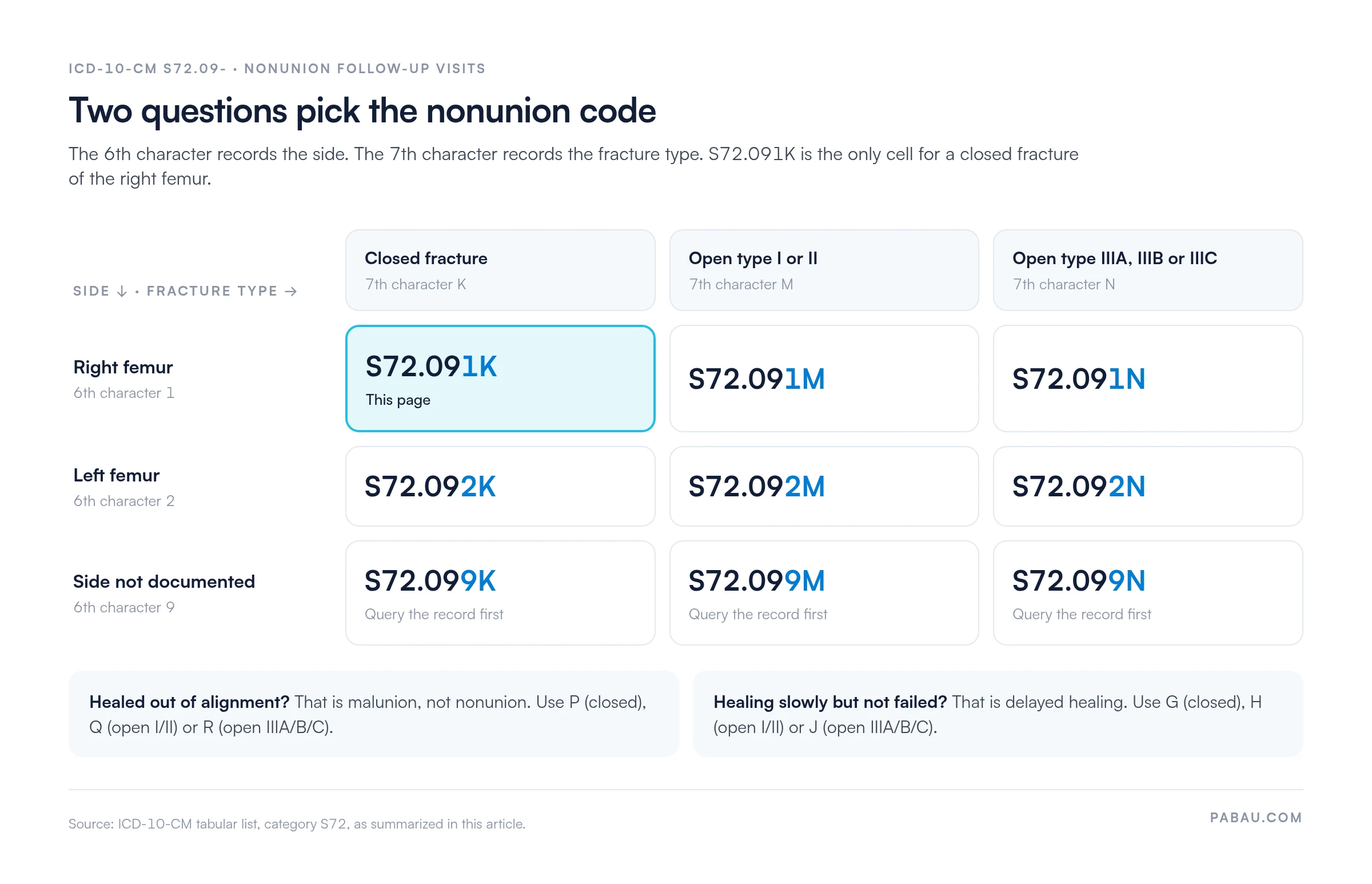
Within each trio, the letter also records the fracture type. K, P and G apply to closed fractures. M, Q and H apply to open type I or II fractures, and N, R and J to open type IIIA, IIIB or IIIC. Picking the wrong letter within a trio is a frequent source of coding errors on this code family.
Open fractures have their own equivalents. B and C cover the initial encounter, E and F routine healing, H and J delayed healing, and M and N nonunion.
AHA Coding Clinic advisories document a common error. Coders keep using character A on follow-up visits because the same provider is treating the patient. The 7th character reflects the nature of the encounter rather than the provider relationship. Once active initial treatment ends and the patient returns for ongoing care, character A is incorrect regardless of who is treating.
Nonunion means the fractured bone ends have not joined and the fracture gap remains biologically active. Malunion means healing has occurred, but the bone consolidated in an incorrect position. The distinction is visible on imaging. Nonunion shows a persistent fracture line with no bridging callus, while malunion shows callus formation with angular or rotational deformity.
Choosing K when the record describes a malunion misrepresents the clinical picture and draws payer scrutiny. The same goes for choosing P, Q or R when the physician documents nonunion.
S72.091A is the code for the initial encounter, the first active treatment visit. S72.091K applies to every subsequent visit where the provider is actively managing nonunion of that same fracture. The distinction matters for two reasons.
Payers scrutinize initial-encounter codes used on dates beyond the expected active treatment window. Medicare audit programs also cross-reference encounter dates against admission records. Using A beyond the first active treatment episode is a flag for upcoding audits.
S72.091 is the base code for other fracture of head and neck of right femur. Each valid 7th character produces a distinct billable code for a specific encounter scenario. The AAPC Codify ICD-10-CM lookup lists the full family. The table below covers the variants coders meet most often, plus the left-femur nonunion code.
For a nonunion visit, the choice comes down to two questions: Which side is fractured, and was the fracture closed or open? The grid below maps each answer to its code, including the S72.099- codes for an undocumented side.
The femoral head is the ball-shaped proximal end of the femur that articulates with the acetabulum. The femoral neck connects the head to the shaft at an angle, making it mechanically vulnerable to both traumatic and insufficiency fractures.
In ICD-10-CM’s S72 classification, “head and neck” is treated as one combined anatomical zone. A fracture in either subregion that misses the criteria for a more specific code falls under the “other” classification at S72.091. Those more specific codes include midcervical, base of neck and articular head.
Laterality is captured in the 6th character: 1 = right femur, 2 = left femur, 9 = unspecified. S72.091K is right femur only. For orthopedic and physical therapy practices managing post-fracture rehabilitation, confirming laterality in the clinical note comes before code selection.
Document laterality explicitly in every note: Right, left, or bilateral. Imaging reports frequently omit ‘right’ or ‘left’ in the narrative impression and use only a diagram. If the coder cannot confirm laterality from the written clinical record, query the physician before assigning S72.091K versus S72.092K.
S72.091K sits within the S72 category, which carries Excludes1 and Excludes2 notes that affect code selection. Per the CMS ICD-10 codes guidance, periprosthetic fractures around a hip implant are not coded in S72. They fall under M97.0- (periprosthetic fracture around internal prosthetic hip joint), with M97.01- for the right hip.
Pathological fractures, caused by bone disease rather than trauma, are coded under M80 (osteoporosis with current pathological fracture) or M84.4- rather than S72. If the record ties the fracture to osteoporosis, metastatic disease or another underlying condition, consider that M-code as the principal diagnosis. S72.091K belongs on the claim only if the record also documents a traumatic component.
Adjacent codes in the S72.0 group that coders compare against S72.091K include:
A common misconception about S72.091K is that it requires an external cause code (W-series fall codes, place of occurrence, activity codes). It does not. ICD-10-CM Official Guidelines tie external cause codes to the character A encounter, the initial one. That is when the cause of injury is first documented and treated.
On subsequent encounters coded K, external cause codes are generally not required by guidelines, though individual payer contracts may vary. If a K-character claim does carry an external cause code, that code takes the 7th character D for a subsequent encounter. Mismatched 7th characters between the principal diagnosis and the external cause code draw edits from clearinghouse scrubbers.
Payers do not accept the K character based on the passage of time alone. The clinical record must actively support nonunion to achieve clean claim submission. These elements must all be present:
Medicare accepts S72.091K as a valid diagnosis code. Coverage for the treatments that usually follow nonunion, such as bone growth stimulators, revision arthroplasty and autograft procedures, is a separate question. Local Coverage Determinations (LCDs) issued by each Medicare Administrative Contractor (MAC) govern it, and the criteria vary by jurisdiction.
Verify the applicable LCD before submitting claims for bone stimulator application (CPT 20974, 20975) paired with S72.091K. Checking your MAC region’s medical billing compliance requirements first keeps those claims from stalling at review.
For commercial payers, prior authorization is often required for surgical revision of a nonunion. The authorization request should include the S72.091K code, imaging documentation, the initial treatment history, and the clinical rationale for the planned procedure. Submitting this package proactively reduces mid-claim denials.
After the first claim, review your electronic remittance advice for payer-specific adjustments. Matching each one against the standard denial codes shows which ones will repeat on later visits.
K-character fracture claims deny for a predictable set of reasons. Routing denials through structured denial management workflows before resubmission reduces write-offs. The most frequent denial triggers for S72.091K are:
Routing S72.091K claims through a Claim.MD clearinghouse catches format-level errors before the claim reaches the MAC. Pabau, the practice management and billing platform we build, connects to Claim.MD. The integration covers CMS-1500 claims, real-time eligibility checks, claim status tracking and electronic remittance advice, across thousands of US payers.
A consistent pre-submission workflow reduces S72.091K denials before the claim leaves the practice. Use your claims management software to enforce these steps at the point of coding:
Run a quarterly audit of your S72.091K claims against the corresponding imaging dates. If imaging predates the encounter by more than 90 days and no new imaging was ordered, payers will question the nonunion determination. Pair every K-character claim with a same-encounter imaging date, or with a clinical note explaining why prior imaging still supports the nonunion finding.
Without a check at coding time, a K-character claim can leave the practice with a missing authorization code or an invalid field. The payer finds the problem weeks later, and the claim comes back for rework.
In Pabau, each claim is raised from the patient’s invoice. Claim validation then checks every claim for missing or invalid details before it leaves Pabau. Prior authorizations for revision surgery are stored as cases, so the authorization code follows the appointment onto the claim.
US practices send CMS-1500 claims through Claim.MD and track each one from Pending to Paid in the claims dashboard. A rejected claim is flagged Needs action with its reason, so your team can correct and resubmit it without hunting through payer letters.

Pabau’s claims management software checks every claim for missing or invalid details before it leaves Pabau, so fracture claims reach the payer complete.

S72.091K is easy to assign once the record holds five facts. Those are a subsequent encounter, the right femur, a closed fracture, a physician’s nonunion statement and imaging on file. Denials follow when one of them is missing, or when the 7th character defaults to A out of habit.
The practical move is to run that five-point check at coding time, before the claim is built. It costs a coder a minute per claim and spares the practice weeks of payer correspondence on a code family that payers already review closely.
Book a demo to see how Pabau checks fracture claims for missing details before they reach the payer.

Need a systematic approach to claim denials? Denial management in healthcare covers the workflows that reduce repeat denials on fracture and trauma codes.
Submitting fracture claims through a clearinghouse? How the Claim.MD clearinghouse works explains real-time eligibility, ERA processing, and payer enrollment for US practices.
Want to understand the broader billing picture? Superbill documentation walks through how diagnosis codes like S72.091K connect to the claim form that reaches the payer.
Coding a malunion after an open fracture? ICD-10 code S72.091Q covers the right femoral head or neck fracture that healed out of alignment after an open type I or II injury.
ICD-10 code S72.091K is the billable ICD-10-CM code for a subsequent encounter for a closed fracture of the right femoral head or neck with nonunion. It applies to follow-up visits where the treating physician documents that the fracture has not achieved bony union and is under active management.
Yes, S72.091K is a billable ICD-10-CM code valid for reimbursement. It carries no billable restriction flag in the CDC/NCHS tabular list. CMS and most commercial payers accept it when it is paired with appropriate procedure codes and supporting documentation. It applies to closed fractures only, and nonunion after an open fracture takes S72.091M or S72.091N.
S72.091K codes nonunion, where the bone ends have failed to unite. S72.091P codes malunion of a closed fracture (open-fracture malunion is Q or R), meaning the bone has healed in an incorrect position. Imaging confirms the distinction. A persistent fracture line indicates nonunion (K), and consolidated bone in angular or rotational deformity indicates malunion (P for closed; Q or R for open).
Use character D when a closed fracture is healing on schedule with expected callus formation. Use K when the physician documents nonunion, meaning the bone ends have not united and active management of that failure is underway. D reflects routine healing progress, while K reflects failed healing that needs intervention.
The medical record must contain four elements. It needs a date of service after the initial treatment episode and an explicit physician statement of nonunion. It also needs imaging showing a persistent fracture line, plus documentation of active treatment. Imaging findings without a physician’s clinical statement are insufficient on their own.
No. S72.091K is right femur only, encoded in the 6th character (1 = right). For the same clinical scenario on the left femur, use S72.092K (subsequent encounter for closed fracture with nonunion, left femur). Using S72.091K for a left-sided fracture is a laterality mismatch that payers may deny on edit.



