ICD-10 Code S65.312S: Laceration of deep palmar arch
ICD-10 Code S65.312S: code details at a glance ICD-10 Code S65.312S is the billa...

Last Updated: Oct 22, 2026
Billable Code Specific Code
S72.021D is the billable ICD-10-CM code for displaced fracture of epiphysis (separation) (upper) of right femur, subsequent encounter for closed fracture with routine healing. It covers follow-up visits after active treatment ends, while the closed fracture heals as expected.
The sixth character 1 sets both the right side and displacement, so a left-sided or nondisplaced fracture needs a different code. Pediatric capital femoral epiphyseal fractures and Salter-Harris Type I fractures are excluded here and coded to S79.01- instead.
Let Pabau's smart automation suggest the right codes, reduce claim denials, and keep your practice compliant—effortlessly.
Automate repetitive tasks and focus on what matters most—your patients.
Reduce coding errors and ensure compliance with the latest regulations.
Clean claims, fewer denials, and faster reimbursements.
Powerful insights and reporting to help your practice thrive.
HIPAA compliant SOC 2 certified GDPR-compliant Trusted by 4,000+ clinics worldwide

S72.021D codes a follow-up visit for a displaced upper femoral epiphysis fracture of the right femur that is healing as expected.
The sixth character 1 means displaced and right-sided, so a left fracture needs S72.022D and an undocumented side needs S72.023D.
The 7th character D covers a closed fracture with routine healing only; an open fracture at the same stage takes E or F.
Pediatric capital femoral epiphyseal fractures and Salter-Harris Type I injuries are Excludes1 at S72.02 and belong in S79.01- instead.
Do not swap in a Z47 aftercare code, because the tabular list sends healing-fracture aftercare to the fracture code with D.
ICD-10 Code S72.021D reports a displaced fracture of the upper femoral epiphysis of the right femur at a subsequent encounter. Use it once active treatment is finished and the closed fracture is healing on schedule.
Each character of S72.021D narrows the diagnosis one step further. Read in order, they therefore show why the code cannot describe a left hip, an open fracture or a femoral neck break.
So if you change a single position, the claim describes a different injury or visit. The diagram below maps each sixth- and seventh-character swap to the code it produces.
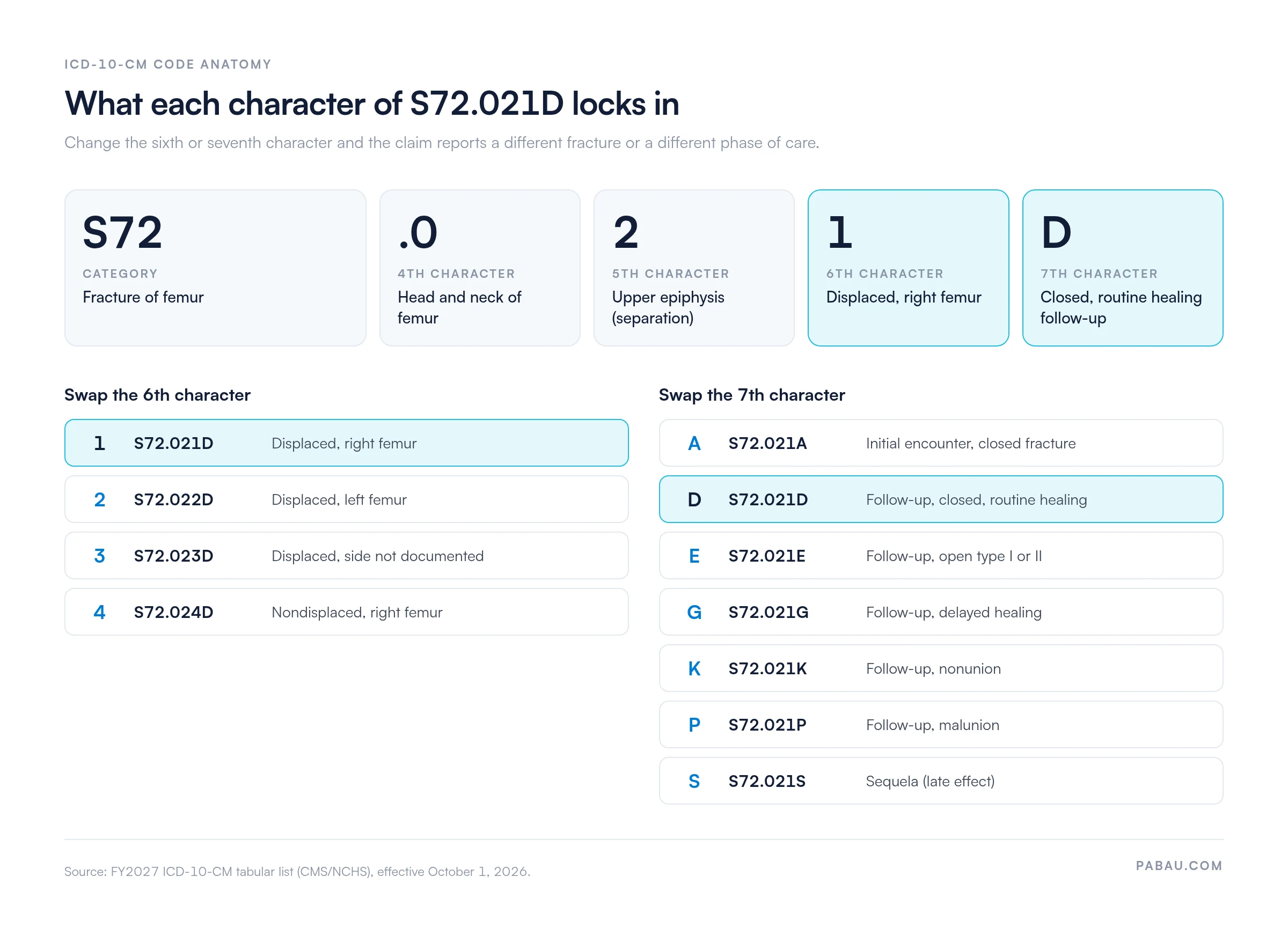
Two default rules apply across category S72. A fracture not documented as displaced or nondisplaced is coded as displaced, and one not documented as open or closed is coded as closed.
However, those defaults only fill silence in the record. When the imaging report and the visit note disagree on displacement, query the provider before choosing between S72.021D and S72.024D.
The upper femoral epiphysis is the rounded end of the femur that forms the femoral head. During growth, a cartilage growth plate called the physis joins it to the femoral neck.
In other words, an epiphyseal separation is a break through that junction, so the head shifts relative to the neck. ICD-10-CM lists this injury, also called a transepiphyseal fracture, under S72.02.
Displaced means the provider has noted that the fragments moved out of alignment. Because ICD-10-CM sets no measurement threshold, the note decides between the displaced and nondisplaced codes.
Follow-up visits often watch for avascular necrosis of the femoral head. However, if it appears after the fracture has healed, code M87.251 (osteonecrosis due to previous trauma, right femur) first, then S72.021S.
Before the 7th character matters, the coder has to confirm the injury belongs in S72.02 at all. For example, the wording of the imaging report and operative note can point to different code families.
For a physeal fracture, Section I.C.19.c.3 of the guidelines says to assign only the physeal fracture code. Also, no second code is added to name the bone.
Category S72 takes 16 seventh characters. In fact, every code in the category needs one. Each character pairs a phase of care with whether the fracture was closed or open.
Section I.C.19.a of the FY2027 Official Guidelines applies D once the patient has completed active treatment and receives routine care during healing or recovery. Thus, the phase of care decides the character, not the provider.
A new surgeon seeing the patient for the first time still reports D if active treatment is over. However, care for complications of the surgical repair is coded with complication codes instead (Section I.C.19.c.1).
Open-fracture types follow the Gustilo classification. However, when an open fracture has no documented Gustilo type, the guidelines default to type I or II, which is E at the routine-healing stage.
Do not report an orthopedic aftercare Z code for these visits, because category Z47 carries an Excludes1 note that sends healing-fracture aftercare to the fracture code with 7th character D.
State the healing status in plain words at every follow-up visit. A note reading fracture healing as expected, continue protected weight-bearing, supports the subsequent-encounter code. A note that says only hip pain follow-up leaves the coder to query the provider first.
The neighbors of S72.021D differ by side, displacement, encounter or subgroup. Every descriptor below comes from the FY2027 ICD-10-CM tabular list. For codes outside this family, our diagnostic codes guide covers ICD-10, ICD-11 and SNOMED CT.
The tabular list places notes at three levels above S72.021D. Each one changes what the code can and cannot report.
An Excludes1 note means the two conditions are never coded together. By contrast, an Excludes2 note means the condition is not part of this code, but both may be reported when the patient has both.
External cause codes from Chapter 20 explain how the injury happened. There is no national mandate to report them, but a state reporting rule or a payer can require them (Section I.C.20).
Carrying the mechanism forward matters most when another party may be liable, such as an auto insurer or a workers’ compensation carrier.
S72.021D explains why the patient was seen, while the CPT code reports what was done. The pairings below reflect typical follow-up services, and the documentation decides each line.
In addition, the global period changes how the same visit is billed. When the surgeon who performed the fixation sees the patient inside that period, routine follow-up is part of the surgical payment.
In that case the visit is reported with 99024 for tracking, not a paid E/M code. A different provider, or a visit after the global period ends, bills the E/M level the documentation supports.
A follow-up note has to support the diagnosis, the encounter type and the service at once. These are the elements a coder needs to assign S72.021D without a query.
As a result, when each element is present, the claim can go out without a coding query. That is the practical definition of a clean claim for this code.
Most of the errors below come from a mismatch between the note and the code. Each error, however, has a direct fix in the tabular list or the guidelines.
When a claim comes back denied, the electronic remittance advice carries the reason and remark codes. Read both before correcting and resubmitting, so the fix answers the payer’s stated reason.
A steady denial management workflow then logs the cause, so the same error does not repeat on the next fracture follow-up.
Follow-up fracture claims depend on details spread across the operative note, the imaging report and the visit note. When those sit in separate systems, the coder therefore hunts for them before the claim can go.
Pabau, the practice management platform we build, keeps a patient’s notes, forms and billing in one record. Its claims management software pulls the details already on that record into a pre-filled claim.
For US practices, Pabau submits claims through its Claim.MD clearinghouse integration and tracks their status and remittances. Code selection stays with your coder, so the 7th character and sequencing still come from the documentation.
Also, checking coverage before the visit removes another source of rework. Our guide to insurance eligibility verification covers that step, and our overview of medical billing shows where it fits in the wider cycle.
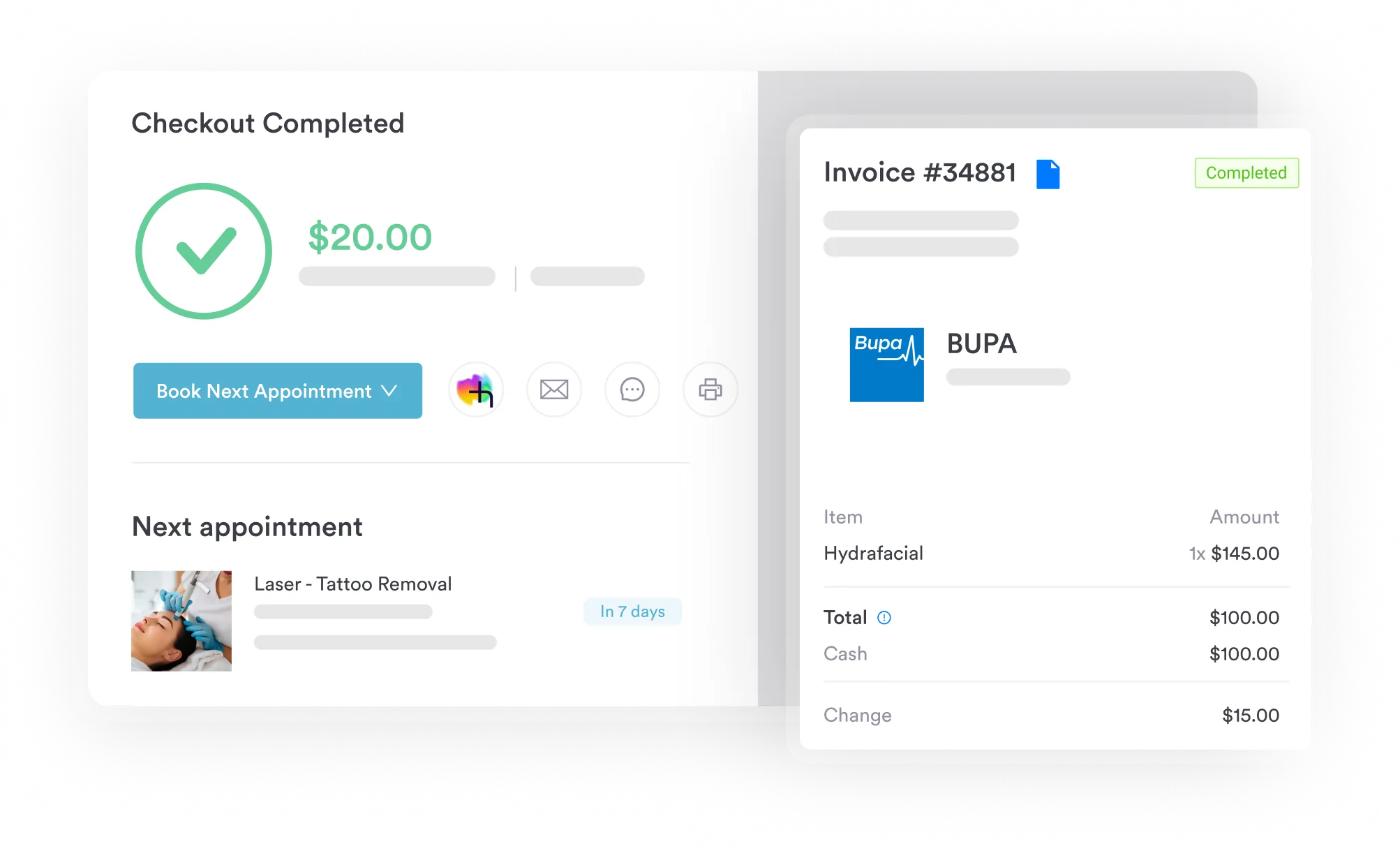

Pabau pulls the details already in the patient record into a pre-filled claim, then submits and tracks it through Claim.MD. Your coder keeps control of every code.

S72.021D is a narrow code, and that narrowness is the point. In fact, it names one side, one displacement status, one fracture group and one phase of healing.
Before assigning it, confirm three facts in the record. The injury is a traumatic epiphyseal separation rather than a physeal fracture, the right femur is involved, and active treatment has ended.
If the record cannot confirm one of them, query the provider before the claim goes out. After all, a short delay now costs less than a denial and a resubmission later.
Book a demo to see how Pabau keeps fracture follow-up documentation and claims in one place.

Want to know what a clearinghouse does with your claim? Our Claim.MD clearinghouse guide explains how claims are checked and routed to payers.
Struggling to read denial codes on fracture claims? Denial codes in medical billing explains common reason codes and the corrective action for each.
Want a walkthrough of the 837 file that carries your ICD-10 codes to payers? Our 837 file guide covers claim structure, loop segments, and the fields where ICD-10 diagnosis codes sit.
ICD-10 Code S72.021D means a displaced upper epiphysis fracture of the right femur at a subsequent encounter for a closed fracture with routine healing. It is used once active treatment is complete and the fracture is healing as expected.
Yes. The sixth character 1 means the right femur. A displaced left-sided fracture at the same stage is S72.022D, and S72.023D is used only when the record does not state the side.
No. A traumatic acute or acute-on-chronic slipped capital femoral epiphysis is coded to S79.01-, which S72.02 excludes. A slip with no trauma is coded from M93.0-, slipped upper femoral epiphysis (nontraumatic).
No. A fracture through bone weakened by a tumor is coded from M84.5-, such as M84.551D for the right femur at a routine-healing follow-up. A fracture in known osteoporosis after minor trauma is coded from M80.-.
Report the same mechanism as the initial claim with 7th character D, such as W19.XXXD for an unspecified fall. Place of occurrence and activity codes are assigned only once, at the initial encounter.