ICD-10 Code T31.77: Burns involving 70-79% of body surface
ICD-10 code T31.77: Quick reference and code details ICD-10 code T31.77 is the b...

Last Updated: Nov 5, 2026
Billable Code Specific Code
S66.499S is the billable ICD-10-CM code for other specified injury of intrinsic muscle, fascia and tendon of unspecified thumb at wrist and hand level, sequela.
It covers the thenar muscles and adductor pollicis when the record does not name the right or left thumb. The 7th character S means the acute injury has healed and a residual condition remains, such as contracture or weak pinch. Under the sequencing rules, that residual condition is coded first and S66.499S second.
Let Pabau's smart automation suggest the right codes, reduce claim denials, and keep your practice compliant—effortlessly.
Automate repetitive tasks and focus on what matters most—your patients.
Reduce coding errors and ensure compliance with the latest regulations.
Clean claims, fewer denials, and faster reimbursements.
Powerful insights and reporting to help your practice thrive.
HIPAA compliant SOC 2 certified GDPR-compliant Trusted by 4,000+ clinics worldwide

S66.499S codes the sequela of an other specified injury to an intrinsic muscle, fascia or tendon of the thumb, side not documented.
The thumb’s intrinsic muscles are the thenar group and adductor pollicis. Intrinsic injuries of the other fingers code to S66.5-, not S66.4-.
The 7th character S needs a documented prior injury, a resolved acute phase and a current residual condition causally linked to it.
Per Guidelines Section I.B.10, the residual condition goes first, such as contracture of the hand (M24.54-), and S66.499S goes second.
Bill S66.491S or S66.492S only when the note names the right or left thumb. Otherwise, S66.499S is the correct code.
The table below holds the reference data for ICD-10 code S66.499S. Use it to confirm billable status, code hierarchy and fiscal year before you code.
S66.499S covers an other specified injury of an intrinsic muscle, fascia or tendon of the thumb at wrist and hand level. The injury is now in its sequela phase, and the record does not say which thumb.
Intrinsic muscles start and end within the hand. For the thumb, that means the three thenar muscles plus adductor pollicis. The long flexor (S66.0-) and the thumb extensors (S66.2-) start in the forearm, so their injuries code elsewhere.
“Other specified injury” is the S66.49- group. It applies when the provider names an injury type that is not a strain (S66.41-) or a laceration (S66.42-). If the record names no injury type at all, S66.40- is the better fit. An intrinsic thumb strain under active treatment, side not documented, codes to S66.419A instead.
“Unspecified thumb” describes a record that names no side. The laterality codes S66.491S (right thumb) and S66.492S (left thumb) apply only when the note names the side.
The 7th character S, sequela, means the acute phase of the injury has resolved. The patient now has a residual condition that is a direct late effect of that injury. ICD-10-CM Official Guidelines Sections I.B.10 and I.C.19 govern how the encounter is coded.
Residual conditions often coded with S66.499S include contracture of the hand (M24.54-) and pain in the hand or fingers (M79.64-). Tendon adhesion, weak pinch or grip, and reduced thumb motion also appear often.
The 7th character stays S even when the sequela phase involves active treatment. Take a patient in occupational therapy for weak pinch strength six months after a healed thenar muscle injury. That encounter is still coded S, because the treatment addresses the sequela, not the acute injury.
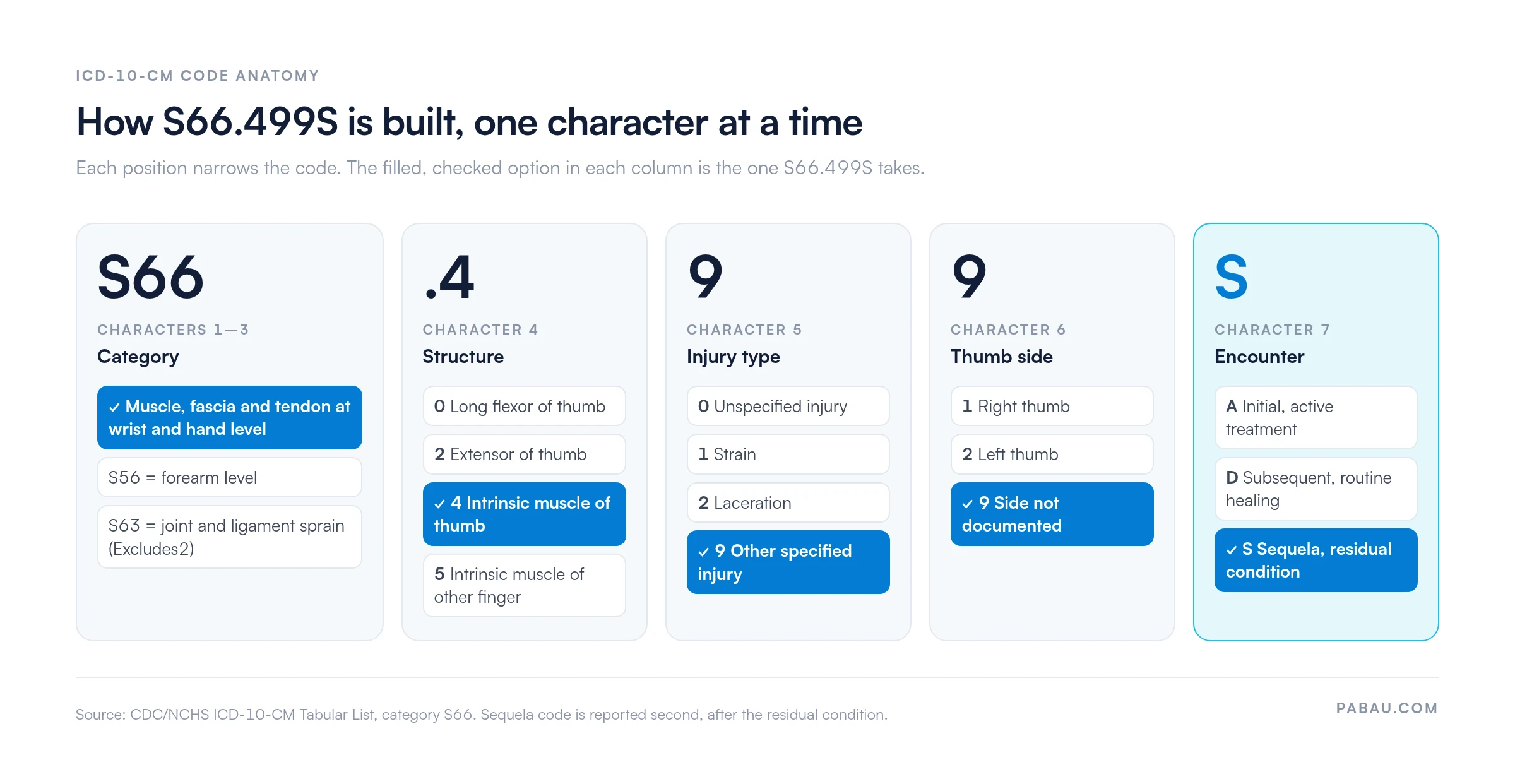
Each character in S66.499S adds a level of clinical detail. Knowing the hierarchy prevents miscoding at the subcategory level.
Within S66.4, the 5th character sets the injury type. S66.40- is an unspecified injury, S66.41- a strain, S66.42- a laceration and S66.49- an other specified injury. The 6th character sets laterality, with 1 for the right thumb, 2 for the left and 9 for unspecified. The diagram below lays out each position and the value S66.499S takes.
Coders often mix S66.499S up with adjacent codes that describe a different encounter, digit, structure or injury type. The table below covers the most frequent pairs.
Check the Excludes2 note at S66 before you finalize a code from this block. Sprains of thumb joints and ligaments belong in S63.6-. If the record documents a sprain with no muscle or tendon involvement, S66.499S is an overcoding error.
The S66 category carries notes that define its boundaries. Knowing them prevents both overcoding and undercoding.
Documentation for S66.499S must establish three things: A prior acute injury, resolution of that acute phase, and a current residual condition causally linked to it. If any one is missing, the claim is open to audit.
Coders cannot infer sequela status from the time since the injury. The provider must state in the current note that the acute phase has resolved. The note must also say that today’s condition is a late effect of the documented injury.
ICD-10-CM Official Guidelines Section I.B.10 sets the order for sequela coding. The condition or nature of the sequela goes first. The sequela code, S66.499S, goes second and is never the first-listed diagnosis.
In medical billing for a sequela visit, S66.499S travels with the codes below, in this order.
Practices that send electronic claims through a clearinghouse such as Claim.MD can verify eligibility before the visit. Claims are then scrubbed for missing or invalid details before submission, so errors surface before a denial does.
S66.499S explains why the patient is being seen. The CPT code describes what was done, and payers check that the two agree. At the sequela stage, most services are therapy or follow-up visits.
The therapy note should tie each service to the documented residual condition. A 97530 session, for example, should name the pinch or grasp limit its tasks target. A treatment plan that names the contracture or weakness makes medical necessity easy for a payer to confirm.
Payer requirements for S66.499S vary across Medicare, Medicaid and workers’ compensation. Treating them alike leads to denials, especially on long courses of hand therapy.
Practices handling workers’ compensation hand cases should confirm their clearinghouse supports the external cause code pairings their state requires. Submitting a clean claim with the right companion codes gets sequela visits paid on the first pass.
Denials on S66.499S follow predictable patterns. Catching them before submission saves an appeal later.
Audit every claim that uses an S66.4- code with 7th character S before submission. Check that the note records (1) the prior acute injury, (2) a statement that it has resolved and (3) the specific residual condition.
Structured denial management workflows that sort denials by 7th character surface S66.499S patterns quickly. Tracking those reasons with the relevant denial codes shows billing teams which checklist items to tighten.
Sequela claims fail on paperwork more often than on code choice. The injury note, the resolution statement and the residual condition often sit in different records. The claim then leaves without the full story.
In Pabau’s practice software, the encounter note, patient history and claim share one patient record. Pabau’s claims management software verifies insurance eligibility before the visit. It also scrubs each claim for missing or invalid details before submission.
That leaves coders free to check the documentation behind each code, and fewer claims come back for rework.

Pabau verifies eligibility before the visit and scrubs claims for missing or invalid details before submission. ICD-10 code S66.499S claims reach the payer complete.

S66.499S is a narrow code, and that is why it goes wrong. It covers only the thumb’s intrinsic muscles, only after the acute phase has resolved, and only in second place.
The fix belongs in the clinical note. A provider statement that the injury has healed, and that today’s problem is causally linked to it, carries the claim. Without it, even a correct code fails review.
If your team codes hand injuries often, build the thumb, laterality and sequencing checks into the encounter template. Book a demo to see how Pabau keeps sequela injury claims complete from note to submission.

Need to understand how clearinghouse validation works? How the Claim.MD clearinghouse works with Pabau explains eligibility verification and claim scrubbing.
Want to reduce denial rates across your injury code set? Medical billing compliance best practices covers documentation audit frameworks for ICD-10-CM injury codes.
Want the wider billing picture? What is revenue cycle management places injury coding within the full billing and collections workflow.
ICD-10 code S66.499S is the billable code for other specified injury of an intrinsic muscle, fascia or tendon of an unspecified thumb, sequela. It applies once the acute injury has healed and a residual condition remains, such as contracture or weak pinch.
S66.499A covers active treatment of the new injury. S66.499D covers routine follow-up while it heals. S66.499S applies once the acute phase has resolved and a residual condition remains. The note must state that healing is complete before S66.499S is assigned.
Not on every claim. There is no national requirement to report external cause codes, but many workers’ compensation payers and some states require them. Where one is required, report it with 7th character S, and confirm each payer’s policy first.
The most common reasons are: The wrong 7th character, a missing record of the original injury, and no statement linking the residual condition to it. Listing S66.499S first and billing a thumb side the note does not name also cause denials.
Yes. S66.499S is a valid, billable ICD-10-CM code for Medicare, Medicaid, workers’ compensation and commercial claims. Coverage for ongoing hand therapy still depends on each payer’s medical necessity and documentation rules.
Under Guidelines Section I.B.10, the residual condition is coded first, such as contracture of the hand (M24.54-). S66.499S follows it as the second code. Add an external cause code with 7th character S when the payer requires one.
No. S66.499S covers the thumb only. Intrinsic muscle, fascia and tendon injuries of the index, middle, ring or little finger code to S66.5-, with 7th character S at the sequela stage.