ICD-10 Code T31.77: Burns involving 70-79% of body surface
ICD-10 code T31.77: Quick reference and code details ICD-10 code T31.77 is the b...

Last Updated: Nov 5, 2026
Billable Code Specific Code
S66.593D is the billable ICD-10-CM code for other injury of the intrinsic muscle, fascia and tendon of the left middle finger, subsequent encounter.
It covers routine follow-up visits while the injury heals. It is easy to confuse with S66.513D, the strain code for the same finger, and with the initial-encounter version S66.593A.
Let Pabau's smart automation suggest the right codes, reduce claim denials, and keep your practice compliant—effortlessly.
Automate repetitive tasks and focus on what matters most—your patients.
Reduce coding errors and ensure compliance with the latest regulations.
Clean claims, fewer denials, and faster reimbursements.
Powerful insights and reporting to help your practice thrive.
HIPAA compliant SOC 2 certified GDPR-compliant Trusted by 4,000+ clinics worldwide

S66.593D is the billable ICD-10-CM code for other injury of the intrinsic muscle, fascia and tendon of the left middle finger, subsequent encounter.
The code carries both digit and side. Its sixth character 3 means the left middle finger, and the right middle finger is S66.592D.
Use it only when the note names an injury type other than a strain (S66.513D) or a laceration (S66.523D).
The 7th character D marks routine follow-up during healing. Switch from A once active treatment ends, and to S for late effects.
A claim holds up when the note states the left middle finger, the intrinsic structure, the injury type and the phase of care.
Use the table below to check the code before you build the claim. Every field follows the official ICD-10-CM tabular list published by the Centers for Medicare and Medicaid Services.
S66.593D reports a follow-up visit for an injury to an intrinsic muscle, fascia or tendon of the left middle finger. The word “other” matters here. It means the provider documented a specific injury type that is neither a strain nor a laceration. Both of those have codes of their own.
Intrinsic muscles start and end within the hand. In the middle finger they are the second lumbrical and the second and third dorsal interossei. They flex the knuckle joint, straighten the finger joints and move the finger from side to side.
The code is narrower than its subcategory title suggests. “Other and unspecified finger” describes the whole S66.5 subcategory, but S66.593D itself names one digit on one hand. When the note says an intrinsic structure was injured but gives no injury type, the code is S66.503D, unspecified injury, instead.
Eight of the ten codes in the S66.59 family name both a finger and a hand. The pattern is easy to learn: an even sixth character means the right hand, and an odd one means the left. The last two slots cover a finger the code set does not name and a finger the note does not identify. During active treatment, those two slots are coded S66.598A and S66.599A.
A single digit separates S66.592D from S66.593D, so a transposed side is the easiest error to make on this family. Confirm the hand in the note before you confirm the code.
The 7th character D marks a subsequent encounter. The ICD-10-CM Official Guidelines for Coding and Reporting (Section I.C.19.a) define it as routine care during the healing or recovery phase. The phase of care decides it, whatever number the visit has in the sequence.
Because the qualifier follows the phase of care, a physical therapist, an occupational therapist and a hand surgeon all report D at a follow-up visit. The provider does not need to be the one who reported A.
Don’t add an aftercare Z code to these visits either. The guidelines report injury follow-up care through the 7th character D, not through the aftercare codes.
The 7th character is the one part of this code that changes as care moves on. Carrying A into therapy visits that should carry D is an easy error to make, and the table below shows where each version belongs.
The tabular list attaches its instructions at several levels above S66.593D. Each one below applies to this code.
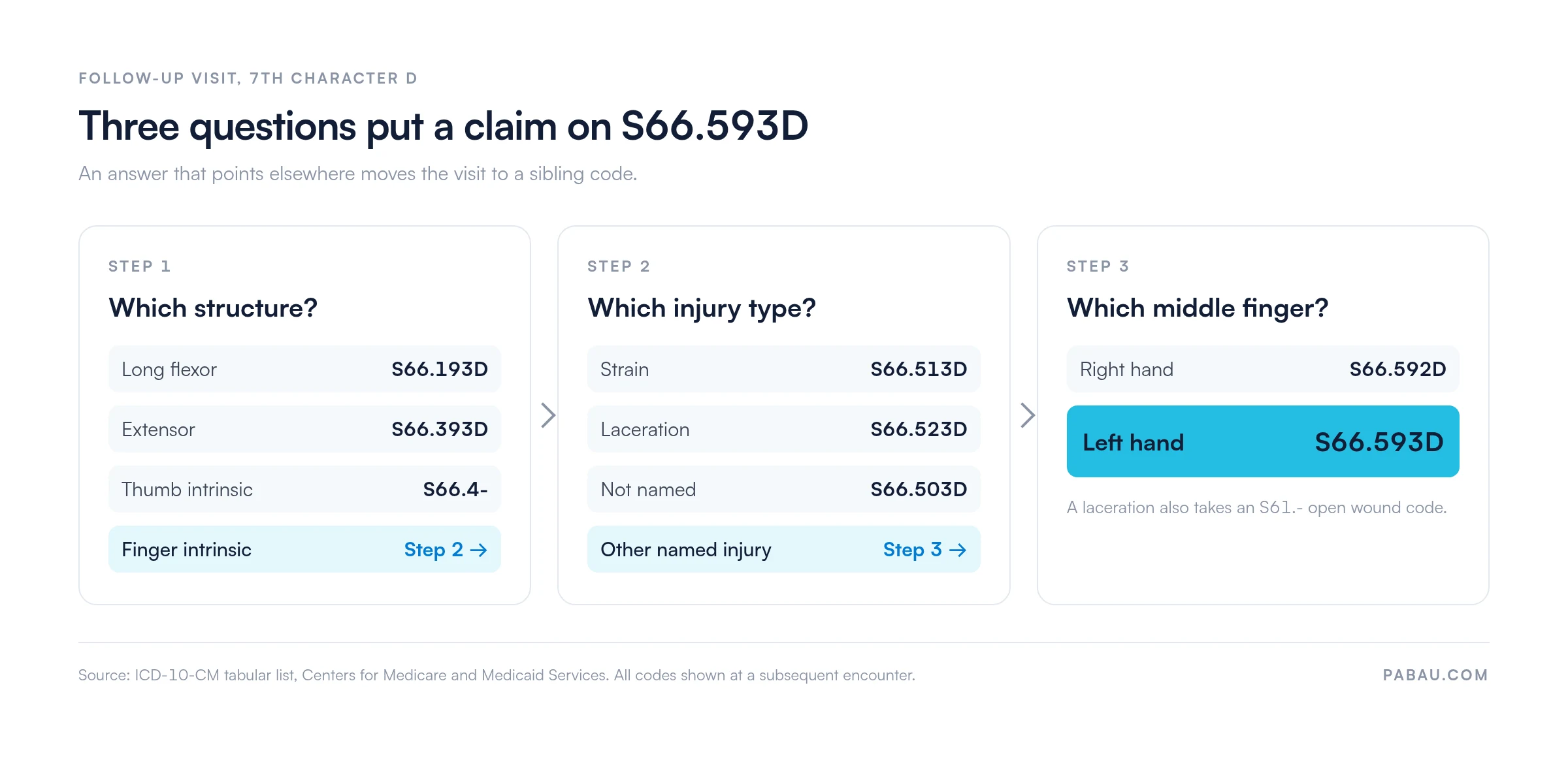
Three questions sit behind this code: which structure, which injury type and which hand. A different answer to any of them moves the claim to a sibling code. The path below and the table after it show where each answer leads.
Payers in a post-payment audit look for a note that supports each element of the descriptor. For clean claim submission, the note should state all six of the following:
CMS and most commercial payers do not require prior authorization for a diagnosis code. The procedures billed with it often do, especially physical therapy, and the rules vary by plan. Insurance eligibility verification before the first follow-up visit protects therapy claims that are otherwise coded correctly.
Some payers check a D-encounter claim against their own claim history for the same injury. When no initial claim appears, the claim may pend for manual review. Putting the original treatment date and provider in the claim notes answers that question up front.
Run an eligibility check before the first follow-up therapy visit. Confirm whether the plan needs a referral or prior authorization for the CPT codes you will bill with S66.593D. Catching a missing authorization before the visit avoids a denial that can take several appeal cycles to overturn.
Denials on this code trace back to a short list of documentation and selection errors. Each one below maps to a check you can run before submission, which keeps work out of your denial management workflows.
When a denial does arrive, check the denial code reference first. The claim adjustment reason code on the ERA tells you whether it is a coding issue, a coverage issue or a records request. Answering the wrong category wastes an appeal cycle.
Follow-up visits for this injury are mostly physical and occupational therapy, plus evaluation and management visits with a hand or orthopedic surgeon. For medical billing purposes, the CPT code must match the services documented. The diagnosis alone never justifies a procedure.
Yes. Physical and occupational therapists report S66.593D at routine visits while the left middle finger heals. A patient who is new to the therapy practice still takes D when active treatment happened elsewhere. Referral and authorization rules come from the payer and the state practice act, not from the code.
For practices that see many hand referrals, the hard part is tracking authorization dates, visit counts and encounter qualifiers together. Practice management tools that link scheduling, notes and billing keep those three in step.
In many practices the clinician writes the finger, side and visit phase into the note. Someone in billing then rereads that note and picks the code. On a family where a 2 and a 3 separate the right and left middle finger, one misread digit changes the diagnosis.
Pabau’s charting and billing tools share one patient record, so the note and the claim are built from the same entry. Its denial-reducing claims software submits 837P claims through the Claim.MD clearinghouse and processes the ERAs that come back.
The result is a claim that agrees with the note it came from. Encounter qualifiers stay consistent from the first visit to the last, so your team spends less time answering payer queries.
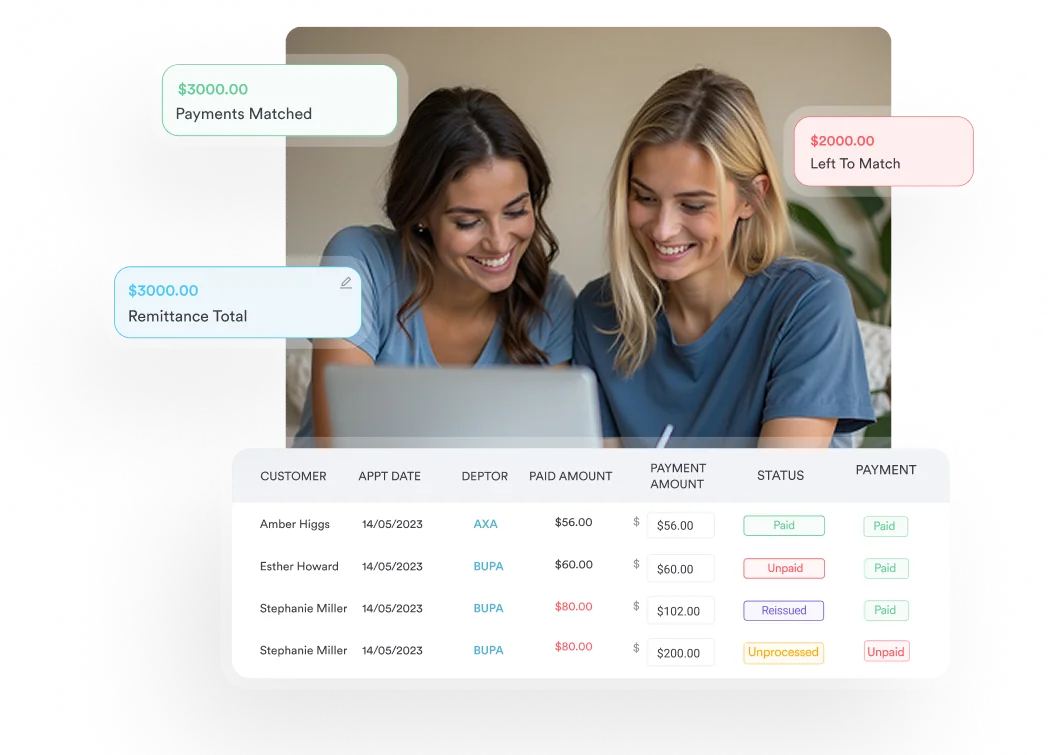

Pabau links clinical documentation to electronic claim submission through Claim.MD. Therapy and orthopedic practices keep encounter qualifiers consistent from the clinical note to the 837P file.

S66.593D rewards precision. The code already states a left middle finger, an intrinsic structure, a named injury type and a follow-up visit. The note has to state all four as well.
When it does, the claim is hard to dispute. When it doesn’t, the cheapest fix is a query to the provider before submission, not an appeal after a denial.
Book a demo to see how Pabau carries the documented finger, side and encounter phase from the clinical note to the claim.

Need a full reference on claim denial codes? Denial codes in medical billing covers CARC and RARC code meanings with guidance on when to appeal versus correct and resubmit.
Want to understand the clearinghouse layer? Claim.MD clearinghouse guide explains how electronic claim validation works before a file reaches the payer, and what a clean claim requires.
Exploring how revenue cycle management fits together? What is revenue cycle management walks through the end-to-end process from eligibility check through final payment posting.
ICD-10 code S66.593D reports a follow-up visit for an injury to an intrinsic muscle, fascia or tendon of the left middle finger. “Other injury” means the documented injury type is neither a strain nor a laceration. The 7th character D marks routine care during healing, after active treatment.
Use S66.593D once active treatment has ended and the patient is receiving routine care during healing. That usually starts at the first follow-up visit and includes later therapy sessions. Use S66.593A only while the patient is receiving active treatment, such as an emergency visit, a first evaluation or splinting on the day of injury.
S66.593D applies to the left middle finger only. The sixth character 3 sets both the digit and the hand. The right middle finger is S66.592D, and the other fingers run from S66.590D to S66.599D. An intrinsic injury of the thumb codes to S66.4- instead.
Denials usually follow a wrong 7th character, a side or finger that doesn’t match the note, or an injury type the note doesn’t support. A long flexor or extensor injury billed with this intrinsic code also fails review. Missing initial treatment records and expired therapy authorizations cause the rest.
The ICD-10-CM guidelines let any qualified provider report D, because the qualifier reflects the phase of care, not the provider type. Whether a referral is needed before therapy is a separate question. Payer policy and the state practice act decide it, so confirm both before the episode begins.
S66.513D reports a strain of the same intrinsic structures of the left middle finger. S66.593D covers any other documented injury type, except a laceration, which is S66.523D. The injury the provider names in the note decides between them.
No. S66.593D covers the intrinsic muscles, which start within the hand. An injury to the long flexor muscle, fascia and tendon of the left middle finger codes to S66.1- instead. For another injury type at a follow-up visit, that code is S66.193D.