ICD-10 Code S66.308A: Extensor muscle injury, other finger
ICD-10 Code S66.308A: Definition and code hierarchy ICD-10 Code S66.308A is the ...

Last Updated: Oct 14, 2026
Billable Code Specific Code
S66.419A is the billable ICD-10-CM code for strain of intrinsic muscle, fascia and tendon of unspecified thumb at wrist and hand level, initial encounter. It is valid for the 2026 edition, effective October 1, 2025.
Coders often confuse it with its laterality-specific siblings, S66.411A for the right thumb and S66.412A for the left. The other frequent mix-up is with the S63.6xx thumb sprain codes, which cover ligament injuries rather than musculotendinous strains. Assignment turns on one line in the chart, namely whether the documented structure is a muscle or tendon.
Let Pabau's smart automation suggest the right codes, reduce claim denials, and keep your practice compliant—effortlessly.
Automate repetitive tasks and focus on what matters most—your patients.
Reduce coding errors and ensure compliance with the latest regulations.
Clean claims, fewer denials, and faster reimbursements.
Powerful insights and reporting to help your practice thrive.
HIPAA compliant SOC 2 certified GDPR-compliant Trusted by 4,000+ clinics worldwide

S66.419A is a billable ICD-10-CM code valid for 2026, effective October 1, 2025. The parent code S66.419 carries no 7th character, so it is not billable.
The 7th character A marks an initial encounter. Switch to S66.419D for follow-up visits and S66.419S for long-term sequelae.
Use S66.419A only when laterality is not documented. Query the provider first if the chart hints at a specific side.
Pabau’s claims management software carries built-in CPT and ICD-10 catalogs, so S66.419A claims leave with the 7th character the note supports.
ICD-10 code S66.419A is the billable code for a strain of the intrinsic muscle, fascia and tendon of an unspecified thumb. It applies at wrist and hand level, on an initial encounter. The table below carries the reference data a coder needs before submitting a claim. Per CMS ICD-10 coding guidelines, a code must be used at its highest level of specificity. S66.419 without the 7th character fails that test and gets rejected on submission.
Each segment of S66.419A carries a distinct clinical meaning. Read as a compound, the code tells a coder exactly what the documentation has to support.
Notes for this injury rarely use the tabular list’s wording. Approximate synonyms that map to S66.419A include intrinsic thumb muscle strain, musculotendinous strain of thumb, thenar muscle strain, and adductor pollicis strain. These terms turn up constantly in emergency and urgent care notes. They map cleanly to S66.419A when the injury sits in the muscle-tendon unit rather than the ligament.
The 7th character in S66.419A defines the encounter type, not the severity of the injury. Picking the wrong character is one of the most common reasons claims in the S66 block get denied or downcoded.
Here is a documentation trap that catches hand injury billing regularly. A physical therapist sees the patient for a fourth session and keeps billing S66.419A. That is incorrect. Once active treatment gives way to rehabilitation or follow-up care, the code must switch to the D character. The treating clinician’s notes should state whether a visit is active treatment or ongoing management.
The only difference between these three codes is documented laterality. S66.419A applies when the clinical note does not specify which thumb was injured. ICD-10-CM conventions ask coders to query the provider before defaulting to “unspecified”. If the physical exam or the imaging report names a specific hand, the laterality-specific code is required.
Payers increasingly treat unspecified codes as a documentation quality indicator. Leaning on S66.419A when the chart could still yield the laterality invites targeted audits, particularly in high-volume hand injury practices.
The note’s own wording settles it. Muscle and tendon injuries are strains, so they belong to S66.419A and its siblings. Ligament and joint capsule injuries are sprains, which sit in the S63.6xx family. A clinician may feel the two mechanisms are similar, and the anatomical structure still decides the code.
When the clinical note says “thumb injury” without specifying strain or sprain, the coder cannot select S66.419A. A provider query is required. Naming the injured structure is the highest-impact documentation improvement available for thumb injury coding accuracy.
The structure question is only the first of three checks that settle the whole code. The diagram below runs through all three in the order a coder meets them.
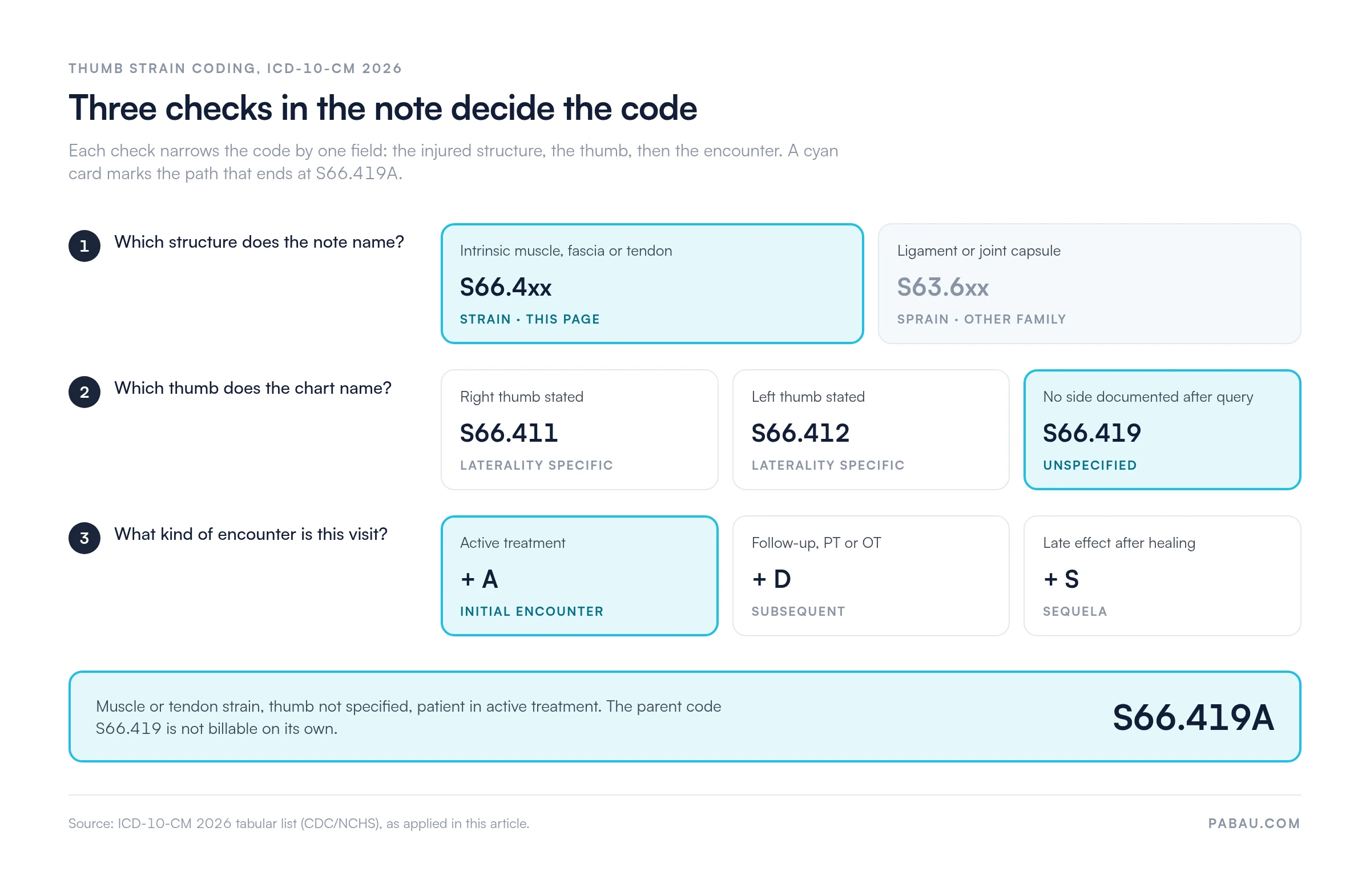
The full S66.4 sub-category covers both lateralities and all three encounter types for intrinsic muscle, fascia and tendon injuries of the thumb. Our diagnostic code reference library is the place to confirm a neighboring code before you submit.
Subcategory S66.4 covers the thumb only. An intrinsic muscle, fascia or tendon injury to any other finger belongs in S66.5, where S66.598A covers other specified injuries at an initial encounter.
The move from S66.419A to S66.419D is one of the most routinely miscoded sequences in hand injury billing. Knowing when each code applies stops systematic undercoding or overcoding across an episode of care.
Those sequela criteria are not specific to the hand. The same standard applies at any other site, including S09.11XS for the sequela of a head muscle and tendon strain.
Denials on S66 codes often trace back to a single documentation failure. The encounter type described in the note does not match the 7th character on the claim. A note reading “routine follow-up for thumb strain” that is billed as S66.419A rather than S66.419D is the pattern that triggers retrospective audits.
S66.419A is confirmed billable in the CDC/NCHS ICD-10-CM web tool for the 2026 edition. Reimbursement still depends on payer coverage policy. Medicare, Medicaid and commercial payers each apply their own medical necessity criteria, so billable status alone never guarantees payment.
The most common rejection on this code is mechanical rather than clinical. A claim carrying the non-billable parent S66.419 comes back before any reviewer reads the note. The 7th character has to be present on the line. Scrubbing the code at submission is far cheaper than arguing it at appeal.
The clinical note has to support every element of S66.419A before a coder can assign it. For a musculotendinous injury code, that means going well past “thumb pain”. The note must place the injury in the correct anatomical structure and in the correct encounter context.
A clean claim submission for S66.419A needs all five elements above in the note. Miss one, most often the anatomical structure or the encounter-type statement, and the coder has to query the provider. Every query adds cycle time to the claim.
Run a quarterly audit on your S66 claims. Pull every encounter coded S66.419A and check the note against the five documentation elements above. Laterality and anatomical specificity are where most provider queries start, so those two columns show you where to coach the clinical team first.
A billing team managing a hand injury episode needs the procedure side as well as the diagnosis code. The table below lists the pairings that come up most often. Pairing guidance reflects coding practice rather than a guarantee of reimbursement, and prior authorization rules vary by payer. During physical or occupational therapy, these CPT codes usually pair with S66.419D instead of S66.419A.
For legacy billing systems, payer crosswalk reference or historical record analysis, S66.419A maps back to ICD-9-CM code 842.10, “Sprain of hand, unspecified site”. ICD-9 had no thumb-specific code for a muscle or tendon strain, so the CMS general equivalence mappings route the concept to that unspecified hand entry. The older system also lacked the laterality and encounter-type detail that ICD-10-CM introduced.
The crosswalk is approximate, not exact. ICD-9 code 842.10 sits in the sprain block and never names the muscle-tendon unit at all. Flag that limitation whenever you use crosswalk data for a payer appeal or a historical comparison.
Most practices catch 7th-character errors on the remittance advice, weeks after the visit. A coder reads the note by hand and the claim goes out. The mismatch between “routine follow-up” and the A character surfaces only when the payer returns it. Reworking that line costs more staff time than the original charge earned.
Pabau is practice management software for healthcare practices, and it moves that check upstream. Its error-checking claims software validates each ICD-10 code at the point of submission. The non-billable parent S66.419 never reaches a payer, because the claim cannot leave without its 7th character.
Coders work from the same catalog the biller submits from. Laterality and encounter type then stay consistent from the first visit to the last therapy session. Hand therapy and orthopedic teams get their denial rate back without adding a second review step.

Pabau’s claims management software validates ICD-10 codes at submission and flags 7th-character errors before your S66.419A claim reaches the payer. See how it works for your practice.

S66.419A is a billable, encounter-specific code for intrinsic thumb muscle and tendon strains at wrist and hand level. Three decisions around it carry the most weight. Pick the 7th character that matches the visit. Use a laterality-specific code whenever the chart supports one. Let the structure named in the note keep this code apart from the S63.6xx sprain family.
All three decisions are made in the clinical note, not in the code book. A practice that tightens its hand injury documentation template fixes its S66 denial rate at the same time. It also stops the query cycle that eats the coder’s week. Book a demo to see how Pabau validates hand injury codes before the claim leaves your practice.

Need to understand denial patterns for musculoskeletal claims? Denial management in healthcare billing covers the most common rejection reasons for injury codes and how to reduce them systematically.
Looking for a complete medical billing compliance framework? Medical billing compliance requirements outlines the documentation and audit standards that apply to ICD-10 musculoskeletal claims.
Want to see how Claim.MD integrates with your practice workflow? Claim.MD clearinghouse overview explains how electronic claim submission and ERA remittance work for US practices.
ICD-10 code S66.419A is the billable diagnosis code for a strain of the intrinsic muscle, fascia and tendon of an unspecified thumb. The injury sits at wrist and hand level, and the code applies to an initial encounter. The code is valid for the 2026 ICD-10-CM edition and sits in the S66 category covering muscle and tendon injuries at wrist and hand level.
Yes, S66.419A is a billable, specific ICD-10-CM code valid for reimbursement. The parent code S66.419 is not billable on its own. A 7th character of A, D or S is required before any claim can be submitted.
All three codes describe the same injury, an intrinsic thumb muscle or tendon strain with unspecified laterality, and they differ only by encounter type. S66.419A covers initial encounters during active treatment. S66.419D covers subsequent encounters, meaning follow-up and rehabilitation. S66.419S covers sequela, the late effects that persist after the original injury has healed.
Use S66.411A when the clinical note documents a right thumb injury and S66.412A for a left thumb injury. Use S66.419A only when laterality is genuinely unspecified or unknown. Query the provider before defaulting to S66.419A, because a chart that references a specific hand requires the laterality-specific code.
Common pairings include 99213 and 99214 for evaluation and management visits. Splinting at the acute encounter uses 29085, while therapeutic exercise and manual therapy use 97110 and 97140. Therapy visits are usually billed with S66.419D rather than S66.419A. Payer coverage policies vary, so treat these pairings as guidance only.
The approximate ICD-9-CM crosswalk for S66.419A is 842.10, “Sprain of hand, unspecified site”. ICD-9 had no thumb-specific code for a muscle or tendon strain, so the CMS general equivalence mappings route the concept to that unspecified hand entry. The mapping is approximate, and it captures neither laterality nor encounter type.
Thumb strains, meaning muscle and tendon injuries, use codes in the S66.4xx family, including S66.419A for an unspecified thumb. Thumb sprains, meaning ligament and joint capsule injuries, use codes in the S63.6xx family. The clinical note must name the injured structure, because that is what decides which code family applies.