ICD-10 Code S52.541M: Smith’s fracture of right radius with nonunion (open type I or II)
ICD-10 Code S52.541M: Definition and billable status ICD-10 Code S52.541M is the...

Last Updated: Oct 15, 2026
Billable Code Specific Code
S66.308A is the billable ICD-10-CM code for unspecified injury of extensor muscle, fascia and tendon of other finger at wrist and hand level, initial encounter.
It applies when the chart names a non-thumb finger and confirms extensor involvement, but states neither the hand nor the injury type. The code sits in Chapter 19 (S00-T88), subcategory S66.3, and the 7th character "A" marks active treatment. Once the hand is documented, a per-finger code replaces it, such as S66.300A (right) or S66.301A (left) for the index finger. S66.309A covers charts that never identify the finger.
Let Pabau's smart automation suggest the right codes, reduce claim denials, and keep your practice compliant—effortlessly.
Automate repetitive tasks and focus on what matters most—your patients.
Reduce coding errors and ensure compliance with the latest regulations.
Clean claims, fewer denials, and faster reimbursements.
Powerful insights and reporting to help your practice thrive.
HIPAA compliant SOC 2 certified GDPR-compliant Trusted by 4,000+ clinics worldwide

ICD-10 Code S66.308A covers an unspecified extensor tendon injury of a named non-thumb finger when the chart doesn’t say which hand. Thumb extensor injuries code to S66.2- instead.
The 7th character ‘A’ marks active treatment, ‘D’ marks routine care while the injury heals, and ‘S’ flags sequela.
Once the chart names both the finger and the hand, a laterality-specific code from S66.300A to S66.307A replaces S66.308A.
Pabau’s claims management software works with Claim.MD to check ICD-10 and CPT pairings before a claim goes out.
ICD-10 Code S66.308A is the billable code for an unspecified extensor tendon injury of a named non-thumb finger, initial encounter. The Tabular List applies it when the chart names the finger but not the hand. It’s valid in the FY2027 ICD-10-CM edition, effective October 1, 2026, per the CMS ICD-10-CM code files.
Its full official descriptor is: Unspecified injury of extensor muscle, fascia and tendon of other finger at wrist and hand level, initial encounter.
Every code in the ICD-10-CM code set nests the same way. The table below traces S66.308A from its chapter down to the billable 7th-character level.
“Other finger” here means a specified finger other than the thumb, with the hand left undocumented. An Excludes2 note at S66.3 sends thumb extensor injuries to subcategory S66.2-. So S66.308A never applies to a thumb, and thumb flexor injuries sit separately in S66.0-.
The base code S66.308 needs a 7th character to become billable. Three options exist, governed by the ICD-10-CM Official Coding Guidelines, Section I.C.19. Picking the wrong one misstates the treatment phase on the claim.
The 7th character tracks the treatment phase, not the injury’s age or whether the provider is new to the patient. The evaluation and the surgical repair take “A.” Once active treatment ends, visits during healing take “D,” and rehabilitation after the repair generally falls into that phase.
S66.308A is the code for a named finger when the hand isn’t documented, so it has no right or left version of its own. When the chart names both the finger and the hand, a per-finger code replaces it. Payers often question unspecified laterality on surgical claims, so check the operative note before you settle on S66.308A.
The decision runs in three steps, and the order matters:
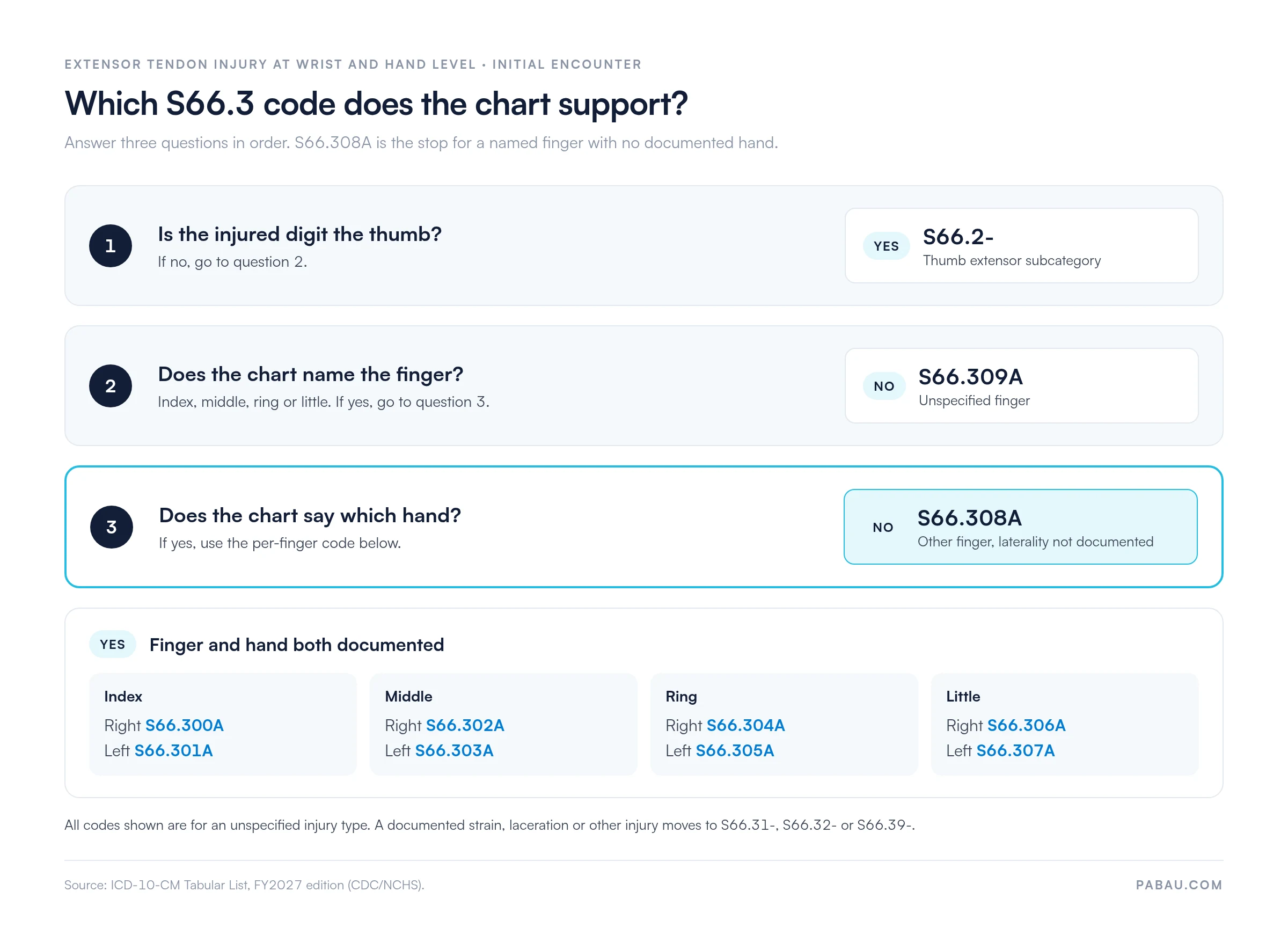
S66.308A and S66.309A look interchangeable, but the Tabular List separates them on a single detail. Use S66.308A when the chart names the finger, such as “ring finger,” but not the side.
Use S66.309A only when the chart never identifies the finger. If the note says “right ring finger,” code S66.304A, because either fallback would under-code it.
Several neighboring codes share similar descriptors, and picking the wrong one triggers claim edits and medical necessity reviews. The usual mix-ups involve flexor versus extensor, the thumb subcategories, injury type and laterality.
The AAPC ICD-10-CM code lookup shows the full S66 tree side by side, which helps when matching documentation to the right finger and hand. Two instructional notes at category S66 matter most here.
A “Code also” note tells you to report any associated open wound (S61.-) alongside the tendon code. The Excludes2 note covers sprains of the wrist and hand joints and ligaments (S63.-). An Excludes2 condition can be coded together with S66.308A when both are documented.
Payers expect the clinical documentation to support each element of the code: the tendon type, the finger, the hand and the encounter type. A missing element triggers either a denial or a request for more records.
Required documentation elements for a clean S66.308A claim:
Hand surgery, orthopedic and physical therapy practices that use one structured note capture all five elements at once. Clear notes are the base of medical billing, because a coder can only code what the chart states. Where an element is missing, query the treating provider before submission instead of falling back to a less specific code.
S66.308A is a diagnosis code, and it pairs with CPT procedure codes to form a complete claim. The pairings below cover the range of treatment for extensor tendon injuries, from rehabilitation to surgical repair.
CPT 26418 is the closest surgical match when the operative note describes a finger extensor repair. Confirm payer bundling edits in the applicable Local Coverage Determination (LCD) before you submit. Some Medicare Administrative Contractors (MACs) add their own edits for hand tendon repairs.
For therapy visits after the repair, CPT 97110 covers therapeutic exercise in 15-minute units. Match its diagnosis to the treatment phase, because rehabilitation rarely counts as active treatment.
The five denial reasons below each have a fix at the documentation or submission stage.
A solid denial management workflow catches these issues before submission, not in the remittance cycle. A clearinghouse with claim editing helps with submitting a clean claim the first time, which avoids the resubmission wait after a rejection.
The ICD-10-CM Official Coding Guidelines for Chapter 19 and the CDC/NCHS ICD-10-CM tool provide the authoritative rules. This checklist distills the practical steps to run through on every S66.308A encounter.
Send S66.308A claims for a second review whenever the paired CPT code is surgical, such as 26418. Payers scrutinize surgical claims with unspecified laterality more closely than E/M-only claims. A quick chart check at coding can save a full resubmission cycle.
Without a pre-submission check, a missing 7th character or a mismatched CPT code usually surfaces only when the remittance comes back denied. By then the visit is weeks old, and the provider query competes with new patients.
Pabau’s claims management software works with Claim.MD to run eligibility checks and validate ICD-10 and CPT pairings before the claim leaves the practice. The coder sees the error while the chart is still open, so the query to the provider happens while the visit is fresh.
For S66.308A claims, that check is where an extensor repair paired with a flexor diagnosis, or a code sent without its 7th character, gets flagged.


Pabau works with Claim.MD to validate ICD-10 and CPT pairings, run eligibility checks and flag a missing 7th character before submission. Your S66.308A claims go out clean.

S66.308A earns its place in one narrow situation. The chart names a non-thumb finger and confirms extensor involvement, but leaves out the hand and the injury type.
Treat it as a deliberate choice, made after checking the note for laterality, and query the provider when the hand is missing. That one query often turns S66.308A into a laterality-specific code that holds up better on a surgical claim.
Building that check into the pre-submission step costs less than appealing a denial. Book a demo to see how Pabau flags ICD-10 and CPT errors on hand injury claims before they reach the payer.

Need to understand the broader claims submission process? Medical claims clearinghouse guide covers how electronic claim routing works from practice to payer.
Looking for guidance on ICD-10-CM 837 electronic file submission? 837 file overview explains the transaction set structure used for professional claims.
Want to reduce remittance surprises? Electronic remittance advice (ERA) guide explains how to read and act on 835 payment files.
ICD-10 Code S66.308A is the billable code for an unspecified extensor muscle, fascia and tendon injury of a non-thumb finger, initial encounter. It sits in subcategory S66.3 of Chapter 19. Use it when the chart names the finger and confirms extensor involvement but doesn’t state the injury type or the hand.
S66.308A applies when the chart names the injured finger but not the hand. S66.309A is for charts that never identify the finger. If the note says “right ring finger,” use S66.304A, because either fallback would under-code it.
The 7th character “A” marks an initial encounter, meaning the patient is receiving active treatment for the injury. It covers the evaluation and the surgical repair, even when a new provider sees the patient. “D” takes over for routine care while the injury heals, and “S” covers sequela.
Yes. S66.308A is a valid, billable code in the FY2027 ICD-10-CM edition, effective October 1, 2026. Some payers apply medical necessity edits when it’s paired with a surgical CPT code and laterality is missing. Keep the notes that support extensor involvement and the encounter type in case of review.
CPT 26418, repair of a finger extensor tendon without free graft, is the usual surgical pairing. CPT 97110 covers therapeutic exercise during rehabilitation, which usually takes the “D” version of the diagnosis. E/M codes 99213 and 99214 apply to follow-up evaluation visits. Confirm payer bundling edits and LCD rules before submitting a surgical pairing.
Use S66.308A only when the chart names the finger but not the hand. Once both are documented, pick the per-finger code. The index finger is S66.300A (right) or S66.301A (left), and the middle finger is S66.302A or S66.303A. The ring finger is S66.304A or S66.305A, and the little finger is S66.306A or S66.307A.