ICD-10 Code S82.242H: Displaced spiral tibial shaft fracture, delayed healing
ICD-10 Code S82.242H: Definition and code details ICD-10 Code S82.242H designate...

Last Updated: Oct 15, 2026
Billable Code Specific Code
S61.452D is the billable ICD-10-CM code for open bite of left hand, subsequent encounter.
It applies once active treatment is complete and the patient returns for follow-up care. The code is valid for HIPAA-covered transactions from October 1, 2025 through September 30, 2026.
Picking the wrong 7th character on hand wound follow-up visits is a common reason these claims get denied. Coders often bill the initial encounter code (A) through the whole treatment episode, when D should take over once active treatment ends.
Per CMS ICD-10-CM guidelines, the 7th character D applies to every follow-up visit after the patient's active treatment phase ends. A new active treatment event resets the choice back to A, even late in the episode.
Let Pabau's smart automation suggest the right codes, reduce claim denials, and keep your practice compliant—effortlessly.
Automate repetitive tasks and focus on what matters most—your patients.
Reduce coding errors and ensure compliance with the latest regulations.
Clean claims, fewer denials, and faster reimbursements.
Powerful insights and reporting to help your practice thrive.
HIPAA compliant SOC 2 certified GDPR-compliant Trusted by 4,000+ clinics worldwide

S61.452D is a billable ICD-10-CM code for an open bite of the left hand at follow-up visits, distinct from the initial encounter code S61.452A.
The 7th character D means subsequent encounter, so active treatment is complete and the patient is back for wound care or a healing check.
Continuing to use S61.452A after active treatment ends is the most common coder error, and it triggers denials that need rework.
Pabau’s claims management software checks the administrative details on a claim, such as membership and authorization numbers, before it is submitted.
S61.452D is a specific, billable ICD-10-CM code. It entered the 2026 edition of the ICD-10-CM on October 1, 2025, and is valid through September 30, 2026. The table below summarizes the key facts coders and clinicians need before billing.
The ICD-10-CM system uses a hierarchical alphanumeric structure. S61.452D sits within the S60-S69 block covering injuries to the wrist, hand, and fingers. Coders using the CDC/NCHS ICD-10-CM web tool can verify billable status and effective dates against the official tabular list.
S61.452D means an open bite of the left hand, coded at a visit that happens after active treatment has ended. Each segment of the seven-character code carries a distinct clinical meaning, and breaking it down removes ambiguity when you are choosing between sibling codes.
The laterality digit “2” separates S61.452D from its right-hand counterpart S61.451D. Documenting left versus right hand in the clinical note is a prerequisite for billing this code accurately. When the documentation is ambiguous, S61.459D (unspecified hand) applies, though payers scrutinize unspecified codes more closely.
S61.452 requires a 7th character to be complete and billable. The three valid options describe where the patient sits in the treatment continuum. Choosing the wrong one is the single most common reason these claims are denied, and the same A/D/S framework runs through the whole S00-T88 chapter.
CMS ICD-10-CM guidelines add one wrinkle worth knowing. The initial encounter (A) is appropriate for any visit where a new or different provider is giving active treatment. That holds even if another provider already saw the patient. “Subsequent” does not mean a second or third visit by count. It means active treatment has ended.
The subsequent encounter 7th character (D) applies once the injury’s active treatment phase is over. Per the CMS ICD-10-CM Official Guidelines Section I.C.19, the definition is clinical rather than visit-count based.
Situations where S61.452D is the correct code:
Situations where S61.452A (initial encounter) is still correct despite a prior visit:
Both lists come down to one question a coder can ask at the top of every follow-up visit, shown below.
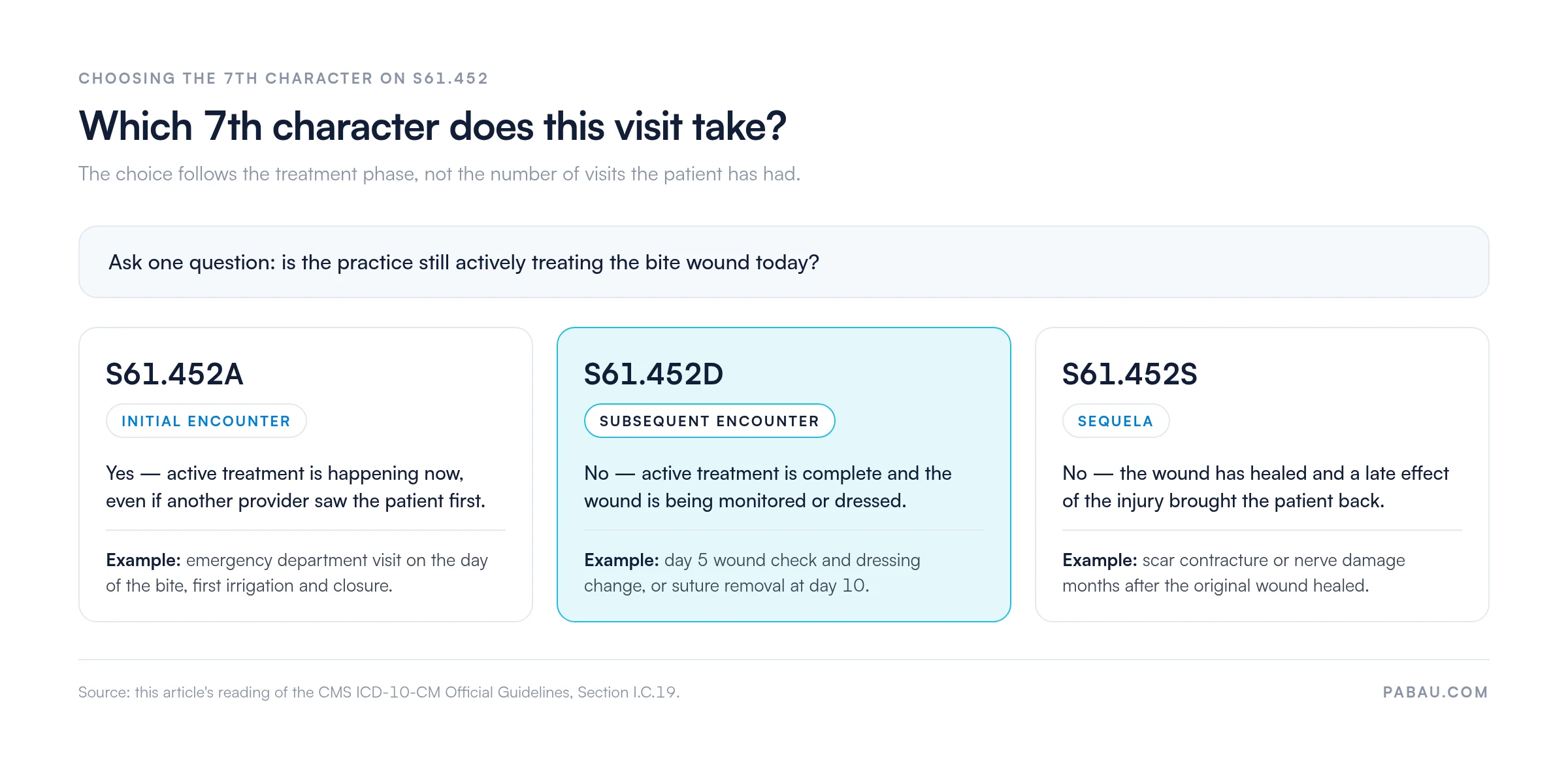
Applying that one question protects against the most frequent denial reason on hand bite claims. A coder who already handles another injury category will recognize the logic, because the S chapter applies it the same way throughout.
An open bite wound is a traumatic break in the skin caused by teeth pressing through the tissue. It leaves irregular, crushing edges rather than the clean edges of a laceration. The left hand is a common site, because people instinctively raise the non-dominant hand during animal attacks or altercations.
Common causes a coder should be aware of when reviewing documentation for S61.452D:
Bite wounds to the hand follow a defined treatment pathway. It opens with irrigation and debridement, an antibiotic prophylaxis assessment, and closure or delayed primary closure. Human bites are often left open at first and monitored. The visits that generate S61.452D billing are the wound checks later in that pathway.
Two documentation elements drive 7th character selection. The note has to state which hand was bitten, and it has to make clear that today’s visit is follow-up rather than active treatment. Practices handling high volumes of injury follow-ups need both facts in a fixed place in the chart, not buried in free text.
The following alternate descriptions all map to S61.452D for documentation and coding purposes. Coders will encounter these terms in physician notes, discharge summaries, and referral letters.
None of these alternate terms change the code. The clinical documentation does not need to use the exact ICD-10-CM language, because the coder applies the code from the clinical description. What the note must confirm is the body site, the wound type, and the treatment phase.
S61.452D sits within a clear hierarchical structure. Understanding the hierarchy helps coders navigate the tabular list and select sibling codes when laterality or encounter type differs.
Note that S61.45 excludes superficial bite of hand. If the wound does not break the skin, coders should look at S60.57 (other superficial bite of hand) instead. The AAPC ICD-10-CM code lookup navigates this hierarchy in detail, showing Excludes1 and Excludes2 notes at each level.
S61.452D belongs to a family of closely related codes. Selecting the correct sibling requires accurate documentation of laterality and encounter type.
Pabau’s ICD-10 diagnostic codes library sets out the neighboring codes at each subcategory level, along with their billable status. Checking an adjacent code before filing takes less time than appealing the denial afterwards.
S61.452D is a diagnosis code; it pairs with CPT procedure codes that describe what the clinician did during the subsequent encounter visit. The table below lists the CPT codes most commonly billed alongside S61.452D at follow-up visits.
Practices submitting these combinations electronically route them through a clearinghouse. That route covers claim transmission, real-time eligibility checks, and electronic remittance tracking. It does not confirm that your diagnosis and procedure codes describe the same phase of care. The 7th character still has to be right before the claim goes out.
Pairing S61.452D with an E/M code requires documented medical decision-making complexity, and a brief wound check typically supports 99212 or 99213. Your practice’s claims management software should flag missing membership or authorization details before the claim leaves the office.
Coders working with hand bite codes run into a predictable set of recurring errors. Each one below traces back to a specific documentation habit or coding shortcut that drives denials.
Solid documentation habits are the upstream fix for all of these. When denials do come through, a structured denial management process lets coders investigate, correct, and resubmit rather than writing off the revenue.
Run a weekly audit of your S61.45x claim rejections filtered by 7th character. The most frequent cause is continued use of S61.452A after the initial visit. Give coders one rule to work from. If the wound was previously closed or debrided and today’s visit is a check or dressing change, use the D character. That single rule clears most of these edits without a payer call.
In most practices, a 7th character error surfaces only after the payer has rejected the claim. The note says “wound check, left hand”, the claim goes out carrying S61.452A, and the rejection lands two weeks later. By then the coder is reconstructing the visit from a note written for a clinician, not for a payer.
Practice management software like Pabau keeps the charting and the billing in one patient record. The note that documents a follow-up visit is the note the claim is built from. Clinical templates hold laterality and treatment phase in named fields rather than free text. A coder reading the chart can see which phase the patient is in without paging through the episode.
Pabau’s claims management software then checks the administrative details on each claim, such as membership numbers and authorization codes, before it is submitted. Clinical code selection stays with your coder. What changes is how many claims come back for reasons that had nothing to do with the diagnosis.

Pabau checks the administrative details on every claim, including membership numbers and authorization codes, before it is submitted. Your coders spend less time reworking claims that came back on paperwork rather than clinical detail.

S61.452D stops being difficult once the 7th character is tied to treatment phase instead of visit count. The judgment that matters at each follow-up is whether the practice is still treating the wound or watching it heal. The chart has to answer that before anyone codes the visit.
For practices with steady injury follow-up volumes, accuracy at the 7th character compounds into recovered or lost revenue over a year. Pabau’s claims management software validates the administrative details on each claim, such as membership and authorization numbers, before it is submitted. Book a demo to see how the clinical note and the claim stay in one record.

Need a primer on how ICD-10 claim submissions reach payers? Medical claims clearinghouse guide explains how electronic claims move from practice to payer and where errors get flagged.
Unsure how to handle a denial on a subsequent encounter code? Denial codes in medical billing covers the most common remittance adjustment reason codes and how to respond to each one.
Want to understand the full lifecycle of a claim? Superbill guide walks through how encounter documentation converts into a billing-ready superbill with ICD-10 and CPT codes aligned.
ICD-10 Code S61.452D is the billable ICD-10-CM diagnosis code for an open bite of the left hand at a subsequent encounter. It means the patient is receiving follow-up care after the wound’s active treatment phase has ended. It covers visits such as wound checks, dressing changes, and suture removal where no new active treatment is being performed.
Yes. S61.452D is a specific, billable ICD-10-CM code valid for reimbursement in all HIPAA-covered transactions for fiscal year 2026 (October 1, 2025 through September 30, 2026). It is reportable without needing a more specific code beneath it.
S61.452A is used when the patient is receiving active treatment for the open bite of the left hand, such as wound irrigation, debridement, or closure. S61.452D applies once that active treatment phase is complete and the patient returns for routine follow-up care. The distinction is based on clinical treatment status, not how many visits have occurred.
Use 7th character D when the patient’s injury is no longer receiving active treatment. The visit is for routine aftercare such as wound monitoring, dressing changes, or suture removal. Per CMS ICD-10-CM Official Guidelines Section I.C.19, “subsequent” refers to treatment phase, not visit number.
Subsequent encounter (D) applies while the original injury is still being monitored or treated in its aftercare phase. Sequela (S) applies only once the original injury has fully healed. The patient then presents with a late effect of that injury, such as scar contracture or residual nerve dysfunction.
Common CPT codes paired with S61.452D include 99212 and 99213 for established patient office visits. Others include 97602 for non-selective wound debridement and 29130 for static finger splint application. The appropriate E/M level depends on the complexity of medical decision-making documented at the follow-up visit.