ICD-10 Code Y76.0: Diagnostic obstetric and gynecological devices
ICD-10 Code Y76.0: Definition and billable status ICD-10 Code Y76.0 is a valid, ...

Last Updated: Oct 23, 2026
Billable Code Specific Code
S61.314A is the billable ICD-10-CM code for laceration without foreign body of right ring finger with damage to nail, initial encounter.
It sits within subcategory S61.3 for open wounds of fingers with nail damage. Claims need explicit documentation of laterality (right hand) and nail involvement. The "A" seventh character designates active treatment, so the code applies only while the wound is actively managed. Skip nail-damage documentation or apply the wrong encounter qualifier, and the claim may deny.
Let Pabau's smart automation suggest the right codes, reduce claim denials, and keep your practice compliant—effortlessly.
Automate repetitive tasks and focus on what matters most—your patients.
Reduce coding errors and ensure compliance with the latest regulations.
Clean claims, fewer denials, and faster reimbursements.
Powerful insights and reporting to help your practice thrive.
HIPAA compliant SOC 2 certified GDPR-compliant Trusted by 4,000+ clinics worldwide

S61.314A is a billable ICD-10-CM code for a laceration without foreign body of the right ring finger with documented nail damage.
The ‘A’ seventh character applies while the wound is under active treatment. Switch to ‘D’ only once the visit is routine healing care, such as suture removal.
Clinical notes must state the affected digit (right ring or fourth finger), a laceration with no retained foreign body, and nail damage.
Pabau, the practice management platform we build, records documentation at the point of care and submits claims through Claim.MD, our US clearinghouse partner.
ICD-10 Code S61.314A is a valid, specific, billable code for a laceration without foreign body of the right ring finger with nail damage, initial encounter. It is valid in the current ICD-10-CM release, so confirm it each October. The table below captures the reference data coders need before submitting a claim.
The official ICD-10-CM tabular list is maintained by the National Center for Health Statistics (NCHS) at the CDC and updated every October. Always confirm code validity against the current release before submitting.
Each character in S61.314A encodes a specific clinical fact. Misread any segment and you may pull the wrong code from the tabular list.
The digit identifier “4” is where coders most often slip. In the S61.31x family, 0 and 1 mark the right and left index fingers, and 2 and 3 the middle fingers.
Next come 4 and 5 for the right and left ring fingers and 6 and 7 for the little fingers. Code 8 covers another finger and 9 an unspecified finger.
Swapping “4” for “5” codes the left ring finger instead of the right. Swapping it for “6” codes the little finger instead of the ring finger. Either error can deny on payers that cross-check the diagnosis against the procedure note.
S61.314A applies when the clinical note documents all of the following elements simultaneously. Missing any one element means a different, less-specific code applies.
If the chart note documents the laceration but not nail involvement, the correct code is S61.214A. That code covers the same right ring finger laceration without damage to nail. If the note names the nail damage but not the wound type, S61.304A (unspecified open wound of right ring finger with damage to nail) applies.
Nail bed injuries often need extra procedures, which affects wound-repair CPT selection.
The seventh character in S61.314A communicates the episode of care. Choosing the wrong one misstates where the patient is in treatment, and payers can deny the claim for it.
Per CDC/NCHS ICD-10-CM guidance, “initial encounter” does not literally mean “first visit.” It means the patient is receiving active treatment for the condition. A second or third visit for wound debridement or dressing changes still uses “A” if the wound is being actively managed. Switching to “D” while the wound is still under active treatment misstates the episode of care.
The CDC tabular list places its instructional notes at the S61 category. They govern what can and cannot appear on the same claim as S61.314A.
Code also (S61): Any associated wound infection. A laceration that becomes infected is coded with S61.314A plus the code for the infection.
Excludes1 (S61, never coded together): Open fracture of wrist, hand and finger (S62.- with 7th character B) and traumatic amputation of wrist and hand (S68.-). If the laceration overlies an open fracture of the same finger, code the fracture instead. A closed fracture is not excluded. A traumatic amputation is likewise coded from S68.- rather than S61.
Wound type within S61.3: S61.31- covers lacerations without a foreign body only. A laceration with a retained foreign body is S61.32-, a puncture wound is S61.33- or S61.34-, and an open bite is S61.35-.
The S61.31- family covers lacerations without a foreign body of the fingers with nail damage. The table below lists the full group from the official ICD-10-CM code set, plus the follow-up codes and the neighbors most often confused with S61.314A.
Before selecting S61.314A, confirm two things in the chart note. First, ‘right’ and ‘ring’ or ‘fourth’ finger appear in the same wound description. Second, nail involvement is explicitly documented, not just implied. If either element is missing, query the provider before coding.
CPT selection depends on wound length and complexity. ICD-10 Code S61.314A pairs with wound-repair codes such as 12001 from the integumentary system section. The nail involvement documented to support S61.314A may also drive 11760 when the nail bed itself is repaired.
NCCI edits may restrict certain CPT pairs. Verify current edit tables before billing 11730 on the same claim as a wound-repair code or 11760. Check the AAPC ICD-10-CM code lookup for crosswalk guidance on pairing CPT codes with S61.314A.
ICD-10-CM specificity rules require that the clinical note supports every element encoded in the code. For S61.314A, five documentation elements are non-negotiable.
When one of these elements is missing from the note, a neighboring code applies instead. The checks below show which code each gap in the note points to.
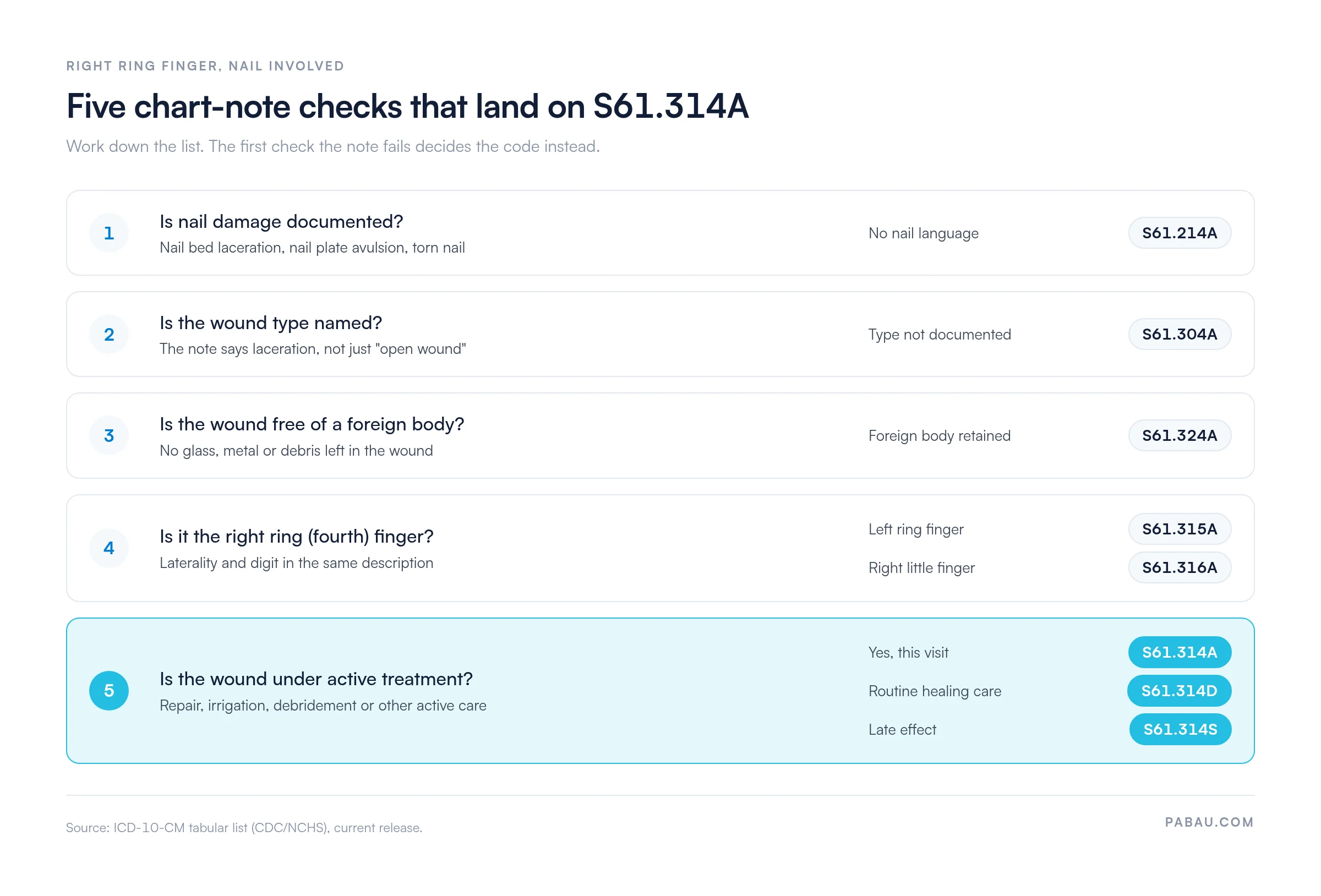
Pabau’s claims management software captures clinical documentation at the point of care. The digit, laterality and nail findings are recorded in the same chart the claim is built from.
Claims using S61.314A deny for a predictable set of reasons. Each denial pattern has a direct fix tied to documentation or coding workflow. The remittance names each rejection with standard claim denial codes, which point you to the matching row below.
Medicare Part B processes S61.314A claims under standard outpatient wound-care guidelines. Preauthorization is not typically required for simple or intermediate wound repair, but complex repair (CPT 13131) may trigger a medical necessity review at some payers.
Medicaid requirements vary by state. Some state Medicaid programs require specific modifier use or place quantity limits on wound-repair services per encounter. Check your state Medicaid fee schedule before billing.
Workers’ compensation claims using S61.314A carry extra documentation requirements in most US jurisdictions. The mechanism of injury must be clearly linked to workplace activity. Some states also require a First Report of Injury form before the first claim is processed.
Coding and reimbursement rules for workers’ compensation vary by jurisdiction, so confirm them with the relevant state board before submitting. The CMS ICD code lists provide guidance on valid diagnosis codes across payer types.
Run this five-step checklist before submitting any S61.314A claim.
The CDC ICD-10-CM browser shows the S61 category notes next to each S61.31- code, which helps when double-checking adjacent codes during coding review.
Practices with high volumes of injury claims benefit from a clearinghouse that runs real-time insurance eligibility verification. It confirms the plan is active before the claim goes out, so a coding fix is never stacked on an inactive policy.
Run a monthly audit of claims coded S61.31xA: pull all claims in the S61.31 family and sort by 7th character. Any cluster of ‘D’ codes on visit dates within the first week of the injury is a red flag. Those visits were likely still active treatment and should have used ‘A’. Correcting these before a payer audit saves recoupment exposure.
Some practices chart the wound in one system and build the claim in another. A biller then retypes the digit, the laterality and the nail findings. Each retype is a chance to land on S61.315A or S61.214A by mistake.
Pabau submits claims through Claim.MD, our US clearinghouse partner, with real-time eligibility checks. The codes go out with the documentation captured at the point of care, so billing staff work from the record the clinician wrote.
The diagnosis on the claim matches the note it came from. That means fewer laterality and nail-damage denials, and fewer provider queries after the claim has already gone out.

Pabau captures documentation at the point of care and submits claims through Claim.MD, our US clearinghouse partner, with real-time eligibility checks. See how it works for your billing team.

S61.314A only holds up when the note says right, ring and nail in the same wound description. Build those three words into the template your clinicians chart in, and the 7th character becomes the only call left at billing.
That structure costs a few seconds per note. It saves the query-and-resubmit loop a denied finger wound claim sets off. For claims that still come back, our guide to denial management covers the recovery steps. Book a demo to see how Pabau carries the wound note straight into a clean claim.

Need to understand how claims reach the clearinghouse? Medical claims clearinghouse guide explains the end-to-end submission workflow from practice to payer.
Working through a denied finger wound claim? Denial codes in medical billing covers common CARC denial codes and how to respond to each one.
Want to strengthen your ICD-10 documentation workflow? Medical billing compliance outlines the documentation standards that support clean-claim submission across payer types.
Want one form for the whole wound visit? Encounter form template captures diagnosis, procedure and visit details on a single page.
ICD-10 Code S61.314A is the billable diagnosis code for a laceration without foreign body of the right ring finger with damage to nail, initial encounter. It is used when a patient receives active treatment for a cut to the fourth digit of the right hand with documented nail involvement.
Yes, S61.314A is billable and valid in the current ICD-10-CM release, so confirm it each October. It is a specific, seven-character code that meets ICD-10-CM requirements for payable status without an additional specificity code.
S61.314A designates initial encounter, used when the wound is under active treatment. S61.314D designates subsequent encounter, used when the wound is healing and the visit is a wound check or suture removal. The clinical activity on that visit determines which seventh character applies, not the visit number.
The most common CPT pairings are 12001 (simple repair, 2.5 cm or less) and 12002 (simple repair, 2.6 to 7.5 cm). Intermediate repair codes 12041 and 12042 apply when layered closure is required. Nail bed repair (11760) is billed when performed, subject to NCCI edits. Nail avulsion (11730) is reportable only as a distinct procedure, never with 11760 for nail bed access.
Yes, explicit nail-damage documentation is required. The note must include specific language about the nail, such as nail bed laceration or nail plate avulsion. A right ring finger laceration with no nail reference is coded S61.214A instead.
Yes, provided both wounds are documented. S61.315A is the left ring finger equivalent. If the patient has nail-damaging lacerations on both ring fingers, both codes may appear on the same claim with supporting documentation for each wound.