ICD-10 Code S06.341D: Traumatic right cerebral hemorrhage
ICD-10 Code S06.341D: Definition and quick-reference data ICD-10 Code S06.341D i...

Last Updated: Oct 9, 2026
Billable Code Specific Code
S05.92XS is the billable ICD-10-CM code for unspecified injury of left eye and orbit, sequela. It reports a residual condition, such as blurred vision or double vision, caused by a left eye or orbit injury that has already healed.
The code sits in category S05 (Injury of eye and orbit) in Chapter 19 of ICD-10-CM. Its seventh character S marks a sequela encounter, so the residual condition is coded first and S05.92XS follows it. Use D instead while the original injury is still healing.
Let Pabau's smart automation suggest the right codes, reduce claim denials, and keep your practice compliant—effortlessly.
Automate repetitive tasks and focus on what matters most—your patients.
Reduce coding errors and ensure compliance with the latest regulations.
Clean claims, fewer denials, and faster reimbursements.
Powerful insights and reporting to help your practice thrive.
HIPAA compliant SOC 2 certified GDPR-compliant Trusted by 4,000+ clinics worldwide

S05.92XS is billable for FY2027 and codes the late effect of an unspecified left eye and orbit injury, not the active injury.
The seventh character S applies only once the original injury has healed. Use A for active treatment and D for routine healing visits.
Sequela encounters need two codes: the specific residual condition listed first, followed by S05.92XS.
Common denials on this code trace back to a missing placeholder X, a D where S belongs, or S05.92XS listed first.
Pabau, the practice software we build, sends claims through Claim.MD and tracks each one to paid, pending, or error.
ICD-10 Code S05.92XS is the billable diagnosis code for a residual condition caused by an unspecified left eye and orbit injury that has already healed. It has been valid since October 1, 2015, and remains valid in the FY2027 code set. The CDC/NCHS ICD-10-CM web tool lists it as a terminal code with no further subdivisions.
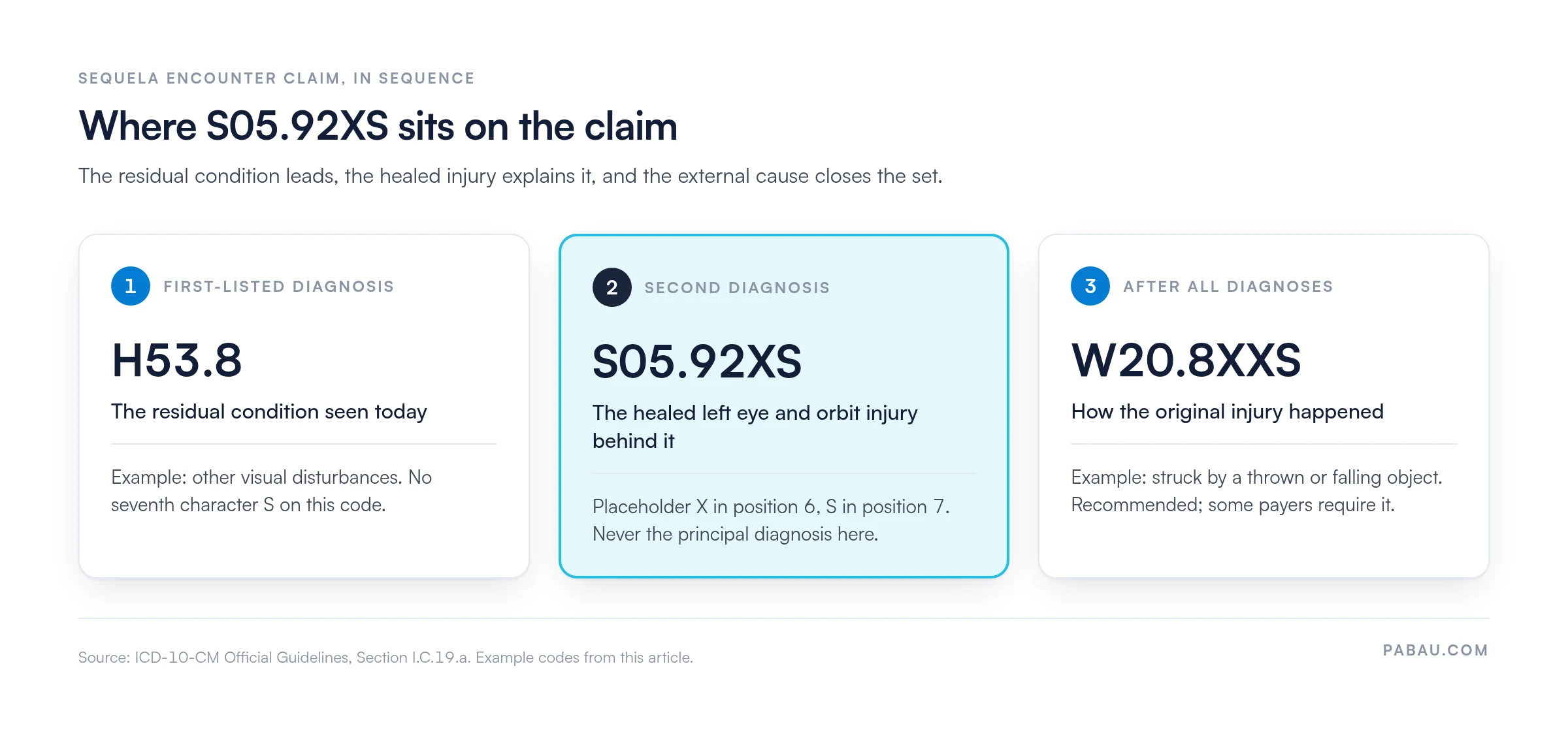
At a sequela visit, S05.92XS never goes on the claim alone. The residual condition is listed first, S05.92XS follows it, and an external cause code closes the set.
Each of the seven characters in S05.92XS carries a specific meaning. In medical billing, a structural error in any one of them gets the claim rejected before anyone reads the clinical notes.
The placeholder X in the sixth position is not optional. The S05.92 subcategory has no sixth-character detail defined in ICD-10-CM. Without the X filler, the code reads as six characters (S05.92S), which is not a valid code. Payers reject it at the front-end edits stage with no human review.
S05.92XS covers a residual condition that arose as a direct result of a prior unspecified injury to the left eye and its orbital structures. The original injury may have involved the eyeball itself, the orbital cavity, the periorbital tissues, or the adnexa. What matters at the sequela encounter is that the acute phase is over and the patient presents with a lingering effect.
The S05 category and its parent block carry Excludes2 notes. The conditions below are not part of S05.92XS. When one is present, code it separately, alongside S05.92XS rather than in place of it.
S05.92XS, S05.92XD, and S05.92XA differ only in their seventh character, but that single character determines whether a claim pays. The CMS ICD-10-CM coding guidelines define each encounter type in Section I.C.19.a. Coders who go by instinct rather than guideline wording often apply D where S belongs.
The practical distinction between D and S trips up experienced coders. A patient who returns six months after orbital trauma still experiencing blurred vision is not presenting for a routine wound check (D). The original injury healed. The blurred vision is a sequela. The correct code is S05.92XS, paired with the appropriate residual condition code listed first.
Payers look for three things when they review an S05.92XS claim. Missing any one of them usually triggers a medical necessity denial.
When all three elements appear in the note, the two-code rule applies. List the residual condition first, such as H53.8 for other visual disturbances. S05.92XS follows as the second code, identifying where the sequela came from.
Under ICD-10-CM Official Guidelines I.C.19.a, the sequela injury code is never the principal diagnosis when a specific residual condition can be coded.
ICD-10-CM guidelines recommend reporting an external cause code alongside S05.92XS to identify what caused the original left eye injury. These codes come from Chapter 20 (V00-Y99) and carry the same seventh character S to signal sequela status.
The AAPC ICD-10-CM code reference treats external cause reporting as strongly recommended for injury sequela encounters. Whether a payer makes it mandatory varies.
The order on the claim follows the guideline. The residual condition comes first, S05.92XS second, and the external cause sequela code third. An external cause code never sits ahead of a diagnosis code, as the sequence below shows.
Check the original encounter note before every sequela visit. Was the prior injury coded to a more specific S05 subcategory, such as S05.12XA for a left eye contusion? Then the sequela takes that subcategory too. That means S05.12XS, not S05.92XS. Payers are less likely to question medical necessity when the sequela code traces back to a precise prior injury code.
The S05 block contains more than 30 terminal codes once all seventh-character extensions are applied. The table below covers the codes coders most frequently confuse with S05.92XS, along with the distinguishing factor that determines which code is correct.
Coding principle: S05.92XS is the code of last resort within the S05.9- family. If the original or current record documents the injury type with any specificity (contusion, laceration, penetration, foreign body), a more specific S05 subcategory applies. Use the unspecified code only when documentation genuinely does not support greater specificity.
Sequela encounter claims carry a heavier documentation burden than initial or subsequent encounter claims. Payers including Medicare and most commercial plans expect a longer clinical trail that connects today’s residual condition to the original injury. Submitting S05.92XS without that trail is the fastest path to a medical necessity denial.
Running every claim through claims management software with clearinghouse edits catches an invalid code like S05.92S before the payer sees it. Pabau sends US claims through its Claim.MD clearinghouse partner, so a rejected claim comes back to the same system that raised it.
The electronic remittance advice on a denied S05.92XS claim gives the exact reason codes behind the denial. Those are the Claim Adjustment Reason Code (CARC) and the Remittance Advice Remark Code (RARC). Start every appeal from them. Our guide to common denial codes explains what each CARC means and how to respond.
Build a sequela checklist into your EHR workflow for any S05 code billed as a sequela. It confirms the prior injury is on record and the residual condition is named and linked. It also confirms the injury is marked resolved, the residual condition is sequenced first, and the placeholder X is present. Finally, it checks that an external cause code is added. A quick check before submission saves weeks of appeals.
The authoritative source for sequela coding rules is Section I.C.19.a of the ICD-10-CM Official Guidelines for Coding and Reporting, published annually by CMS and NCHS.
The ResDAC ICD codes guidance describes how these guidelines govern diagnosis coding across Medicare claims data. The core rules governing S05.92XS are summarized below.
A sequela claim depends on records from two visits. The prior injury sits in an old note and today’s residual finding sits in a new one. Someone has to connect them before the claim goes out.
In Pabau, both visits live on the same patient record, so the provider can tie today’s finding to the original injury while charting. The invoice raised at checkout becomes an electronic CMS-1500 claim through Claim.MD, with no re-keying. Real-time eligibility checks confirm coverage before the patient is in the chair.
Each claim then moves through clear stages in the claims dashboard: pending, submitted, processing, paid, or error. ERA remittances post back into Pabau too. When an S05.92XS claim is rejected, the reason codes and the prior-injury notes sit in one place, ready for the correction.

Pabau turns invoices into electronic claims through Claim.MD and tracks each one from submission to payment. Rejected sequela claims come back to the record that holds the notes to fix them.

The deciding question for S05.92XS is whether the chart proves the injury has healed. If it does, S is correct and the residual condition goes first. If it doesn’t, the visit is still a D encounter, however much time has passed.
So build that proof into the note at the sequela visit itself, rather than reconstructing it during an appeal. A minute of extra charting costs far less than a resubmission cycle. Our guide to medical billing compliance covers the wider documentation habits that keep claims like this defensible.
Book a demo to see how Pabau keeps sequela notes, claims, and remittances on one patient record.

Need to understand how claims move from code to payment? Revenue cycle management explained covers the full claim lifecycle from eligibility check through remittance posting.
Struggling with ocular injury claim denials? What makes a clean claim explains the front-end edit requirements that catch placeholder and character errors before submission.
Coding double vision after an eye injury? ICD-10 Code H53.2 covers diplopia, one of the residual conditions that can be listed ahead of S05.92XS.
Is the left eye injury still healing? ICD-10 Code S05.12XD covers the subsequent encounter for a left eye contusion.
ICD-10 Code S05.92XS is the billable diagnosis code for an unspecified injury of the left eye and orbit, sequela. The patient has a residual condition caused by a prior left eye injury that has fully healed. The seventh character S distinguishes this from an active injury encounter (A) or a routine follow-up visit while the injury is still healing (D).
Yes, S05.92XS is a billable, terminal ICD-10-CM diagnosis code valid for FY2027 encounters. It has no further subdivisions. On a claim, it goes after the code for the current residual condition.
S05.92XS applies when the original left eye injury has completely healed and the patient now has a residual condition caused by it. S05.92XD applies when the original injury is still healing and the patient returns for routine follow-up care. Using D when the injury has healed and a late effect is present is the most common documentation and billing error for this code family.
Use seventh character S when the original injury has healed and the visit is for a residual condition caused by that injury. Use D when the patient returns for ongoing care while the original injury is still in the healing process. The ICD-10-CM Official Guidelines Section I.C.19.a specify that sequela (S) applies to conditions that arise after the injury’s active phase is complete.
ICD-10-CM guidelines recommend pairing S05.92XS with a Chapter 20 external cause code that carries seventh character S as well. That code identifies how the original injury happened, such as a fall, an assault, or a motor vehicle accident. These codes are sequenced after all diagnosis codes. Whether a specific payer mandates external cause reporting varies; check the applicable LCD or payer policy before submitting without one.
Common denial reasons include seventh character D used instead of S and a missing placeholder X in position six. Others are S05.92XS sequenced as the principal diagnosis and no prior injury documentation in the record. Missing external cause codes cause denials with payers that mandate them. Each of these is correctable on appeal when the underlying documentation supports sequela coding.
S05.92XS is most often confused with S05.92XD (subsequent encounter) and S05.91XS (right eye). Coders also mix it up with S05.12XS (contusion sequela) and S05.32XS (laceration sequela). Coders should apply S05.92XS only when the injury type is genuinely undocumented. If the original record specifies contusion, laceration, or another injury type, the corresponding specific S05 code with seventh character S applies instead.
Payers generally require three documentation elements. They want evidence of the original left eye injury in the record and a current note linking the residual condition to it. They also want a provider statement confirming the original injury has healed. Payers may also check that the residual condition is the principal diagnosis and that an external cause code with seventh character S is present.