ICD-10 code S61.201A: Open wound of left index finger without nail damage
ICD-10 code S61.201A covers a left index finger wound of unstated type ICD-10 co...

Last Updated: Oct 16, 2026
Billable Code Specific Code
S60.312D is the billable ICD-10-CM code for abrasion of left thumb, subsequent encounter.
Let Pabau's smart automation suggest the right codes, reduce claim denials, and keep your practice compliant—effortlessly.
Automate repetitive tasks and focus on what matters most—your patients.
Reduce coding errors and ensure compliance with the latest regulations.
Clean claims, fewer denials, and faster reimbursements.
Powerful insights and reporting to help your practice thrive.
HIPAA compliant SOC 2 certified GDPR-compliant Trusted by 4,000+ clinics worldwide

S60.312D is a billable ICD-10-CM code for abrasion of left thumb, subsequent encounter, effective October 1, 2025 through September 30, 2026.
The 7th character D means the patient is receiving active care after the initial treatment phase, distinct from A (initial) and S (sequela).
Using S60.319D (unspecified thumb) when the affected side is documented is a common and avoidable coding error.
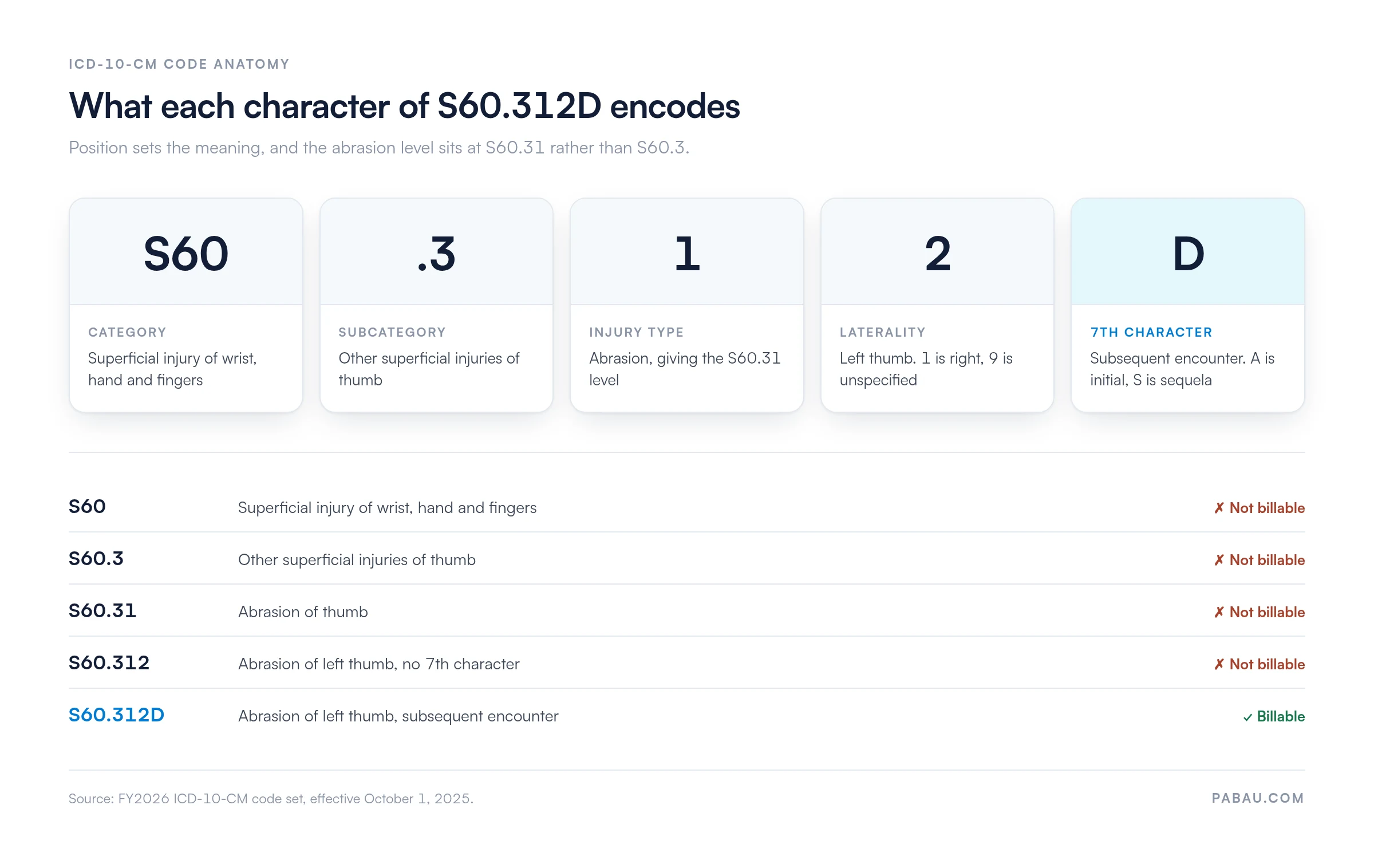
The abrasion level sits at S60.31, so the digit 1 in S60.312D encodes the injury type rather than the site.
Pabau’s claims management software and Claim.MD clearinghouse integration support ICD-10-CM code submission on CMS-1500 and UB-04 claim forms.
S60.312D is a billable ICD-10-CM code for abrasion of left thumb, subsequent encounter.
It applies to follow-up visits during the active healing phase, after the first treatment contact. The 7th character D is what separates it from S60.312A and S60.312S.
According to the CDC/NCHS ICD-10-CM web tool, S60.312D is confirmed billable and specific under the FY2026 code set. The code is valid for submission on standard CMS claim forms, provided the encounter type and laterality are clearly documented in the clinical record.
Every character in S60.312D carries a specific meaning. Get one of them wrong and the claim points at the wrong code or trips a laterality edit.
The full parent code is S60.312, which cannot be used on its own for billing. A 7th character is mandatory. Each position narrows the one before it, and the abrasion level sits at S60.31 rather than at S60.3.
The 7th character is where superficial injury coding most often goes wrong. Many coders default to A (initial encounter) regardless of visit context, which creates a mismatch between the claim and the clinical note.
Per ICD-10-CM Official Guidelines Section I.C.19, the subsequent encounter designation applies for as long as the patient is receiving active care for the injury. That holds even if the original treating provider no longer sees them. The coding guidance from the CMS ICD-10 codes page confirms this reading for Chapter 19 injury codes.
Knowing where S60.312D sits in the code hierarchy helps coders navigate related codes quickly and catch parent-level exclusion notes that might apply.
Other superficial injury codes in the S00-T88 block follow the same hierarchical logic. The ICD-10-CM code index is where to check a neighboring wrist or finger site before the claim goes out.
S60.312D is one of nine billable codes in the S60.31 abrasion of thumb subcategory. Payers check laterality carefully, and using the unspecified code when the affected side is documented creates an avoidable query.
Use the AAPC ICD-10-CM code lookup to verify the laterality family for any superficial injury code. It also covers the adjacent finger codes, S60.4- through S60.9-, if they appear on the same claim.
Clinical notes rarely use the exact ICD-10-CM descriptor phrase. These are the documentation terms that map to S60.312D and support accurate code assignment from chart text.
When abstracting from clinical notes, coders should confirm both laterality (“left”) and encounter context (“follow-up,” “wound check,” “subsequent”) before assigning S60.312D. Documentation that is ambiguous about laterality requires a provider query rather than defaulting to S60.319D (unspecified). Digital clinical forms that prompt for laterality at the point of care reduce abstraction errors downstream.
Three areas generate the most coding questions on superficial thumb injuries: the Excludes2 note, laterality selection, and the encounter-type transition from A to D.
An Excludes2 note means the excluded condition is not part of the coded condition, but both can be reported together when documented. A patient may present for follow-up care with both a left thumb abrasion and a separate hand abrasion. Report S60.312D and the appropriate S60.81- code together. This is different from an Excludes1 note, which prohibits dual reporting.
ICD-10-CM instructs coders to assign the most specific code when laterality is documented. If the note clearly states “left thumb,” S60.312D is the correct code.
S60.319D (unspecified) is only appropriate when the provider has not documented which thumb is affected and a query is not feasible. Recording laterality in every encounter note removes the need for that query.
The transition from S60.312A (initial encounter) to S60.312D occurs when the patient returns for follow-up care after the first active treatment visit. There is no fixed number of days.
The clinical context sets the encounter type. A wound check three days after the initial injury is S60.312D. A review step that checks the 7th character against the visit date and the note context catches the error before submission.
This decision table covers the three most common clinical scenarios coders encounter when coding left thumb abrasions across a care episode.
Consistent encounter-type selection across the care episode prevents claim mismatches between the first visit and the follow-ups. All of them carry the same injury code, so only the 7th character tells them apart.
Selecting the right 7th character is a documentation problem before it is a coding one. When the encounter type is captured in a structured note at the point of care, the coding decision is already made.
Pabau is an all-in-one practice management system with claims and billing built in. Its claims management software supports ICD-10-CM code entry and generates CMS-1500 claims from the encounter record. Through the Claim.MD clearinghouse integration, practices submit claims electronically to thousands of US payers. Real-time eligibility checks and electronic remittance advice (835) close the billing loop.
A clean claim submission for S60.312D needs the encounter type, the laterality and the Excludes2 context to match the note. Any mismatch between the note and the claim form is what the payer queries. Connecting the note, the code and the submission in one system removes the handoff where 7th character errors appear.

Pabau integrates with the Claim.MD clearinghouse, supporting CMS-1500 and UB-04 submission for ICD-10-CM codes including S60.312D. Book a demo to see how accurate code documentation and automated claim workflows reduce denials.

Two errors account for most S60.312D queries. The first is using A for a follow-up visit. The second is defaulting to S60.319D when the note already documents the left thumb.
Both are caught by the same habit. Read the note for laterality and encounter context before you pick the 7th character. Query the provider when either one is missing.
Practices that build that check into the claim workflow stop submitting superficial injury claims twice. Book a demo to see how Pabau keeps the encounter note, the code and the CMS-1500 claim in step.

Need the fundamentals of the billing cycle? What is revenue cycle management covers the path from encounter to payment.
Want fewer denials on injury claims? Denial management in healthcare lists the common denial reasons and how to resolve them.
Coding to a documentation standard? Medical billing compliance sets out the record-keeping that survives a payer audit.
Filing a follow-up claim late? Timely filing limits explains each payer’s submission window and how to protect it.
S60.312D is a billable ICD-10-CM diagnosis code for Abrasion of left thumb, subsequent encounter. It belongs to Chapter 19 (S00-T88, Injury and Poisoning), under the superficial injury of wrist, hand and fingers category (S60). The 7th character D identifies it as a subsequent encounter, meaning the patient is receiving active follow-up care after the initial treatment visit.
Yes. S60.312D is a billable and specific ICD-10-CM code, confirmed valid for the FY2026 edition (effective October 1, 2025 through September 30, 2026). It can be submitted on CMS-1500 and UB-04 claim forms. The parent code S60.312 without a 7th character is not billable.
S60.312A (initial encounter) is used when the patient is receiving active treatment for the left thumb abrasion for the first time. S60.312D (subsequent encounter) is used for all follow-up visits during the active healing phase, such as wound checks, dressing changes, or reassessments. Use D even if the patient sees a different provider for follow-up.
Use S60.312D while the patient is still in the active healing phase for the thumb abrasion. Use S60.312S (sequela) only after the injury has healed and the patient presents with a late effect, such as scar sensitivity. The sequela code is reported alongside a code for the specific late-effect condition.
Yes. S60.312D is valid for submission on both CMS-1500 (professional) and UB-04 (institutional) claim forms. Verify payer-specific rules with individual carriers. Some Medicare Advantage and Medicaid managed care plans apply extra medical necessity requirements to superficial injury codes.
The parent code is S60.312 (Abrasion of left thumb), which is not billable on its own. A 7th character (A, D, or S) is required to make the code specific and billable. S60.312 sits under subcategory S60.31 (Abrasion of thumb), which sits under S60.3 (Other superficial injuries of thumb). Both fall inside category S60, superficial injury of wrist, hand and fingers.