ICD-10 Code S46.999A: Other injury, unspecified shoulder muscle
ICD-10 code S46.999A: Quick reference card ICD-10 code S46.999A is the billable ...

Last Updated: Oct 27, 2026
Billable Code Specific Code
S50.819D is the billable ICD-10-CM code for abrasion of unspecified forearm, subsequent encounter.
The 7th character D signals that the abrasion was treated at an earlier encounter, which is coded S50.819A. The current visit covers continued care, such as a wound check, rather than new active treatment. Claims for this code are commonly denied when that initial encounter record is missing or misfiled.
Let Pabau's smart automation suggest the right codes, reduce claim denials, and keep your practice compliant—effortlessly.
Automate repetitive tasks and focus on what matters most—your patients.
Reduce coding errors and ensure compliance with the latest regulations.
Clean claims, fewer denials, and faster reimbursements.
Powerful insights and reporting to help your practice thrive.
HIPAA compliant SOC 2 certified GDPR-compliant Trusted by 4,000+ clinics worldwide

S50.819D reports a follow-up visit for a forearm abrasion when the record does not say which arm was injured
The 7th character D applies only after active treatment was delivered at an earlier visit, coded S50.819A
Use S50.811D for the right forearm or S50.812D for the left whenever the side is documented anywhere in the record
Abrasions are not coded when a more serious injury, such as a fracture or open wound, affects the same site
Elbow injuries take separate codes, such as S50.319D for an elbow abrasion and S50.00XD for an elbow contusion
Pabau’s claims tools help practices link each follow-up visit to its initial encounter before the claim goes out
ICD-10 code S50.819D is the billable ICD-10-CM code for “Abrasion of unspecified forearm, subsequent encounter.” It reports a follow-up visit for a scraped forearm when the record does not state which arm was injured.
According to the CDC/NCHS ICD-10-CM web tool, the code sits in Chapter 19, block S50-S59 (Injuries to the elbow and forearm). Its category is S50 (Superficial injury of elbow and forearm), and its subcategory is S50.81 (Abrasion of forearm).
The table below gives every reference field a coder needs at a glance.
The 7th character D means the patient is receiving routine care for a healing injury after active treatment at an earlier encounter. Under the ICD-10-CM Official Guidelines for Coding and Reporting, this covers wound checks, dressing changes and follow-up visits for the same injury.
The three 7th characters for S50.819 work as a set. Each one describes the encounter, so the same abrasion can carry different codes across its course of care.
Key rule: The 7th character reflects the status of the encounter, not the status of the wound. A forearm abrasion that is still raw can be coded D, as long as the visit is routine care rather than new active treatment.
The hierarchy shows coders when to query a provider for more detail and when the unspecified code is the right fit. The CMS ICD-10-CM code files trace the path as follows.
Category S50 holds several injury types for two body sites, so both need checking. Contusions sit in S50.0- (elbow) and S50.1- (forearm). Elbow abrasions and other superficial elbow injuries sit in S50.3-, and forearm abrasions sit in S50.81-. A follow-up visit for a bruised forearm with no side recorded, for example, is S50.10XD.
The AAPC ICD-10-CM code lookup and the ICD List code reference help coders navigate the full S50 range when confirming adjacent codes. For code-by-code detail, our ICD-10-CM guides for coders cover many injury codes from the same chapter.
Confirm the body site before you pick the code. An abrasion just above the wrist is still a forearm injury, while one on the point of the elbow belongs in S50.31-. Abrasions of the wrist and hand move to category S60.
Providers rarely write “abrasion of forearm” word for word. Notes may describe a scraped forearm, a skinned forearm or road rash on the forearm. All of these point to subcategory S50.81 when only the skin surface is involved.
Subcategory S50.81 contains three codes split by laterality, and each takes the 7th characters A, D and S. Choosing the right one matters. Some payers reject unspecified laterality as insufficiently specific, while others accept it when the documentation supports it.
The unspecified laterality trap: Coding S50.819D when S50.811D or S50.812D would be accurate is not acceptable. The ICD-10-CM Official Guidelines reserve unspecified codes for cases where the information for a more specific code is not available.
If the initial note says “left forearm” and that note is in the chart, S50.812D is the correct code at the follow-up visit. Practices that default to the unspecified code to save time invite laterality edits and audit findings.
The decision path below puts these checks in the order a coder meets them. Site comes first, then injury type, then side, then the reason for the visit.
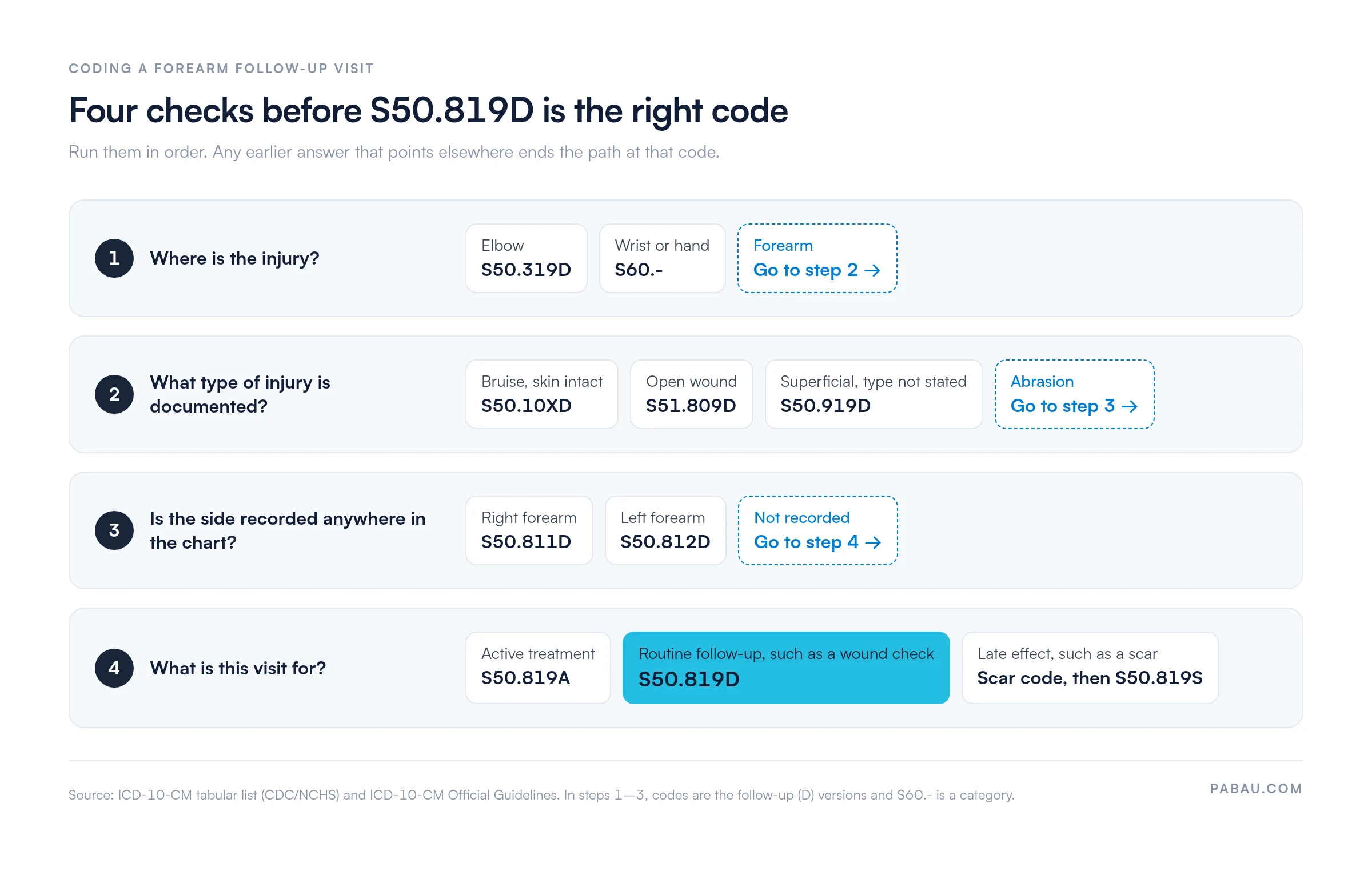
Sequela and subsequent encounter are distinct ICD-10-CM concepts that coders often confuse. A subsequent encounter means the abrasion itself is still being managed, even if the care is routine. A sequela means the abrasion has healed and the patient now has a late effect caused by it.
Per the Chapter 19 guidelines, the code for the sequela condition is listed first and the injury code with 7th character S follows it. Reversing that order can trigger technical denials, even when both codes are valid.
The medical record must show a clear A-to-D chain for S50.819D to hold up on audit. Reviewers look for the initial encounter first. If it is missing, the subsequent encounter code has no anchor.
Required documentation elements:
Pre-submission checks in claims software for practices can flag a subsequent encounter code submitted without a matching initial encounter on file. That check stops the claim before a missing initial encounter turns into a denial.
ICD-10-CM guidelines encourage external cause codes alongside injury codes to capture how the injury happened. Some payers, including many workers’ compensation carriers, expect them. External cause codes are always secondary and never replace S50.819D as the first-listed diagnosis.
Cause codes carry a 7th character too, and it should match the injury code. At a follow-up visit, that character is D for both codes. Place of occurrence (Y92) and activity (Y93) codes are different. They are reported once, at the initial encounter, and are left off the S50.819D claim.
Check each payer’s policy on external cause codes before you submit injury claims. No national rule requires them on every claim, but some commercial payers and workers’ compensation carriers ask for them.
S50.819D claims are denied more often for procedural and documentation reasons than for clinical ones. Denial management in healthcare for this code comes down to four recurring patterns.
For practices submitting claims through a US clearinghouse, Pabau integrates with the Claim.MD clearinghouse, which checks claims against payer edits before transmission. That scrub catches 7th-character mismatches and missing codes before they become denials.
S50.819D usually appears on a CMS-1500 claim with an evaluation and management (E&M) code for the follow-up visit. A wound check with a dressing change may also carry a supply or procedure code, depending on what the provider documents.
For practices new to injury code sequencing, foundational medical billing workflows explain how first-listed and secondary diagnoses work on the claim form. A forearm abrasion rarely drives an inpatient stay. In outpatient care, S50.819D is first-listed when the abrasion follow-up is the main reason for the visit.
Many S50.819D denials start before anyone touches the claim. The initial visit sits in one record, the wound check in another, and the biller cannot see that both belong to the same injury.
Pabau keeps both visits in one patient record. Coders can see the S50.819A encounter, its date and the documented side before they choose the follow-up code. Clean claim submission then runs through the clearinghouse integration, which flags mismatched 7th characters before the payer does.
The result is fewer rejected follow-up claims and less time spent chasing records from the first visit.

Pabau links each follow-up visit to its initial encounter and checks codes before submission, so S50.819D claims go out complete the first time.

S50.819D is a narrow code. It fits only a follow-up visit for a scraped forearm when no one recorded which arm was hurt. If the side is in the chart, the code is S50.811D or S50.812D. If the injury is on the elbow, or is a bruise or an open wound, it belongs elsewhere in S50 or S51.
Treat the initial encounter note as part of every follow-up claim. A practice that confirms the A visit, the side and the site before coding avoids many denials this code attracts. Book a demo to see how Pabau ties injury follow-up visits to their first encounter and keeps those claims clean.

Need to understand how claim denials are tracked and appealed? Denial codes in medical billing covers the CARC reason codes most commonly returned on injury code claims.
Submitting injury claims through a clearinghouse? How Claim.MD clearinghouse works explains the pre-submission edits, eligibility checks and ERA handling that reduce S50.819D rejections.
Building a cleaner claim submission process? Medical billing compliance outlines the documentation standards that keep Chapter 19 injury code claims audit-ready.
ICD-10 code S50.819D is the billable ICD-10-CM code for abrasion of unspecified forearm, subsequent encounter. It reports a follow-up visit for a scraped forearm when the record does not state which arm was injured. Active treatment must have been delivered at an earlier visit coded S50.819A.
No. S50.819D is a forearm abrasion code in subcategory S50.81. A follow-up visit for a bruised elbow with no side recorded is S50.00XD, and an elbow abrasion follow-up is S50.319D.
A subsequent encounter (7th character D) means the abrasion is still being managed while it heals. A sequela (7th character S) means the abrasion has healed and the patient presents with a late effect, such as a scar. The late effect is coded first, followed by S50.819S.
Yes. S50.819D is a billable ICD-10-CM code with all seven characters assigned. It can be submitted on a CMS-1500 professional claim or an outpatient institutional claim.
Common reasons include a D used on what was an initial active-treatment visit, and a missing initial encounter record. Payers also flag unspecified laterality when S50.811D or S50.812D was supported. A wrong site, such as an elbow abrasion coded as forearm, causes denials too.
ICD-10-CM guidelines encourage external cause codes, but no national rule requires them on every claim. Some commercial payers and workers’ compensation carriers expect them, so check each payer’s policy. At a follow-up visit, use the D version of the cause code and leave off place and activity codes.
Use A (S50.819A) on the visit where the provider actively evaluates and treats the abrasion. Use D (S50.819D) on later visits for the same injury, such as wound checks and dressing changes, where no new active treatment starts.