ICD-10 Code S52.541M: Smith’s fracture of right radius with nonunion (open type I or II)
ICD-10 Code S52.541M: Definition and billable status ICD-10 Code S52.541M is the...

Last Updated: Oct 15, 2026
Billable Code Specific Code
S59.141D is the billable ICD-10-CM code for a Salter-Harris Type IV physeal fracture of the upper end of the right radius. It applies at a subsequent encounter for fracture with routine healing, once active treatment is complete.
The code sits in category S59, other and unspecified injuries of elbow and forearm. Assigning it takes three details from the chart: a Type IV fracture line, a right-sided elbow injury, and a healing-phase visit.
Let Pabau's smart automation suggest the right codes, reduce claim denials, and keep your practice compliant—effortlessly.
Automate repetitive tasks and focus on what matters most—your patients.
Reduce coding errors and ensure compliance with the latest regulations.
Clean claims, fewer denials, and faster reimbursements.
Powerful insights and reporting to help your practice thrive.
HIPAA compliant SOC 2 certified GDPR-compliant Trusted by 4,000+ clinics worldwide

ICD-10 Code S59.141D is valid and billable in the FY2027 code set. It covers Salter-Harris Type IV physeal fractures of the upper end of the right radius at subsequent encounters.
The seventh character D signals that active fracture treatment is complete and the patient is receiving routine care during healing.
Laterality is mandatory: S59.141D is right-sided and S59.142D is left. Use S59.149D (unspecified) only when the record genuinely does not specify a side.
The upper end of the radius sits at the elbow. A Type IV physeal fracture at the lower end, near the wrist, is coded S59.241D instead.
Companion CPT codes come from the radial head and neck fracture family, such as 24650, 24655, and 24665. Claims software such as Pabau flags NCCI bundling conflicts before submission.
ICD-10 Code S59.141D is a specific, billable ICD-10-CM code, effective since October 1, 2015. It is unchanged in the FY2027 code set, effective October 1, 2026. It belongs to the S59 category, “Other and unspecified injuries of elbow and forearm,” within the S50-S59 block for injuries to the elbow and forearm.
The CMS ICD-10 code set requires all S59.14_ codes to carry a seventh character; the base code S59.141 alone is non-billable.
Each component of the code string carries a distinct meaning, from the chapter letter to the seventh character.
Confirm current validity using the CDC/NCHS ICD-10-CM web tool, which publishes the official tabular list for each fiscal year. Our library of ICD-10-CM codes explains other fracture codes that follow the same seventh-character structure.
A Salter-Harris Type IV fracture crosses all three zones of the growth plate complex: the metaphysis, the physis (growth plate), and the epiphysis. Every other type involves the physis plus at most one other zone, as the table below shows.
Because Type IV fractures cross the growth plate and extend into the joint surface, they carry a higher risk of growth arrest and joint incongruity.
That severity is why displaced Type IV fractures of the upper radius usually need surgical fixation. It is also why accurate coding matters for post-operative follow-up billing.
S59.141D applies at a follow-up visit after the fracture has been treated. The injury involves the proximal radial physis, the growth plate at the base of the radial head. It sits inside the elbow joint, where the radial head turns against the capitellum and the ulna as the forearm rotates.
Physeal fractures here occur in children and adolescents whose growth plates are still open, often after a fall onto an outstretched hand. Most pediatric injuries in this region are radial neck fractures with a Salter-Harris Type II pattern.
A Type IV split through the radial head is less common. Because Type II is the usual pattern here, confirm the Type IV fracture line on imaging before assigning S59.14- instead of S59.12-.
Laterality is a required coding axis for the entire S59.14_ family. The sixth character carries it: 1 for the right arm, 2 for the left, and 9 when the side is unspecified.
ICD-10-CM guidelines are clear: when the clinical record specifies a side, unspecified laterality is not acceptable. Using S59.149D when the chart documents a fracture of the right proximal radius is a coding error and may trigger a medical record audit.
The seventh character D denotes a subsequent encounter, per ICD-10-CM Official Guidelines Section I.C.19.a. At this visit, the patient receives routine care during healing after active fracture treatment has ended.
A common error in the S59.141 family is assigning D to every visit after the first. The guideline ties the character to the treatment phase, so a later visit can still take A.
Key rule: if the patient returns for more surgery on the same fracture, the encounter character resets to A, even after a D visit. The character follows the work done at the current visit.
S59.141A applies while active treatment is still underway. S59.141D applies once that phase has ended and the patient is monitored through healing.
The practical test is what the provider does at the visit. If they direct or substantively change the treatment plan, the visit is still active treatment and takes A as its character. If they observe, check alignment, or manage the cast, the visit takes D.
S59.141D sits in the S59 category within the S50-S59 block. Review the notes at both levels before finalizing the code. Both are Excludes2 notes, which point to conditions coded elsewhere that can coexist with this injury.
Excludes2 at the S50-S59 block level:
Excludes2 at the S59 category level: other and unspecified injuries of wrist and hand (S69.-).
Note on upper end vs lower end of the radius: S59.1- covers physeal fractures of the upper (proximal) end of the radius, at the elbow. A Type IV physeal fracture of the lower (distal) end, near the wrist, belongs to the separate S59.2- subcategory. Its right-arm subsequent encounter code is S59.241D. Check the imaging report for the fracture site before choosing either family.
Note on physeal vs non-physeal fractures: a radial head or neck fracture that spares the growth plate is coded in S52.1- instead. For example, S52.121D and S52.131D cover displaced closed fractures of the right radial head and neck at a routine-healing follow-up. S59.141D applies only when the record documents a physeal fracture with a Type IV pattern.
Five checks in the chart decide whether S59.141D is the right code, and the path below runs them in order.
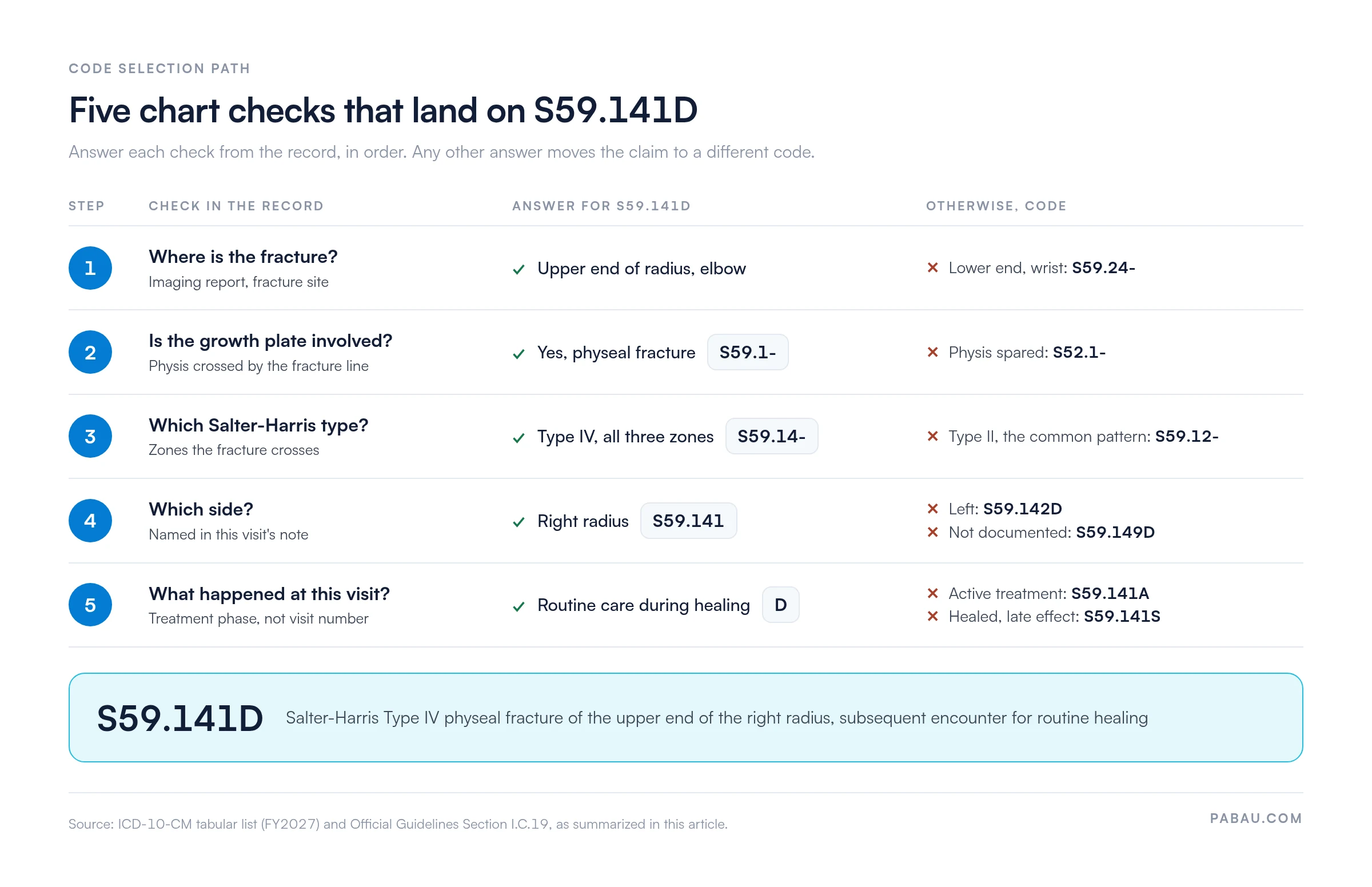
When reviewing a chart for S59.141D, check the radiology report for two confirmations. First, the fracture line crosses the physis, metaphysis, and epiphysis (Type IV pattern). Second, the operative or office note names the right proximal radius, at the radial head or neck. Absent either, query the provider before assigning ICD-10 Code S59.141D or any S59.14_ variant.
Follow-up billing for this growth plate fracture pairs the S59.141D diagnosis with the CPT code for what happened at the visit.
That may be evaluation only, a cast or splint change, or a procedure such as hardware removal. Fracture care codes for the upper radius come from the radial head and neck family, not the distal radius codes.

A complete superbill for each encounter captures the CPT and diagnosis code pairing. That lowers the risk of a payer reading a cast-management visit as unbundled from the global surgical period.
A routine check inside that period is reported with 99024 at no charge. Verify NCCI edits for the specific CPT-to-CPT combinations using current CMS NCCI tables before submitting.
The clinical record must contain specific elements to justify S59.141D on a claim. When an element is missing, payers often request medical records or open a post-payment audit on subsequent encounter fracture codes.
Denials on subsequent encounter fracture codes cluster around a handful of correctable patterns, set out in the table below.
Effective denial management in healthcare settings starts by finding which of these patterns returns the most claims. The next step is fixing the documentation or coding workflow that produces it.
Pre-submission validation against payer edits, including a check that the specific plan accepts ICD-10 Code S59.141D, reduces write-off exposure before the claim leaves the practice.
The governing reference for S59.141D is the ICD-10-CM Official Guidelines for Coding and Reporting. Section I.C.19 covers injury, poisoning, and certain other consequences of external causes. Published annually by CMS and NCHS, the guidelines define encounter types, laterality requirements, and sequencing rules for traumatic fracture codes.
Sound medical billing compliance requires coders to check code validity against the new fiscal year’s tabular list each October 1. The AAPC ICD-10-CM lookup and ICD List help cross-reference code descriptors and active status.
Also check the clean claim submission criteria your clearinghouse applies. Some payers also have local coverage determination (LCD) policies that govern fracture follow-up frequency.
Most S59.141D denials start upstream. A seventh character gets keyed from memory, a side is copied from the last note, or a cast change lands inside a global period. Catching those by hand means a coder rereads every follow-up chart before the claim goes out.
Pabau’s claims management software checks each claim before submission and flags NCCI bundling conflicts when several CPT codes share a date of service. Claims then go out electronically through Claim.MD, Pabau’s US clearinghouse partner. Claim.MD validates ICD-10-CM codes against current payer rules for thousands of US payers.
Missing seventh characters and laterality conflicts get caught before transmission, so fracture follow-up visits are paid on the first pass instead of the second.

Pabau integrates with Claim.MD to validate ICD-10-CM codes against payer rules for thousands of US payers before submission. Seventh-character errors and laterality mismatches get caught before they become denials.

Coding S59.141D correctly starts with the anatomy. A Type IV growth plate fracture at the elbow belongs in S59.14-, not in the wrist-level S59.24- family or the non-physeal S52.1- codes. Settle the fracture site first, and the remaining digits follow from the chart.
The second judgment is timing. Keep D for visits where the provider is watching the fracture heal, and return to A the moment active treatment resumes. Coding the visit in front of you, not its place in the series, keeps these claims out of the denial queue.
Book a demo to see how Pabau checks fracture follow-up claims before they reach the payer.

Coding a proximal radius growth plate fracture before the Salter-Harris type is confirmed? ICD-10 code S59.101A covers an unspecified physeal fracture of the upper end of the right radius at the initial encounter.
Treating the same Type IV pattern higher up the arm? ICD-10 code S49.041D covers a Salter-Harris Type IV fracture of the right upper humerus at a routine-healing follow-up.
Seeing a patient for a late effect once the growth plate fracture has healed? ICD-10 code S59.231S shows how the sequela character S works for a Type III fracture of the right radius.
Billing the follow-up X-ray that checks healing at the elbow? CPT code 73070 covers a two-view elbow X-ray and explains when 73080 applies instead.
ICD-10 Code S59.141D is a billable ICD-10-CM code for a Salter-Harris Type IV physeal fracture of the upper end of the right radius. It applies at a subsequent encounter for routine healing, after active fracture treatment is complete.
Yes. S59.141D is a valid, billable ICD-10-CM code, unchanged in the FY2027 code set effective October 1, 2026. The base code S59.141 has no seventh character, so payers reject it.
S59.141A applies while the patient is receiving active treatment for the fracture. S59.141D applies once active treatment is complete and the patient receives routine care during healing. The distinction is based on treatment phase, not chronological visit number.
Use the seventh character D when the provider’s note documents a follow-up visit during healing with no new active intervention. Cast checks, wound checks, and imaging to confirm alignment during the healing phase all qualify for the D character.
No. S59.141D is specific to the right radius. For the left radius at a subsequent encounter, use S59.142D. Use S59.149D (unspecified) only when the record does not name a side.
The common causes are a missing or wrong seventh character, or S59.149D (unspecified) used when the chart names a side. Payers also deny an acute treatment visit coded D instead of A, the initial encounter character. E/M codes billed inside the global surgical period without the correct modifier are denied too.
A Salter-Harris Type IV physeal fracture of the lower end of the right radius, near the wrist, is coded S59.241D at a routine-healing subsequent encounter. S59.141D is reserved for the upper end, at the elbow.