ICD-10 Code S66.308A: Extensor muscle injury, other finger
ICD-10 Code S66.308A: Definition and code hierarchy ICD-10 Code S66.308A is the ...

Last Updated: Oct 14, 2026
Billable Code Specific Code
S49.041D is the billable ICD-10-CM code for a Salter-Harris Type IV physeal fracture of the upper end of the humerus, right arm. The 7th character D marks a subsequent encounter for a fracture with routine healing.
A wrong 7th character and a wrong laterality digit cause most denials on this code. Both need a corrected claim before the payer reimburses.
Let Pabau's smart automation suggest the right codes, reduce claim denials, and keep your practice compliant—effortlessly.
Automate repetitive tasks and focus on what matters most—your patients.
Reduce coding errors and ensure compliance with the latest regulations.
Clean claims, fewer denials, and faster reimbursements.
Powerful insights and reporting to help your practice thrive.
HIPAA compliant SOC 2 certified GDPR-compliant Trusted by 4,000+ clinics worldwide

ICD-10 Code S49.041D identifies a Salter-Harris Type IV physeal fracture of the upper end of the right humerus, at a routine-healing follow-up.
The upper end of the humerus sits at the shoulder, so elbow and distal humerus findings point to the S49.1 codes instead.
The D suffix applies only after active treatment ends and the fracture is healing routinely. Use A for initial treatment and S for sequela.
Type IV fractures cross all three zones, meaning metaphysis, physis, and epiphysis. Confirm that pattern on imaging before choosing over Type I, II, or III codes.
Practice management software like Pabau integrates with Claim.MD to flag encounter-suffix mismatches and missing laterality before claims reach the payer.
ICD-10 Code S49.041D describes a physeal (growth plate) fracture at the upper end of the right humerus, classified as Salter-Harris Type IV.
The code applies at a subsequent encounter, while the fracture is healing routinely. Each element of the descriptor carries a specific coding obligation.
The phrase “upper end of humerus” refers to the proximal humeral physis, which sits inside the shoulder. Growth plate fractures at the elbow end of the same bone belong to the S49.1 block instead. Read the anatomical site on the imaging report before committing to the S49.0 block.
The Salter-Harris classification, published in 1963, grades physeal fractures by how the fracture line relates to the growth plate. It underpins an entire block of pediatric fracture codes in ICD-10-CM. Type IV is the most surgically significant common type, because the fracture crosses all three anatomical zones. The diagram below traces where each type’s fracture line runs.
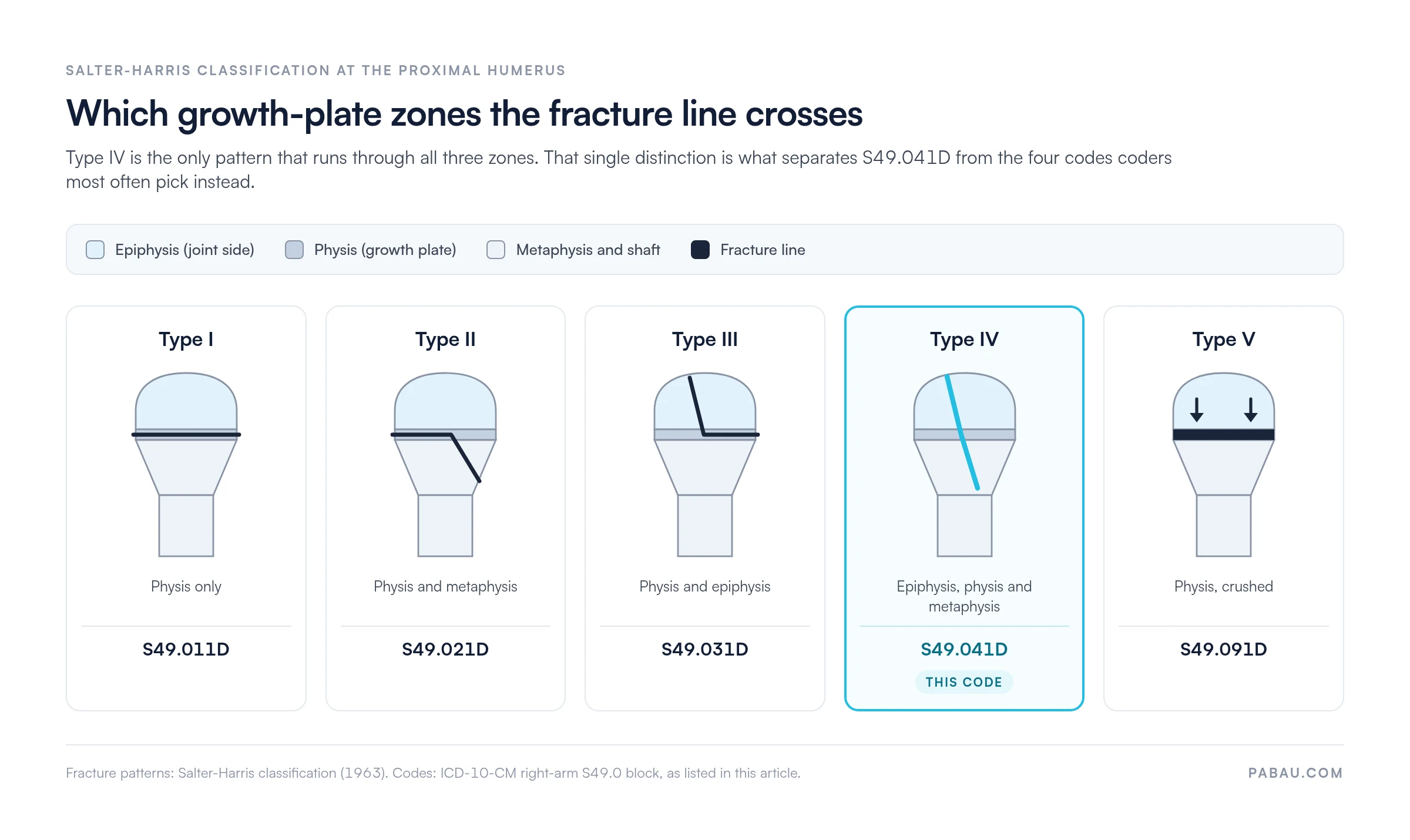
Each pattern maps to its own subcategory inside the S49.0 block. The zones named in the radiology report therefore decide the fourth and fifth characters of the code. The table below pairs each type with its right-humerus code.
Most proximal humeral physeal fractures are Salter-Harris Type II and heal well without surgery. The proximal physis drives roughly 80% of the humerus’s length growth, so remodeling potential at this site is unusually high. Type IV is the exception. Its fracture line crosses the articular surface as well as the physis, so surgeons usually restore the anatomy with open reduction and internal fixation. That surgical history shapes which CPT codes appear alongside S49.041D at follow-up visits.
The 7th character in ICD-10-CM fracture codes defines the encounter type. Per the CMS ICD-10-CM coding guidelines, selecting the wrong character is the single most common coding error on fracture claims. The fracture-specific logic for S49.041D is set out below.
D is the correct suffix at a follow-up appointment with the orthopedic surgeon or pediatric orthopedist. The surgeon reviews healing progress on X-ray, and the record documents no complication. The D encounter does not require a specific number of weeks post-injury. It reflects the clinical phase, not a calendar threshold.
S49.041D sits within the S49.04 block, which covers Salter-Harris Type IV fractures of the upper end of the humerus. The adjacent codes below are the ones coders most often need to separate, especially when laterality, anatomical level, or the encounter suffix changes between visits.
Type III is the most frequently confused fracture pattern. The difference shows on imaging. Type III stops at the epiphysis, while Type IV also extends into the metaphysis. The right-arm Type III code is S49.031D, and S49.032D covers the same pattern on the left side. Confirm the pattern in the radiology report before coding either one.
Four codes from the S49.0 physeal fracture block draw the most incorrect selections. Each comes up when the record documents a growth plate injury of the right proximal humerus. In every case the differentiating factor is the imaging-confirmed fracture pattern, not the severity or the treatment method.
Check the radiology report before the surgery note. Radiologists often classify the fracture type in the impression line. If the impression says ‘Salter-Harris Type IV’ and the surgery note says only ‘physeal fracture’, query the surgeon. Clarify the type before selecting S49.091D over S49.041D.
S49.041D needs specific elements in the medical record to survive a payer review. A generic note saying “follow-up for fracture” is insufficient. Payers expect documentation that supports every qualifier in the code descriptor.
ICD-10 Code S49.041D appears on claims for follow-up visits, not for the original surgical procedure. The CPT codes most commonly paired with it reflect post-operative care and fracture management check-ins. Verify current CPT descriptors with the AAPC ICD-10-CM lookup before submitting.
Once the shoulder moves into rehabilitation, physical therapy CPT codes such as 97110 and 97530 may replace E&M codes on the claim. S49.041D remains the appropriate ICD-10 diagnosis code through that transition. Running the CPT-to-ICD-10 medical necessity edits at the point of submission catches the pairing errors that follow the switch.
Medicare generally covers subsequent fracture care visits when documentation supports ongoing medical management. Most private payers follow similar policies. Prior authorization rules for specialist follow-up visits still vary by plan, so confirm the pathway before the follow-up is booked.
S49.041D claims are denied for a predictable set of reasons. A pre-submission audit prevents most of them. Checking the suffix, the documented side, and the imaging on file takes a minute per claim and settles all three at once.
Reviewing medical billing denial codes helps billers match each category above to the CARC and RARC reason codes that appear on the ERA. Fixing a suffix or laterality error before submission removes the appeal entirely.
Salter-Harris fractures occur predominantly in skeletally immature patients, though adults with persistently open physes can present with similar injuries. The guidance below applies across the S49.0 physeal block, with notes specific to S49.041D.
In most orthopedic practices the encounter suffix is maintained by hand. A biller opens the last visit note, judges whether active treatment has ended, and edits the 7th character before the claim goes out. Over four to six follow-ups per patient, that manual check is the step that slips.
Pabau keeps the diagnosis on the patient record rather than on a single claim line. When the clinician closes a follow-up note, the coded diagnosis and the documented side carry forward to the next encounter. The biller adjusts one character instead of rebuilding the line from the chart.
Pabau’s claims management software then routes the claim to Claim.MD, which runs code-pair and medical necessity edits before submission. A wrong 7th character and a wrong laterality digit sink most S49.041D claims. Both get caught here, while the line can still be fixed in seconds.

Pabau’s claims management software integrates with Claim.MD to validate ICD-10 and CPT code pairs, flag encounter-suffix mismatches, and submit clean claims electronically. Book a demo to see how it reduces follow-up claim denials.

Accurate use of ICD-10 Code S49.041D rests on three checks. The radiology report must confirm the Type IV three-zone pattern at the upper end of the humerus. The physician note must state the right side explicitly. The encounter must have moved past active treatment into routine healing. The D suffix is the element most often misapplied, so auditing it before submission is the highest-return quality check for this code.
Pabau’s claims management software connects to Claim.MD to run code-pair edits and flag ICD-10 encounter-suffix errors before they reach the payer. To see how it works for orthopedic and sports medicine practices, book a demo.

Need a deeper look at how clearinghouses catch code errors before submission? Claim.MD clearinghouse guide explains how electronic claim validation works end to end.
Want to understand electronic remittance and how payers report denial reasons? Electronic remittance advice (ERA) guide covers reading 835 files and CARC/RARC codes.
Want fewer S49.041D claims coming back unpaid? What is a clean claim in medical billing? sets out the checks that stop suffix and laterality errors at source.
ICD-10 Code S49.041D is a billable diagnosis code for a Salter-Harris Type IV physeal fracture of the upper end of the right humerus. It covers follow-up visits during routine healing, after active treatment has ended.
No. S49.041D sits at the upper end of the humerus, which is the shoulder end of the bone. Growth plate fractures at the elbow end fall in the S49.1 block instead, such as S49.141D for the right arm and S49.142D for the left.
Use D when active treatment is complete and the patient attends a follow-up while the fracture heals routinely. Use A for any visit where active treatment is performed, including the initial surgical encounter, closed reduction, or sling application.
All three describe the same injury, a Salter-Harris Type IV fracture of the upper end of the right humerus. They differ by encounter phase. A covers initial and active treatment. D covers subsequent visits during routine healing. S covers sequela such as growth arrest or shoulder stiffness after healing.
Salter-Harris fractures occur mainly in children with open growth plates, but the code is not restricted to pediatric patients. Adults with persistently open physes can sustain Type IV injuries. When imaging confirms growth plate involvement at the upper end of the right humerus, S49.041D is appropriate regardless of age.
Four errors account for most denials. Billers use the A suffix at a follow-up visit where D applies. They select an unspecified laterality code when “right” is documented. They code “other physeal fracture” (S49.091D) when the record states Type IV. Or the claim goes out with no imaging documentation to support physeal involvement.
Yes. S49.041D is a valid ICD-10-CM code for workers’ compensation claims when the mechanism of injury is work-related. The documentation must support a Salter-Harris Type IV fracture of the upper end of the right humerus at a subsequent encounter. Workers’ comp payers may require extra fields such as cause of injury codes, so confirm state-specific requirements before submission.