ICD-10 Code S66.308A: Extensor muscle injury, other finger
ICD-10 Code S66.308A: Definition and code hierarchy ICD-10 Code S66.308A is the ...

Last Updated: Oct 14, 2026
Billable Code Specific Code
S59.231S is the billable ICD-10-CM code for Salter-Harris Type III physeal fracture of lower end of radius, right arm, sequela. It applies only once the fracture's acute phase has fully resolved and the patient presents for a late effect.
Most errors on this code come from confusing suffix S with suffix D or K, which both cover ongoing fracture management. Coders in orthopedic, pediatric, and sports medicine settings meet the distinction most often, usually when a child returns with persistent wrist deformity.
Let Pabau's smart automation suggest the right codes, reduce claim denials, and keep your practice compliant—effortlessly.
Automate repetitive tasks and focus on what matters most—your patients.
Reduce coding errors and ensure compliance with the latest regulations.
Clean claims, fewer denials, and faster reimbursements.
Powerful insights and reporting to help your practice thrive.
HIPAA compliant SOC 2 certified GDPR-compliant Trusted by 4,000+ clinics worldwide

S59.231S is a billable, HIPAA-valid ICD-10-CM code effective October 1, 2025, unlike the non-billable parent S59.231.
Suffix S means sequela only, so the fracture has resolved and the visit addresses a late effect rather than continued care.
Confusing S with K (nonunion) or D (routine follow-up) is the top denial trigger for this code family.
Documentation must state that the fracture is healed and name the late effect it caused.
Pabau’s claims management software supports clean-claim submission for orthopedic diagnosis codes, reducing S59.231S denials before they reach the payer.
ICD-10 Code S59.231S is the complete, billable form of the parent code S59.231.
It is valid for HIPAA-covered transactions and accepted for claim submission as of October 1, 2025. The S appended as the 7th character turns the non-billable parent into a specific, reimbursement-ready code. Without that character, S59.231 cannot go on a claim at all.
Before the claim goes out, confirm the encounter matches the sequela definition rather than the suffix that was used last time. That check takes a moment. Reworking a denied orthopedic claim takes considerably longer.
S59.231 requires a 7th character for every claim submission. The character signals the encounter type to the payer and determines medical necessity alignment. Selecting the wrong suffix is the fastest route to a denial on this code family.
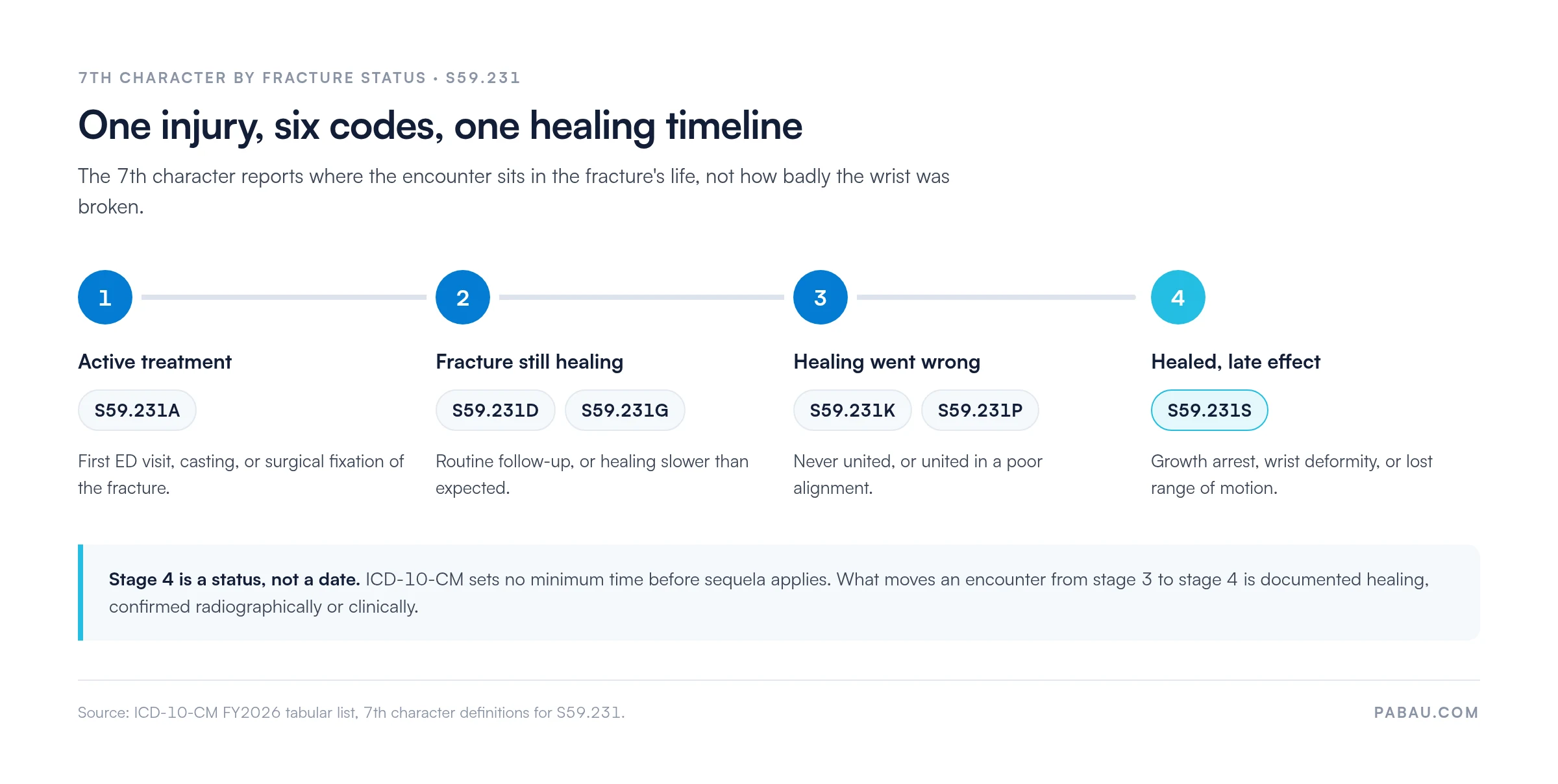
Sequela coding for ICD-10 Code S59.231S turns on one condition. The original fracture must be resolved, and the current visit must treat something that fracture left behind. Laid out along the injury’s own timeline, the six suffixes stop competing with each other.
A Salter-Harris Type III fracture is a physeal (growth plate) injury whose fracture line runs through the epiphysis and exits at the articular surface. The physis itself stays partially intact on one side. It is an intra-articular fracture involving epiphyseal bone and physis, without crossing the metaphysis.
Accurate type assignment is essential for coding because each Salter-Harris type maps to a distinct ICD-10-CM code family. Conflating Type II (which exits through the metaphysis) with Type III in documentation leads to a miscoded claim that payers can identify on audit. Site matters as much as type, so a Type III fracture of the left distal ulna with delayed healing takes S59.032G.
The distal radial physis is the most commonly fractured growth plate in children. It sits at the wrist end of the radius and stays active until skeletal maturity, usually between ages 14 and 17.
Laterality is a mandatory coding element here. Right arm and left arm map to different ICD-10-CM codes, and the unspecified-arm code belongs only in notes that genuinely omit the side.
S59.231S sits inside a clear hierarchical chain. Knowing where it sits helps when a payer queries the code’s validity, or when you are crosswalking from an older edition. The same chapter-to-code path runs through the rest of the ICD-10-CM code library, so the method transfers to any injury code you verify.
The CDC/NCHS ICD-10-CM web tool carries the official tabular list and index for FY2026, so you can check the chain above against the source. Check the effective date while you are there. S59.231S has been valid since October 1, 2025, and a FY2025 lookup will miss any structural change made at that update.
Each 7th character produces a distinct, separately billable code. Every injury code that carries this suffix structure follows the same encounter-type rules. The full sibling set for S59.231 is:
The left-arm equivalents (S59.232x) follow the same suffix structure. S59.239x covers unspecified laterality, though a documented side is always preferable. Submitting S59.231K for a united fracture with residual deformity is a coding error. That encounter belongs under S59.231S, and the distinction affects coverage determination and audit exposure.
Sequela (suffix S) and subsequent encounter (suffixes D, G, K, P) describe different clinical situations. ICD-10 Code S59.231S applies once the fracture is healed. The patient’s current problem must be a late consequence of that healed fracture, not the fracture itself.
Getting that through orthopedic claims management depends on the clinician’s note stating the distinction in words a reviewer can find.
A practical scenario: a 10-year-old treated for a distal radial physeal fracture two years ago returns with a measurably shorter right radius. The wrist is visibly asymmetric. The fracture is healed, and the presenting problem is growth disturbance from physeal damage. S59.231S is the correct injury code for this encounter.
Document fracture healing status explicitly in every note. A phrase like ‘fracture has healed per X-ray dated [date], patient presents for growth-related sequela’ takes ten seconds to write. It also protects the S59.231S code from challenge during a payer audit. Vague notes reading ‘follow-up fracture right wrist’ leave the 7th character selection unsupported.
Sequela coding requires documentation that connects the current condition to the prior injury. Without that link, payers treat the sequela as a new, unrelated diagnosis. The scenarios below illustrate correct and incorrect applications, based on guidance from the CMS ICD-10-CM coding page.
A 13-year-old presents to orthopedic clinic with progressive wrist deformity 18 months after a Salter-Harris Type III fracture of the right distal radius. Imaging confirms physeal arrest of the right distal radius with radial shortening of 8 mm. The prior fracture is healed.
Correct coding: the physeal arrest or radial shortening first, then S59.231S as the injury responsible for it.
A 9-year-old returns 6 weeks post-injury for cast removal and repeat X-ray. Radiograph shows early callus but incomplete bridging. The fracture is not yet healed.
Incorrect: S59.231S. Correct: S59.231D for routine healing, or S59.231G if the healing timeline is abnormal. Using S59.231S here misrepresents the fracture status and carries audit risk.
Pulling the original fracture note forward into the sequela visit is what makes the causal link visible to a reviewer. Where the patient’s history sits in one longitudinal record, that takes two minutes instead of a records request.
The ICD-10-CM Official Guidelines for Coding and Reporting, Section I.C.19.a, govern sequela coding for injuries. The residual condition is sequenced first, and the injury code carrying the S suffix follows it. Reversing that order is a common finding in an injury-coding audit.
Denied sequela claims almost always cite a medical necessity mismatch. It usually traces back to what the original note failed to say. Sorting those denials by encounter type is ordinary denial management, and it shows quickly whether the team’s suffix selection holds up.
Run a quarterly audit of the S59.231S claims you submitted. Pull the matching clinical notes and check three things. Is the fracture healed per imaging? Is the sequela condition named and linked to the prior fracture? Is the sequela condition sequenced ahead of S59.231S? Ten minutes per encounter buys a defensible audit trail.
A wrong 7th character usually surfaces on the remittance advice, weeks after the encounter. The claim then gets worked a second time, and whoever picks it up is reconstructing a note they did not write. On a pediatric orthopedic caseload, that rework lands on the same handful of codes every month.
Practice management software like Pabau keeps the fracture history and the sequela visit in the same patient record. The prior note is one click away when the coder needs it. Pabau’s claims tools then validate diagnosis codes through the Claim.MD clearinghouse before submission. That is where a suffix mismatch gets caught, rather than on the remittance.
The outcome for an orthopedic or pediatric practice is fewer reworked claims on a code family that is easy to get wrong. Coders spend the time on documentation instead of on resubmission.

Pabau integrates with Claim.MD to validate ICD-10-CM codes before submission, 7th character accuracy included. That cuts orthopedic claim denials at the source.

S59.231S is a specific, billable code, but its conditions are narrow. The fracture must be healed and the encounter must address a late effect. The note also has to make that causal chain explicit. Miss one of the three and the claim is exposed.
If you code pediatric orthopedics at any volume, a standing documentation phrase is cheaper than a quarterly audit. Write healing status into the note at the visit, and the 7th character stops being a judgment call months later.
Pabau’s integration with Claim.MD catches 7th character errors before submission, so this code family stops generating rework. Book a demo to see how sequela coding validation works end to end.

Need a guide to clean-claim submission for injury codes? Clean claim best practices covers documentation requirements that reduce denials across ICD-10-CM injury code submissions.
Looking for 837 file guidance for orthopedic claims? 837 EDI file essentials explains how diagnosis codes like S59.231S are transmitted in electronic claim submissions.
Want to understand how payer eligibility affects sequela claims? Insurance eligibility verification walks through how to confirm coverage before submitting late-effect encounters.
ICD-10 Code S59.231S is billable and covers a Salter-Harris Type III physeal fracture of the lower end of the radius, right arm, sequela. Sequela means the original fracture has healed and the patient presents for a late effect, such as growth disturbance or wrist deformity. It became effective October 1, 2025 under the FY2026 ICD-10-CM edition.
The S suffix denotes sequela. The original fracture is healed, and the encounter is for a late effect caused by that prior injury. Suffix D (routine healing) and suffix K (nonunion) both require the fracture to still be present.
S59.231A is for the initial encounter when active treatment begins. S59.231D is for follow-up visits while the fracture is healing normally. S59.231S applies only after the fracture has fully healed and the patient returns for a late effect. The three codes mark three stages in the same injury’s coding lifecycle.
Use S59.231K when the fracture has failed to unite, with no bridging callus and the bone ends still separated. Use S59.231S only once the fracture has healed and the visit addresses a consequence of it, such as physeal arrest or residual deformity. Submitting S59.231S on an unhealed fracture is a coding error with audit and denial risk.
Yes. S59.231S is a fully billable, specific ICD-10-CM code valid for HIPAA-covered transactions, effective October 1, 2025. The parent code S59.231 is not billable on its own. A 7th character is required before any S59.231x code can go on a claim.
The sibling codes are S59.231A (initial encounter), S59.231D (subsequent, routine healing), and S59.231G (subsequent, delayed healing). The set also includes S59.231K (nonunion) and S59.231P (malunion). Left-arm equivalents use S59.232x, and unspecified laterality uses S59.239x.