ICD-10 code S61.201A: Open wound of left index finger without nail damage
ICD-10 code S61.201A covers a left index finger wound of unstated type ICD-10 co...

Last Updated: Oct 16, 2026
Billable Code Specific Code
S59.101A is the billable ICD-10-CM code for unspecified physeal fracture of upper end of radius, right arm, initial encounter for closed fracture.
Let Pabau's smart automation suggest the right codes, reduce claim denials, and keep your practice compliant—effortlessly.
Automate repetitive tasks and focus on what matters most—your patients.
Reduce coding errors and ensure compliance with the latest regulations.
Clean claims, fewer denials, and faster reimbursements.
Powerful insights and reporting to help your practice thrive.
HIPAA compliant SOC 2 certified GDPR-compliant Trusted by 4,000+ clinics worldwide

ICD-10 code S59.101A covers an unspecified growth plate fracture of the right proximal radius, at the initial encounter for a closed fracture.
The code is billable for FY2026 on both CMS-1500 and UB-04 claims. Its parent code, S59.101, is not.
Six 7th characters apply to S59.101, running from A for active treatment through to S for sequela.
Choosing the wrong 7th character is the most common reason these fracture claims come back denied.
Practice management software like Pabau checks ICD-10 codes before submission and sends claims to over 4,000 US payers through Claim.MD.
ICD-10 code S59.101A is a billable code for an unspecified physeal fracture of the upper end of the right radius.
It applies at the initial encounter for a closed fracture. In plain terms, it covers a growth plate injury near the elbow in a patient whose radius is still growing.
Three elements have to line up before a payer accepts the code. Those are laterality, encounter type, and fracture status. Here is what each one means, and how to land on the right 7th character every time.
S59.101A describes an unspecified physeal fracture of the upper end of the radius, right arm. At the initial encounter, the fracture is closed. Each word in that description carries billing weight.
Physeal fractures land mostly on children and adolescents, because the growth plate is weaker than the bone and ligament around it during a growth spurt. A fall onto an outstretched hand is the usual cause at the proximal radius.
Yes. S59.101A is a billable, specific ICD-10-CM code valid for FY2026 reimbursement. It goes on a CMS-1500 professional claim or a UB-04 facility claim, so it works across outpatient practices, emergency departments, and hospital settings.
Its parent code behaves differently. S59.101, without the 7th character, is not billable. It is a header code that holds a place in the hierarchy, and a claim carrying it will be rejected. The 7th character is what makes the code specific enough for a payer to accept.
Practices that submit electronically can catch that problem before the claim leaves the building. A clearinghouse edit flags a header code the moment it appears on the claim line, which turns a denial into a two-minute correction. Knowing what makes a clean claim cuts the back-and-forth that delays payment on fracture cases.
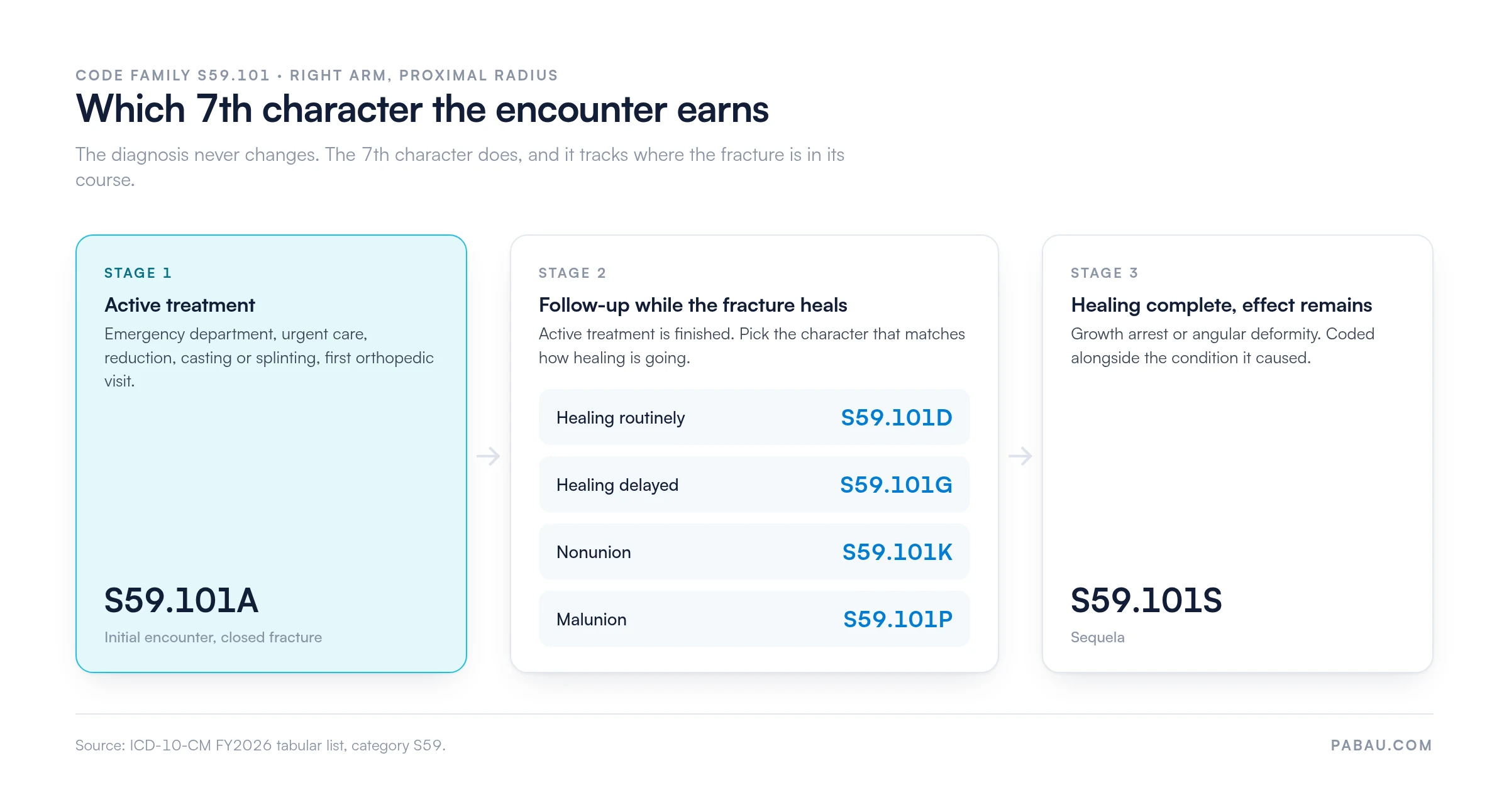
S59.101 supports six 7th character extensions. Picking the wrong one is the most common coding error on physeal fracture claims. Payers run automated edits that compare the encounter type in the record against the character on the claim.
Use the character that matches the phase of care, not the visit number. The ICD-10-CM Official Guidelines define an initial encounter as any visit during active treatment. A patient might get a cast at visit one and a cast adjustment two weeks later. Both visits take the “A” character, as long as treatment is still active.
Subsequent encounter characters (D, G, K, P) start once active treatment is finished and the patient is in routine follow-up. The line is clinical. A surgeon applying a splint is active treatment, while a scheduled check to confirm healing on X-ray is follow-up.
Sequela (S) applies only after the fracture has healed. It codes the residual condition, such as growth arrest or angular deformity left behind by the physeal injury. Pair it with the condition it caused, and never use it for a fracture that is still healing. The flow below maps each character to a point in the fracture’s course.
Write the treatment phase into every encounter note. One line does it: ‘active fracture management’ or ‘routine follow-up, healing as expected’. That single habit removes the guesswork that sends coders to the wrong 7th character.
The physis, or growth plate, is the cartilage zone near the end of a long bone that drives length growth. In a child it is the weakest link in the bone and ligament chain. A force that would sprain an adult’s ligament often breaks the growth plate in a skeletally immature patient.
At the proximal radius, the growth plate sits near the radial head and neck. Fractures here follow a fall on an outstretched hand, axial loading through the elbow, or a direct blow to the side. They peak between ages 5 and 15, and still occur in adolescents whose growth plates have not fused.
The Salter-Harris system sorts physeal fractures by where the fracture line runs across the physis, epiphysis, and metaphysis. Types I through V carry different odds of growth disturbance, and the higher types generally carry more risk of growth arrest.
S59.101A codes an unspecified physeal type. Once imaging names the Salter-Harris type, a more specific code takes over:
Reach for S59.101A when the record does not name the Salter-Harris type or the imaging cannot determine it. Do not assign a type-specific code from S59.11x through S59.14x unless the radiologist’s report or the treating physician names the type outright. At a routine follow-up visit, a documented Type IV fracture of the right arm takes ICD-10 code S59.141D.
Knowing where the code sits makes the neighboring codes easier to find. It also stops you coding above or below the detail in the record. The structure runs from the chapter down to the billable code. Our wider ICD-10-CM code index follows the same pattern across every chapter.
A handful of codes sit close enough to S59.101A that they come up in the same charts. Laterality and encounter type work the same way across all of them, so the habits you build here carry over.
The three laterality siblings differ by one digit, and the record decides which one you use.
Treat S59.109A as a last resort. Most payers accept it, but auditors pull those claims for record review. Laterality is nearly always visible in an imaging report or an examination note. A chart line reading “right elbow X-ray obtained” already documents the side.
Other codes that turn up in the same clinical picture:
A code reference tells you what S59.101A means. An auditor asks a harder question, which is whether the chart supports it. To hold up on review, the clinical record needs all five of these:
Leave any of these out and the coder is left guessing. Guessing pushes the claim toward a vaguer code, such as S59.109A for unspecified laterality or S52.101A for a non-physeal fracture. Neither one describes what the clinician saw. Querying the treating provider settles it before the claim goes out.
Add a five-field fracture checklist to your orthopedic and emergency encounter templates: laterality, open or closed, anatomical site, physeal or not, and encounter type. Five fields, added once, head off most fracture coding queries.
Practices migrating legacy data, or arguing an old claim with a payer, sometimes need the ICD-9-CM predecessor. Two codes are in play:
Watch the descriptors on these two. The neck of the radius has its own ICD-9 code, 813.06, and it is often attached to 813.07 by mistake. ICD-9-CM never split physeal fractures at the Salter-Harris level that ICD-10-CM reaches, so the crosswalk stays approximate. For an audit or payer correspondence on ICD-9-era claims, check the official GEM files on the CMS ICD-10 codes page.
In most practices, the 7th character is decided twice. A clinician writes the encounter note, then a coder reads it days later and works out which phase of care it describes. When the note is vague, the coder either queries the provider or picks the safest-looking character. Both routes cost time, and the second one costs denials.
Practice management software like Pabau closes that distance. Encounter templates capture laterality, open or closed status, and treatment phase as structured fields at the point of care. The answer is already in the chart when coding starts. Built-in ICD-10 lookup then puts the right code on the claim line without a separate reference book.
From there, claims go out through our claims software for practices, which connects to Claim.MD and over 4,000 US payers. Header codes and missing 7th characters get flagged before submission rather than after rejection, so your team spends its week on care instead of resubmissions.

Pabau captures laterality and treatment phase in the encounter note, validates ICD-10 codes at submission, and sends claims to over 4,000 US payers through Claim.MD.

S59.101A is a precise code sitting on top of an imprecise note. The diagnosis rarely changes between visits, so the money hinges on one letter at the end of the code. That letter is only as good as the phase of care written in the chart.
Fix the documentation and the coding follows. Get laterality, physeal involvement, and treatment phase into the note while the patient is still in the room, and the coder never has to guess. That is a five-second habit at the chart, weighed against a denial that takes weeks to unwind.
Book a demo to see how Pabau turns fracture documentation into clean claims for your practice.

Seeing fracture claims come back denied? Denial management in healthcare sets out how to work a denial queue and stop the same errors repeating.
Submitting fracture claims electronically for the first time? Understanding the 837 file explains the electronic claim format your clearinghouse uses to transmit ICD-10 diagnosis codes to payers.
Want to reduce claim rejections across your orthopedic or urgent care practice? Revenue cycle management fundamentals covers the full billing workflow from code assignment through payment posting.
S59.101A is a billable ICD-10-CM code for an unspecified physeal (growth plate) fracture of the right proximal radius. It applies at the initial encounter for a closed fracture. “Unspecified” means the Salter-Harris type was never documented. The 7th character “A” means the patient is under active treatment.
Yes. S59.101A is a specific, billable ICD-10-CM code valid for FY2026, accepted on CMS-1500 professional claims and UB-04 facility claims. The parent code S59.101, without a 7th character, is not billable and will be rejected by payers.
S59.101A covers the active treatment phase of the fracture, and S59.101D covers follow-up visits once active treatment is finished and the fracture is healing routinely. Both describe the same injury, an unspecified physeal fracture of the upper end of the right radius. Only the encounter type documented in the record separates them.
Six 7th characters apply. A marks the initial encounter with a closed fracture, and D covers a subsequent encounter with routine healing. G covers delayed healing, K nonunion, P malunion, and S sequela. The character must match the encounter type documented in the medical record.
Use S59.101A when the fracture is in the right arm and S59.102A when it is in the left arm. Laterality has to be documented explicitly, and an imaging report, an examination note, or operative documentation all satisfy that. Use S59.109A for an unspecified arm only when laterality genuinely cannot be determined.
The CPT code follows the treatment given rather than the diagnosis. For a proximal radius fracture, the usual pairings are 24650 for closed treatment without manipulation and 24655 for closed treatment with manipulation. Open treatment uses 24665 or 24666. Distal radius codes such as 25600 do not apply here, because S59.101A sits at the upper end of the radius. Confirm the choice against current AMA CPT guidance before submitting.
The approximate ICD-9-CM predecessors are 813.05 (fracture of head of radius, closed) and 813.07 (other and unspecified closed fractures of proximal end of radius). Which one fits depends on the anatomical detail in the original record. Note that fracture of neck of radius, closed, is 813.06, not 813.07. ICD-9-CM did not separate physeal fractures the way ICD-10-CM does, so the crosswalk stays approximate. Verify against the CMS GEM files for auditing or legacy claim work.