ICD code S52.572M – Other intraarticular left radius fracture with nonunion
Billable Code•Specific Code
Code Definition
S52.572M is the billable ICD-10-CM code for an open intraarticular fracture of the lower end of the left radius with nonunion, at a subsequent encounter. It applies at a follow-up visit when an open Gustilo type I or II fracture of the left distal radius has failed to heal.
The 7th character M marks nonunion, while a fracture that healed in a faulty position takes Q. The treating provider must diagnose nonunion explicitly. The record should also show the original open grade, because a closed fracture takes K and a type III fracture takes N.
Related Information
Chapter
S00-T88 Injury, poisoning and certain other consequences of external causes
Category
S52 Fracture of forearm
Group
S52.572 Other intraarticular fracture of lower end of left radius
Billable
Yes
Code also known as
left distal radius fracture nonunion, ununited fracture of left distal radius, open intraarticular left wrist fracture with nonunion
Save time. Improve accuracy. Get paid faster.
Automate coding with Pabau
Let Pabau's smart automation suggest the right codes, reduce claim denials, and keep your practice compliant—effortlessly.
Other intraarticular left radius fracture with nonunion
Codes
Suggested by Pabau AI
S52.572MOther intraarticular left radius fracture with nonunion
ICD Code Suggestion
AI
Suggested code
S52.572MOther intraarticular left radius fracture with nonunionHigh match
Confidence score
98%
Why this code?
Matches patient diagnosis
Supported by clinical notes
Commonly used for this condition
Why practices choose Pabau
Save hours every week
Automate repetitive tasks and focus on what matters most—your patients.
Improve accuracy
Reduce coding errors and ensure compliance with the latest regulations.
Get paid faster
Clean claims, fewer denials, and faster reimbursements.
Grow with confidence
Powerful insights and reporting to help your practice thrive.
HIPAA compliant•SOC 2 certified•GDPR-compliant•Trusted by 4,000+ clinics worldwide
Key takeaways
S52.572M is the billable ICD-10-CM code for an open intraarticular fracture of the left distal radius that has not united. It applies at follow-up visits after an open type I or II injury.
Nonunion means the fracture has failed to heal. A fracture that healed in the wrong position is a malunion, which takes P, Q, or R instead.
The M character depends on the original open fracture grade. A closed fracture takes K, and an open type IIIA, IIIB, or IIIC fracture takes N.
S52.572 is the left side. Use S52.571M for the right radius and S52.579M only when the record never states a side.
Nonunion repair codes 25400 and 25405 are the usual surgical pairings, and 25405 already includes harvesting the autograft.
ICD-10 Code S52.572M: Definition and billable status
ICD-10 Code S52.572M is a valid, billable ICD-10-CM code for an open intraarticular fracture of the left distal radius with nonunion. It applies at a subsequent encounter, and the open fracture was graded type I or II. It has been valid since October 1, 2015, and it remains unchanged in the 2027 code set.
In plain terms, the patient broke the joint surface at the wrist end of the left radius, and the skin was broken at the injury. Treatment has moved past the acute phase, yet the bone ends have not knitted together.
Code details at a glance
Field
Value
Code
S52.572M
Full descriptor
Other intraarticular fracture of lower end of left radius, subsequent encounter for open fracture type I or II with nonunion
Billable
Yes. The code is specific enough for claim submission.
ICD-10-CM chapter
S00-T88: Injury, poisoning and certain other consequences of external causes
Category
S52: Fracture of forearm
Subcategory
S52.57: Other intraarticular fracture of lower end of radius
Code group
S52.572: Other intraarticular fracture of lower end of left radius
7th character
M = subsequent encounter for open fracture type I or II with nonunion
Laterality
Left (S52.571M = right; S52.579M = unspecified)
Valid from
FY 2016 (October 1, 2015)
What S52.572M covers: Breaking down the code
Each part of the descriptor narrows the code, and each one has to be supported by the record. Here is what the five components mean.
Other intraarticular: The fracture line enters the radiocarpal joint, but it does not match a named pattern. Colles (S52.53-), Smith (S52.54-), and Barton (S52.56-) fractures each have their own subcategory. Use the named code whenever the record identifies one.
Lower end of left radius: The distal metaphysis and epiphysis of the left radius, including the joint surface. Shaft fractures and radial styloid fractures (S52.51-) code elsewhere in S52.
Subsequent encounter: The visit falls after the acute treatment phase. Any provider can report it, because the 7th character tracks the phase of care rather than who treated the patient first.
Open fracture type I or II: The injury broke the skin, and the surgeon graded the wound Gustilo-Anderson type I or II at presentation. That grade carries forward to every later encounter.
Nonunion: The fracture has failed to unite. Imaging shows a persistent fracture line and no bridging bone, and the treating provider has diagnosed nonunion.
Understanding the 7th character M: Open fracture type I or II with nonunion
Category S52 uses 16 seventh characters, and M is one of three nonunion values. The table shows the full set, so the M row can be read against its neighbors.
7th character
Meaning
Phase
A
Initial encounter for closed fracture
Active treatment
B
Initial encounter for open fracture type I or II
Active treatment
C
Initial encounter for open fracture type IIIA, IIIB, or IIIC
Active treatment
D
Subsequent encounter for closed fracture with routine healing
Follow-up, healing normally
E
Subsequent encounter for open fracture type I or II with routine healing
Follow-up, healing normally
F
Subsequent encounter for open fracture type IIIA, IIIB, or IIIC with routine healing
Follow-up, healing normally
G
Subsequent encounter for closed fracture with delayed healing
Follow-up, healing slowly
H
Subsequent encounter for open fracture type I or II with delayed healing
Follow-up, healing slowly
J
Subsequent encounter for open fracture type IIIA, IIIB, or IIIC with delayed healing
Follow-up, healing slowly
K
Subsequent encounter for closed fracture with nonunion
Follow-up, not united
M
Subsequent encounter for open fracture type I or II with nonunion
Follow-up, not united
N
Subsequent encounter for open fracture type IIIA, IIIB, or IIIC with nonunion
Follow-up, not united
P
Subsequent encounter for closed fracture with malunion
Follow-up, healed out of position
Q
Subsequent encounter for open fracture type I or II with malunion
Follow-up, healed out of position
R
Subsequent encounter for open fracture type IIIA, IIIB, or IIIC with malunion
Follow-up, healed out of position
S
Sequela
Late effect of the original injury
Nonunion vs. malunion: These are opposite outcomes. Nonunion (K, M, N) means the bone has not healed. Malunion (P, Q, R) means it healed, but in the wrong position. A coder who reads M as malunion will put the claim on the wrong clinical footing.
Nonunion vs. delayed healing: Delayed healing (H for an open type I or II fracture) means union is slow but still progressing. Move to M only when the provider documents that healing has stopped and diagnoses nonunion. Serial wrist radiographs, billed with CPT 73110, give the provider the evidence for that call.
The official guidelines settle when these characters apply. Section I.C.19.c.1 says care for malunion and nonunion is reported with the subsequent-care characters for nonunion (K, M, N) or malunion (P, Q, R). That holds even when the visit is a surgical repair.
Gustilo-Anderson grade and why it decides M over K or N
ICD-10-CM bases its open fracture characters on the Gustilo-Anderson classification. The surgeon grades the wound at the original injury, usually in the initial debridement note. That grade then decides the nonunion character months later.
Fracture at presentation
Wound findings
7th character at a nonunion follow-up
Closed
Skin intact over the fracture
K
Open type I
Clean wound under 1 cm, minimal soft tissue damage
M
Open type II
Wound over 1 cm, moderate soft tissue damage, no extensive stripping
M
Open type IIIA
Extensive laceration, adequate soft tissue cover of the bone
N
Open type IIIB
Extensive soft tissue loss with periosteal stripping; needs flap coverage
N
Open type IIIC
Open fracture with arterial injury that needs repair
N
The category notes add a default that catches many claims. A fracture not documented as open or closed is coded as closed. If the follow-up note never says the injury was open, the code falls to S52.572K unless the original record is checked.
Pro Tip
Copy the Gustilo grade into the problem list at the initial encounter. A follow-up note written six months later rarely restates it, and the coder then has no support for M over K or N.
Laterality and commonly confused codes
The S52.57 family splits by side, encounter type, open fracture grade, and healing status. These are the codes most often swapped with S52.572M.
Code
Meaning
When to use it instead of S52.572M
S52.571M
Same descriptor, right radius
The record documents the right wrist
S52.579M
Same descriptor, unspecified radius
No document in the record states a side
S52.572K
Left radius, closed fracture with nonunion
The original fracture was closed
S52.572N
Left radius, open type IIIA, IIIB, or IIIC with nonunion
The original wound was graded type III
S52.572H
Left radius, open type I or II with delayed healing
Union is slow but still progressing
S52.572Q
Left radius, open type I or II with malunion
The fracture healed, but in a faulty position
S52.572B
Left radius, initial encounter, open type I or II
The patient is still in active fracture treatment
S52.572S
Left radius, sequela
The visit treats a late effect, such as post-traumatic arthritis
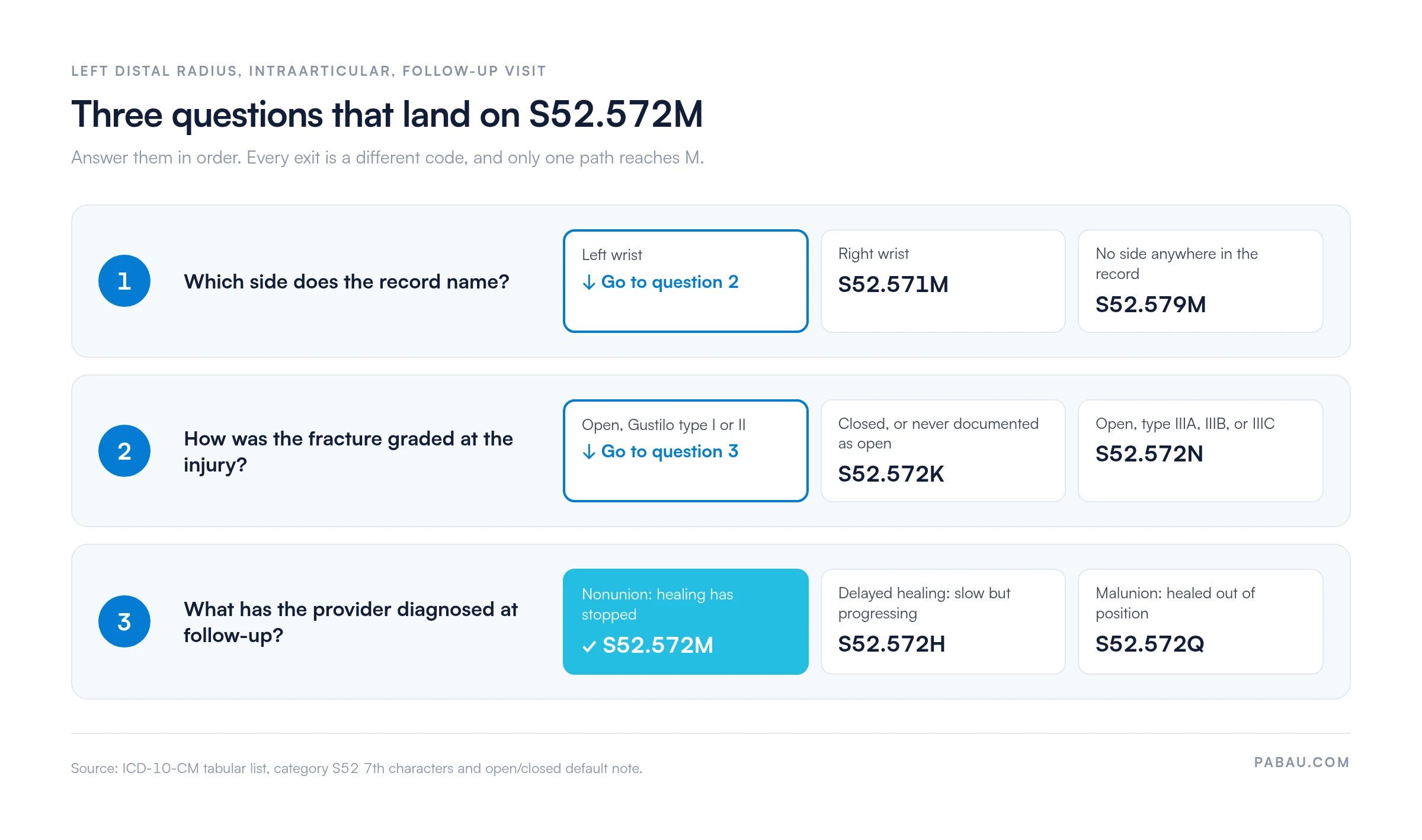
Decision rule: Answer three questions in order. Which side does the record name? Was the original fracture open, and at what grade? Has the provider diagnosed nonunion rather than delayed healing or malunion? Left, open type I or II, and nonunion together give S52.572M.
Each wrong answer exits to a sibling code, so a claim reaches M only when side, grade, and healing status all hold. Based on the ICD-10-CM tabular list for category S52.
Includes, excludes, and official coding notes
The tabular notes for S52 and S52.5 decide when another code takes priority. Check them before assigning S52.572M.
What the code includes
Intraarticular fractures of the left distal radius that do not fit the Colles, Smith, or Barton patterns
Fractures at the radiocarpal joint surface that were open at presentation and graded Gustilo type I or II
Follow-up visits, including surgical repair, where the provider has diagnosed nonunion
What the code excludes
Excludes1 at S52: Traumatic amputation of forearm (S58.-) cannot be coded with S52.572M.
Excludes2 at S52: Fracture at wrist and hand level (S62.-) and periprosthetic fracture around an internal prosthetic elbow joint (M97.4). Either may be coded alongside S52.572M when both conditions exist.
Physeal fractures: Growth plate fractures of the lower end of the radius code to S59.2- in skeletally immature patients.
Stress and pathological fractures: These code to Chapter 13, such as M84.3- for stress fractures. S52 covers traumatic fractures only.
Named patterns: A Colles, Smith, or Barton fracture with nonunion takes the M character in its own subcategory, not in S52.57.
Clinical documentation requirements for S52.572M
Coders assign S52.572M from provider documentation, not from their own reading of an imaging report. Five elements need to appear in the record before the code is safe to submit.
An explicit nonunion diagnosis. The provider writes “nonunion”, “ununited fracture”, or “failure of union”. A radiology line such as “persistent lucency at the fracture site” only counts once the provider adopts it as a diagnosis.
The original open fracture grade. The record shows the injury was open and graded type I or II. The current note can cite the initial operative or emergency record.
The left side. The note, imaging, or operative report names the left wrist. Without a side anywhere in the record, S52.579M applies instead.
Follow-up context. The note shows this visit follows the acute treatment phase. Time since injury and the prior treatment, such as plate fixation or casting, should both appear.
Infection status. Open fractures carry a higher risk of infected nonunion. When the provider documents infection, code it as well, such as osteomyelitis from category M86.
Orthopedic and physical therapy practices managing wrist fractures benefit from follow-up templates that prompt for all five elements at each visit.
CPT codes commonly paired with S52.572M
A nonunion follow-up usually leads to one of three paths: monitoring, bone healing stimulation, or surgical repair. These CPT codes cover each path. Descriptors follow the AMA CPT code set.
CPT code
Descriptor
Use context
25400
Repair of nonunion or malunion, radius OR ulna; without graft (eg, compression technique)
Surgical repair of the radius nonunion with compression fixation, no bone graft
25405
Repair of nonunion or malunion, radius OR ulna; with autograft (includes obtaining graft)
Repair with the patient’s own bone graft; graft harvest is not billed separately
25415
Repair of nonunion or malunion, radius AND ulna; without graft (eg, compression technique)
Only when the ulna nonunion is repaired in the same session, with its own diagnosis code
20680
Removal of implant; deep (eg, buried wire, pin, screw, metal band, nail, rod or plate)
Removing failed fixation before revision, when separately reportable under payer edits
20690
Application of a uniplanar (pins or wires in 1 plane), unilateral, external fixation system
External fixation to stabilize the nonunion, often where infection rules out a plate
11044
Debridement, bone (includes epidermis, dermis, subcutaneous tissue, muscle and/or fascia, if performed); first 20 sq cm or less
Debridement of infected or devitalized bone at an infected nonunion
20975
Electrical stimulation to aid bone healing; invasive (operative)
Implanted bone stimulator placed during surgery
20979
Low intensity ultrasound stimulation to aid bone healing, noninvasive (nonoperative)
In-office ultrasound bone stimulation for an established nonunion
73110
Radiologic examination, wrist; complete, minimum of 3 views
Serial imaging to confirm nonunion or check union after repair
99213 / 99214
Office or other outpatient visit for the evaluation and management of an established patient (low / moderate medical decision making)
Nonunion follow-up visit without a same-day procedure
Two code families are often billed here by mistake. CPT 25608 and 25609 describe open treatment of an acute intraarticular distal radius fracture, not repair of a nonunion. The osteoplasty codes describe length correction instead.
One example is 25391, “Osteoplasty, radius OR ulna; lengthening with autograft”. Report it only when the operative note documents a separate lengthening procedure, and check NCCI edits first.
Verify each pairing against the current AMA CPT codebook and the patient’s record before submission. Practices that route claims through claims management software can apply CPT-to-ICD-10 crosswalk rules before a claim leaves the system. Submitting claims through a Claim.MD clearinghouse adds payer edits that flag mismatches before adjudication.
Payer requirements and prior authorization
Payer rules for S52.572M vary by insurer and Medicare jurisdiction. The points below are common expectations, not universal ones, so verify each payer’s current policy before submitting.
Serial imaging. Payers expect radiographs over time showing that healing has stopped. One film rarely supports a nonunion diagnosis on its own.
Bone stimulator criteria. Medicare’s osteogenic stimulator policy (NCD 150.2) treats a long-bone nonunion as established once serial radiographs show healing has ceased for at least 3 months. The two sets must be at least 90 days apart.
Prior authorization for repair. Most commercial payers require authorization for 25400 and 25405. Send the imaging, the functional assessment, and the planned procedure before scheduling surgery.
Open fracture history. Reviewers check that the claim’s open fracture grade matches the initial encounter record. Keep that record easy to retrieve.
Medicare LCD review. Medicare Administrative Contractors publish jurisdiction-specific Local Coverage Determinations for fracture care. Running insurance eligibility verification before the visit confirms which MAC policy applies.
Common claim denial reasons for S52.572M
Most S52.572M denials trace back to a character, side, or bundling error. These six patterns come up most often, each with its fix.
K instead of M. The follow-up note omits the open fracture history, so the coder defaults to closed. Fix: pull the initial encounter record and confirm the Gustilo grade.
M read as malunion. The claim pairs S52.572M with a malunion procedure or a note describing a healed deformity. Fix: use S52.572Q when an open type I or II fracture healed out of position.
Wrong side. S52.572M goes out for a right wrist, or S52.579M goes out when the side is documented. Fix: match the code to the side in the imaging and operative reports.
Graft harvest billed twice. A separate bone graft code is billed with 25405. Fix: remember that 25405 includes obtaining the autograft.
Acute fracture codes on a nonunion. 25608 or 25609 is billed with S52.572M. Fix: use the 25400 family for nonunion repair.
Missing modifier 57. The E/M visit where the surgeon decides on nonunion repair falls on the day of or the day before surgery. Fix: append modifier 57 so the decision visit is paid outside the global package.
Practices with a structured denial management process catch these patterns before they reach the payer.
Reviewing the denial codes alongside the claim history shows whether the root cause was documentation or coding. Sending clean claims from the outset is faster than appealing after adjudication.
How Pabau keeps S52.572M nonunion claims clean
Nonunion claims depend on facts recorded months apart. The Gustilo grade sits in an emergency or operative note from the injury. The nonunion diagnosis appears in a follow-up note months later, often written by a different provider.
Pabau, the practice management platform we build for orthopedic, physical therapy, and multi-specialty practices, keeps those notes on one patient timeline. The open fracture grade stays visible at every later visit, so the coder can support M over K without a records request.
Pabau’s claims tools link diagnosis codes to procedure codes at the point of service and run edit checks before release. A 25405 claim with a separate graft code, or a malunion note under a nonunion code, is flagged before the payer sees it.
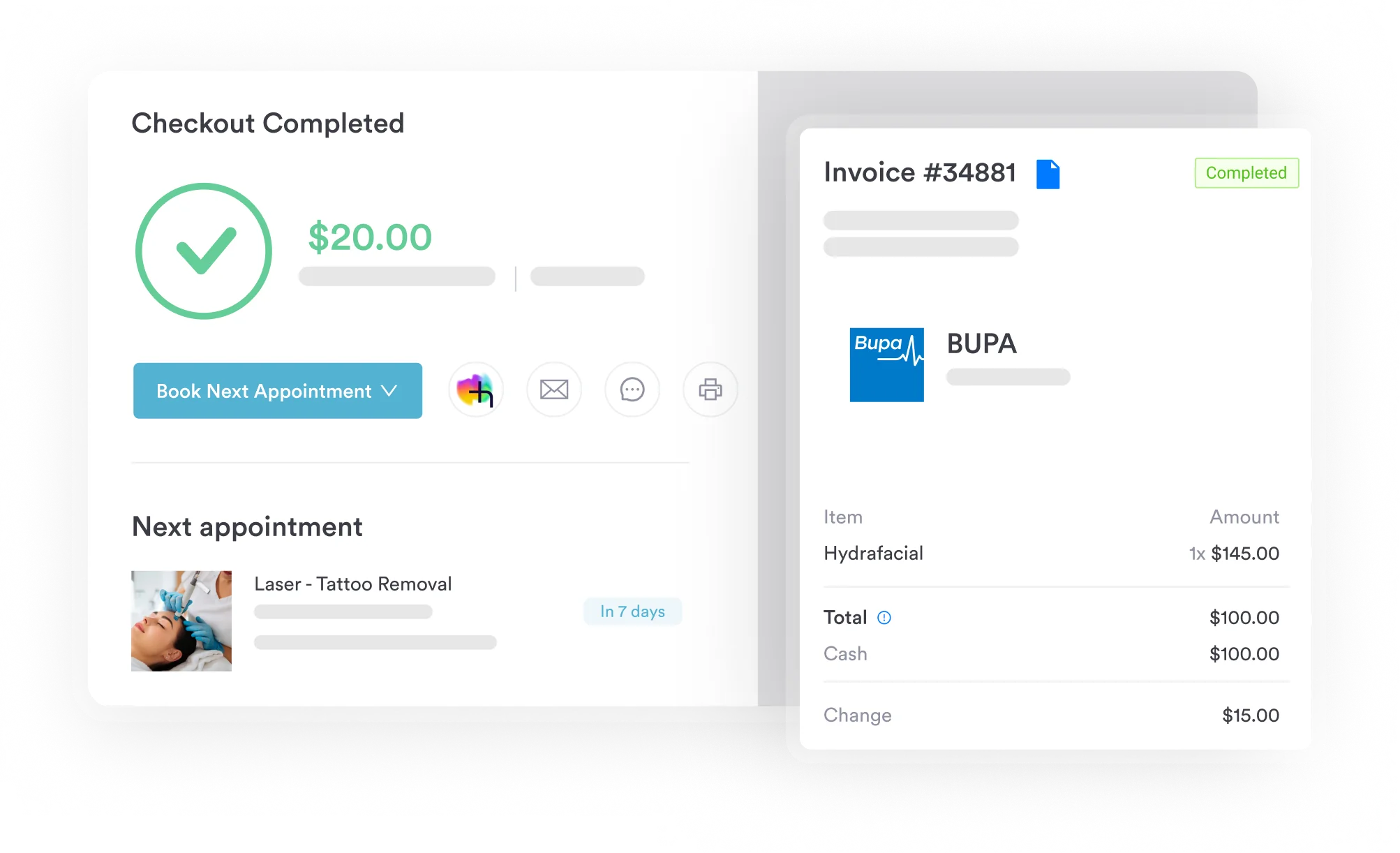
Pabau’s checkout raises the insurer invoice from the visit record, so a nonunion follow-up goes out with the same codes the note supports.
Keep fracture nonunion claims clean
Pabau links diagnosis and procedure codes at the point of service and flags 7th character and bundling errors before a claim leaves the practice. Book a demo to see it on your fracture claims.
S52.572M rests on three facts recorded at different times. They are the left side, an open type I or II grade at the injury, and a nonunion diagnosis at follow-up. Lose any one of them and the claim drifts to K, N, Q, or the wrong side.
The practices that bill this code cleanly treat the original Gustilo grade as part of the diagnosis rather than a detail of the first visit. They also keep nonunion and malunion apart in every note and claim. To see how Pabau’s medical billing workflows support that across a long fracture episode, book a demo.
Continue your research
Want to understand the full medical billing lifecycle behind this code?Revenue cycle management explains how ICD-10 code accuracy fits into collections, appeals, and clean-claim rates.
Frequently asked questions
What does ICD-10 Code S52.572M mean?
ICD-10 Code S52.572M is the billable diagnosis code for an open intraarticular fracture of the left distal radius with nonunion, at a follow-up visit. It applies when the open fracture was graded type I or II. The fracture broke the skin at the injury, and it has not healed since.
Is S52.572M a billable ICD-10 code?
Yes. S52.572M is a valid, billable ICD-10-CM code, effective since October 1, 2015. Payers accept it when the record supports the left side, the open fracture grade, and a provider-documented nonunion.
Does the M in S52.572M mean malunion?
No. In fracture coding, M means a subsequent encounter for an open type I or II fracture with nonunion. Malunion uses P, Q, or R, and the open type I or II malunion code is S52.572Q.
What is the difference between nonunion and malunion?
Nonunion means the fracture has failed to heal, and the bone ends remain separate. Malunion means the fracture healed, but in an abnormal position. Each needs an explicit provider diagnosis before a coder can assign it.
When should I use S52.572K instead of S52.572M?
Use S52.572K when the original left distal radius fracture was closed. Use S52.572M when it was open and graded type I or II. A fracture not documented as open or closed defaults to closed.
Is S52.572M a left or right wrist code?
S52.572M is the left wrist code. S52.571M covers the right radius, and S52.579M is the unspecified code for records that never state a side.
Which CPT codes are billed with S52.572M?
Surgical repair usually uses 25400 without graft or 25405 with autograft. Other common pairings include 20690 for external fixation, 11044 for bone debridement, and 20979 for ultrasound bone stimulation. Wrist imaging with 73110 is also common.
What are the common claim denial reasons for S52.572M?
The most frequent denials come from coding K when the fracture was open and reading M as malunion. Wrong laterality, billing graft harvest separately with 25405, and acute fracture codes such as 25608 also cause denials.