ICD-10 Code T31.77: Burns involving 70-79% of body surface
ICD-10 code T31.77: Quick reference and code details ICD-10 code T31.77 is the b...

Last Updated: Nov 5, 2026
Billable Code Specific Code
S52.511Q is the billable ICD-10-CM code for displaced fracture of right radial styloid process, subsequent encounter for open fracture type I or II with malunion.
The 7th character Q encodes three facts. The visit is a follow-up, the original open wound was Gustilo type I or II, and the fracture healed in malalignment. A type IIIA, IIIB, or IIIC wound with malunion takes S52.511R instead.
Let Pabau's smart automation suggest the right codes, reduce claim denials, and keep your practice compliant—effortlessly.
Automate repetitive tasks and focus on what matters most—your patients.
Reduce coding errors and ensure compliance with the latest regulations.
Clean claims, fewer denials, and faster reimbursements.
Powerful insights and reporting to help your practice thrive.
HIPAA compliant SOC 2 certified GDPR-compliant Trusted by 4,000+ clinics worldwide

S52.511Q is billed at a follow-up visit for an open Gustilo type I or II fracture of the right radial styloid that healed in malalignment.
The 7th character Q covers open fracture type I or II with malunion. A type IIIA, IIIB, or IIIC wound with malunion takes S52.511R instead.
Malunion and nonunion are the two most confused healing characters: Q and R mean malunion, while M and N mean nonunion for open fractures.
The left-wrist counterpart is S52.512Q, so laterality in the current note decides between the two codes.
Pabau, the practice and billing software we build, submits claims through the Claim.MD clearinghouse and tracks each one from submission to remittance.
ICD-10 Code S52.511Q is the billable diagnosis code for a follow-up visit on an open right radial styloid fracture that healed out of alignment. The original wound was Gustilo type I or II. Its official descriptor reads “Displaced fracture of right radial styloid process, subsequent encounter for open fracture type I or II with malunion.”
The table below breaks the code into its parts, so coders can check each one against the record.
The radial styloid process is the bony prominence on the thumb side of the distal radius. It has its own subcategory, separate from unspecified lower-end fractures (S52.50-), Colles’ fractures (S52.53-), and other intra-articular fractures (S52.57-).
Coders sometimes apply S52.511Q to any distal wrist fracture, which is incorrect. The record must name the styloid process as the fracture site.
The 7th character Q records three facts. The visit is a follow-up, the original fracture was open and classified as Gustilo-Anderson type I or II, and the bone has united in malalignment.
The CMS ICD-10-CM Official Guidelines, Section I.C.19, govern how each element is assigned. The table below sets Q against the other 7th characters in the S52 category.
Two errors recur in audit reviews. First, coders use S52.511Q on the initial emergency department or surgical visit, when S52.511B is correct for a type I or II open fracture. Second, coders treat Q and R as interchangeable malunion codes. Q applies only to a type I or II wound, and R covers type IIIA, IIIB, and IIIC.
The Gustilo-Anderson grade decides which open-fracture 7th character applies, and the treating surgeon assigns it, not the coder. The CDC/NCHS ICD-10-CM web tool confirms the split shown in the grid below. Types I and II take B, E, H, M, and Q as the 7th character. Types IIIA to IIIC take C, F, J, N, and R in their place.
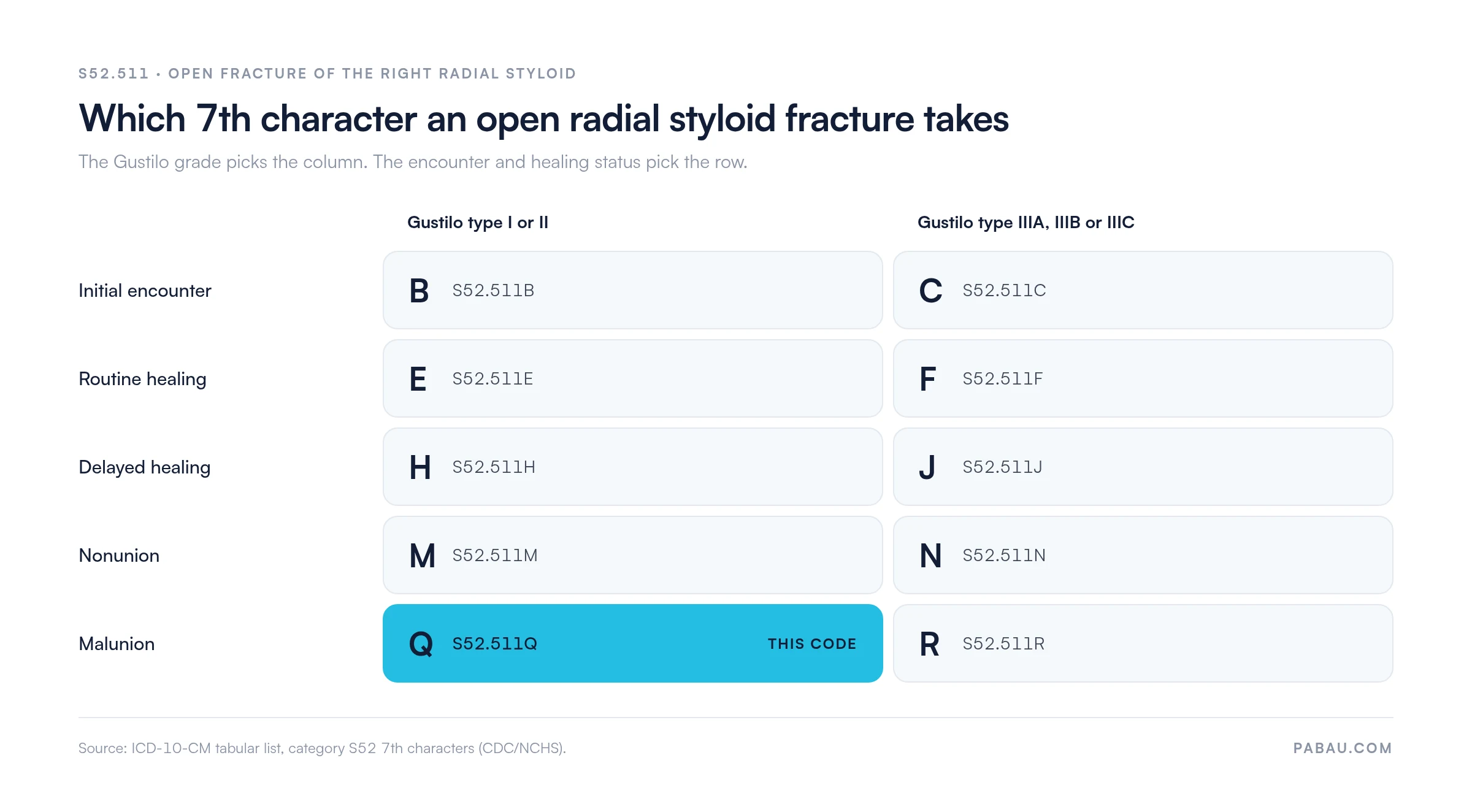
When the record calls the fracture open but gives no Gustilo grade, the guidelines default it to type I or II, which points to S52.511Q. Query the surgeon anyway if the wound description suggests extensive soft tissue loss or vascular repair. A type IIIA, IIIB, or IIIC grade moves the claim to S52.511R.
Malunion means the fracture healed in an incorrect anatomical position. Nonunion means the bone failed to unite. The distinction needs imaging evidence or an explicit physician statement, because coders cannot judge healing status from symptoms alone.
The physician’s note must use the word “malunion,” or state that the fracture healed in a malpositioned or angulated alignment. Phrases like “not healing well” or “continued pain” support neither a malunion nor a nonunion character.
Because S52.511Q is a subsequent-encounter code, it appears on follow-up and corrective procedure claims, not at the initial injury. The CPT codes below are the most common procedure pairings. A malunion that goes to surgery is usually corrected by osteotomy, which the nonunion and malunion repair codes cover.
These CPT-to-diagnosis pairings are illustrative, not prescriptive. The exact procedure code is determined by what the surgeon performed and documented. Never select a CPT code to match a desired reimbursement level.
Payers accept S52.511Q only when the medical record supports every element the code encodes. A clean claim needs all five of the following in the chart before it goes out.
When any of these elements is absent, query the physician before submitting. Submitting without documentation support risks denial and, in audit settings, potential compliance exposure.
S52.511Q denials trace back to six recurring coding and documentation errors, set out below with the fix for each. When a denial does arrive, match the reason on the remittance advice against the list of payer-specific denial codes before you appeal. A structured denial management workflow then routes the claim back to the coder who can fix it.
Run a pre-submission audit on every S52.511Q claim: confirm the original operative note is attached to the encounter in your EHR. Check that the Gustilo grade in that note is type I or II, and that the current progress note names malunion. These three checks catch the most frequent denial causes above before the claim goes out.
Per CMS ICD-10-CM Official Guidelines Section I.C.20, external cause codes are reported as secondary diagnoses to explain how an injury occurred. Good medical billing compliance practice includes reporting them even when payers do not require them.
Some payers use them to validate medical necessity for corrective procedures. The external cause codes below are common for distal radius fractures.
The external cause code must reflect the original injury mechanism, not the reason for the current follow-up visit. Place of occurrence (Y92) and activity (Y93) codes are reported only at the initial encounter, so they do not belong on an S52.511Q claim. External cause codes never stand alone and always follow S52.511Q.
The S52.511 subcategory holds one code per 7th character for the displaced right radial styloid fracture, 16 in all. The table below lists the ones coders check most often against S52.511Q. Our guide to how medical billing works shows where the diagnosis code sits in the claim lifecycle.
S52.512Q is the left-side counterpart: “Displaced fracture of left radial styloid process, subsequent encounter for open fracture type I or II with malunion.” If the chart documents the left wrist, switch to S52.512Q. Using S52.511Q for a left-sided injury is a laterality error and a common denial trigger.
An S52.511Q claim depends on details spread across several documents. The Gustilo grade sits in the original operative note, the malunion finding in a radiology report, and laterality in today’s progress note. When billing staff re-key those details into a separate system, a type II wound can easily become a type III code.
Pabau keeps the clinical record and the claim in one place, so the coder works from the notes themselves. Its end-to-end claims management covers submission, eligibility checks, claim status, and remittance posting. A rejection on a fracture follow-up claim shows up against the patient record the day it comes back.

Pabau’s claims management software submits claims through the Claim.MD clearinghouse, checks eligibility, and posts remittances against the patient record. See how it handles fracture follow-up billing.

S52.511Q turns on one clinical fact that coders often get backwards: the wound grade. Q is the malunion code for a type I or II open fracture, and R is its type III counterpart. A record that states the Gustilo grade, the malunion, and the right side leaves the coder nothing to guess.
Build that check into the follow-up visit, before the claim is drafted, and most of these denials never happen. If your team bills orthopedic or trauma follow-ups, book a demo to see how Pabau keeps fracture documentation and claim submission in one workflow.

Need to understand how clearinghouse submission works for fracture claims? Our Claim.MD clearinghouse guide explains how electronic claim validation catches errors before payers see them.
Looking for the revenue cycle context behind these codes? What is revenue cycle management covers the full claim lifecycle from encounter through payment posting.
Want to verify eligibility before treating complex fracture follow-ups? Insurance eligibility verification outlines how real-time checks reduce prior-auth and coverage surprises.
ICD-10 Code S52.511Q is the billable code for a displaced right radial styloid fracture, subsequent encounter for open fracture type I or II with malunion. It is used at follow-up visits when an open Gustilo type I or II fracture has healed in an incorrect anatomical position.
The 7th character Q records three facts: a subsequent encounter, an open fracture of Gustilo type I or II, and healing in malalignment. A type IIIA, IIIB, or IIIC open fracture with malunion takes R instead.
S52.511Q is a subsequent encounter for an open type I or II fracture that healed in malalignment. S52.511K is a subsequent encounter for a closed fracture that failed to unite. The two codes differ in both fracture type and healing outcome.
Malunion means the fracture healed in a malaligned position, and nonunion means it failed to unite. In ICD-10-CM, malunion takes P (closed), Q (open type I or II), or R (open type IIIA to IIIC). Nonunion takes K, M, or N in the same order. Imaging evidence or an explicit physician statement supports the choice.
Yes, S52.511Q is a fully specified, billable ICD-10-CM code. All 7-character fracture codes in ICD-10-CM are billable when every character is supported by clinical documentation. It remains valid in the current FY2027 code set, effective October 1, 2026.
The most common denial is Q billed on the initial visit, where S52.511B belongs. Next comes Q billed for a type IIIA to IIIC wound, which needs S52.511R. Laterality errors and a missing malunion statement follow close behind. Checking all five documentation elements before submission prevents most of these denials.